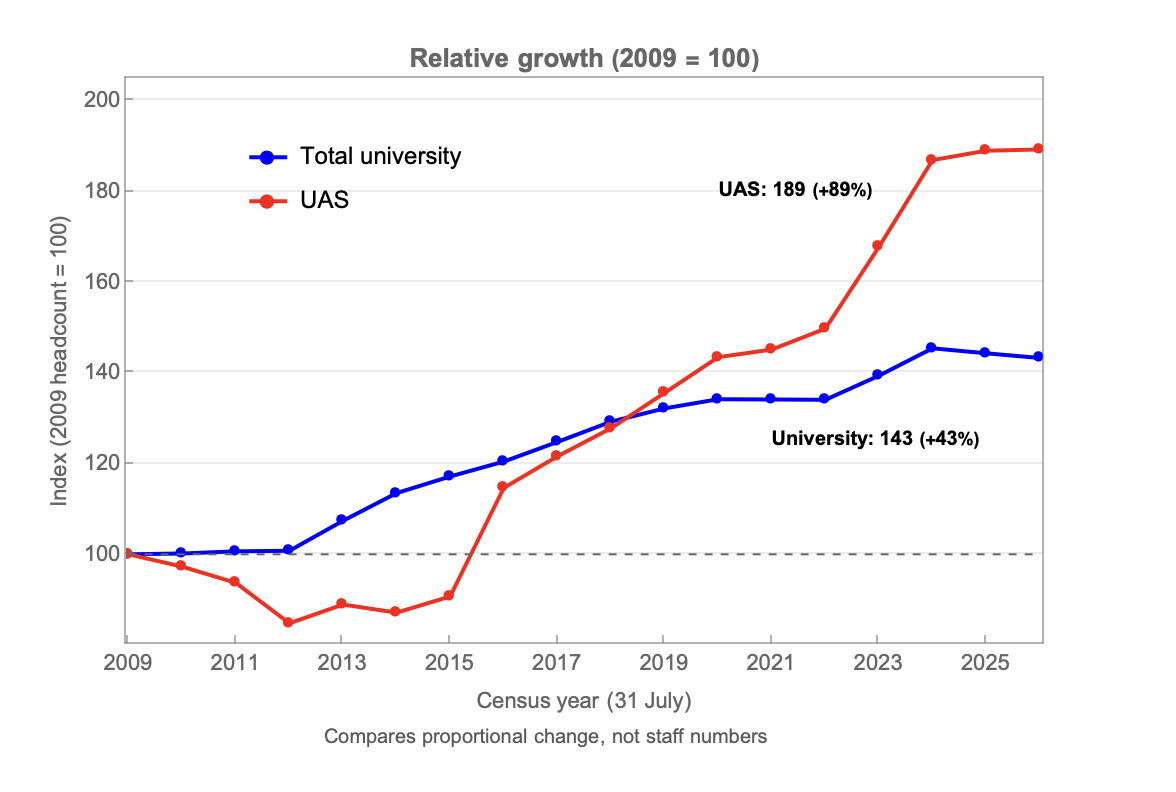
The University of Cambridge has added thousands of employees since 2009. But the most striking change is not the growth of its workforce. It is where that growth has occurred and what it says about the university’s priorities. Cambridge presents itself as a world-leading centre of teaching and research. Yet its staffing figures raise an awkward problem; the institution’s administrative machinery is expanding much faster than the academic enterprise it exists to support.
The headline plot shows each year’s headcount divided by its 2009 headcount, multiplied by 100. This allows proportional growth to be compared. By 2026, total university headcount had risen by 43%, while UAS headcount had increased by 89%. Specifically, the total university headcount rose from 9,452 in 2009 to 13,545 in 2026. Over the same period, headcount in Unified Administration and Services (UAS) rose from 1,065 to 2,016. UAS staffing grew at roughly twice the rate of the university’s overall workforce.
These numbers represent the academic and academic-related established and unestablished posts in the University. Researchers, college fellows, assistant and temporary staff (together representing around two-thirds of all employees) are excluded from these numbers.
An expanding centre
The contrast becomes particularly striking in the later years of the series. UAS headcount increased from 1,595 in 2022 to 2,016 in 2026, which is a growth of around 26% in four years. University headcount rose from 12,673 to 13,545 over the same period, an increase of approximately 7%. The administrative grouping has therefore expanded considerably faster than the institution as a whole.
Of course, a modern university needs professional expertise in finance, estates, legal services, research support, information systems, governance, compliance and human resources. New responsibilities can require additional staff, while centralising services may improve consistency or reduce duplication elsewhere.
But these explanations need to be demonstrated, not assumed. If administrative expansion is necessary, university senior management should be able to explain which responsibilities have increased, what benefits additional staff have delivered and whether the same outcomes could have been achieved more efficiently.
Which parts of the administration are growing?
Between 2009 and 2026, the Academic Division grew from 131 employees to 456. The Cambridge Research Office increased from 66 to 211, while Finance rose from 97 to 272. Estates grew from 242 to 420, and Human Resources from 117 to 206. These are substantial increases in several different areas of university administration and support.
Not every division followed the same trajectory. Governance and Compliance increased only modestly, from 98 to 107, across the period. The Health, Safety, and Regulated Facilities Division rose from 66 to 264, although a particularly sharp jump between 2015 and 2016 makes this series difficult to interpret without further information about organisational changes.
Research support, safety and estates management can be essential to the university’s academic mission. The real issue is whether the scale, structure and cost of central services are justified by the work they perform.
Nor should the figures be read as a complete inventory of administration across Cambridge. Many professional and support staff work outside UAS, within academic departments and other parts of the university.
What about the academic workforce?
The university-wide totals tell only part of the story. Established academic headcount rose from 1,453 in 2009 to 1,697 in 2026 — an increase of about 17%. Established academic-related headcount, by contrast, fell from 742 to 305, a decline of approximately 59%. Meanwhile, unestablished academic-related headcount climbed from 682 to 3,090. Unestablished academic headcount also increased sharply in the final years, rising from 118 in 2021 to 472 in 2026. These are striking changes, showing that employment growth has been concentrated in unestablished academic-related staff.
This debate is not new. In a 2025 discussion, published in the Cambridge University Reporter, concern was raised about the growth of UAS staffing relative to academic staffing. The discussion cited a separate calculation in which UAS posts increased by 37% between 2018–19 and 2023–24, while academic staff numbers at Cambridge fell by 4% — see especially the remarks of Dr D.R.H Jones, former President and Acting Master of Christ’s College.
Those figures use a different dataset and time period from the headcount data presented here. Nevertheless, they raise the same fundamental question: how does Cambridge balance central administration against its core academic activities?
A university that expects scrutiny of academic performance, research outcomes and spending should be willing to scrutinise its own administrative growth. That means publishing clear explanations of staffing changes, distinguishing permanent posts from fixed-term appointments, tracking full-time equivalents as well as headcount and assessing what additional expenditure achieves.
Cambridge needs to explain the growth
The figures do not by themselves prove that Cambridge’s administration is bloated, that public or tuition-fee money is being wasted, or that administrative growth has damaged teaching and research. Those are claims that would require further evidence, including expenditure, staffing responsibilities, workloads and performance.
But the figures do establish a substantial disparity in growth rates. From 2009 to 2026, UAS headcount increased by 89%, compared with 43% across the university as a whole. In the latest four years, the gap was wider still.
That is enough to justify a pointed question: what has Cambridge gained from the expansion of its central administration, and how does the university know that the benefits justify the additional staffing?
Caution posters!
Please take care in posting about Dr Lola Salem
https://www.lbc.co.uk/article/oxford-university-tutor-lola-salem-accused-of-possessing-indecent-child-images-5HjdjnB_2/
She has been charged with criminal offences and is awaiting trial. She is also the former partner of Michael Gove. Please do not speculate on this case as it may prejudice the trial. We don’t want to end up facing charges of contempt of court.
Factual information (with links) is OK.
Sad news from Oxford, particularly from Oriel. Your linked below was working fine but is not working now. You may considering BBC’s:
https://www.bbc.com/news/articles/c9kgjymxpzxdo
Turning to Cambridge, I wonder whether there is a correlation between the expansion of the University’s central administration and the number of legal cases brought against it. Of course, correlation does not imply causation, but examining the relationship over time might reveal an interesting pattern and raise important questions about institutional governance and accountability.
You are correct. The link is now no longer working and the article has been removed.
Oxford Mail link still up
https://www.oxfordmail.co.uk/news/26628547.oxford-university-lecturer-charged-indecent-children-images/
Obviously, Carter-Ruck or Mishcon de Reya have been busy.
Shall I just say it’s a curious story in many ways.
Daily Mail with more details
https://www.dailymail.com/news/article-16205315/Michael-Goves-Oxford-don-ex-girlfriend-facing-trial-possession-child-abuse-images.html
It is unclear to me that whether the biggest problem is the UAS or the growth of “support” roles in Departments. You state that UAS staffing increased from 1,065 to 2,016 (+89%) between 2009 and 2026. Also that the total count of academic-related staff increased in the same period from 742+682=1,424 to 305+3,090=3,395 (+138%). It would seem likely that the rate of increase of academic-related staff outside of the UAS is even greater than that within the UAS.
I suspect that the number of assistant staff performing administrative functions throughout the University has increased significantly too.
The odd thing is that most academics seem to feel less supported, and feel that they are spending more time on administrative matters, despite the obvious increases in support headcounts both centrally and in Departments.
One might blame in part the embrace of the HERA grading system, which has tended to mean that if one does less, but employs subordinates to help, one gets paid more, as managing people gains credit that simply getting things done does not. Non-academics are directly rewarded for increasing the size of their teams, whereas academics tend to be graded on achievements rather than team size.
Great comment. Here’s the new graph showing you’re dead right
Someone should really conduct a time use study to find out what all these people do all day. I suspect you will find some who are underpaid, overworked and insecure — while others simply attend the odd meeting, redraft a strategy document that will never be finished, and bounce around an email or two before another session of LEGO serious play
A lot of work can be created unnecessarily.
People can be hard at work (eg creating strategy documents) that are of limited use (eg there’s no money to implement the changes)
A bungled HR investigation can generate many years of fruitful work for the HR division and others
Everyone can be hard at work, but the work may not be useful or necessary
The ones who are overstressed, underpaid and overworked are those closest to the front lines of what a university actually does — i.e. teaching students and supporting research. The higher you go the more and more the salaries rise and the workload disappears in to endless Teams chats, over-attended meetings, gossip, paper shuffling and checking of social media
As an administrator you can now recruit a whole team to do the work you were initially employed to do.
The good news is you get double rewards: less to do (just “managing” your team) and more salary.
The increase in academic staff since 2021 is likely to be driven largely by the new Teaching and Scholarship pathway. Most of these staff will be employed on non-tenured contracts to teach master’s courses, with little or no opportunity to conduct research. The high international fees paid by students on these courses help fund the expanding administration.
Another aspect of all this which would be much harder to gather the data for (though it could be done, at least on a small level as an example) is the secondment of academic staff to administrative work. Where I work, the way this happens is through workload. When we “need”, let’s say, a Deputy Global Ecological Trends and Beekeeping Director (or whatever) at an academic unit level, that post is filled by an academic, and a notional workload tariff is applied to the role, let’s say 250 hours. That 250 hours always comes out of the teaching part of the workload, as far as I have ever seen. What’s more, the nature of these tariffs is inherently inflationary: I have never seen the workload tariff for an administrative role go down, but I have definitely seen it go up. So there is an awful lot of administrative, non-academic work being carried out by academics. By the time you add up all these 0.05 and 0.1 FTE workload tariffs, you are taking about real money (or headcount, in this context). And someone has to pick up the slack of the teaching, which means either hiring in more non-established teaching staff or, when the money is tight, piling that workload on those who don’t have the administrative roles, frequently taking people well past 100%. We can think of all this as the sort of “dark matter” (I say with trepidation, knowing actual astronomers read this!) of university administrative burden.
It’s a classic runaway reaction. You can see it clearly in the CRUK Oncology School of Medicine fiasco.
If one person had managed the whole thing, it would have been sorted out quickly and cheaply.
But above a threshold number of HR “specialists” , there is a switchover to protocol-driven formulaic decision making.
This turned a single malicious (and easily disprovable) allegation into a huge bin-fire that has been burning furiously for years. Hundreds of hours of staff time have already been consumed and the only end in sight seems to be the High Court.
Of course all this extra work requires further HR and legal specialist hires. And each n+1 HR hire makes the protocols more elaborate and the decisions even worse. It is a process which feeds off the very damage it creates.
High Court cases are on the public record as soon as filing occurs! Get the pop corn out…
The 21 Group has a panoramic view of the forthcoming court cases and tribunals for 2027
If you thought 2026 was bad the University, there’s far worse to come …
Public records show 13 cases against the University of Cambridge in the High Court, about half of which remain live. One trial is listed for 30th November 2026.
In addition the same records show another 4 cases against individual Cambridge colleges, all of which are live.
So in all, that’s more than 10 cases against Cambridge that are currently live and awaiting a High Court hearing.
Is that normal?
For Oxford I could barely find a single live High Court case brought against the university or colleges, none for LSE or St Andrews, and only one for Durham (over a business contract).
How is it possible that Cambridge stands as the one university in the UK with so many claims to defend at High Court?
There are at least another 15 Employment Tribunals pending.
Without wholesale reform of HR/Legal, we’re facing a really grim future.
Some of those cases are worse than the Whistleblowing Tribunal in terms of what was done to individuals
So add county court and cases pending and we are talking easily 30+ lawsuits against Cambridge right now. Nuts!!!!
Who is responsible for overseeing legal services? Isn’t their whole job to make sure laws are complied with and this doesn’t happen? Why hasn’t someone lost their job yet?
21 group should find out what % of high court and ET pending cases against Russell Group unis are just Cambridge.
I guess at least half
Legal Services has (surprise, surprise) massively expanded. All very busy.
Ms Samantha Gardner was the one presiding over the epic disaster at Bury St Edmunds Employment Tribunal in the Summer.
Here thay all are;
1. David Robert Kingdon Parsons
2. Samantha Nicola Gardner
3. Rosemary Angela Boyle
4. William Howard Bateman
5. Katherine Souter
6. Audrey Sebatindira
7. Claire Piffard
8. Emma Beverland
9. Julie Christina Taylor
10. Kirstie Staples
11. Matthew Doorbar
12. Nicholas Blazey
13. Peter Aldred
Not sure I envy whoever has to negotiate the next renewal on our legal insurance
It’s all good news for the lawyers, though.
Legal action is very profitable …. for lawyers
You’ll be pleased to know that Shakespeare Martineau are also picking up High Court cases. It’s like a dealer hooking their client on an even more expensive drug.
At one time, the University used mainly Shakespeare Martineau for its legal problems
It’s now using Bristows, Mills & Reeve, Farrer & Co, Carter Ruck and DWF as well as SM.
There should be a statue of Deborah Prentice erected in the offices of The Law Society — she’s done wonderful work remunerating lawyers
What a bunch of (expensive!) losers! The American Queen is a complete disaster of a VC and under her UCam will only continue to go down.
Overseeing legal services?
Aren’t they the ones overseeing? And redacting themselves out of whatever they’re doing, for good measure?
So next case is next month, then presumably every other month or two after that?
Imagine the scandals of this summer continuing on repeat every 2-3 months for the next 2-3 years.
We’ll be hearing a lot from Prentice about “These issues which predated my arrival …”
And to be fair, they did. She’s not responsible for setting fire to Astronomy or CRUK-Cambridge.
She let the fires burn. For three whole years. A good leader would never do so. She is fully responsible. Fully.
There’s obviously quite a lot going on underneath these figures. Some of it is explainable as natural growth and some of it is more worrying.
The University’s estate has grown, so we need more people in Estates to manage it. Research income has grown, therefore the Research Office needs more people to negotiate contracts and manage grants. More people means more grievances, and therefore more people in HR to process them (though not necessarily more quickly!)
On the worrying side, the VC alluded to the rise in regulatory and compliance requirements in her speech. She’s right. Since 2009 we’ve seen the 2017 HE and Research Act and the shift in regulation from HEFCE to OfS, GDPR, the Prevent duty, the Bribery Act, modern-slavery reporting, research-integrity concordats, the Trusted Research / National Security and Investment regime, more onerous UKRI terms, REF and TEF administration, and much more heavy weight visa compliance rules. None of which makes life easier for our academics.
Risk aversion and reputation management is a major driver in the growth of Legal, HR and External Comms. This doesn’t serve our academic mission, merely our institutional anxieties.
There are some things: EDI, wellbeing, internal communications, project management, organisational and process change, which used to be done informally (and sometimes even effectively) by people with other job titles. These now have dedicated professional teams, but with no visible improvement in delivery. The reason academics feel less supported, not more, is the amount of busy-work these teams create for everybody.
The shift from established academic-related posts to unestablished academic-related is a deliberate strategy. If you’re going to increase the number of administrative staff and you’re not sure you want to keep them around until retirement, of course you’re going to make them unestablished and likely on short term contracts too. The potentially unforeseen side effect is that this casualisation of the professional services workforce (and many of their academic colleagues) excludes the majority from Regent House and makes it costly to speak up when bad things happen. The inevitable conclusion, and the answer to the final question in the post, is that our feedback mechanisms for ensuring value for money and good institutional performance are degraded, to the point of now being non-existent.
“Risk aversion and reputation management is a major driver in the growth of Legal, HR and External Comms”
It seems to have been a catastrophic failure over 2026
Exactly. It’s the wrong thing for us to be spending money on.
Well, I must say that surely if you cared about “risk aversion” and “reputation management” then the very last thing you would do is escalate and pile up court cases for years and years on end. That seems like the precise formula for reputational self-destruction.
Perhaps a better term than ‘risk aversion’ would be ‘liability avoidance’. Avoiding liability works in the short term, until the only way to protect your reputation is to admit you’re wrong. But that implies there’s someone to blame, which the Cambridge system is structurally incapable of doing.
100%!! In the short run the university can “avoid” reputational harm by, say, sending a threatening letter or two to Times Higher to kill a story.
But eventually it is 10x more destructive once the story is out.
Not to mention the last thing you’d want to do when a university is trying to stop sinking further down the rankings… produced by, among others, the Times Higher.
The university is reaping what it has sowed and will continue reaping it for some time to come.
This is right.
For example, the problem with Cambridge using Non-Disclosure Agreements (NDAs) is not so much that the matter is not made public, but that there is no incentive to fix the underlying difficulties. And so they continue
The NDA liability is identical to the liability of issuing SLAPPs. It buries a scandal temporarily, and perhaps permanently some of the time. But the moment it becomes public that the university uses such aggressive measures suddenly there is a scandal 100 times greater and one that permanently damages the university’s reputation.
Requiring an NDA to be signed to attempt to hide misconduct is an unambiguously corrupt act and one that has been outlawed and nullified by the Higher Education (Freedom of Speech) Act 2023. Doesn’t stop at least one university in my experience still trying it on though since the relevant parts of the act were made active.
Oh, it’s routinely used still by many universities.
@Anon I think it is even worse for the university than you realise.
What happened this summer is that the press finally called the university’s bluff over all its SLAPP letters. They understood what was implicit all along. The letters are a bluff. There is no way that a university whose reputation depends on upholding truth and knowledge is going to take a newspaper to court. It isn’t about whether they could win or lose the case: It is that as soon as they file to court, there is now an even bigger story for the rest of the press to publish about how Cambridge is trying to shut down the media and free speech. They have never pulled the trigger on these. They never will.
With NDAs, it is the same. Even without the Higher Education (FS) Act, they are unenforceable. Sure, they might work for the Epsteins and Trumps of this world, but for any institution with a public reputation to maintain, it would be an immediate “Streisand Effect” the moment they tried to enforce it. At that point there is a public record — not only that they are using NDAs — but the who and the what of what they tried to silence would quickly spill out. And even if it would have got little media coverage before it becomes a story because of the fact of having tried to silence someone. And if they also tried to prevent whistleblowers or victims exercising their HE (FS) rights, that just magnifies it all the way to parliament and the higher courts.
Also don’t forget that Cambridge is on public record claiming that it does not use NDAs. People can tolerate nefariousness,
the one thing people never forgive is hypocrisy!
https://www.cam.ac.uk/notices/news/university-of-cambridge-statement-on-use-of-non-disclosure-agreements-ndas
“The University of Cambridge will never use Non-Disclosure Agreements (NDAs) to prevent individuals from reporting sexual misconduct or to cover up inappropriate behaviour. The University considers the safety and wellbeing of members of its community to be of paramount importance and supports the right of complainants to take the matter to the police or other regulatory agencies and warn others about proven perpetrators of abuse or inappropriate behaviour.
There are, however, rare occasions when non-disclosure agreements, made as part of the settlement of a dispute, can benefit all parties to it[1]. Where a complainant genuinely wishes a settlement agreement to contain an NDA, its terms are clear and the complainant has received independent legal advice about its effect, the parties should be free to reach a settlement on this basis. The University is unable to give a commitment that could be interpreted as preventing the use of NDAs in this sort of situation, however infrequently it may arise.”
There’s a big loophole in the promise
‘The University of Cambridge will never use Non-Disclosure Agreements (NDAs) to prevent individuals from reporting sexual misconduct or to cover up inappropriate behaviour.
Where a complainant genuinely wishes a settlement agreement to contain an NDA… the parties should be free to reach a settlement on this basis’
All of this is a lie. A total lie.
‘Should’ = wishful thinking. No such exemption in The Higher Education (Freedom of Speech) Act 2023 and any such NDA is still void.
@Anon
That’s exactly the point. Neither party can agree to an NDA that attempts to cover sexual misconduct, bullying or harassment, even if both sides were to agree. Attempting to do so would itself constitute an illegal act on the part of the party who proposed it. And that just adds to the reputational liability by attempting to break the law.
In fact, the provisions of the Act are stricter than this. The key provision is section A1(11) of the Higher Education and Research Act 2017, inserted by section 1 of the Higher Education (Freedom of Speech) Act 2023 and in force from 1 August 2025.
It requires a registered higher education provider to ensure it does not enter into an NDA relating to a relevant complaint about sexual abuse, sexual harassment, sexual misconduct, bullying or other harassment. If it does, the entire NDA is void. If the institution even /attempts/ to use the NDA to prevent disclosure of those acts, this confirms immediately that it understood the terms of the NDA to be in violation of the Act, thereby rendering the entire agreement void in toto. The communication of this understanding would also lack legal privilege due to it making an illegal demand.
At this point the NDA itself and all its contents could then be disclosed in full to the public.
‘liability avoidance’ – exactly. The focus should remain firmly on the lawyers who are the University’s biggest problem (among its very many problems).
Why did Cambridge engage a (n ex-Cambridge) defamation specialist as head of its legal department, and not e.g. a contract lawyer?
Ironically, the whole point of a defamation specialist is to protect reputation, and yet, under his leadership the university has just undergone the worst reputational damage in its history
“Ironically, the whole point of a defamation specialist is to protect reputation, and yet, under his leadership the university has just undergone the worst reputational damage in its history”
Why is the HR Director still in her job? Why is the Head of Legal still in his job? Why is the Head of Comms still in his job? Why is the VC still in her job?
Based on where this conversation is going I think there’s a good chance they will all be out of job soon
Astonished they have not already gone.
None of them will be in post by October 2027.
Que la lumière soit.
“the whole point of a defamation specialist is to protect reputation, and yet, under his leadership the university has just undergone the worst reputational damage”
I do not think that to be a coincidence. Lawyers are people who practice a particular form of overconfident stupidity. They consider themselves masters of their little game, and no doubt, they must be very good at it. But they cannot see that their legal game is just one game within many that form the game of life; the game of politics, the game of media, the game of public opinion, the game of money. They fail to see how their game is determined by the other games – to give the most obvious examples, that it is politics that writes the law, public opinion that determines how it is interpreted, and money which determines whether games are contested or the pieces are smashed from the board entirely. They fail to see when the other pieces have lined up in a way that will pop their entire game bubble: as it did this summer, and will surely continue to do; because they lack the modesty and commonsense insight that a non-specialist would have.
You would have thought that in recent cases someone more senior would have taken ownership of the whole situation, thought about the trade-offs and instructed the lawyers appropriately. But we all know Cambridge doesn’t work like that.
The problem might be that it is the lawyers who instruct…?
Quite possibly. After all, the Evans tribunal found exactly this inversion of authority from HR.
“You would have thought that in recent cases someone more senior would have taken ownership of the whole situation, thought about the trade-offs and instructed the lawyers appropriately. But we all know Cambridge doesn’t work like that.”
If the stresses on society are not stable, the laws are not stable, that is the time it is critical to apply independent judgement to what the lawyers are instructing, that is the time that separates those whose judgement has atrophied due to over-reliance on legal advice they have expended no mental effort trying to understand & those whose judgement has been honed by having expended significant mental effort trying to understand all the complex legal advice they have been exposed to.
Laws are dynamic, laws are not static. In order to stay on the right side of shifting laws it is necessary for those in governance roles to move at the same speed the laws are moving at.
The problem is a person can end up with the same level of legal obligations as a UTO, full college fellow & charity trustee without having an established position. A person can have governance obligations in relation to students & staff including safeguarding obligations. A person can hit every organisational error in relation to established & unestablished staff & in relation to students and have a legal obligation to raise concerns in relation to every organisational error but no established post to maintain any employment while raising concerns something which could take years. Cambridge governance was not set up for this, to give this level of legal obligations to a person in an unestablished position & certainly not to a person employed as a temporary worker.
A legal obligation is a legal obligation, it doesn’t disappear because an organisational error means a person has been given it in whilst in the type of employment/position that would maximise the level of difficulty a person would have in complying with that legal obligation. Cambridge was set up for self governance but it wasn’t set up for the highest level of governance obligation to fall on a temporary worker.
Cambridge is unusual in that it will give a person more increasingly serious governance obligations up to some of the highest levels in the organisation while simultaneously degrading the persons employment all the way down to temporary worker. It mirrors the employment kinetics where Cambridge can end up simultaneously trying to put a person through a promotion process & a dismissal process at the same time. A person is given more & more responsibility while being held closer & closer to an at will dismissal point. A person organisational responsibility can be shifted on to & who can be dismissed at will & with very limited access to an employment tribunal. All the risk, none of the security & none of the reward.
“what has Cambridge gained from the expansion of its central administration, and how does the university know that the benefits justify the additional staffing?”
It’s not so much what Cambridge gained from the expansion but what it lost during the expansion that made the difference. Organisational coherence, the organisational ability to reason with a person, the organisational ability to remember significant actions taken in relation to a person e.g. forgetting to give a person a contract, forgetting to pay a person, forgetting a person has been fired, the organisational ability to deliver effective organisational care in relation to a person.
I think this is a sign centralisation is seen by those at the centre as a one-way problem solving system, a mechanism by which the centre can solve any problem it has with the periphery by raising the problem with the periphery but not a mechanism by which the periphery can solve any problem it has with the centre – i.e. any systemic problem the centre is tasked with solving – by raising it with the centre. I think it’s also a sign centralisation is in incomplete and/or error laden which is a more likely outcome if centralisation is seen as a one-way problem solving mechanism instead of a two-way problem solving mechanism. Active feedback – two-way problem solving – is needed to get to a more complete centralisation with fewer errors.
It even manages to give temporary (TES) workers authority over Established Officers, and sees no problem in having Officers line-managed by unestablished staff on fixed-term contracts. Statutes do not explicitly forbid this, but I do not see that they intended it to happen.
Can an Officer obey an order from a non-Officer if the Officer believes the order to be contrary to the University’s interest? If he does obey, and something bad happens, who would be disciplined?
“It even manages to give temporary (TES) workers authority over Established Officers”
I am not surprised – temporary worker agreements are being used in situations where internal guidance would rule out their usage. If a person has been in an organisation for a decade as a UTO and full college fellow it’s going to be very difficult for the organisation to convince a judge the person is a temporary worker especially if the internal guidance rules out the use of that type of contract in their case. The permanent temporary state, all the responsibility & risk of a permanent position with the security, pay & working conditions of a temporary worker. The governance structure was not set up for this.
In any whistleblowing process there has to be no incentive to raise concerns either way – no gains, no loses – because if there are any biases in an error correction system the error correction itself has the potential to introduce even bigger errors than the errors it is correcting. If a person is in permanent employment the situation is much more straightforward in terms of clarity because employment being continued is the neutral position but if a person is in temporary employment then it is less clear whether employment being continued is a gain or employment being discontinued is a loss arising from making a public interest disclosure – it’s an additional element of complexity in an already difficult situation that will significantly increase the resource cost of handling the public interest disclosure situation. Increasing levels of responsibility to positions where more significant public interest concerns could be evident coupled to decreasing lengths of employment contract is not a good combination from a governance perspective.
A Fellow of Darwin College has contacted the 21 Group to confirm he has resigned following the appointment of Prof ‘Less than Candid’ Peake as Master
We thank him for his principled stand.