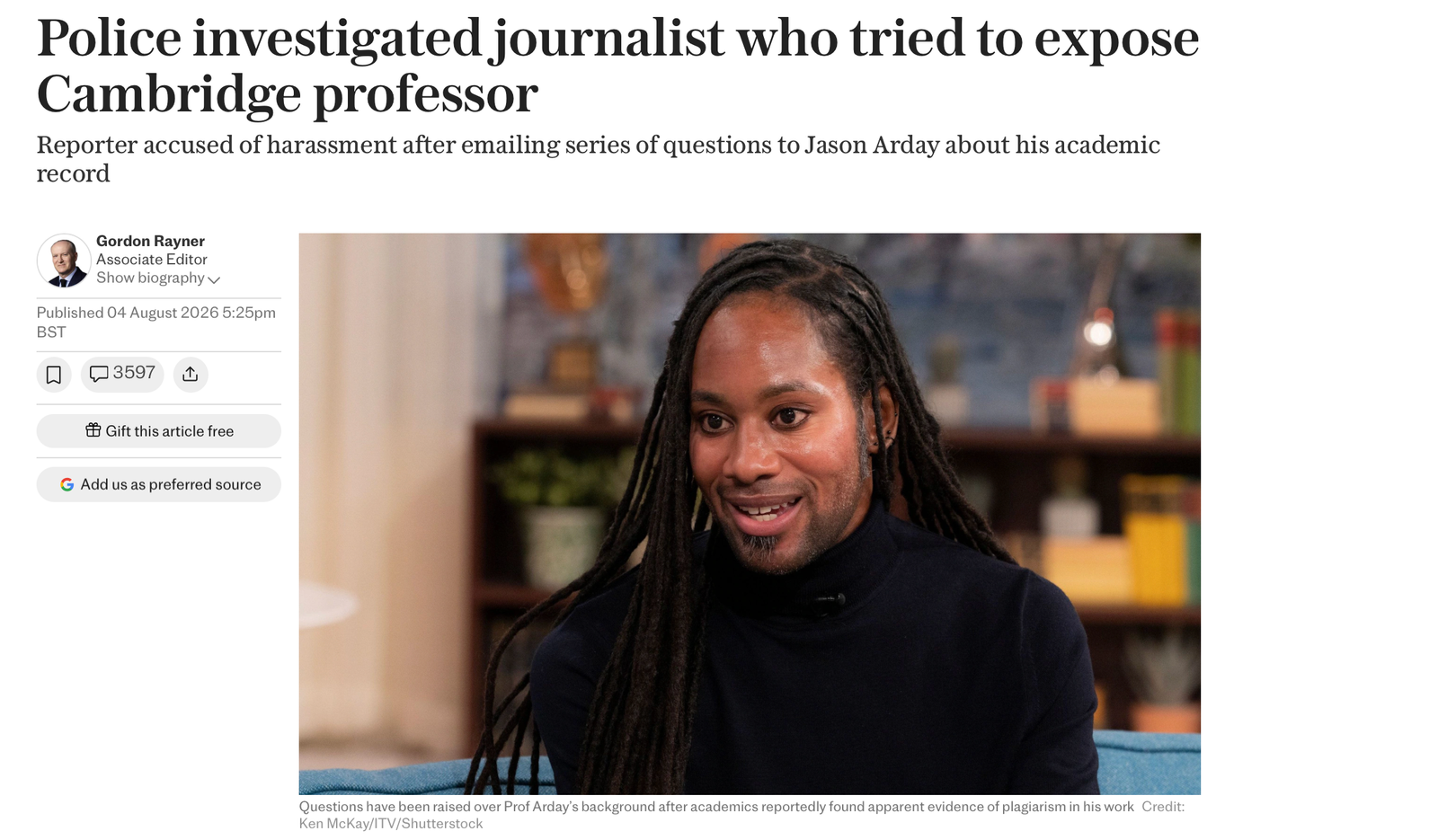
Recent revelations in The Telegraph have taken us to the heart of the scandal
As the Times Higher Education (THE) prepared to publish a story on plagiarism and research misconduct in September 2025, the journalist Jack Grove sent a series of questions to Professor Jason Arday regarding his academic record. In response, Prof Arday engaged the law firm Carter-Ruck, which suggested in correspondence with Grove and THE that the publication’s “apparent attack” might be “racially motivated.” Prof Arday complained to the police. Grove was then investigated for four months. He later had a visit from police officers who advised him to cease contact with Prof Arday, citing concerns that the questions had impacted Arday’s mental health.
In other words, the Metropolitan Police investigated a journalist performing his professional duty. Offering a right of reply prior to publication is a well-established principle of responsible journalism.
Such developments are troubling in a democratic society.
Who recommended this course of action? Given that Prof Arday is autistic, it is likely he sought guidance in handling what must have been a difficult situation. It seems plausible that he turned to someone in the University whom he trusted for advice, especially as this was a matter relating to his research work.
Indeed, the University had an obligation to offer advice under its duty of care as an employer. What advice was given to Prof Arday?
More broadly, the University appears to have form in handling matters in this way. There have been earlier instances where public funds were used to contain reputational damage. During the ‘Cambridge Whistleblowing Tribunal’, it emerged that Professor Richard McMahon — who had made defamatory and untrue allegations — received financial backing in a private legal case. In the Cancer Research UK scandal, Professor Paul Pharaoh received threatening letters from the University solicitors about divulging information on social media. The 21 Group is also aware of other cases in which whistleblowing academics in Cambridge have been subject to police intimidation and arrest.
These are not isolated incidents but reflect recurring approaches associated with the University’s Human Resources, Communications, and Legal divisions.
The Daily Telegraph reported: “A spokesman for Cambridge University said: ‘The University did not make any complaint to the police against Jack Grove in 2025. Neither was it aware of any such complaint being made.’” This prompts the question: what, precisely, is meant by “the University” in this context?
Given that both the Vice-Chancellor, Professor Deborah Prentice, and the Chancellor, Lord Chris Smith, have repeatedly stressed the importance of free speech, should we not expect a clear condemnation of these events? Should we not also expect a thorough and transparent investigation?
The institutional cowardice and dishonesty are by far the most egregious things in this scandal.
Cambridge needs to respect the mental health of this vulnerable autistic man. Elon Musk must be allowed to tweet about the Arday scandal
You mean this guy?
https://x.com/elonmusk/status/2084678514402271486
Never heard of him before but jolly ho he seems to have quite a few followers. Maybe he did something to deserve it.
5.3 million views and counting.
Still no word from Cambridge – weren’t they “back to work” yesterday? How long does it take to put out a statement?
5.3M views by now…
Is anyone seeing this news? Apparently Dr Arday has ‘resigned.”
https://www.telegraph.co.uk/gift/dc3cb625ffdeb3f4
Everyone else remains in their posts. All the people who hired him. The Research Integrity Office. HR. Top Administrators.
Anyone seeing this news?
Jason Arday Resigns After Telegraph Reveals His False Book Claims
https://www.telegraph.co.uk/gift/dc3cb625ffdeb3f4
Have corrected the Persuasion headline
Now reads
“Surely liberals can agree that using the police to arrest journalists and critics is bad”
It’s worth making a further point. Plagiarism started the matter, but is tis clear that there is fabrication of datasets & research fraud as well
See this thread
https://x.com/Afinetheorem/status/2084666949955387634
Author is prof at Toronto. Samples do not exist, quotes are reused from other studies
Obviously, there needs to be an investigation into such serious allegations — not conducted by Cambridge’s Research Integrity Office which has now has zero credibility
Plagiarism was merely the entryway to the real scandal on Jason, his compulsive lying and made-up backstory.
And Jason is merely the trapdoor to the rot at the heart of the humanities establishment at Cambridge.
Gravitationally inverted, a ladder that you can throw away once you have climbed it.
Eric Rasmusen wrote a Substack post asking who hired Dr Arday and why. See his open letter:
https://ericrasmusen.substack.com/p/who-hired-the-ridiculous-jason-arday
Don’t worry, Jesus College is investigating the research misconduct case alongside the university.
“Jesus College, where Prof Arday is a fellow, has also launched its own process alongside the university’s investigation.
A college spokesman said: “Parallel to the University of Cambridge’s investigation into Prof Arday, Jesus College is launching its own process.
“Prof Arday’s college fellowship is linked to his university role and we will fully support the university.”
https://www.telegraph.co.uk/gift/dc3cb625ffdeb3f4
The Times just published another, but the link seems broken. Search for:
“Jason Arday: Police investigated journalist who questioned professor”
And you will find many in the US now, including at the New York Post, National Review, The Free Press, …
The behaviour of Prentice & the Pro-Vice Chancellors is a disgrace. What is Vira doing? How will this scandal affect his welcome message for students in Michaelmas? And what about Varsity!??!?!
https://www.varsity.co.uk/
If Jason can hire lawyers and enlist the police to go after journalists just thing of the wrath he could inflict upon students enrolled at Cambridge? But perhaps he already has? So no wonder Varsity are terrified.
Varsity is not “terrified” by Arday, but by the University. Varsity has already cancelled stories last time because they exposed the degrading state of Cambridge University.
Can someone clarify who are the sponsors of Varsity? Alumni? If so, who?
This only makes it even more curious.
Varsity makes most of its money from graduate-recruiter advertising (law firms, consultancies, banks targeting Cambridge students). Ad inventory is sold across print (page rates from £200 to £1,000) and web (banners, sponsored links, tenancies) via the Varsity Publications commercial site.
The Arday story is gargantuam. It would bring massive readership volumes: not least of all from the very students the paper’s advertisers aim to reach.
I also imagine that many alumni are interested too.
So if they are not covering it, they are doing so at significant material cost to the publication.
“Varsity makes most of its money from graduate-recruiter advertising (law firms, consultancies, banks targeting Cambridge students)”
Can you please tell us some names or perhaps tell me where I can find the information? I intend to contact them, cc the editors and the leadership. It is an absolute shame that Varsity is not covering this issue and it is surely not Arday that is telling them not to do so. Does the University also contribute to funds for Varsity or has any legal power to cancel their stories before publishing?
Fire the Varsity, they don’t represent the students or faculty.
New from Daily Mail, but paywalled…
https://www.dailymail.com/news/article-16028647/GUY-ADAMS-Oxbridge-youngest-black-professor-story.html
The University has no direct authority over Varsity. It just happens to own the building which Varsity occupies, and happens to have authority over those individuals who write for Varsity and who are also students or employees of the University. But no-one would ever dream that it would ever abuse its position as landlord or degree-awarder, so all is well. Next people will be claiming that the University would use dark arts to influence full-time professional journalists working for major news outlets. Absurd.
Absolutely.
Varsity of course offer the university right of reply on any critical story (as is standard journalistic practice) It would be inconceivable that the university might try to apply any pressure to drop articles 😉
Still, Varsity have dropped a series of articles on bullying, CRUK-Cam & events at a number of departments in the School of Physical Sciences.
They had a scoop on the ‘Whistleblowing Employment Tribunal’, but pulled the story at the last minutes. The University had correctly advised that it might be prudent to wait till 2100 when everyone connected with events would be dead.
Given what was done to Jack Grove …. very sensible. Students are much more exposed!
Journalism takes ethics the Varsity doesn’t have.
There is nothing that prevents the editors of Varsity of either publishing and ignoring the pressure, or report it to another newspaper as Jack Grove did. Now would be the ideal time to do it, namely regarding Arday’s and other stories, to show what kind of institution we have at Cambridge. It is their reputation as editors that is on the line as well. If they keep the same embarrassing silence as the senior leadership, it will not work for their future as journalists if that is what they intend to do. Their silence is sure embarrassing for their main audience, other students and alumni of the University.
“And Jason is merely the trapdoor to the rot at the heart of the humanities establishment at Cambridge”
The sciences are not far behind, especially as compulsive lying and misrepresentation of expertise are concerned.
Biological and medical sciences are a shit show. It’s not wrong to say there are full professors who would struggle to enter the university as undergraduates. At the same time they destroyed our CRUK lab (one of the most productive in the University) and ended many of our careers.
Another story on the involvement of the police…
https://afcomm.org.uk/2026/08/05/jason-arday-reported-academic-critic-to-police/
“Jason Arday reported academic critic to police after questions over his research”
Why would a person (or an institution) report someone to the police who was asking questions about the integrity of their work, without clarifying the situation? How odd.
“Jason Arday reported academic critic to police after questions over his research”
This is a cross regulatory situation where a journalist is attempting to make a contribution to regulating the academic standards of an academic & an academic is in response trying to make a contribution to regulating the standards of journalism of a journalist. An academic and/or journalist could refer the cross regulatory situation to their own principal regulator – OfS/independent press standards organisation – in tandem with referring the situation to the cross regulator in the particular cross regulatory situation – independent press standards organisation/OfS. The police could also refer the cross regulatory situation to the appropriate combination of regulators as a check point before taking decisions in relation to police involvement in a cross regulatory situation.
If a professional is subjected to a step change in regulation with respect to professional standards – self imposed and/or externally imposed – the resultant step change in the level of scrutiny – self scrutiny and/or external scrutiny – has the potential to result in a significant step change increase in work-related stress and hence mental health risk. This means that in any cross regulatory situation like the one above – step change in regulation with respect to professional standards – there is a mental health risk to consider on both sides of the cross regulatory situation.
There is a situational mental health risk – associated with a cross regulation situation – independent of the personal risk factors operating on each side of that cross regulatory situation which may or may not be known to those handling the case. In handling that type of situation there is a risk of giving too much weight to known personal risk factors operating on one side of that cross regulatory situation and not enough weight to situational risk factors – which could be significant & dynamic for both sides of that cross regulatory situation – and the possibility of hidden/unknown personal risk factors being uncovered in that cross regulatory situation and starting to operating on either side of it.
If a professional can sustainably regulate their own self with respect to their own professional standards this means the professional has found a way/ways to regulate their own work-related stress and their own mental health risk while continuously meeting the professional standards expected of them. If a person cannot sustainably regulate themselves with respect to their own professional standards this means the professional has not found a way/ways to regulate their own work-related stress and their own mental health risk while continuously meeting the expected professional standards expected of them.
The risk of a professional in the latter position attempting to make a contribution to the regulation of others to professional standards – PhD students, journalists – is that there is a higher probability of the person trying to impose their own form of regulation with respect to professional standards on others – by example and/or by instruction [where instruction may or may not be in conflict with example] – when their own form of regulation with respect to professional standards has not allowed the person themselves to sustainably regulate their own work-related stress and their own mental health risk while continuously meeting the professional standards expected of them.
There is then an increased risk of inaccurate regulation of others with respect to professional standards by a professional in the latter position which could generate excess work-related stress and mental health risk for those others above accurate regulation of others with respect to professional standards. There is an increased risk of a professional in the latter position entering into a cross regulatory situation where in response to the person attempting to make a contribution to regulating others with respect to professional standards others attempt to make a contribution to regulating the person with respect to professional standards.
If a person holds an inaccurate representation of others – e.g. believes others hold an undue bias with respect to a particular personal characteristic when others hold no such undue bias with respect to that particular personal characteristic – there is an increased risk of inaccurate regulation of others by the person with respect to anything – that includes professional standards.
If it turned out that the police were still monitoring private citizens on behalf of Cambridge or Arday that would be the scandal to top all scandals
https://x.com/NeilThin/status/2084941778788970585
“As well as sabotaging the reputations of sociologists, fellow “Black” scholars, and DEI promoters, he’s massively lowered the bar for entry into the community of successful scam artists”
The programme for September’s Alumni Festival is now published. Perhaps that provides some opportunities to ask questions and raise legitimate concerns …
https://gript.ie/how-cambridge-university-became-a-dei-victim/
“Cambridge University has become a victim of its own Diversity, Equity, and Inclusion (DEI) machinery. By building its modern institutional brand around a symbolic narrative of progressive representation, social justice imperatives effectively superseded basic academic standards. When an elite university ties its prestige so heavily to ideological EDI imperatives, it loses the internal leverage required to enforce its own core standards. In trying to protect its flagship diversity initiatives, Cambridge has found itself trapped—forced to defend documented scholarship failures to preserve its organisational narrative.”
“The central crisis for Cambridge is not that an individual scholar produced questionable work, but that the university’s administrative apparatus rendered itself incapable of addressing it.”
“Rather than encouraging transparency, the institutional structure incentivized suppression to protect the brand from reputational fallout.”
“By treating legitimate academic scrutiny as an existential threat to its social justice mission, Cambridge painted itself into a corner: admitting fault meant destroying its celebrated DEI narrative, while denying the facts severely eroded its standing as a world-class academic institution.”
Every day is now Ar-day
The question is, the next scandal to get major attention will be POLIS or IoA with the verdict of the Whistleblowing tribunal case? Hopefully, Arday’s will last a few more days until the next starts.
Feels like this will just be continuous from now on until end of the year.
The second question is: how long will their silence last?
Jason must be sweating like crazy this week?
Meanwhile… check periodically the names who signed the Letter (top right). Some of them included…
Elizabeth Holmes
Ivana Steal
Helluva Frawd
I_love_fraud
Or instead just check this new article:
https://donnalouiseflowers.substack.com/p/believe-me?r=1mnouu&utm_medium=ios&utm_source=notes-share-action
Really glad to see that Elizabeth Holmes is moving on from a difficult patch in her career and taking the time to stand up for Jason. This just shows – no matter what you’ve done, you can always make things right. I’m sure the Good Law Project have rigorous checks in place so it must really be her, otherwise we’d end up questioning all the names on the list and I for one would most certainly not want to suggest that.
Helluva Frawd is well known for her social justice campaigning – though we have often wondered what on earth her parents, Mr. and Mrs. Frawd, were thinking when they chose her first name
But was it her? There was another interesting name who signed a few days ago called BaronMunchausen…
https://www.imdb.com/title/tt0036191/mediaviewer/rm2240509184/?ref_=tt_ph_2
The baron clearly feels solidarity considering how he was also unfairly maligned and attacked
The University of Cambridge is now so full of second-rate and incompetent people that being competent and conscientious has become a “risk to others”, being intelligent and inquisitive “toxic”, challenging bullshit “unprofessional”.
Intelligence and intelligent work are no longer welcome in this University. In fact it has become a significant risk to one’s career, to one’s health, to one’s life.
News from Malta…
https://timesofmalta.com/article/publisher-defends-cambridge-professor-plagiarism-row.1132366
“Publisher Simon & Schuster has defended Jason Arday, a University of Cambridge professor facing snowballing accusations of plagiarism ahead of the release of his memoir.
We are proud to publish Professor Jason Arday. We have worked closely with him… and can speak to the professionalism and integrity he has brought to every stage of the publication,” Simon & Schuster said in a statement sent to AFP on Wednesday.”
But my favourite is,
“The publisher noted that “no allegations of plagiarism have been made with respect to” the memoir, which is set to be published next week in the United States and the end of the month in the UK.”
1. Simon & Schuster’s own speakers’ bureau quietly edited Arday’s bio between May and July 2025 removing the specific “£5.5 million raised for 80 charities” figure and claims about running 600 miles in six days. This was well before the public scandal broke on Arday. It suggests the publisher had internal doubts about his claims well before the media raised concerns.
2. That they did even this much is puzzling. Memoirs are not fact-checked by trade publishers; they historically do not independently verify memoirists’ claims (a norm criticized since the James Frey affair of 2006). It is hard to avoid the implication that Simon & Schuster had sufficient reason to doubt Arday’s honesty well before sending the publication to print; but have apparently, have since done no due diligence on his other claims, nor have they chosen to suspend the book release while the matter is addressed.
Missing a story from The Telegraph? Here you go!
https://www.telegraph.co.uk/news/2026/08/05/jason-arday-falsely-claimed-to-have-published-book/
“Jason Arday falsely claimed to have published book “
What about The Times? Missing it? Here you go, and this comes with a surprise!
https://www.thetimes.com/uk/scotland/article/jason-arday-professor-glasgow-university-8cf3hbqv9
“The 21 Group, which offers supports to academics experiencing bullying, victimisation and harassment at UK universities, also called on Glasgow to “come clean” about Arday’s appointment.
A 21 Group spokesman said: “A key unanswered question is the composition of the appointments committee that selected him. Given the significance of awarding a professorial title, transparency about the appointment process would help establish the level of academic scrutiny and due diligence applied. Did the members of the panel read the works? How did they decide it was of professorial standing?”
The group has called for Arday’s recruitment by UK universities to be investigated by two regulatory bodies, the Office for Students and the Scottish Funding Council. “Only an independent, external inquiry will now do,” a 21 Group spokesman said.”
“Statement about Professor Arday”
https://www.cam.ac.uk/notices/news/statement-about-professor-arday
“The University of Cambridge has begun an investigation following new information about Professor Arday’s academic qualifications and honorary appointments. In order to ensure a fair process, we will not comment further until this has concluded.”
What about Carter-Ruck and the police?
As we all know, any internal inquiry will have a very well-defined scope that is vanishingly small
That is why we need a Grace asking for an external audit of the Research Integrity Office.
Now, who will be the “Responsible Person” and “Independent Investigator”? I can think of some good candidates…
This is a must. The Research Integrity Office and the Research Office in general need an urgent review. The RO used to be run by a wine merchant! Both RIO and RO played a major role in bungling and corrupting the process that resulted in the gigantic SCM oncology/cancer research scandal! World class research destroyed and DEI-related mediocrity promoted. UCam is doomed!
Absolutely. The Research Integrity Office must be added to the Grace on an audit into HR.
In other news, Prof Fox will be examining the disappearance of hens from the henhouse
He promises full transparency, between mouthfuls
The Master of Jesus seems no longer to be a signatory to the Good Law Project letter – so she’ll be fine to undertake the College investigation.
And only two grammatical errors!
And they say that the University and the Colleges are independent… It seems Jesus will also investigate Arday and the GLP Letter also lost another name…
https://x.com/guyadams/status/2085064131560800693
Do not worry, they still have:
Elizabeth Holmes
Ivana Steal
Helluva Frawd
I_love_fraud
BaronMunchausen
Professor Sir Simon Baron-Cohen, University of Cambridge
among others!
They told The Guardian, not The Telegraph and The Times… Why?
https://www.theguardian.com/education/2026/aug/05/cambridge-jason-arday-announces-investigation-into-professor-accused-of-plagiarism
Wait… They also know!
https://www.thetimes.com/uk/education/article/jason-arday-cambridge-investigates-academic-accused-of-plagiarism-5lttc0qv9
And The Telegraph:
https://www.telegraph.co.uk/news/2026/08/05/jason-arday-falsely-claimed-to-have-published-book/
Meanwhile, Varsity has a new story!
https://www.varsity.co.uk/news/31908
Really glad Varsity finally caved to overwhelming public pressure and covered the return of a Spanish grammar book to the library.
But how will they pay the late dues? A public investigation is overdue, pffff …
Look who just resigned!
https://goodlawproject.org/an-update-from-jason-arday/?utm_source=twitter&utm_campaign=glp_post_27503&utm_medium=social_media&utm_content=05-08-2026
I hope he will still publishes the book otherwise these will be sad times until the next scandal…
publish
Was this before or after the University announced an investigation ?
https://www.cam.ac.uk/notices/news/statement-about-professor-arday
My guess is that likely they came at the same time. We commented on that announcement above when it came out. The Sun, the Independent, and other newspapers and others are publishing on it.
https://www.independent.co.uk/news/uk/home-news/professor-cambridge-university-jason-arday-plagiarism-b3028219.html
Note that the GLP announcement says “I will return” and, of course, he never apologises. Why would he? He stayed 3 years at Cambridge University but learned the basis.
BBC…
https://www.bbc.com/news/articles/c1e146jw618o
Suspiciously choreographed, no?
The University announces an investigation. Arday resigns. Everything unfolds with remarkable speed and precision.
It raises the question: was there a behind-the-scenes legal settlement?
Are we seeing the public shadow-play of a private agreement?
Of course. But the shameful thing here is that he continues with his narrative after everything that was published about him. At least the Good Law Project campaign is still online and it reads:
“ArdayIsAFraud signed 3 minutes ago ”
https://goodlawproject.org/petition/stand-in-solidarity-with-jason-arday/
Hopefully, the University will clarify about the use of Carter-Ruck and police to threaten and silence journalists and academics who want to report misconduct. And Prentice? Why should she speak?
YES! Like the early retirement of the former Head/Director of the Research Office at the age of 55 or so. He was used by the University oligarchy and HR to conduct the bungled ‘investigation’ into totally false allegations that are behind the SCM oncology/cancer research scandal. He is now a wine merchant!!! Rhys Morgan was already Head of Research Integrity. UCam oligarchy uses people. Arday was just a DEI puppet! The American Queen will not relinquish her 550k unless she is kicked out!
Why the stuff about employment law and uni procedures if they knew he would go? Cover?
More likely they turned on him and knew enough to force him out.
More likely they turned on him and knew enough to force him out.
He knew enough about them to make it very embarrassing.
By the end, it needed shutting down quickly. Money is the only way to do that
Suspiciously choreographed is a fine way to put it.
The headline of an article changed from ‘Cambridge announces investigation’ to ‘Arday resigns.’ My colleagues and I suspect he was pushed to resign and paid a secret settlement.
We also see Cambridge has gone on the offensive to shut down allegations of covering up research misconduct by its favoured academics.
This is hilarious! This guy does not exist!
https://x.com/DavidDecosimo/status/2085087100404158976
Yesterday Cambridge was still insisting that he was the victim of a “vile campaign” and had done nothing wrong. Can the Cambridge VC explain the inconsistency here?
Perhaps the 6.6M views of Musk’s tweet yesterday, and the number of articles published in the US helped the managers to get a different perspective about the problem.
https://x.com/elonmusk/status/2084678514402271486
Do not forget what our great Chancellor Lord Smith told us 2 months ago, “If you want to understand the United States, go to Cambridge ”
https://www.telegraph.co.uk/news/2026/05/20/if-you-want-to-understand-united-states-go-to-cambridge/
Yeah they realised it would be better to pay Arday a million pounds to disappear than lose many more millions in US donations. But who will be made to take accountability for the damage?
@TheResearcher
I’d have been better off to have never read that article, thank you very much indeed.
More focus on the US is surely what Cambridge needs! Embarrassing for the Chancellor, and a pity for us the new Chancellor isn’t Wyn Evans.
True. If Wyn had been Chancellor, the clean up would have started one year ago, and story would be: “Cambridge purge sets university on track to restore transparency and research excellence”.
Instead of: “Cambridge Cover-Ups Question University Reputation.”
You’re right. The headlines would be marvelous. The reality of transparency and research excellence would be even better. I don’t believe any reasonable person is happy with cover ups and the reputational damage. Most could get behind Chancellor Wyn Evans on that front.
Maybe this a finally a sign that Cambridge has learnt to admit that it was wrong when the evidence is clearly laid out in front of them.
🤣
Let’s see how they deal with the next scandal!
You mean, will they protect the next Jason for as long as possible until eventually having to fire him anyway
Yes.
The next stories are worse. Arday lied for self-promotion, but others lied to cause harm and to destroy other academic careers.
Are you thinking SCM, oncology/cancer research scandal?? And how DEI worked there to first believe in blatant lies and then promote the originator of the lies?
@Ender
Right, there’s a critical difference.
I’ve seen nothing in the evidence to suggest Dr Arday bullied or that his lies caused harm to others and destroyed their careers. In other cases known throughout Cambridge, that’s not the case. The research misconduct comes with bullying, retaliation, blacklisting and as we’ve seen on this blog, false statements that are defamatory to the whistleblower.
If my recollection is correct, Dr Magdalen Connolly’s case was also about bullying.
@EtonMess
No bullying? Arday called the rozzers on a jouro, threatened an academic investigating his work with a report of harassment and insinuated criticism of him was racially motivated to keep the story hidden.
Harmful retaliation against those seeking to expose the truth is an MO.
It can take many forms, including allowing the obvious defamatory lies of others to be “taken very seriously”.
@Eh? and @Blacklisted
Good points, thank you.
I suppose the bullying cases I know of are rather extreme. My scale is off and needs adjusting.
The journalists and that academic were indeed bullied. In this case, journalists were in a unique position. Not clever to bully them.
The allegations that investigators are closet racists is another form of bullying, although I understand those ‘smear campaign’ allegations came from the spokesperson in the first instance. Not denying many headlines were racist- they are- but investigating research misconduct isn’t an inherently racist act. Eileen Nugent posted an interesting comment on the problems with such allegations. Anyway, it was satisfying to see that allegation backfire.
Cambridge artificially separates bullying from research misconduct. Most commentators know that bullying and research misconduct often go hand in hand. The bullies receive institutional support; the victims are further disempowered.
No question following their endorsements of Arday:
– Cremin as Head of Education.
– Vira as PVC.
Others?
— Morgan as Head of Research Integrity
— Helm as Head of Comms
– spokesperson as spokesperson
“– spokesperson as spokesperson”
Hahahaha LOL. Sadly the little people are the ones certain to take the hit if only to protect the higher ups.
Cremin is already stepping down as head of education from October. That will probably be seen as enough to limit any further damage there.
Vira isn’t particularly implicated, unless he’s just had enough and decides to go anyway. His remarks when Arday was appointed will have been ghost written for him.
Morgan I’d count as one of the little people in the Old Schools, just following orders. It’d be difficult to fire any of the little people at this point, but some of them will be scapegoated at the next round of redundancies.
None of this matters if Cambridge tries to draw a line under this affair and changes nothing. The Graces are still relevant and important.
Whose orders is Morgan following?
The line manager of Dr Morgan is Dr Andrew Jackson, who suggested the Head of POLIS as one of the “Responsible Persons” for my report of research misconduct. When I asked him if he knew the scandals of POLIS and why she could not act as “Responsible Person” he told me he did not know about the scandals.
The line manager of Dr Jackson is Dr Mike Glover, the Academic Secretary and acting Registrary.
@Old Schools Refugee
I’m inclined to defer to your opinion given your username. However, I’m sceptical about the characterisation of Dr Morgan as ‘one of the little people in the Old Schools.’ What is his full title? It cannot be insignificant.
There are now three cases in the public realm where his name is front and centre, but somehow he’s out of the picture:
Dr Arday,
Dr Connolly, and
ForBetterScience.
It’s always the same pattern. The case is out of scope, or it’s divided up into multiple different cases to weaken it, or somehow the real problem is denied out of existence according to the university. It seems apparent this official has significant power and control over investigative processes and likely sharpens his techniques with each case.
Personally, I’d not underestimate Dr Morgan.
“The line manager of Dr Morgan is Dr Andrew Jackson, who suggested the Head of POLIS as one of the “Responsible Persons” for my report of research misconduct.”
Realistically I reckon they have weeks to a couple of months at best to resign – if they want to avoid experiencing the “full Arday”.
Wait a minute, we still have more news!!!
https://www.thetimes.com/uk/education/article/ason-arday-cambridge-professor-research-investigation-lsdpkqkr7
“Jason Arday: Times analysis finds ‘impossible’ data in his work “
And another from The Telegraph:
https://www.telegraph.co.uk/news/2026/08/05/the-downfall-of-cambridges-diversity-poster-boy/
“The downfall of Cambridge’s diversity poster boy. Prof Arday’s career at top university is over, but the questions for those who appointed him remain “
And finally, one from Jack Grove:
https://www.timeshighereducation.com/opinion/i-was-reported-police-over-arday-case-i-was-just-doing-my-job
It’s good the pressure is being kept on the university. The more news, the better. Cambridge would’ve avoided this scandal had they investigated the research misconduct in the first place. The fact that they also didn’t investigate any of Dr Arday’s unbelievable claims, or even his false book, only gives more credibility to the allegations of covering up research misconduct. Who is investigated and who is not must be questioned in this public debate.
These things will be vanishing from the websites, get them while you can!
https://news.educ.cam.ac.uk/230223-jason-arday
Welcoming the appointment, Professor Bhaskar Vira, Pro-Vice-Chancellor for Education at the University of Cambridge, said: “Jason Arday is an exceptional scholar of race, inequality and education. He will contribute significantly to Cambridge’s research in this area and to addressing the under-representation of people from socio-economically disadvantaged backgrounds: especially those from Black, Asian, and other Minority Ethnic communities.”
“His experiences highlight the barriers faced by many under-represented groups across higher education and especially at leading universities. Cambridge has a responsibility to do everything it can to address this by creating academic spaces where everyone feels they belong.”
“We are making extensive efforts in this regard – including the expansion of the ‘Get In Cambridge’ programme which provides financial support to address systemic disadvantages and the lack of social and educational capital which often constrains the ability of minority ethnic students to continue with their education. A great deal remains to be done and Jason’s expertise will inform and enhance these ongoing endeavours.“
“I am not privy to the hiring process for a professorial chair at Cambridge. I do not know exactly why and how Arday got the job or who else was in the running. But what happens when an academic’s story is sold through him being the “youngest black ever” (sitting alongside familiar monikers such as “the first black” or “black excellence”) and asterisked by a tale of hardship? You are not encouraged or invited to engage with the substance of their scholarship; instead, you are invited to clap. Instead of his appointment conjuring the question “what new opportunities for research will this lead to?”, it was “doesn’t this make you feel good?”
What this means is that Arday was treated not as a scholar but as a mascot, one who was particularly expedient for an institution that had been regularly embarrassed by its historic record on race: too few black students (in my cohort at Cambridge matriculating in 2015 there were only 15 black males out of 3,449 students); single-figure black academics (which is still the case); allegations of institutional racism. Independent of the merits or pitfalls of his own scholarship, what success looked like for Arday in this role was limited; what accountability could look like if misconduct occurred was constrained by him being a vehicle for Cambridge to signal its institutional progress.”
https://www.theguardian.com/commentisfree/2026/aug/06/jason-arday-dei-race-issues-university-of-cambridge
One more from the Telegraph?
https://www.telegraph.co.uk/news/2026/08/06/jason-arday-cambridge-university-plagiarism-row-polanski/
“Jason Arday held to higher standards because he’s black, suggests Polanski “
The wide circulation of this video of Cremin (“we are so lucky to have you”) and Arday (grinning) has surely been punishment enough
https://x.com/DionLeFou/status/2081294581040071123/video/1
Good interview by Kathleen Stock:
https://www.youtube.com/watch?v=ODQjzGcoxFY
“The Jason Arday Affair Has Debased Cambridge’s Reputation As An Elite Institution”
And another interesting one by Roger Mosey who worked in Cambridge:
https://www.youtube.com/watch?v=zlQJVHlw_uo
The saga continues…
“Jason Arday claimed he was paid ‘1.4 million’ for memoir from publisher”
https://www.theguardian.com/education/2026/aug/06/jason-arday-claim-memoir-publisher-simon-and-schuster-cambridge
But will we still see that memoir?
“Cambridge Prof. Simon Baron-Cohen has since yesterday removed his name from the open letter offering “unwavering” support for now-former Cambridge professor Jason Arday that was posted by The Good Law Project.”
https://x.com/benryanwriter/status/2085348716580344130
At least they still have Baron Munchausen!
Oh wow. This definitely explains why they would not pull the book then. It is a huge sunk cost – the prepayment, the print run, the PR schedule. And even if they sued Arday for fraud they’d never recover the money.
Note that he apparently did not specify the currency. It could be 1.4 million alpacas, like Johnny Depp stated during his 2022 defamation trial that he would not return to Disney for $300 million alpacas!
the moon has now eclipsed the sun, the time has come for better things
Not sure Jason has repented yet. The show goes on.
Could you stop it even if you wanted to?
“Serious questions for Cambridge after professor at centre of plagiarism row resigns”
https://www.bbc.com/news/articles/cpvwd30we17o
“Who Hired the Ridiculous Jason Arday at Cambridge? I Have the Names.”
https://ericrasmusen.substack.com/p/who-hired-the-ridiculous-jason-arday?utm_source=multiple-personal-recommendations-email&utm_medium=email&triedRedirect=true
Next we need the list who kept Jason employed even when everyone knew he was lying.
Just because someone is a Cambridge named professor, you cannot ever take them at their word. You have to demand evidence. Those who failed to demand evidence must be fired too.
Look at this (sent to 21 Group by a co-conspirator)
https://www.spirehouse.co.uk/jobs-hr/head-of-hr973
HR currently advertising through a head hunter for a 65k per annum head of HR policy. Apparently they will lead a team of 4 HR policy wonks
Given the academic recruitment freezes, this seems insulting.
HR does what the senior leadership lets them to do. Was this approved by the HR Committee?
https://www.governanceandcompliance.admin.cam.ac.uk/university-committees/human-resources-committee
Kamal Munir is still presented as the Chair despite he “stepped down” as ProVC so perhaps one can ask him who is allowing these hiring, namely before the Grace asking for an external audit of HR practices?
News from The Guardian!
https://www.theguardian.com/uk-news/2026/aug/06/jason-arday-cambridge-dons-demand-accountability-grotesque-racism
“Cambridge dons demand accountability over Jason Arday appointment
Exclusive: Academics say university must take responsibility for ‘grotesque racism’ unleashed and hold independent inquiry”
Will Hilary Cremin resign as well after this? There is also a YouTube interview:
https://www.thetimes.com/uk/education/article/jason-arday-boss-plagiarism-allegations-dismissed-m53d6g3xp
And one more from The Telegraph:
https://www.telegraph.co.uk/news/2026/08/06/the-cambridge-diversity-scramble-that-led-to-arday-fiasco/
“Deborah Prentice, the vice-chancellor who was hired in the same year as Prof Arday, did nothing to publicly address the growing crisis that was eating away at Cambridge’s reputation. Spokesmen for the university insisted that neither she nor anyone else could do anything.
Academics within the university pointed the finger at the research policy, integrity and governance division, which is overseen by Prof Sir John Aston, the pro-vice-chancellor for research and a mathematician. A draft resolution, or “grace”, was circulated among Cambridge academics, calling for an investigation into the alleged shortcomings of the integrity team.”
Imagine if Jason had not only plagiarized the title of his dissertation, typos and all, but also plagiarized a false statement to court, typos and all. Consequences?
“Every Claim In Jason Arday’s Memoir Unpacked”
https://www.youtube.com/watch?v=0LOblZm_cnc
Varsity, are you alive? https://www.varsity.co.uk/
Perhaps when the University wrote, “In order to ensure a fair process, we will not comment further until this [investigation] has concluded,” that included Varsity as well? One issue is that Varsity did not make any comment on this topic for two weeks. Really embarrassing.
Arday in April 2026…
“He also seemed to address such allegations at a conference in April for the British Sociological Association, where he gave a talk about pervasive efforts to discredit Black scholars including himself. “These people are brilliant, perversely brilliant,” he told his colleagues. “There are times when you look at what they’re doing and you say to yourself, Well done, well played, very good. You’ve caught me [in] a thousand knots—how do I get myself out of this situation?””
https://www.theatlantic.com/books/2026/08/jason-arday-cambridge-academic-memoir-resignation/688206/
“Great and Unfortunate Things, which Arday co-wrote with Eve Claxton, is still scheduled to come out next week from Simon & Schuster. The story that it tells should not be taken at face value; it differs notably from other versions of his life that Arday has shared in public and in private, including in the original proposal he sent out with his agent.”
“the most disturbing inconsistencies arise from Arday’s book proposal, a copy of which was obtained by The Atlantic. That document, from 2024, cites several accolades of which no proof exists online. The proposal also lays out many of the same events as the memoir but with slightly different dates and details: The boys who beat him up were not his age but four years older; his suicide attempt happened before, not during, the pandemic. And whereas the book describes Arday as having survived two brain tumors, the proposal says he had a bout of testicular cancer. No reference to that illness appears in the memoir.”
I strongly recommend The Atlantic’s article. It is full of pearls!
“Today, in academic circles, that’s what I’m known for,” he writes in his proposal. “Everybody says, ‘Jason is the guy that teaches everyone the tricks.’”
“There’s a moment near the end of Great and Unfortunate Things when Arday’s confidence begins to waver. He’s filling out his application for the professorship at Cambridge, and just then, as he draws to the brink of destiny, doubts begin to fill his mind. “What if I have completely overestimated my capabilities?” he writes. “What if my story ends up being a cautionary tale like Icarus about flying too close to the sun?””
And new message from the University:
https://www.cam.ac.uk/notices/news/university-statement-07-august-2026
” the University’s Research Policy Committee will review the Misconduct in Research policy.”
What we need is an external audit of practices and cases, not just a revision of the current policy because that revision will not affect past cover ups!
DEI is everywhere in Cambridge! Look at the SCM and discover who has a super mediocre CV and despite that is Co-Director of a major Centre…
…….possibly a finger in the SCM CRUK Onc scandal pie?….
You guessed right! Scandal will eventually surface. But with DEI involved one cannot guess where it will end…
https://www.theguardian.com/uk-news/2026/aug/06/jason-arday-cambridge-dons-demand-accountability-grotesque-racism
As reported in The Guardian, Prof Priya Gopal is organising a letter.
Please contact her for more information. (use university email lookup for her email address)
I just sent her an email asking if she needs help and signatures from both current and former members of Cambridge University, and in particular if she would consider a former student who was just expelled as a Cambridge student after reporting misconduct of senior members.
Foa tried to organize a similar letter two years ago and had 15-20 former scholars from one department alone (POLIS) reporting misconduct, nepotistic hiring practices and bullying.
If this is all a revenge mission from former staff that is the most incredible story ever – and one (unlike the Arday memoir) that I would actually love to read
If you were thinking to contact the Vice-Chancellor, do not waste your time. It seems she is away again, now until the end of August… What a great leader!
Professor Deborah Prentice’s automatic message: “Out of office until 22/08”
https://www.bbc.co.uk/news/articles/c05q0nznq24o
Pressure growing for independent review
And for the state of affairs at Cambridge University more generally:
https://www.telegraph.co.uk/news/2026/08/07/cambridge-review-hiring-process-academics-arday-fiasco/
Check the video of the associated editor; he will not let this go.
Financial Times talks about Jason Arday!!!
https://www.ft.com/content/0fd301d9-7e47-46ff-89b9-b666a8a1c148?syn-25a6b1a6=1
What about the ranking FT? How misleading was it?
If this is true, this is the best yet. This chap claims that he was a primary school colleague of Arday and that he was definitely not mute. “Chatty Patty”…
https://x.com/DionLeFou/status/2085684590740402553
“Cambridge academics reject university’s attempt to end row over Jason Arday”
https://www.theguardian.com/uk-news/2026/aug/07/cambridge-academics-reject-universitys-attempt-to-end-row-over-jason-arday
“The nearly 100 signatories are senior professors and Cambridge academics, including Suchitra Sebastian, a professor of physics, and Mónica Figueroa, a professor of sociology, as well as Timothy Gowers, a past winner of the Field medal for mathematics. Other prominent names include Nicholas Guyatt, a professor of North American history, Mary Laven, a professor of early modern history, Anuj Dawar, a professor of logic, and Clair Wills, the King Edward VII professor of English literature.”
“The letter sent on Friday to Prof Deborah Prentice, Cambridge’s vice-chancellor, highlights the “toxic and frequently racist commentary” that has accompanied much of the online and media coverage, adding: “These manifestly false claims have the potential to set back the modest progress Cambridge has made in addressing historical under representation, and to deter any Black academic from applying for or accepting a position at the university in the future.””
“The letter states: “We therefore ask that you appoint an independent body comprising senior academics from within and beyond Cambridge to address these issues, with a clear timeline for completing its work and a commitment to share its findings with the university and the public.””
Do they know that Prentice is on leave until 22 August? I guess they got the automatic reply…
What a time to take a second vacation. Don’t staff have to secure approval prior to a vacation request on full pay? If so who the fuck approved this?
I guess she did 😂
I hope people who never interacted with her start to understand what kind of leader she is. Those who had already interacted with her, namely to report misconduct at Cambridge, already knew. A person who sees the institution she is responsible for being mocked nationally and internationally, chooses to be in silence for weeks and then decides to go on holidays, is clearly not a good leader, but I guess that she will eventually realize that and will hopefully step down.
The truth is simple. The media would not let the Arday scandal go because they knew it was a seam of gold that would unravel every lie about his backstory. And now, the media will not let Cambridge go, because the Arday scandal is just the first of five to ten scandals involving staff abuse, corruption and the utter failure of meritocracy. This is not the beginning of the end. Only the end of the very beginning.
To look at the failure of meritocracy look at the Cambridge Cancer Centre!
“Jason Arday has exposed Cambridge’s corruption”
https://spectator.com/article/the-fantastical-truth-about-jason-arday/
“Arday’s students think Cambridge failed them. Now they want their grades reviewed ”
“Graduates consider legal action after receiving lower marks than expected following ‘inadequate’ supervision by professor ”
https://www.telegraph.co.uk/news/2026/08/07/ardays-students-think-cambridge-failed-them-now-they/
Good luck with OSCCA…
“Prof Deborah Prentice, the university’s vice-chancellor, is facing demands to refund the tuition fees of students who were taught by Mr Arday after they were “deceived about the nature of their education”. A mass refund or large-scale retrospective grade changes would be unprecedented in the university’s 800-year history.”
She is on holidays folks!
“Former Cambridge students who contacted The Telegraph complained that Mr Arday gave them minimal supervision, telling some they did not need supervision because they were so outstanding, only for them to get lower grades than predicted. One student who asked to be allocated another supervisor was accused of racism (though there is no suggestion Mr Arday made the accusation).
Now, ex-students have said they are considering appealing to Cambridge to review their grades, including one case where a student appealed their grade at the time but had their appeal rejected.”
Of course it was rejected!!! OSCCA behaves as HR! Students, wake up!
OK, this is the best part:
“Last year, when Cambridge was confronted with evidence of Mr Arday’s plagiarism by academics and Jack Grove, a Times Higher Education reporter, Cambridge asked Prof Manuel Eisner, its professor of criminology, to investigate, and under its standard procedure its “responsible person” was Prof Cremin.”
Cremin was the Responsible Person?!?!?!? She could not be more conflicted.
Jason Arday has exposed Cambridge’s corruption indeed.