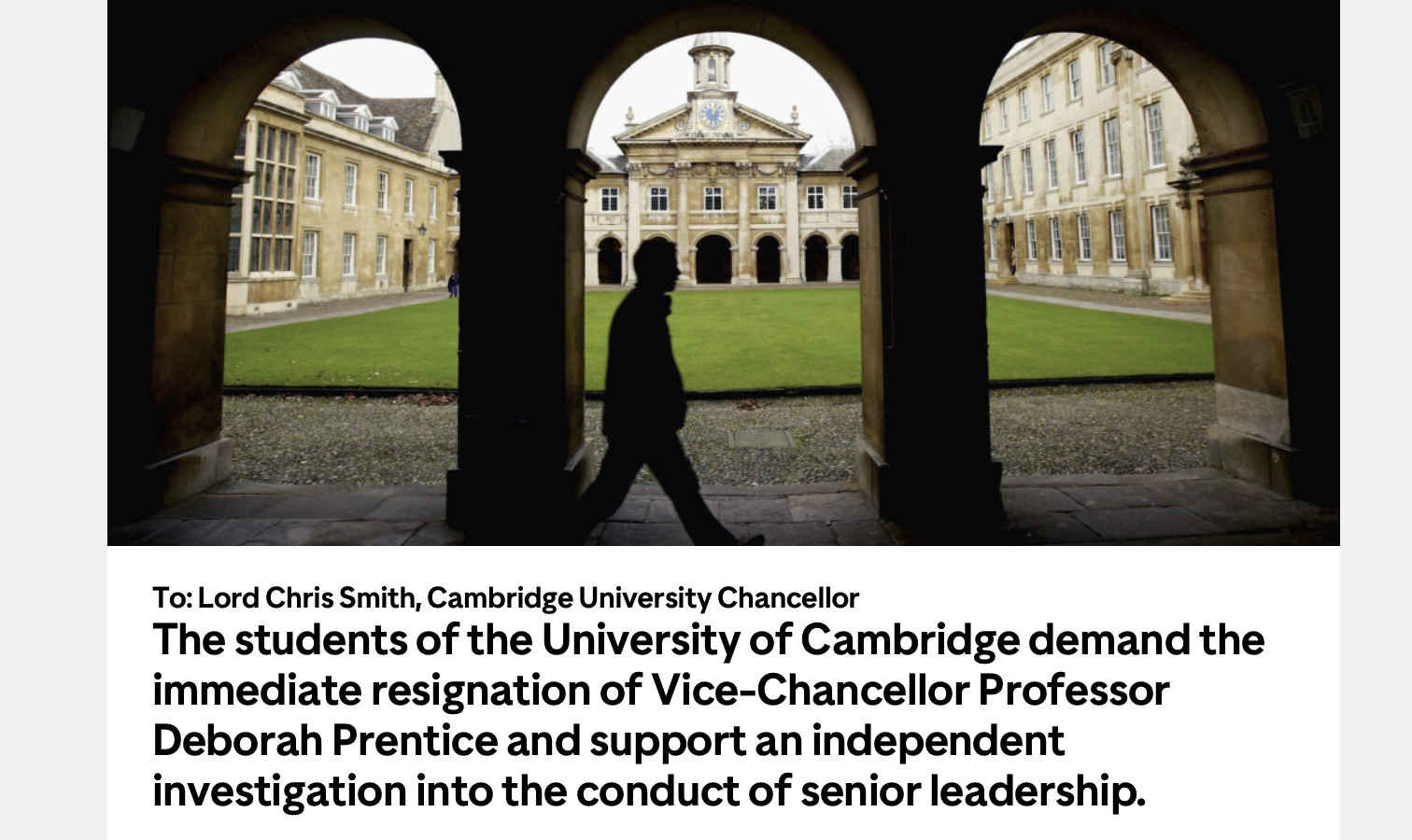
Another petition! Who in Cambridge is feeding all this stuff to the Good Law Project?
Jolyon Maugham, whose interventions in the Arday affair have been wholly destructive, is now calling for Deborah Prentice to resign as Vice-Chancellor. This makes her completely safe: Jolyon’s support is a death knell for any cause he embraces.
For now, there are two reasons why Deborah Prentice appears secure. First, there is no obvious or credible replacement (though one may emerge). Second, two significant investigations remain outstanding: one into the Cambridge Whistleblowing tribunal, and another into the appointment of, and support provided to, Jason Arday. For plotters, it’s best to wait for those investigations to conclude so that Prentice owns the mistakes. A new Vice Chancellor will want any failings identified in them to be laid at his or her predecessor’s door.
However, Deborah Prentice is facing significant problems. She has a depleted senior leadership team, still missing key personnel. She faces opposition to her plans for rearrangement of the senior leadership and the creation of a Chief Financial Officer. And she is facing some very serious and public problems, to which so far she has not responded well.
As for Jolyon, the Good Law Project has recently announced the decision to place ownership of the organisation in a Jersey purpose trust. It’s reasonable to ask why the use of an offshore jurisdiction was necessary, what protections or advantages it provides, and whether the arrangement could ultimately have tax advantages.
Given that Good Law Project campaigns publicly on issues of corporate accountability and government transparency, it should provide clear, detailed evidence explaining why a Jersey-based structure was chosen.
(We have been redesigning the website, any glitches please report to us at [email protected])
The safety of the VC is inverse to the safety of the university’s reputation
Princeton stories
https://en.wikipedia.org/wiki/Suicide_of_Antonio_Calvo
Consider also the claims of fact published in the plaintiff’s pleadings in the District Court case of W.P v Princeton (ultimately settled in 2019, but probably b/c Princeton eventually
succeeded in its motion to strip the plaintiff [an undergraduate, who had on a reckless impulse attempted a suicidal gesture, thereafter seeking clinical help from Princeton’s *extremely risk-averse* medical clinic] of his litigation pseudonymity. The brutal actions of Princeton in its ostracising of the student were considered so grave that the Obama administration’s DoJ intervened to investigate, imposing on Princeton (w/o any acknowledgement of liability) an “agreement” which bound it properly to comply with the very Federal obligations which it de facto breached in its treatment of W.P.
Prentice was Provost at the time the private litigation was settled. She was Dean of Faculty when Princeton defendants were joined in the litigation. I do not know specifically whether she had any involvement in the administration of the student’s grievance or in the litigation or in the Federal agreement.
What I do know is that it’s wholly preposterous to presume charitably that Prentice is some bona fide actor merely captured by the sophistication of subordinates.
I know *directly* of cases under the governance of her administrative offices at Princeton which are scandalous and outrageous in their abuse of rights and of proper process.
There does seem to be a pattern at work here. The “W.P.” case is about a Princeton undergraduate who, as an 18-year-old freshman in February 2012, attempted suicide in his dorm room by swallowing about 20 antidepressant pills before immediately trying to vomit them up. He had been diagnosed with bipolar disorder. According to the complaint, Princeton evicted him from campus housing, barred him from classes, and banned him from campus. He was told that if he did not withdraw “voluntarily,” he would be involuntarily withdrawn once he had missed roughly three weeks of classes.
So much for “duty of care”.
Nor can I be the only one to note similarities between the treatment of Cofnas by Cambridge, and how Katz was forced out of Princeton. In each case, a Jewish academic made a race-related statement that infuriated activists, the institution publicly signaled its displeasure, and the eventual dismissal was justified on grounds the institution said had nothing to do with the speech.
The real discrimination is against east Asians and south Asians and Jews are just first canary in the coalmine of resentment and anti-achievement racism.
Indeed.
Students for Fair Admissions v. Harvard an example of recent anti-Asian discrimination, or more correctly anti-merit discrimination by the Academia.
“I know *directly* of cases under the governance of her administrative offices at Princeton which are scandalous and outrageous in their abuse of rights and of proper process.”
Good to know @PrincetonTiger. Thanks. I guess that regarding these cases in Princeton, she does not have the excuse of being in a new country and in a new University with limited knowledge about whom to trust, right? Prentice had 3 years to understand how Cambridge works and she preferred to listen to Munir, Parsons and Hudson instead of the multiple members who reported serious misconduct to her directly. Moreover, she actively engaged in whistleblowing retaliation in Cambridge so it is not clear how she can remain as a Vice-Chancellor, but perhaps I am missing something. This video should be sufficiently embarrassing for her:
https://www.bbc.com/news/articles/cy9wzr5545yo
“I guess that regarding these cases in Princeton, she does not have the excuse of being in a new country and in a new University with limited knowledge about whom to trust, right?”
My belief is that you guess right. The supposition by some in Cambridge (including this Blog’s owner, it seems) that Prentice is merely a naive captive of a Cambridge administrative cabal is (if I may say) as complacently chauvinistic as it is poorly-informed.
In my view, her very appointment was more likely a ground, a governing incentive, for any such cabal to *extend* its practices of maladministration at Cambridge, precisely because she not only got away with maladministration at Princeton but was even promoted in spite of it. Not to mention the perverse incentives which attended and still attend her express & successful association with DEI-defined sources of funds and donations.
“Who in Cambridge is feeding all this stuff to the Good Law Project?” Well we have a pretty good idea that someone in Homerton asked for the initial petition, Jolyon said that himself. Going to guess that whoever is calling on GLP to pressure the VC to resign is someone who is afraid of exposure from any investigation, or maybe, just afraid of exposure in general?
Homerton must be under intense pressure right now. Perhaps they could be closed down? Would make a good new home for the Vet School!
The Goodlaw Project appears to be run my complete clowns. What a ridiculous letter.
“there is no obvious or credible replacement”
That is not a reason for not resigning and it is hard to believe that there is no one better than her to act as Vice-Chancellor, at least temporarily. A person who engaged in whistleblowing retaliation cannot act as a Vice-Chancellor, but apparently she does not understand why.
“two significant investigations remain outstanding: one into the Cambridge Whistleblowing tribunal”
What will be investigated exactly? Wasn’t it investigated by a the Employment Tribunal and there was an unanimous decision, namely about the direct involvement of Deborah Prentice? So far, the University has learned nothing from this decision, and continues retaliating against people who blew the whistle. I thus hope that members willing to step forward will be able to contribute to the damage hearings in January 2027 and report their recent experiences to the Judge of this case.
The GLP asks some important questions, but these are rightly answered by Arday’s inquest if the coroner decides to investigate the wider circumstances of his death. Preempting the inquest just looks like distasteful opportunism.
I agree that Prentice should stay put for now. Her departure would be the easiest, cheapest thing for her and the university to do, and would solve nothing. The dysfunctional administration and all of its conflicted interests would stay intact.
Prof. Evans’ tribunal was damaging but perhaps not decisive. It will empower other whistleblowers to come forward and go public, or to court. The real questions an investigation should answer are: how widespread are the practices reported in the Evans case, and how do we fix them? It’s not about our processes, which look fine on paper and were largely followed, but why the motivations, accountability and conflicted interests of those involved weren’t recognised and corrected for.
There are a few important upcoming fixed points in the calendar. Her 1st October speech will be paid an unusual amount of attention, including from the press. What she says and her tone will be far more important than usual. Secondly, the CRUK case will go to the High Court and then go public. Thirdly, Arday’s inquest is sure to be reported widely, and its scope is up to the coroner. She has no control over the timing of these, but she should stay in place as the ultimate accountable person until these events are behind us.
If the VC, ProVCs and other key leadership remain during the “investigations” of issues where they were directly involved, do not have any doubt that the narrative of the output will be controlled as it has been so far. See what the Council will do with the proposed Grace asking an independent externally-led audit of HR practices, and if they are willing to consider a similar audit for the Research Integrity Office.
Institutions that review their own malpractices tend to exonerate themselves and in Cambridge this is standard.
I know, and have experienced it myself. It’s the truly external investigations, such as court cases which report to the public and not Council or the VC, which are more important.
Once CRUK and POLIS hit high court the media will again be down on Cambridge and its gilded butterfly administration like no tomorrow.
The faculty of education radical Islamist professorship scandal gets worse. Spectator is reporting today that she writes that Muslims should study engineering and computers ‘to produce advanced weaponry for Jihad in order that the deen [Islam] may dominate over all other deens.’.
How did this slip through Prevent?
In another 2017 publication she attacks ‘western education’ as a ‘threat’ to Muslims, and another chapter in the same volume details a plan to create a fully Islamic education system as part of an Islamic dictatorship in which ‘nothing will be contained within the curriculum that contradicts with Islam, such as the teaching of the ideas of freedom, nationalism, democracy or evolution in a positive light’.
‘Nor can there be any schools established on any other religion, sect or race… Even the non-Muslims need to be educated under the educational curriculum of Islam… by pushing them to think about the correct belief in life.’
For a young woman leaving Saudi or Iran for the first time to taste the freedom of a western education, can you imagine how miserable it must be to face such teaching at Cambridge?
She was hired by Cremin? And can you imagine what they would do to Cremin given the chance?
I think one thing most non-Muslims probably do not appreciate how extreme such views are considered even within the House of Islam. Even in Saudi Arabia, for example, there is no requirement that non-Muslims take Islamic education in school. What we are looking at here is Islamic State levels of extremism. It is almost as if the jihadis left Syria, and somehow, found welcome asylum within the Cambridge Faculty of Education.
“Approached for comment [Ahmed] did not reply when asked if she still shared the views she expressed”
“a Cambridge University-hosted project run by Ahmed promotes an ‘Islamic curriculum’ which tells 12-year-olds that Hamas is an ‘excuse that Israel uses to justify its attacks on the Gaza Strip’, calls the civilian hostages taken by the terror group on October 7 ‘prisoners of war’ and publishes in pupils’ course material a map of the region from which Israel has been erased”
That’s the voice of Cambridge, folks, the bastion of western civilization. And then they wonder why they were occupied by protests last year.
The reason the initial reaction was to attack press freedom is because the media is running down a storyboard, and the board is a long one. The university knows that, and they are desperate for it to stop before it hits the big ones, and the only way they can do so is to shut down the media entirely. Jason Arday was never meant to be that important, it only blew up by accident because of the public reaction. No one in the media anticipated that it would go viral the way it did. Probably it was expected to last a few days and cause only a minor ripple. Then the Farah Ahmed story was next (already more than a million views on X), and so on, continuing week after week down the list. Everyone in Cambridge has an idea of what is left on the list. There is no way this will stop. It can only run now until the end.
shouldn’t this title read
“The Vice Chancellor’s Position is Safe … For Now” (checks watch)
Funky site relaunch. Did the surge in traffic last month require you to fix the backend?
By favourite new feature is “Be Kind”
It reminds me the advice of the most discussed Lead HR Business Partner in the 21 Group and other lovely HR. Did they update their LinkedIn profile already? I wonder if they they thought they would get away with it.
“Update your linkedin profiles”
Famous last words
*My
Not sure “safe” is the word I would use. Her position is teetering on a knife edge and the only path to safety is to wield that knife on the inner circle.
Latest story, “Cambridge defends academic over ‘produce weaponry for Jihad’ article”. I guess we cannot fault the university for free speech radicalism.
forgot to post link
https://www.jewishnews.co.uk/cambridge-defends-academic-over-produce-weaponry-for-jihad-writings/
It is possible to have a cultural fault where every person in a system is a potential victim of a systemic lack of understanding of a particular systemic problem – i.e. there is a systemic problem that is not fully/accurately understood by the system in which that systemic problem exists – rather than any one person in a system being a victim of any other person/group of people in a system.
The presence of such a cultural fault might only become apparent when moving from implicit regulation of e.g.
minimisation of unnecessary discrimination in conditions of maximisation of necessary discrimination [regulated professional employment]
[system: society/organisation/group]-person stress regulation
[system: society/organisation/group]-person reciprocal duty of care
inherent in existing employment/education practices to the explicit regulation of
minimisation of unnecessary discrimination in conditions of maximisation of necessary discrimination [regulated professional employment]
[system: society/organisation/group]-person stress regulation
[system: society/organisation/group]-person reciprocal duty of care
in employment/education practices.
Attempts to explicitly regulate – e.g. organisation-person reciprocal duty of care – something previously implicitly regulated in existing employment/education practices could lead to the discovery that existing employment/education practices – although thought to be acceptable and optimal – start to look less than acceptable and less than optimal in certain cases once organisation-person reciprocal duty of care regulation is explicitly taken into account.
Since before attempting to explicitly regulate organisation-person reciprocal duty of care no one in the system was able to develop an understanding of why what was being done was sub-optimal and less than acceptable and/or an understanding of a more optimal and more acceptable way to do it then every person in the system was in the same position with respect to that systemic problem. Every person in the system was a potential victim of a lack of understanding of that particular systemic problem rather than any one person being a victim of any other person/group of people in a system.
A whole system could make one person a systemic focal point for a particular type of systemic problem. A whole system could turn one person in the system into a human systemic fault dump – a person on whom the whole system can place all fault/blame for a systemic problem of a particular type. Every other person in the system could then avoid looking at their own role in a particular type of systemic problem and could leave their own understanding of a particular type of systemic problem unchanged.
The whole system could direct all the systemic stress arising from explicitly trying to regulate something that was never explicitly regulated before – e.g. organisation-person reciprocal duty of care & discovering the existence of a systemic problem with the regulation of organisation-person reciprocal duty of care in that particular way – towards one person. If that one person has no where to redirect any of that systemic stress that is being focussed on them then the stress of a whole system arising from a particular systemic problem could accumulate on that one person. The pressure on that one person could then increase by the amount of pressure a whole system can generate for one person – an unnatural amount of pressure for any one person to be put under by a whole system – and that one person could then be at increased risk of a system-person stress-related accident, a system-person reciprocal duty of care failure and a preventable stress-related death.
If that person cannot withstand that unnatural pressure being placed on them by a whole system and doesn’t make it there would then no longer be a human systemic fault dump in place so the whole system could – having not learned any lesson from that preventable death – select the next person to be a focal point for a systemic problem of a particular type, choose a new human systemic fault dump. The whole system could lurch from one system-person stress-related accident to another system-person stress-related accident, from one system-person reciprocal duty of care failure to another system-person reciprocal duty of care failure, from one preventable stress-related death to another preventable stress-related death.
If the net result of a whole system making a person a human systemic fault dump is that is everyone else in that whole system avoids looking at their own role in a systemic problem of a particular type and leaves their own understanding of a systemic problem of a particular type unchanged then the systemic problem remains in place even after a person has been made into a human systemic fault dump. If a whole system doing something injurious to a persons health – making a person into a human systemic fault dump – cannot then be objectively justified on the grounds that it is a valid way for a whole system to deal with a systemic problem because it proves not to be a valid way for a whole system to deal with a systemic problem then what is being done to a person could amount to systemic abuse of a person.
Really!? It is because reasoning like that of yours that i advice anyone to not go to Academia unless wants something very specific from it.
What is “unnatural”? isn’t the Academia that shunned that word?
And how can be systemic and at same time unnatural?
I am sorry if the use of the word unnatural in the reasoning above is unclear. It can have the meaning not observed in nature but it can also have the meaning abnormal and the meaning in the reasoning above is approximately the second meaning – abnormal – and not the first.
A systemic problem – e.g. chronic understaffing of a hospital – can lead to a particular person in a particular position in a system – medical doctor – being put under pressure/stress that is abnormal such as being forced to stay awake for 36 hours straight while taking life/death medical decisions.
From now on, any time, anywhere, an interviewer speaks with anyone from Cambridge, the first question has to be about Arday and Ahmed and Cremin. I mean, they’d basically be the first person from the university to actually address the issue, so it would be fairly justified.
Inevitable really. The video is entitled: “Did the HR Industry Kill Jason Arday?”
https://youtu.be/5_73xTd2aHc
Not intentionally, but basically, yes
It’s even more subtle than “not intentionally”
It’s a paradoxical society/organisation/group-person interaction where both a society/organisation/group and a person intend to set up a reciprocal relationship that is maximally mutually beneficial and the opposite happens. It’s a paradoxically HR interaction where HR policies that are intended to improve working environments for a particular group of people of which a person is a member have the exact opposite effect for a person.
If great harm is intended and great harm occurs that’s not difficult to understand because there is a match between what was intended and what occurs. There is no implication of any gap in understanding. If the exact opposite of great harm is intended and great harm occurs there is a mismatch between what was intended and what occurred. That is difficult to understand because the mismatch between what was intended and what occurred implies there is a significant gap in understanding that relates to the society/organisation/group and/or the person and/or the society/organisation/group-person interaction.
Paternalist Colonial thinking continues, like if Jason Arday wasn’t a full person.
Jason Arday choose his own destiny (at the moment suicide is what have been implied that have happened).
It was also his choice to lie, it was his choice to ally himself with Cambridge University in a symbiotic relationship based on lies. No one forced him. It was his choice as a person. Based on current evidence a free person.
More from Ayoola:
https://www.youtube.com/watch?v=HO5cNB4TwE8
Well worth watching the segment from 7.40 where he has a former Cambridge student talking about the bullshit he experienced at the Faculty of Education. Lots of choice revelations but he finishes:
“in my final year, a lecturer told me that I shoudn’t worry about my exam results because as someone who’s not from an upper class background, I should be more focused on using my grasp of leftist revolutionary theory to further the interests of the proletariat. I really wanted to be an academic but I couldn’t bring myself to build a career writing divisive, intellectually incoherent bollocks.”
It’s unlikely that most commenters here will have the courage to read this but they should. It implicates their own tendencies, and is particularly damning on treating Harris & Cofnas as disinterested parties–as this blog did– with a genuine stake in academic integrity.
(That is, if this comment makes it through the censorship in the first place)
https://docs.google.com/document/d/1kGQKRlE8Jnlw5M8p9RobvInAq8cmvqNbNmheZZCpsI8/edit?tab=t.0
Thanks for contributing, will take a look. Yeah don’t think anyone would think of Cofnas and their ilk as disinterested. But if there is one thing I have learned from the social media debate and even from academic forums like this one, it is that the silent majority (even among academics!) doesn’t really doesn’t buy in to the sort-of woke agenda. People are on average a bit left, support social democracy and so on, but among the lurkers most people just grind their teeth and roll their eyes in despair at this stuff while trying to get on with their research.
The report seems to be nonsense, written with the intent of stirring up trouble
Whether Cofnas is good or bad, the point is that the evidence of plagiarism is overwhelming. We should be directing our fire at the university, not trying to start a race war.
Even accepting the premise that there are these far-right forces out there who are looking for any opportunity to take down BAME academics still my question remains strategic. Why would we deliver them such an open goal?
@Madam Speaker I certainly hope 21% group is not censoring pro-EDI posts. I guess from your views that you are in central admin or HR, but that should not be relevant. I happen to think EDI deserves a healthy dose of scrutiny along with the rest of HR, but there are elements worth preserving and it’s important the arguments are heard.
We are not censoring posts unless they are abusive or likely to get us into legal difficulties
None of Madam Speaker’s posts have been censored
A double-reverse ferret.
What a morally shoddy and dishonest article. To denounce retired academics for upholding academic standards and a journalist pursuing a story in the public interest and to suggest they were engaged in a racist ‘hunt’ by doing so is appalling, in the context of events.
We should jOiN tHe dOTs. But those dots are not to include the letter sent to the Vice-Chancellor calling for an investigation into Arday’s appointment. Presumably, the academics who organised it are not far-right, by definition.
Madame Speaker should ask herself what are the consequences if racists are the only ones telling the truth.
Fair point. We empowered racists when we ignored reasonable complaints about academic misconduct. And the first complaint from Harris wasn’t motivated by racism at all. Cofnas was handed this on a plate and Cambridge handed it to him.
A fact not widely appreciated is that the origins of DEI lie in antisemtism, specifically the deliberate attempts by elite American colleges to limit Jewish admission in the 1920s (and boost White Anglo-Saxon Protestant admission) by shifting from strictly test-based recruitment to a “well-rounded character” assessment that included sports, family background, and social networks.
The effects were stark. Cornell University Medical College cut Jewish admissions from 40% to 5% in the 1920s and 1930s, with the dean writing in a 1940 letter that “we limit the number of Jews admitted to each class to roughly the proportion of Jews in the population of this state”. Columbia cut Jewish enrollment from 40% in 1920 to roughly half within two years of introducing “selective admissions” under Nicholas Murray Butler.
It was destructive in both cases. By the 1950s they had both lost their place in the very top tier, while the big beneficiaries were big second-tier state schools like Berkeley and Michigan, as well as NYU, MIT and Caltech, which had stuck to strictly merit-based admission. They went from unknown to world-class status in a single generation.
What is happening to Oxbridge right now, and maybe UK universities as a whole, is a repeat of the same episode albeit affecting a far wider pool (Chinese, working-class whites, Jews, eastern Europeans, southern Europeans). St Andrews and Durham have already overtaken Cambridge on the Times ranking in the UK, while Asian universities are smashing higher on the global rankings. The solution is not to ignore diversity entirely, or the role of the university in building a cohesive society, but to uphold that merit remains the first and primary screen, and to empower left-behind groups with genuine skills and learning rather than token degrees.
I think what is killing UK universities is not so much EDI
rather more about the extractive class who have looted and stolen while bleeding the academy dry
Princeton did this shit too in the 1920s. By the time Albert Einstein joined in 1935 he was practically a diversity hire. Einstein then joined the National Association for the Advancement of Colored People and was active in the civil rights movement, getting an honorary degree from a Black college (in his own words: “Being a Jew myself, perhaps I can understand and empathize with how black people feel as victims of discrimination”). Back then the discrimination against both groups was very real, in fact, was a formal policy.
“A fact not widely appreciated is that the origins of DEI lie in antisemtism,”
That is a lie. DEI is a policy that is only possible within the destructive Marxist narrative that to survive needs always extensive pairs of oppressor’s and victims.
It is in itself like all Marxist historicity a Faustian bargain, to be an anti racist you need to be a racist, to fight the “oppressor” you need to have total(itarian) power, to make every person equal you need to deny their personhood.
“A coroner has formally opened an inquest into the death of Jason Arday, who resigned as a professor at the University of Cambridge amid allegations of plagiarism.”
https://www.theguardian.com/uk-news/2026/aug/26/coroner-opens-inquest-due-to-circumstances-surrounding-jason-arday-death
Do we know if the report will look at broader factors affecting his proximate state of mind? That would have quite an important bearing on the public debate and reflection process on this tragic incident.
I find this article very sensible, particularly this section:
https://www.theatlantic.com/ideas/2026/08/jason-arday-innocence-racism/688408/
“Without question, the media coverage of Arday was harsh and high-volume. But much of that volume came from competing outlets breaking fresh news, as more and more of Arday’s extraordinary claims crumbled under scrutiny. Some commentators have argued that coverage ought to have stopped after his resignation. I feel differently; the reporting should (and I think would) have stopped if he admitted to the fabulism. But Arday died still maintaining that he had never lied, and his memoir is on sale, untroubled by corrections to anecdotes that now seem enormously implausible.”
“if he admitted to the fabulism”
There is a question whether a fabulist can ever admit to their stories being fabulism. It is one for a psychiatrist to answer.
The fabulist in Astronomy, who accused his colleagues of the most amazing crimes without ever producing a shred of evidence, will not admit to his allegations being untrue, only “unsubstantiated”.
Shame on the University of Cambridge for encouraging untruths to be told. Shame on the University of Cambridge for allowing fabulists to remain in post and for allowing honest members of the academic community to be defamed.
Shame on the University of Cambridge for paying the legal fees of fabulists who try to silence whistleblowers.
This is so true – shame on the University of Cambridge for allowing the false allegations to destroy a world class cancer lab.
Shame on the university for paying the legal fees for a little-minded digger with little hands who routinely bullies down junior scholars that threaten his fragile ego
I still remember when Spiked considered themselves Marxist (not sure when exactly they became right-libertarians) but their latest piece has more tidbits on the Islamist professorship thing. Contrary to Cambridge claims that her views have changed, “just last year, she co-authored a toolkit titled ‘How Islamic is my school?’ for ‘educators seeking to centre the Islamic worldview in their schools and classrooms’”. According to that, English literature, apparently, is “one of the most damaging subjects” in education. Cambridge’s brand (and CUPA) depend on distancing from this kind of thing. Come on, how hard can it be to state clearly that this is just one academic’s views and doesn’t represent the university?
https://www.spiked-online.com/2026/08/26/how-cambridge-became-the-epicentre-of-western-self-loathing/
Cambridge’s HR-inspired diversity “rebranding” is a bit like when British Airways made a short-lived move to change their tail fins or when Royal Mail switched to “Consignia”. It is not that those aren’t good things: just that it reflects a sort of cosmetic “tokenism” designed to mask the underlying reality. “Ethnic” tailfin or not BA pilots were all still white guys with quad-barrel names like Andrew Dridgingham-Smythe. Royal Mail was still a hellhole of disorganisation and incompetence. You don’t change a culture by changing the image. You have to fix the underlying reality.
Somewhere no doubt in Old Schools there is an HR slide deck parading the success of the new “diversity strategy” with pictures of Arday and Ahmed and so on. Also certain are two more things. 1) no-one in the room was from the “excluded” groups they claimed to promote; and 2) no-one had the interest to read their work nor the knowledge to judge it.
Farah has been a communications disaster for the university. She should resign before she causes any further damage.
Spiked was, until relatively recently,
an interesting libertarian Marxist magazine. They had some piercing criticisms of the liberal left. Sadly in the last ten years they have become indistinguishable from reactionary conservatives. Several cadres still write good stuff for other outlets.
You used to have people on the left who believed in science, measurement, targets and performance. The goals could be around social justice, sure, but they had to be there. Delivery was demanded. Failure was punished.
At some point the left stopped believing in those things so they were orphaned. So the Spiked! crowd took a long walk in the ideological wilderness before finding a home in libertarianism as the final refuge of the political spectrum where objective delivery and recognition of performance held value.
I don’t understand what people are doing with English literature that makes it damaging. It is possible for a person to learn from literature by mentally playing with literature without the person incorporating the literature that is being mentally played into their own thinking. If the amount of mental play possible with a piece of literature is exceptionally high it’s a dense learning source and it could facilitate a depth and complexity of learning that would not be possible without engaging in mental play with that particular piece of literature.
The problem with English literature or any other exclusively wordily area is that it is just words, so very vulnerable to a “1984”.
Marxists went on flight from real world after the Soviet failure. It already started in the 60’s,but the post Soviet world set them to take significant power in a wordly world: humanities, media, entertainment, ONG’s
It is an easy world, you don’t risk have bread missing from stores because you just don’t run them, you are not responsible for industry products and workers, you do not have bridges to fall…
Jason Arday’s one “novel” idea (as expressed in his first book) was that, behind the image of 1990s “cool Britannia”, the country was still structurally unchanged. It was a rebranding exercise, disguised as change.
This reveals the greatest irony of the Jason Arday scandal – that Jason, himself, was used in exactly the same way. Mere PR and spin, set up to fail.
If only he were here today, I would love for him to point this out in his own words.
And who was behind all of this? The head of Jason’s hiring committee was Sally Morgan: a member of Blair’s government, a New Labour apparatchik.
It reflects the ultimate failure of the New Labour logic.
No need to look at inequality (starting with the grossly overpaid administrative class running the university), no need to look at school failure in ethnic communities, no need to do any of the patient, hard work of achieving social change.
Just abandon academic standards and objective merit and run a flimsy PR campaign instead.
“If only he were here today, I would love for him to point this out in his own words.”
He could have done it when he resigned if he wanted, no? It would be very surprising if he did not know he had been used before the recent events. One issue, of course, is that if he had decided to point that out, he would have to grapple with the idea that he had used the institutions that had used him for his own goals.
We are in the realm of speculation here, but it could have been coercive e.g. “sign and take the money or else”. I mean, that would be logical from the perspective of protecting those who were responsible for the whole fiasco. Though also his passing would also mean that the existence of any such agreement could I presume be revealed. In an odd way it would have become his only means to be heard.
“it could have been coercive”
Yes, you are right, it could have been coercive and that would not surprise me. The University could have warned him that they could, for example, call the police as they did to me, or threaten him with a legal action for false representations, if Arday did not comply with their demands. But guess what, he could have chosen to report these practices as well. No one knows what really happened, namely if it was the University who encouraged him to resign without assuming his faults, but my point was simply that he could have chosen to report that backstory if it existed and if he wanted.
They threatened to call the police against you or actually did so? Either way it is horrific to hear of this.
I do not know if they effectively called the police as the police never contacted me, but they did try to intimidate me with that possibility to discuss my “crimes” and it is on paper. To be sure, I ignored them, continued to report on the culture of cover up of the University, and I did not yet get any legal threat for defamation. I will let you know if I ever do 😉
In some ways it is worse if they did not. The inference would be that they used the threat of making a vexatious police report in a coercive manner.
Isn’t that illegal?
Not if he were made to sign an NDA. That would have deprived him of his only means of recovery.
“if he were made to sign an NDA”
Do you mean being paid substantial money for not telling the truth? It is my understanding that not even Cambridge University can force people to sign NDAs if they do not want. This said, I agree with you that if he signed an NDA, and it is reasonable he did, he would be limited on what he could say about the case.
Cambridge tried to get a person who went to its principal regulator with concerns – accurate information about systemic problems – to sign an NDA. The principal regulator wasn’t asking the person to sign an NDA with respect to the concerns that were being raised. If an NDA was an essential part of handling the concerns that were being raised then why wasn’t the national regulator asking the person to sign an NDA with respect to the same concerns? The answer is that an NDA was not an essential part of handling those concerns.
The person refused to sign an NDA and wrote about it in the Cambridge University reporter to make others in the university aware of the possibility of the university taking that approach to a person raising concerns. I for one appreciate how that person – Dr Anita Faul – handled that situation and made information about that situation available to others in the university.
I see not point in unnecessarily disclosing information internal to an organisation but I also see no point in taking money attached to signing an NDA to bury accurate information about the state of systemic problems in an organisation, information that could – if not buried – drive effective systemic change in an organisation.
Cambridge tried to get a person who went to its principal regulator with concerns – accurate information about systemic problems – to sign an NDA. The principal regulator wasn’t asking the person to sign an NDA with respect to the concerns that were being raised. If an NDA was an essential part of handling the concerns that were being raised then why wasn’t the national regulator asking the person to sign an NDA with respect to the same concerns? The answer is that an NDA was not an essential part of handling those concerns.
The person refused to sign an NDA and wrote about it in the Cambridge University reporter to make others in the university aware of the possibility of the university taking that approach to a person raising concerns. I for one appreciate how that person – Dr Anita Faul – handled that situation and made information about that situation available to others in the university.
I see not point in unnecessarily disclosing information internal to an organisation but I also see no point in taking money attached to signing an NDA to bury accurate information about the state of systemic problems in an organisation, information that could – if it wasn’t being buried – drive effective systemic change in an organisation.
The thing about EDI that makes no sense to me is: why academia? Higher education is the most toxic, underpaid, overstressed profession that exists. Getting women and minorities in tech and finance: that makes sense. Channeling group to academic roles just sets people up for failure in life — even if they are objectively talented.
Pardon? I suspect that “women or minorities” would strongly disagree with you, quite reasonably.
Going to very, very charitably interpret your statement as one that the gender wage gap has not closed because EDI is more aggressively pursued in the public than private sector, ironically pushing white men towards higher paying roles in the latter. But I suspect you are just trolling
It was probably someone in HR hoping that we will “take the bait” and start replying with something chauvinist and racist. Only problem: we are neither. God they are delusional.
Feel this has come up before but how did Sally Morgan end up chairing the hiring panel for a named professorship? She is not an academic – did she lobby for it? Did a HoH put her name over? Something doesn’t add up there. How would it fit within her duties to even be on the panel at all?
Morgan is a Deputy Vice-Chancellor, like many Heads of House (College). The VC is the independent chair of a Board of Electors but can send a deputy (almost always a Head of House), as modern VCs usually do. Morgan’s actual role in the decision making, as chair, is likely to have been minimal.
Not sure how popular this will be but not only Max Klinger but also former undergrad Charlie Downes is doing the full circuit about his educational experience at Cambridge. It is a bit Reform-y for my taste and frankly just daft at moments but anyway shows the right has picked to start a culture war over Cambridge. Feels like this is the start of something bigger.
https://youtu.be/fsd4bPvYcRg
He’s obviously angling for a role with Reform UK. He’s even got the little union jack pin and everything. It’s very cute.
How adorable. I want to put him in my handbag.
He’s taking about Royal Holloway I think and yes, he’s already running an even more far-right lunatic fringe party.
The Max Klinger one (which is about Cambridge) is here.
https://www.youtube.com/watch?v=Cd0HlYHNwUk
… Michael Gove revels in victory over Cremin, complete with full page awkward photo of his favourite Cambridge academic.
https://x.com/ColinBrazierTV/status/2093247266697912714
Fun quote: Cremin is specifically sceptical of “empirical truth” which she sees as “favouring a modern, urban, liberal, western view of the world”
Heaven forbid we ever allow such things at Cambridge!
Ironically her postmodern claptrap is the most urban, liberal, western phenomenon that exists …
“Michael Gove has accused Cambridge University of peddling “toxic nonsense” to the next generation of teachers.”
https://www.telegraph.co.uk/politics/2026/08/27/gove-cambridge-toxic-nonsense-education-teacher-training/
The headline (“Cambridge Academic Celebrates Ignorance”) certainly doesn’t pull any punches. I sense a jot of personal animus 😉
Guess he has finally taken up her invitation to debate? Oddly can’t see her reply, though.
Quite a few dog whistles in the Telegraph piece about disregard of objective standards at Cambridge. I sense another story is coming.
Head of communication at Homerton College specifically attacks “Black journalists” (his words) and calls for “heads to roll”. Guess that is what Homerton stands for now.
https://x.com/ProfAliceS/status/2093319578839318663
Singling out black journalists and holding them to a different standard is racism. I see no way around this.
It also looks dangerously close to incitement. Cambridge needs to put out a clear statement rejecting such views and in support of the rule of law.
Do you mean a statement by the Vice-Chancellor of the University who does not follow the law herself, engages in whistleblowing retaliation and continues in her post as if nothing had happened?
I conjecture that Prentice would have been habituated into such a posture of impunity by her high-administrative experience at Princeton. By “habituation” I mean not merely passive compliance with, but positive acquiescence in, patterns of high-administrative strategic decision-making over years.
English and (more broadly) UK observers, and commentators, ought really familiarise themselves with the de facto legal impunity which “Ivy League” universities enjoy, on account of their private institutional status (placing them beyond directly enforceable public statutory regulation, and beyond Constitutional prescriptions).
In a real if qualified respect, they are a law unto themselves: the unlikely general possibility of their being held legally accountable by enforceable sanctions provides them a de facto license to act internally with caprice, arbitrariness, and in bad faith.
Published as news on sharepoint of the University… As far as I can tell, there is not a single reference to plagiarism, cover up, Carter-Ruck, police calls to silence journalists, the response of the Research Integrity Office of Cambridge, and other aspects of this surreal story. Not sure if this group is expecting that people simply ignore these aspects and move on.
“A message from the Senior Black Leaders Group at Cambridge
2 min read
Below is a statement from the Senior Black Leaders Group at Cambridge. The purpose of the Senior Black Leaders Group is to advocate equity for Black academic and professional services staff within the University of Cambridge.
“The tragic passing of Professor Jason Arday represents a profound and devastating loss for his loved ones, for academia, the countless scholars he inspired and the wider community. His death occurred against a backdrop of aggressive media scrutiny, exposing the hyper-surveillance, structural pressures, and hostility that Black scholars, especially in high-profile institutions and roles frequently face. This relentless trial-by-media underscores the urgent need for ethical media restraint and strong institutional safeguards to protect academics from targeted public degradation.
To turn this collective grief into lasting protection, higher education must translate sympathy into systemic accountability. For this we urge the University of Cambridge to strengthen – not retreat from – EDI efforts. Dedicated support structures such as those outlined in its recent Race Equality Charter and clear anti-racism frameworks are essential to counter institutional bias and build a safe, equitable environment for Black staff.
Present Black staff hold their positions strictly on merit. Navigating systemic barriers means Black academics and professional services staff frequently have to achieve far more and clear significantly higher hurdles than their peers just to secure these roles. Acknowledging this reality is critical to rejecting invalidating media narratives that have been amplified in recent weeks, countering imposter dynamics, and allowing Black staff to take rightful ownership of their excellence. You too belong and are Cambridge!
We, in our senior roles, are here to listen and support our community and to be institutional advocates and strategic leaders. More than ever, we want to remain open and accessible to the community, so they feel comfortable reaching out to us for support and advice.
We will continue our objectives towards strengthening support at Cambridge, helping to drive policy reform, and championing representation. Importantly, we want to ensure early-career Black staff are supported, protected and empowered.
Honouring Jason Arday’s life demands a commitment to structural fairness – an environment where Black academics and professional services are valued for their exceptional merit and given the safety and respect to truly thrive.“
Senior Black Leaders Group
Cambridge
Professor Franklin Aigbirhio FRSC FMedSci
Ms Sonita Alleyne OBE
Professor Dame Ijeoma Uchegbu DBE FMedSci HonFRSC
Lord Simon Woolley
Professor Toni Williams
27 August 2026
Black members of staff are welcome to contact any of the members of the Senior Black Leaders Group for support and advice.”
Black scientists deserve unqualified respect for their achievements. The people who need to face questions are the HR morons and diversity activists in the humanities who have put them in this horrible position.
Cambridge has set the progressive cause back by 20 years. If they had just investigated the Arday concerns fairly and early, it could have all been dealt with quietly. Instead, by covering up, they have allowed Cofnas to appear the “hero” – and now we have the whole world taking his “race realism” nonsense seriously. This is a disaster.
Does Cambridge HR read HRreview? They may find this article relevant:
https://hrreview.co.uk/hr-news/employment-law/cambridge-whistleblower-subjected-to-baseless-investigation-tribunal-finds/389938
Remember the words “We will now take time to reflect on the findings in detail” as they may be useful in the damage hearings of January 2027.
We have mental systems for minimising unnecessary discrimination in conditions of maximising necessary discrimination. These mental systems are critical in group survival situations where the ability of individuals in a group to do this – minimise unnecessary discrimination in conditions of maximising necessary discrimination – for every other member of the group becomes critical to minimising the absolute level of internal stress in the group. The minimisation of internal stress in a group maximises the overall survival probability of the group in conditions of high external stress. The group capacity to do this maximises the reciprocity of individual-group relations in a group leading to maximum levels of group function. It maximises the probability of every person in a group finding their optimal position/role in a group for the duration of that group survival situation which is what maximises the probability of group survival in conditions of a significant external group stressor.
It is not the case that there is a blank slate on which to build social theories if a person is a social activist – i.e. a person whose aim it is to drive a particular form of social change – which is distinct from a social scientist who aim it is to accurately observe the ongoing dynamics of social change and to formulate theories with the potential to explain the dynamics of social change observed with no aim to drive any particular form social change. It is not the case that a person can construct any social theory about how human relations work however inconsistent that theory is with how human relations work in practice and can then implement any social theory it is possible to construct and get it to work in practice.
If a group sets out to build a social theory about how human relations work with the aim of improving human relations in the group to increase the level of function/survival probability of a group – i.e. advance a group – then the group is setting out to build a conscious representation of how human relations work that is then shared at the level of the group. That conscious representation is an additional higher order layer of shared information that has the potential to enable a more complex coordination of individual actions permitting more complex group dynamics which can be critical to group survival if a group is under a set of complex external stressors. In order for the group conscious mental representation to perform its intended function – increasing function/survival probability (group advancement) – the conscious mental representation has to be consistent with underlying mental systems.
If a social theory is consistent with existing mental systems at play in group dynamics then it has the potential to enable individuals within a group to achieve higher levels of self control as individuals in a group and to enable a group to achieve higher levels of group self control as a group – i.e. it has the potential to enable increased group function, group stability and group survival probability. If a social theory is at odds existing mental systems at play in group dynamics it has the potential to have the opposite effect. A social theory that is at odds with existing mental systems can then place a limit on the levels of self control individuals can achieve within a group and the levels of group self control a group can achieve as a group i.e. it has the potential to unnecessarily limit group function, group stability and group survival probability.
For years mediocre academics in the humanities at Cambridge have been pushing out talent and hiring mediocre replicants who flatter their egos. It is a cancer that has eaten away at the university.
Meanwhile new video from risky scientists by the way. Shows that Farah Ahmed was running a recent initiative to inculcate British children against the theory of evolution.
https://youtu.be/DoTBmH32U00
Remember, this is Cambridge, folks. Not some Christian conservative fake university in Utah.
I would ***love*** to see Cambridge arrange a recorded joint panel between this Cambridge Islamist education network and the Cambridge Diamonds (trans society). It would be so **fabulous** to watch them grinding their teeth and having to share the stage 🙂
Agreed. I fear it is a cancer that started in places like Education and Sociology, but was allowed to take over POLIS and History. With regret my prognosis is that the patient has just weeks or months left to live.
I’m sorry, but these departments are all lame. If you look at REF rankings they are all middle of the pack alongside Hull or Liverpool John Moores. It is as if Anglia Ruskin had been invited in to take over and no-one objected.
The English department is the major culprit. Get rid of that and Cambridge is a far better, happier and more academic place
Not English the problem is the whole axis connecting Education — Sociology — Gender Studies/POLIS — CRASSH
Correct. There is a handful of academics – no more than 9 or 10 – responsible for the Arday, Ahmed and soon to publish catastrophes. The heads of those departments and schools are all in that number
As a scholar who was a member of both STEM and Humanities at Cambridge, I can safely say that both communities have good and bad scholars. While I have very strong views about what happened in Education and POLIS, namely regarding their Heads of Department, I do not think we need another cultural war between the sciences and the humanities as that has the potential to divert our attention from the fact that Cambridge University is currently based on a culture of cover up and is managed by dishonest people who retaliate against those who opposed this degrading culture of deception. This culture of cover up cuts across departments and schools and is promoted by the senior leadership.
Those who never experienced this culture, get in touch with those who did to know how it works and the impact it has on victims and whistleblowers. That culture is the real cancer of Cambridge University.
True but the public has given Cambridge a free pass for toxic behaviour on the assumption that it somehow upheld “merit”. That is why exposing the Cambridge humanities is important. They are toxic and provably anti-achievement, anti-merit, and anti-scientific.
The Islamic education thing is explicitly anti-science no? I mean they say they want to educate kids out of scientific truths that conflict with religious dogma.
It is not my goal to defend the humanities as I am sure that there are members who can do a much better job than I can, but note that the very concepts you used, including “scientific” vary between cultures, including scientific cultures. If you ask a biologist or a physicist what the scientific method is, they will give you different version based on their practices and the communities they interact with. I am part of both groups so I can assure you that a tension often exists and it has real consequences. A similar issue is faced between molecular and organismic biologists and to a different degree between theoretical and applied physicists or mathematicians. Relatedly, they will have different standards for achievement and merit, which is obviously less pronounced when compared to what we find when we compare the sciences and the humanities, but it exists.
My main point is that the humanities per si are not the problem. Poor humanities scholars who have resentment of scientists might be a problem, and they do exist, but it could be useful for scientists to also understand why such a resentment exists in the first place. The late SP Snow had something interesting to say about these two cultures:
https://en.wikipedia.org/wiki/The_Two_Cultures
“My main point is that the humanities per si are not the problem”
I would agree. There are heads of department in the sciences who refuse to look at evidence, physically move it away, across the desk, when it is put in front of them, close their minds in ways no academic ever should.
And there are heads of department who are fabulists, and support fabulism, to defame and bully those they cannot keep up with.
It is not so much about departments, it’s about the kind of people who are put in charge to run them.
The real fabulists are at the top – HR and heads of school. There is a culture of lies. The Evans ET case showed that quite clearly.
A culture of lies and a culture of groupthink. A toxic combination. Bad actors lie to cover their mistakes, and the lie becomes received wisdom. The entire organisation then acts on that basis are before long lives are destroyed; research labs are destroyed; and the university must wait 2-5 years for a court case to learn the awful truth.
Wherever the lying and fabulism occurs, an organisation like the University cannot afford to have a culture where telling lies is no longer wrong.
The cancer is postmodern nonsense. It’s been obvious for 40 years but despite the efforts of left wing scientists like Alan Sokol and Richard Dawkins it has been allow to metastasise. It’s a fabulous get out clause for mediocre academics because everything goes and objective reality is off the table. The turning point was the decision by the Regent House to confer Derrida with an honorary degree. An indication that post-structuralist blather met the academic standards of the University. It’s been down hill ever since.
Some news from Varsity…
https://www.varsity.co.uk/news/31994
It would be great of we could go beyond the race aspect of the problem. As I was just told, “the university is actually surprising inclusive when it comes to damaging everyone!”
The university should have been celebrating black scholars for their achievements. Not celebrating itself, for having finally hired a black scholar.
The University should have been treating black scholars just like everyone else. But it should not be treating everyone like 💩.
Very true. And it should condemn misconduct, research-related or any other, from their members, regardless of their race, without cover ups and retaliations. If we focus only on the race aspect of this unfortunate event, which certainly existed, we may fail to see the patterns that are common across cases in the University that need to be addressed.
Prof. David Harris interview https://www.youtube.com/watch?v=E3-kCe-ND_k (almost 500k views already)
I think what nobody articulated yet is: Arday was not a researcher and likely not a teacher in heart, not at all. If you enjoy doing research and sincerely want to address a question, you would not rewrite someone’s empirical material as if it was your original study. If you a true teacher, you do not rell the student that (s)he doesn’t need a supervision. He was a hired actor playing the role of a professor.
Another point, I think that in Cambridge many things hold on prestige, especially for ERCs (who sometimes cannot even afford to live in Cambridge proper). Now that system is shaken
This is the guy the EDI/HR lobby are trying to smear as being part of a far-right conspiracy.
This video contains incredible content. He goes fully in to detail on how Cambridge responded, including detail on Hilary Cremin’s and Rhys Morgan’s responses and the attempt to sweep it all under the rug. Also, that he had never met Cofnas or had any idea of his interest in it. Harris was just an innocent retired academic reporting academic integrity concerns to Cambridge.
On other news…
https://www.thetimes.com/uk/education/article/university-of-cambridge-whistleblowing-case-f8gfqxszb
“Inside Cambridge bullying row that saw Judas pinned to professor’s door”
“Cambridge dismissed the complaints against McMahon at the time, but noted that he had accessed the university’s wireless network during lockdown and used the IP addresses of phones belonging to Tausch-Pebody and another colleague to covertly track their movements on site.”
Was Professor Prentice thinking about this fact when she recently told us that “this week an employment tribunal has ruled against the University in favour of a staff member, Professor Wyn Evans, on a number of serious issues. The University needs to look very hard at the judgment, its findings, and what went wrong.” Unfortunately, she was not very specific about the “serious issues” that happened in this case.
https://www.cam.ac.uk/notices/news/statement-to-the-cambridge-community
How is anyone supposed to work at Cambridge knowing their line manager could be tracking their personal movements? I feel a university response is required here to explain how this happened.
“I feel a university response is required here to explain how this happened.”
The University has been aware of this shameful behaviour for years and still claimed in open court that Wyn Evans had a “personal vendetta” against the Respondents. Deeply disturbing that these people continue working as usual and can affect other members.
Can someone remind me if Deborah Prentice already apologized or she continues to run away? This is the best description of her behaviour, running away from problems:
https://www.bbc.com/news/articles/cy9wzr5545yo
How did he get access to the IP addresses? Why did University Information Services give him that data and if so who approved it? At any university I have known that kind of sensitive personal information would never be available on request.
“At any university I have known that kind of sensitive personal information would never be available on request.”
Unfortunately, that is not how Cambridge University works. This became a seriously corrupt place and members who never experienced these kind of practices directly, please do get in touch with those who did so that you are at least aware of what can happen. I appreciate that it is hard to believe if you never went through it.
This is the same university that was just exposed for including tracking pixels in the all-staff communications – trackers linked to each individual member of staff to detect when they read, where they are, what system they are using and most importantly, whether they share the contents (which in a democratic society we are perfectly entitled to do, in fact obliged to do, in relation to matters of public interest). No response from UIS to staff concerns about electronic surveillance there either.
Does it include King’s SCR? That would be a fun one to examine
If you mean that King’s College Cambridge could use card logs to know who was with Simon Goldhill and the student who he sexually harassed in the SCR, the answer is yes and it was likely used. Does the University have easy access to card logs in college buildings? I do not think so because these are run by colleges but the University can surely ask the colleges for that information 😅
From the tribunal judgement:
84.
“We noted that within the report it referenced some sort of dispute or disagreement between Professor McMahon (R2) and Dr Pebody and Professor Gilmore about them accessing the premises during lockdown, and Professor McMahon had accessed the University’s wireless network logs (“Eduroam”) to establish if both had been on site. In doing so Professor McMahon would have known the IP addresses of both Dr Pebody and Professor Gilmore’s telephones and had been covertly tracking their movements on site.
This is something which Dr Pebody was very concerned about at the time and she remains concerned about it now as set out in her witness statement.”
85.
“We understand that the logs were only to be used to provide IT support and trouble shooting assistance, whereas Professor McMahon accessed them to monitor whether Dr Pebody and Professor Gilmore had been on site.
The Tribunal finds this sort of behaviour suggested some sort of focus on both people by Professor McMahon, and we note that Professor Peake as Head of School agreed that this had been an inappropriate thing to have done.”
771.
“Professor McMahon has demonstrated a tendency towards retaliatory behaviour starting with the covert monitoring of Professor Gilmore and Dr Pebody by logging into the Eduroam logs. We understood that to have been something he was not entitled to access for that purpose.”
“How did he get access to the IP addresses? Why did University Information Services give him that data and if so who approved it?”
McMahon was in charge of IT in his department. The ICO reported having received from the University the following information: “Professor McMahon (then Director of Institute of Astronomy, equivalent to a Head of Department) used his pre-existing access to the Local logs in order to check whether two members of departmental staff (…) had been on site. […] Once this came to light, Professor McMahon’s access to the Local logs
(which had been put in place erroneously several years ago by the departmental IT team) was immediately revoked.
Erroneously… several years ago…
And so far as we know the question what other “erroneous access” to personal data might have been given was never asked.
If all department heads of IT have that access then it seems there is no effective protection – if a head of department requests it from their head of IT, then of course they are going to turn this information over. It should not be accessible to any individual – except by written request on specific grounds and via review. All requests should then be logged ready for immediate disclosure via FOIA when requested.
I can confirm that the University also uses card logs from members to track, without their consent, their access to specific buildings. This happened in DAMTP and Subject Access Requests showed that they do not seem troubled by this behaviour at all.
King’s SCR comment was meant to appear under TheResearcher card log comment….
I replied above.
@Confused
Strictly speaking MAC rather than IP addresses but this is a rather technical point.
“Inside Cambridge bullying row that saw Judas pinned to professor’s door”
In Cambridge a person could print out the original Dunning-Kruger paper – “unskilled and unaware of it : how difficulties in recognizing one’s own incompetence lead to inflated self-assessments” – and place it on a coworkers desk (wouldn’t be the first time it happened in Cambridge). It’s a feedback conundrum – is the person who placed it on the desk confessing to being unskilled and unaware with respect to something – e.g. how to treat other people – or is it one persons representation of another person with respect to a particular skill.
“Inside Cambridge bullying row that saw Judas pinned to professor’s door” – Is this a person confessing to something or is it one persons representation of another person?
It is a fitting choice. In the Gospel of Judas, Judas is revealed to be the only true follower of Christ, while the rest of the disciples suffer from delusional group think and lack of critical reflection.
Also, FWIW the Dunning Kruger effect is a statistical artifact. Sometimes bullies declare their idiocy through their choices.
From the recent Spectator article
To be honest I suspect Woolley was probably rather relieved to discover that Spectator knows nothing of recent legal and financial matters at Homerton…
https://spectator.com/article/simon-woolley-is-not-fit-to-lead-a-cambridge-college/
Now we know that Lord Wolley knew Jason Arday for 15 years. This gets even more suspicious now