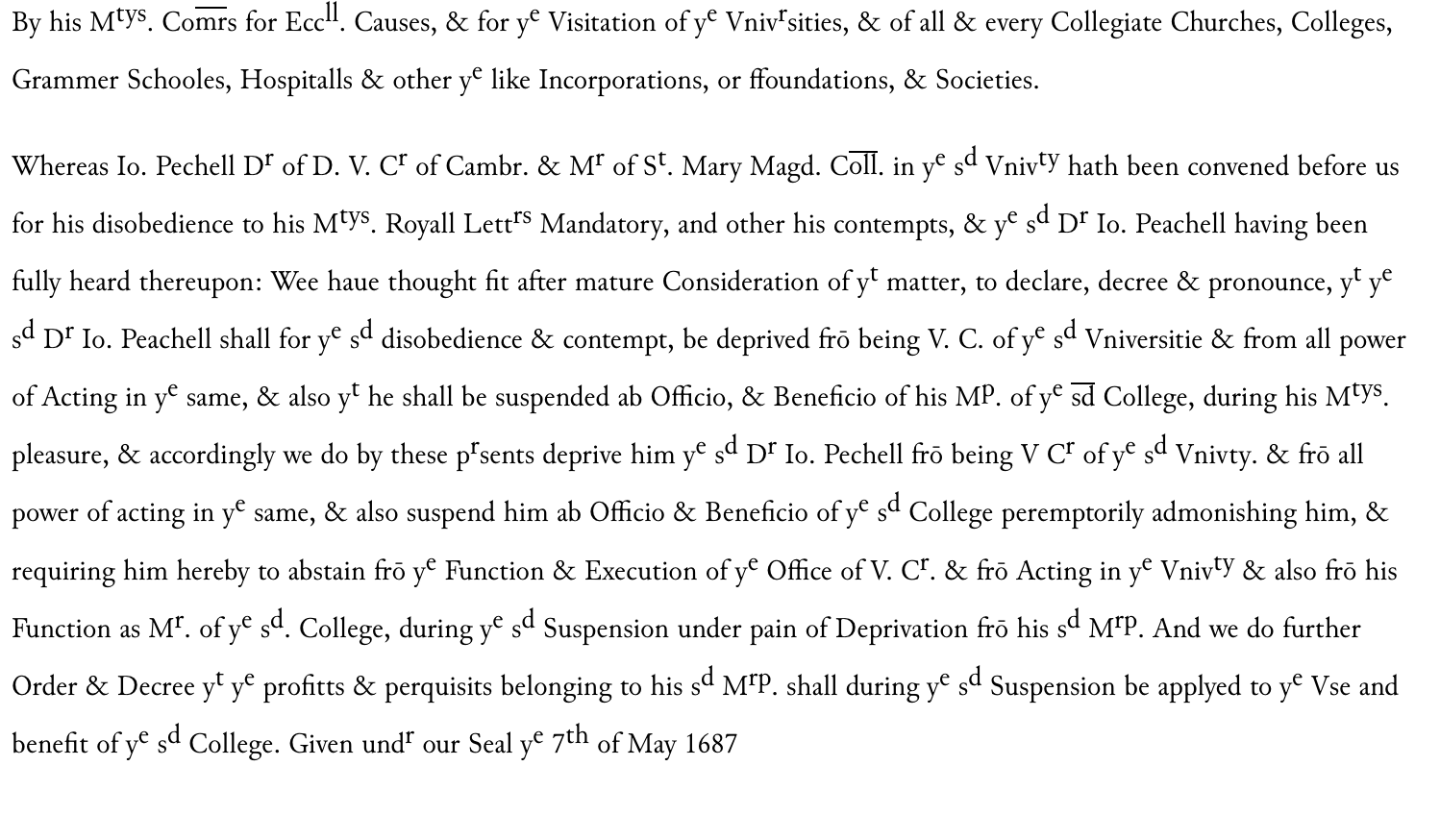
The last time a Cambridge Vice-Chancellor was deprived of office was on 7 May 1687.
John Peachell had refused to comply with James II’s order to award an MA degree to the Catholic monk Alban Francis without requiring the customary religious oaths. Cambridge’s Senate resisted the royal demand, maintaining that the University was bound by its statutes.
Peachell was summoned before the Ecclesiastical Commission, presided over by Lord Chancellor Judge Jeffreys, and formally deprived of the Vice-Chancellorship. Isaac Newton, then a fellow of Trinity College, was among the University’s representatives involved in the dispute and accompanied the delegation to London. He thus found himself among those resisting the King’s attempt to override the University’s requirements. Peachell was also suspended from his Mastership of Magdalene College, although he was restored to that position in October 1688; he never regained the Vice Chancellorship.
Today Deborah Prentice gives her formal annual Vice-Chancellor’s Address to the University.
(Image is text of Keynes Ms. 123, King’s College, Cambridge, UK, published online by the Newton Project )
It is unlikely that the Vice-Chancellor will announce that she is stepping down, especially after all the success she had this past year, during which she faced the problems head-on as a good leader:
https://www.bbc.com/news/articles/cy9wzr5545yo
Optimistic perhaps, but we hope she can fix some of the problems before stepping down.
Prof Deborah Prentice is not the first Vice Chancellor to be criticised in an Employment Tribunal judgment.
The VC of the Open University, Prof Tim Blackman, was criticised in 2024 in the Prof Jo Phoenix case.
Prof Tim Blackman apologised
https://www.open.ac.uk/blogs/news/around-ou/ou-speaks-out/a-statement-from-professor-tim-blackman-vice-chancellor-of-the-open-university-regarding-the-recent-employment-tribunal-judgment/
No apology has yet been issued by Deborah Prentice
We should add Tim Blackman did not appear at the Tribunal — unlike Deborah Prentice.
However his apology was unequivocal: “In several areas we fell very short. We apologise unreservedly to Professor Phoenix for the hurt and distress this has caused.”
As the 21 Group knows, other major cases were running in parallel with the Whistleblowing Tribunal case. Not only did the VC not apologise in relation to this specific case, in which she was directly involved, but she is also aware that the same malpractices are still occurring in other cases and is doing nothing to prevent further damage to either the people involved or the institution for which she is responsible.
I have a feeling that later today she will talk about the “lessons” that “we” have to learn, while these malpractices continue on her watch even as she speaks.
If she is going to apologize for all the malpractices today, it will be a lengthy speech 😉
If she announces that the heads of HR will be having their next annual performance review via live broadcast open session — with the audience able to send in their questions — then that should do the trick.
We would hope that the planned HR review will allow members of the University to submit evidence
The Terms of Reference are yet to be published
Including heads of HR who are leaving! 😊
https://www.cam.ac.uk/jobs/head-of-hr-school-of-clinical-medicine-ah51071
In the meanwhile at College headed by Prof Teflon 1.5 hour-long inclusivity training sessions are mandatory for all undergrads. Go figure…
Interesting. I read recently this post about Caius College, headed by Professor Richard Gilbertson, a Senior Group Leader at the CRUK Cambridge Institute, which mentions something along those lines:
https://x.com/mother_of_rome/status/2104825300232094179
TERF nonsense, irrelevant to the matter at hand.
I fail to see what the Tribunal judgement –or indeed any of these failed managers–has to do with inclusivity.
It is not enough to bully people and to make it clear that they are valueless. One should also force them to attend courses on how they should respect and value each other, whilst bullying them and making it clear that they are not valued.
We want our alumni to be successful, and then to donate money. To me successful, one must be nasty. Too many young, naive, students are infected with an unnatural niceness and goodness of heart. By coercing them to waste hours on being told to be nice, one can hope to undo this damage, and make them detest niceness. They will soon see the contrast between the goody no-hopers in these training sessions, and distinguished people of power like us. They will work out what behaviour is rewarded.
We must take care to ensure that we are not letting standards slip by bullying only minorities when we could have a broad, inclusive, campaign of bullying and condescension.
These kind of courses alway seem less about improving good practice than demonstrating that ‘something has been done’
Department X has a problem with bullying, so HR organise a training course for the department on ‘How not to Bully’.
Now they can say ‘something has been done’.
I think there can be problems achieving a legitimate aim – stop [x] – if the legitimate aim itself is not properly constrained. If the aim is to train every person to stop [x] in relation to others & there are no additional constraints being applied while working towards that aim to also stop [x] in relation to the self by others and to stop [x] in relation to the self by the self then the aim itself could be an unbalanced aim and it’s unclear whether an unbalanced aim can be achieved.
If a person is being trained to stop [x] in relation to others but not to also stop [x] in relation to their own self by others and not to also stop [x] in relation to their own self by their own self then this could result in a person stopping [x] in relation to others at the expense of accepting [x] in relation to themselves by others or accepting [x] in relation to their own self by their own self. The training could achieve the aim of training every person to stop [x] in relation to others without ever achieving the overall aim of stopping [x] because the legitimate aim of the training is not properly constrained.
Do you remember the old, paper, “Staff Guide to Bullying” booklet. Or the Departmental Secretary (now retired) who was said to have read it carefully, and to have used every technique it described? Sending barons on anti-bullying courses can have a negative outcome.
“To me successful, one must be nasty.”
To be successful – one must become resistant to high levels of nastiness from others without resorting to high levels of nastiness towards others. To be inclusive – one must become resistant to others applying high exclusionary forces to you without resorting to applying high exclusionary forces to others. To hold on to your own value – one must become resistant to the attempts of others to devalue you without resorting to attempts to devalue others.
A person/group with an aim [x] – undertaking activities to achieve aim [x] – can experience high resistance from others for reasons that have nothing to do with whether others accept aim [x] to be a legitimate aim or not. If in the course of a person/group undertaking activities to achieve a legitimate aim [x] inaccurate information is been generated & propagated in an environment then high resistance from others can be experienced irrespective of whether those others accept aim [x] to be a legitimate aim or not. People will resist the propagation of inaccurate information in an environment in proportion to both the level of inaccuracy of the information itself and the potential impact on peoples lives of the propagation of information of that particular type with that level of inaccuracy in an environment.
People in universities have a high sensitivity to the accuracy of information i.e. are highly sensitive to the accuracy of information in general & also have highly-specialised sensitivity to the accuracy of particular types of information due to subject specialisation e.g. statements as to the legality of something. There will be people in universities who are highly resistant to the propagation of inaccurate information in a university environment.
A person could be highly sensitive to the accuracy of information in general & highly resistant to the propagation of inaccurate information in an environment & this could happen to be evident in a training session run by a person/group with a legitimate aim [x] in the form of a person being highly resistant to some of the information being presented to them in a training session. It cannot automatically be assumed by the person/group with a legitimate aim [x] that a person they are experiencing high resistance from in a training session does not accept the legitimacy of aim [x], is less able to make a significant contribution to the achievement of aim [x] or is a barrier to achieving aim [x].
If in the course of a person/group trying to achieve a legitimate aim [x] by undertaking activities to achieve aim [x] inaccurate information is being generated & propagated in an environment then this will not increase the overall probability of aim [x] being achieved in reality. This may increase the chances of people being lead to believe a legitimate aim [x] has been achieved when aim [x] has not in reality been achieved but it won’t increase the chances of aim [x] being achieved in reality.
This speech is going to be the dictionary definition of awkward… I can already hear the sound of nails screeching on a blackboard in the background
Why isn’t it online yet?
Last year it wasn’t published until the following day. If anyone was in the room this morning, we’re all waiting to hear from you!
https://www.youtube.com/watch?v=afMRn_sf-mQ
Interesting speech; did not dodge the elephants in the room. As always, ChatGPT has the best transcript analysis (pasted here):
I would read the speech as containing a potentially quite significant institutional reform argument, but not yet an accountability argument.
Its implicit proposition is approximately:
Cambridge’s traditions and academic mission are worth preserving, but its governance and administrative machinery cannot be treated as sacrosanct. When things go seriously wrong, the University must examine itself, use genuinely external expertise, learn from failure, and modernise its systems.
That is a coherent position.
But after the tribunal judgement, there is an important unresolved second proposition:
If the machinery failed partly because of decisions made by people at the top of the institution, can those same structures—including the current leadership—credibly determine the scope and consequences of the investigation into that failure?
The speech gives a strong answer to the first question—yes, Cambridge needs to change—but is much less explicit about the second—who should be accountable when Cambridge’s leadership or governance itself is part of what needs examination?
And that distinction is particularly important because the University has now explicitly committed to independent review. The later announced review following Arday’s death is divided into a review of his support and circumstances and a broader institutional-process review, with an external chair and an expert panel envisaged for the latter.
So, if you are assessing Prentice’s speech critically, I would focus less on whether she sounds committed to change and more on whether the institutional mechanisms she describes can satisfy her own standards of independence, transparency, legibility, timeliness and accountability.
That will provide a much sharper test of the speech than simply asking whether she advocates “change.”
Overall, the tone was surprisingly upbeat, with considerable emphasis placed on successes such as philanthropy, Rokos, corporate partnerships, quantum computers.
However, where I had personal knowledge of the issues discussed, the reality often seemed to contradict Prentice’s account. The presentation therefore gave a rose-tinted view of the future, glossing over serious problems and, at times, making claims that did not appear to align with the facts.
Interesting, what issues specifically? Obviously she had to be upbeat, but also in alignment with facts.
To take one example, new software projects (finance, HR) will drive change & make Cambridge more efficient on optimistic timescales
A reasonable inference would be that she’s not being told what’s actually going on with these projects.
Perhaps I need to watch her speech again, but am I right in saying that the Vice-Chancellor talked about the need for change at the University and about how the University should learn from its negative experiences, but failed to tell us what exactly she will change about her own behaviour in light of her own negative experiences as Vice-Chancellor? I wonder whether she thinks her own behaviour has been good.
Quick initial reactions to the speech.
She did name one of the elephants in the room, but then gave a lecture on zoology.
The lecture seemed to be about institutional culture with no reference to its conduct.
Yes, Cambridge is culturally resistant to change. Her advocacy for a new COO was interesting. Did she frame opposition to this as merely resistance to change?
She was found individually at fault during the Evans tribunal, but it’s all collectively our fault and up to us to effect change?
And finally, there was no apology or hint at culpability for the events of the summer, not even on behalf of the institution.
The implicit message seemed to me something like:
1. I am not in charge of this ship. From the moment I arrived people were telling me what to do, what (not) to say. I was put among long-standing insiders who said they knew what was best down to the tiniest details.
2. I need your help through democratic procedures (Regent House) to do anything against these people.
Hmm…. change… the reason there is resistance to that at Cambridge, is that for decades it has been change for the worse: more power to the administration, a bigger administration, more control by a narrow group, more senseless work for the staff on the ground. No one sane objects to changes for the better.
Spot on. If I remember correctly she did talk about that at the start, how the university had expanded its administrative overhead due to regulatory compliance, government, legal changes and so on. But not about how that same machinery has turned against the spirit of compliance (e.g. on safeguarding) towards a system of non-compliance to cover up failures, obstruct common sense decisions by line management, introduce rigidities that prevent decisions being taken or managerial accountability or initiative, and introduce myriad perverse incentives for rent-seeking from consultants or legal advisors.
Debbie is the disgrace we all know she is. She only cares about her money (550k/year) and has no shame, no honour and no integrity. What did everyone expect! She will not resign. She needs to be kicked out. Wake up people.
The paradox is that she is paid like a CEO, but apparently either does not possess, or does not exert, executive authority. A CEO would have fired people by now, apologised, and proposed a 15-point plan with concrete weekly, monthly, and annual deadlines to right the ship. What we have is spinning things out to independent review, which is fine for someone who is an honorary appointee, but not what you expect from someone on close to a $1m pay package.
She isn’t a CEO.
Absolutely! But of course the oligarchy, Hudson, legal, RO and many HoS and HoD want her to stay because they know what woukd happen to them if she goes. The place stinks like a sewer.
“Call for ‘greater openness to change’ at Cambridge”
As if people could trust the word of a person who engaged in whistleblowing retaliation and did not yet find the time to apolagize:
https://www.bbc.com/news/articles/cmx2z2d1d5y3o
Whatever the outcome of the Court case, I think Professor Teflon’s real punishment still lies ahead of him at Caius. At least when he was at CRUK/Oncology/School of Clinical Medicine he was surrounded by rational and grounded people with who are all aligned with a post-enlightenment view of rational thought and objective truth. Now he’s moved into a madhouse full of unhinged zealots whose only truth is their truth.
I do not quite understand your point. Could you please elaborate?
Panel to investigate university processes & its terms of reference are announced
https://universityofcambridgecloud.sharepoint.com/sites/StaffHub/SitePages/Independent-review-of-certain-University-processes–terms-of-reference-and-panel-members.aspx?CID=83b24970-9e45-4a64-9bea-2d33b5a0041b
Panel is
The review lead and chair of the panel will be Laura Whyte, a non-executive director with expertise in multi-stakeholder environments and large, dispersed workforces. Laura is a former HR Director of John Lewis and has experience as a Remuneration Committee member in listed, private and charitable sectors. Laura led an independent ‘Respect at Work’ review at HMRC, which was published in 2019.
The other panel members are:
Cindy Butts, the Independent Public Advocate for England and Wales, who is serving in a personal capacity and brings more than 20 years in senior independent roles across policing, criminal justice, Parliament and public life. Cindy has a particular focus on organisational culture, governance, complaints and conduct, inclusivity and institutional accountability. She formerly chaired the Independent Commission for Equity in Cricket and made wide-ranging recommendations for institutional and cultural change.
Mary Curnock Cook CBE, an independent education expert and former Chief Executive of UCAS from 2010 to 2017. Mary maintains a portfolio of non-executive governance roles, serving as Non-Executive Director at Pearson Education, lay Council member at the University of Leicester and Trustee at the Higher Education Policy Institute.
Helen Fairfoul OBE. Helen was Chief Executive of the Universities and Colleges Employers Association from 2012 to 2020, where she led national pay negotiations and advised universities on HR, reward and employment strategy across the sector. She currently serves as an independent governor and Pro-Chancellor of Northumbria University, chairing its Finance and Resources Committee alongside other non-eecutive board roles.
Professor Colin Riordan CBE, the Secretary General and Chief Executive Officer of the Association of Commonwealth Universities. Colin was previously Vice-Chancellor of Cardiff University (2012-2023) and the University of Essex (2007-2012). He currently serves as a lay member of Newcastle University Council and has undertaken numerous board roles including on Universities UK, UCAS and Advance HE.
It is going to be a white wash. Total waste of time. Establishment protecting Establishment.
Looks like a roll call of quango apparatchiks, all representatives of management, no democratic input. Who designed this? They have guaranteed another two years of scandals. This is just like the Post Office “self-investigation” of 2012-15.
It’s worth checking out Laura Whyte’s ‘Respect at Work’ review for HMRC. It’s publicly available in full online, as this report should be.
Reporting just to Council, with a likely redacted summary available more widely, is just not good enough. Laura Whyte may seek useful amendments to the terms of reference, but these are granted at the discretion of one person: the deputy chair of Council.
It doesn’t have to be a whitewash, but the mechanisms for turning it into one are plainly there.
This shows why the HR Grace is still badly needed.
“This shows why the HR Grace is still badly needed.”
Exactly.
The entire process should be under transparent democratic control, not managed by the people who made the mistakes.