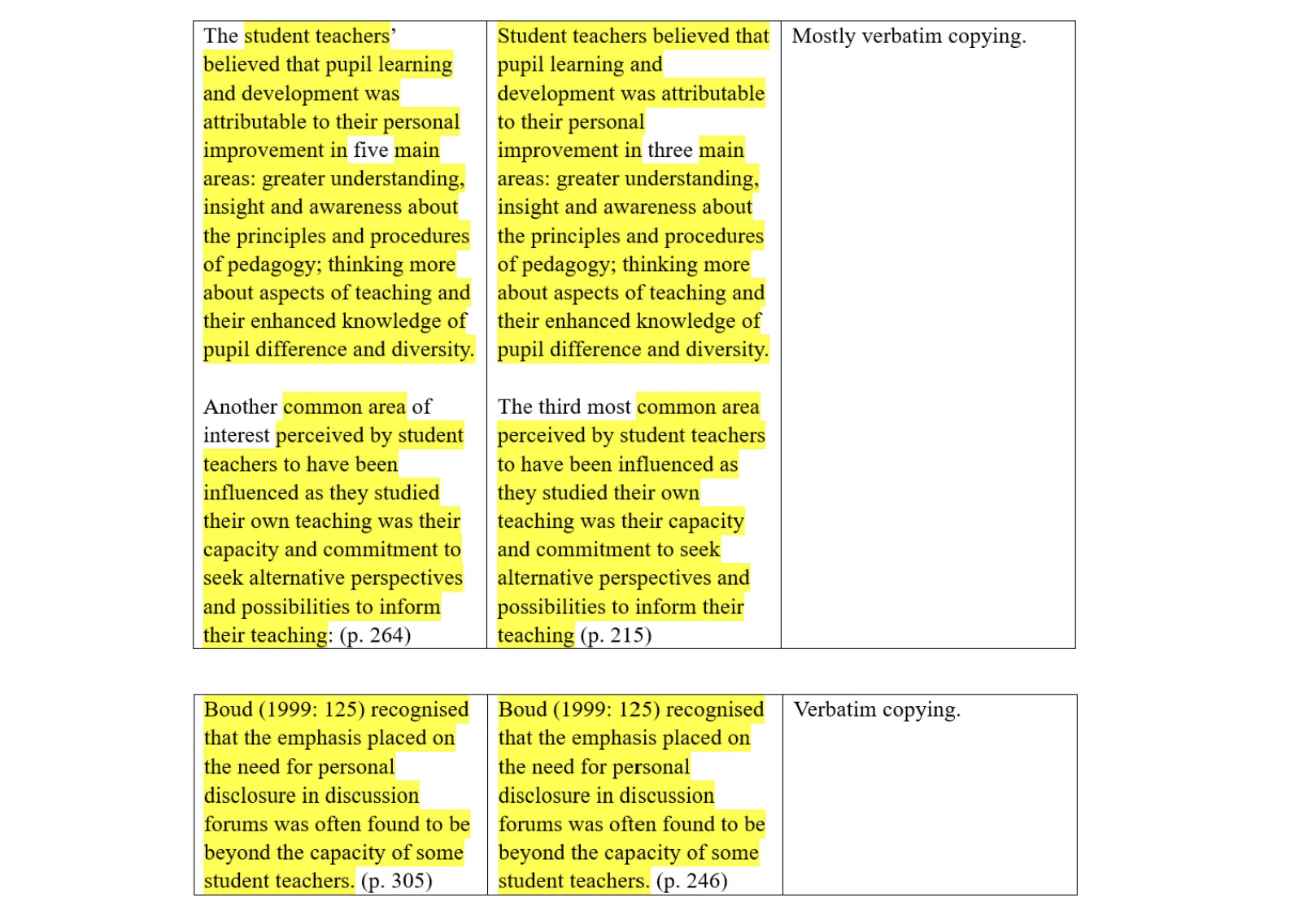
Cambridge University’s Professor of the Sociology of Education, Jason Arday, has become the subject of allegations of plagiarism.
Dr Nathan Cofnas has highlighted a number of passages that appear to show close textual similarities between Arday’s work and those of other sociologists in the fields of education and critical race theory, one example of which is reproduced above. Similar concerns about Professor Arday’s work have also been noted previously by other academics (for example, see Prof David Harris here).
Plagiarism is not a victimless crime. It robs original thinkers of recognition, distorts the integrity of scholarship and undermines the trust on which the entire academic community depends. There will be less well-known or junior scholars who missed out on citations, grants or even tenured jobs because they were deprived of the credit rightfully theirs.
However, it is important to focus on institutional processes and standards rather than on any one individual. The central issue is how Cambridge University addresses and manages such concerns.
Worries were first raised in 2023 both with Liverpool John Moores University and Cambridge University regarding Prof Jason Arday’s Ph D thesis and some of his later publications. Two Professors at UK Universities independently wrote to Dr Rhys Morgan, Head of Policy, Integrity and Governance at Cambridge University about possible plagiarism. They both received almost identical replies:
The University of Cambridge takes issues of research integrity very seriously and we will always consider allegations relating to research conducted under its auspices in line with our policies. In this instance the research that your concerns relate to was carried out before Professor Arday joined the University and it would normally be for the institution at which the work was done to consider any research integrity concerns with a particular paper published in their name. As such we do not consider it within our remit to investigate the papers to which you refer. If you do choose to approach the institutions at which this work was done we would be content for you to let them know that you have also written to us and to provide my name as a contact point. [Dr Rhys Morgan]
Whenever an administrator at Cambridge University says, “We take this very seriously,” it’s usually your first clue that they absolutely don’t …
Dr Morgan clings to a flimsy excuse as a cover for not investigating — namely, it’s someone else’s job. This is familiar territory. Dr Morgan has ‘previous’ in the matter of Dr Juan Manuel Gorriz, as reported by For Better Science.
The response is wrong for two reasons.
First, in his application for a Professorship at Cambridge University, Jason Arday will have provided his curriculum vitae and publication list. Therefore, his present prestigious appointment owes much to his earlier work and his PhD thesis. It is inadequate to dismiss the matter as not “within our remit”, as the material was used to acquire his Professorship.
Secondly, past mistakes are of relevance to the future. If a scholar’s research methodology is deficient, then — at minimum — further mentoring, training and advice are needed to ensure that in the future proper standards are upheld. Papers that may have failed to attribute the work of others need either correction with proper attribution or withdrawal. Addressing such issues would also be in the individual’s own professional interest and could reasonably be expected to form part of the University’s oversight and duty of care.
We take no satisfaction in what has happened. Widening participation in higher education remains an important objective. At the same time, maintaining rigorous standards of research integrity and academic culture is absolutely essential.
It is also noted that the 21 Group has received a number of complaints concerning the Policy, Governance and Integrity Section within the Research Strategy Office. This suggests a need for independent external review to assess its effectiveness.
Sadly, Cambridge University’s reaction to anything awkward is to cover it up. This is very dangerous. As Ben Bradlee, executive editor of The Washington Post, famously said “It’s not the crime, it’s the cover up, that gets you.”
That is such a sad story. But clearly worse is the behaviour of the University and Dr Rhys Morgan’s in particular with him I have interacted multiple times. His response in this case reminds me the response of Dr Alexander Twist, Head of Research Integrity at Consigliere University who once said,
“In this instance the research that your concerns relate to was carried out before Professor Molloy joined the University and it would normally be for the institution at which the work was done to consider any research integrity concerns. As such we do not consider it within our remit to investigate the papers to which you refer.”
https://21percent.org/?p=2723
The reasoning by the research strategy office misses the point that if a person is in a Professorship in an academic community the person is in a position to supervise the academic work of PhD students and postdocs. The academic community has a duty of care to the PhD students and postdocs that are being brought in to the academic community that is independent of the Professor who happens to be supervising them.
This means if there are concerns over the academic work of any academic working at the level of Professorship within the academic community then the academic community itself would have to investigate the concerns to comply with its duty of care to PhD students and postdocs being brought into the academic community to be supervised by the academic.
That may mean working with other academic communities to investigate academic work done in other communities but it doesn’t mean that an academic community can leave any investigation to those other academic communities. An academic community is responsible for upholding its own standards, that means doing an independent investigation of any concerns relating to the academic work of a professor working within an academic community and/or getting an independent external investigation of any concerns done.
It’s not just duty of care to a Professor in the academic community that needs to be considered in this type of situation, it’s also duty of care to current/future PhD students and postdocs in the same academic community. The professor would need to be able to lead by example such that if any PhD student working with the professor followed the example being set then the PhD student would be able to get a PhD degree in that academic community. This means that the professor needs to be able to meet the standards of academic work set by the academic community the professor is supervising PhD students in. The relevant academic standards in this particular situation are the academic standards of the academic community the person is supervising PhD students in.
An implicit assumption in widening participation in academia is that any professor – with or without a widening participation background – in academia is open to supervising students of any background – with or without a widening participation background. This means that professors with a widening participation background are open to supervising students without a widening participation background and vice versa.
If widening participation is done in such a way that an academic community drops it’s academic standards to account for a widening participation background that means eventually there will be professors with a widening participation background who will be supervising students without a widening participation background. The students without a widening participation background being supervised by a professor with a widening participation background will need to meet the academic standards of the academic community which will not be being dropped in their cases as there is no widening participation background to be accounted for. This means there will be people being supervised to meet the academic standards of an academic community by those who have not met the academic standards of that academic community themselves which cannot work.
If it’s a case that a person took longer to meet the academic standards, had to set themselves up with tailored support mechanisms to be able to meet the academic standards, had to find new ways of working to meet the academic standards and/or had to find the persistence to psychologically struggle through repeated failure to meet the academic standards before eventually meeting the academic standards of an academic community this is different situation.
A person in this situation is likely to have acquired a more diverse set of academic skills which could enable the person to supervise a more diverse group of people to meet the academic standards of an academic community. A person in this situation could also have found more effective and efficient ways to work towards meeting academic standards and/or ways to produce academic work at a standard well above the academic standards. A person in this situation could be in a position to offer more careful supervision to a more diverse group of people to meet the academic standards of an academic community. Widening participation could then start to operate at all levels of the academic community up to the level of full professor.
Widening participation cannot come at the cost of meeting academic standards, that strategy cannot work if the aim is to widen participation at all levels of the academic community right up to the highest levels of academia. Once a person goes above a certain level in academia the person is supervising students who need to meet the academic standards of the academic community. If the person themselves has not met the academic standards of an academic community an arrangement where the person is supervising others to meet the standards of the academic community cannot work.
If there are any concerns over whether a full professor is working to the academic standards of an academic community the concerns would need to be investigated.
I liked your point about the widening participation background, but have you considered that a wider widening participation background may not necessarily entail a wider widening of participation background in the context of a widening participation background?
I was the one who took this photo.
Jason Arday and Climate Warrior on top of Mount Everest
https://x.com/ClimateWarrior7/status/2084736479515881877
21 Group, you are completely correct.
Institutional responses to concerns can be as or more significant as the issues themselves. The response by Cambridge University leaves them open to accusations that they violated duty of care to Prof Arday
In terms of duty of care an organisation has to a person when issues arise, a person can only be supported to address any issues that have arisen if a person is prepared to sit down with an organisation and talk through any issues that have arisen in order to determine what exactly the issues are and what would need to be done to address the issues.
Both the organisation and the person have to care enough to be able to sit down together to determine what exactly the issues that have arise are and how to address the issues. Duty of care of Cambridge University to a person is not just the response of Cambridge University to a person, it’s also the response of a person to Cambridge University.
The Cambridge leadership is overwhelmingly white and Anglo. So the underlying logic here seems to be: Sure, we gave Assoc Professor to some random Islamophobic guy after 3 years (Orr) who is advising Farage on how to deport asylum seekers. But look, we gave Professor to a random Black guy too!!
So it all balances out, right???
Right?
Our colonial overlords in Old Schools appear remarkably adept at instrumentalising Black people whenever they need a “decoy” or fig leaf to hide behind. They did exactly the same thing at Bury St Edmunds after all. Why let their own face be known?
It is institutional racism on a whole new level.
I feel sorry for Arday. He was used for his skin colour, by an institution looking to cover itself. I’m sure he’s a perfectly good teacher and mentor. They could have given him the same lecturer or fellow role as everyone else, deserving or not, and that would have been fine. Instead they put him on a pedestal and paraded him for woke points. They didn’t care about him. They still don’t care now. This is what genuine institutional soft racism looks like – treating a Black man as a means, not an ends in himself. Let’s focus our fire on them, and spare Arday.
Why didn’t “redacted” attend the case at Bury? Was it too long of a commute?
Because that “redacted” you mean was not directly involved. Note that redacted is not the only redacted of her group.
It’s a good question, especially as she lives in Bury.
Anyone with a strong instinct for survival knows when to be present and when to be absent
I agree totally with Anonymous. The real cynics here are the academics who did not read Arday’s work (including the PhD, where the problems are conspicuous). What on earth did they ask at interview? Which other candidates did they interview. and reject? Arday is a celebrity, he is very personable and he has some useful friends and contacts and very good PR. It looks like a combination of tokenism and lazy cronyism of the worst kind, or ‘convergent interests;’ as CRT theorists would say. The failure of Cambridge, LJMU and other institutions who appointed him (like Glasgow) to properly investigate his record is shameful.
Fun fact: The Head of the Department of Education (the same department that hired Arday) is alleged to have said in a hiring committee that they shouldn’t hire Asian candidates because “they don’t understand our culture”.
HR nodded along to this like nothing had happened.
Thanks, I wasn’t getting how the story was sad for Arday (the plagiarist). I get how it’s sad for the double victims of plagiarism and of cover-up.
The university did artificially inflate Arday’s status and use him ‘for woke points.’ As a scholar of race and inequality, he couldn’t have been unaware of the game. At the same time, Arday chose to plagiarise and to keep plagiarising. He has agency in this matter.
This is a story about plagiarism by an elite and university cover-up. Arday was and is an elite. As an elite on a high pedestal, he inherited power and a sort of white privilege. So even if 4 Black Cambridge students came forward about his plagiarism, their complaints would be dismissed. The Office of Research Integrity would look at the status of Arday–however artificially inflated by the university and media–and go into cover-up mode.
The problem is plagiarism by elites and the university’s cover-up for elites. Arday was an elite. He plagiarised. He ought to be exposed and shouldn’t receive a pass card for skin colour when he is an elite professor at a top UK university.
The Office of Research Integrity uses racial politics as a distraction while brushing research misconduct under the rug. It’s a bait and switch where they come out looking woke and benevolent but the problems of research misconduct by elites and bullying of whistleblowers remains.
“The Office of Research Integrity would look at the status of Arday–however artificially inflated by the university and media–and go into cover-up mode.”
Now imagine if the research misconduct is not done by one single person but by a Head of Department, a Fellow of the Royal Society that brought many millions to UCam in prestigious research grants and a Lead HR Business Partner that damaged the lines of many people and has been consistently protected by the former ProVC Prof Munir! There is no evidence that is enough for these people, no matter what you send them. The good news is that, if you keep pushing and do not let it go, they will keep digging a bigger hole for themselves!
What makes Arday part of “the elite”? The fact he got to Cambridge? Or is there something else I am missing about his background and career trajectory?
Yes, exactly. He has agency and must be held accountable. To treat him as a victim is a form of racism. Here is Arday himself arguing for objective standards:
https://x.com/TalkTV/status/1406215156913393668
Still not sure I get what makes Arday part of the “elite”. I can very easily accept that the people who HIRED him are part of the elite, not only by virtue of their status as longstanding Cambridge professors but also by virtue of a privileged social background. BUT he seems more like someone who was used by them in order to trumpet their own “progressive” credentials when they are clearly from advantaged social classes.
Arday has been using the University as much as the University has been using him. Who do you think is paying Carter-Ruck to protect him and the reputation of the University? Regardless of the social and cultural background, people only plagiarise if they want. Did he come forward and explain the similarities between his work and others? Perhaps there is a very good reason, but having Carter-Ruck or other firms threatening people who ask about it does not look good for the University and for him. His name is on the line as well. I would think that he should be the first to come forward, but perhaps I am wrong.
Arday is listed as a director on something like 8 companies at Companies House. Look it up. Seems there is some real financial benefit behind all this.
No offence intended, mate, ( – ) but if you’re asking how a full professor at Cambridge meets the definition of an elite, you need to look up the word elite. On no planet can a full professor at a university described as #1 in the world NOT be an elite. Come on.
I get that if someone was raised around Cambridge profs and PhD-holders, Cambridge might not seem elite. That person would be extremely sheltered or not especially self-reflective. Not making any suggestions just sayin’
There is no logical way to contest that a full professor at Cambridge is a global elite and especially one who is also a British national. Arday is a global elite, and he’s been a global elite throughout his academic career at prestigious British institutions. He would have been an elite in the US at Ivys, too. Professors at top universities in the world are elites. It’s just a fact.
@TheResearcher
100% agree
Arday’s not dumb.
He’s obviously quite clever and socially intelligent. No dumb or non-strategic person could prolifically lie for how many years on the global stage without being caught. He’s clever af.
Arday’s critical failure is going to be refusing to be accountable for the plagiarism which is clearly beyond a reasonable doubt. There’s loads of evidence. He can apologise and address the damages caused to the victims and is apparently choosing the denial, cease and desist route. If he acknowledged the misconduct and tried to make amends, he’d likely stop the negative press because there’d be no more story. That’s not the approach he’s taking, and the University and its aggressive law firm are financially supporting his failure to be accountable.
But as others are saying too the Arday case is one pixel in a broader image of University cover-up of research misconduct. The University of Cambridge, branded the #1 research university in the world, is covering up research misconduct by its most ambitious celebrity professors.
The cover-up of research misconduct by Cambridge ought to provoke outrage and political pressure for reform. Who’d want a surgeon or a Cancer researcher who plagiarised their way to a medical qualification and falsifies data? Who wants another war based on falsified ‘academic’ data that kills millions of people and costs almost 2 trillion US dollars? As much as those committing research misconduct, the cover-upers threaten the life of academia which can’t survive w/o research integrity.
Why is the University of Cambridge covering up research misconduct, and why are the cover-uppers kept in their posts, if not promoted? The University must be made to answer.
This is exactly right. The card carrying racists are out in full force–this is an easy gotcha for them, and unfortunately, the University has given this to them gift-wrapped and in a box. Arday deserved mentoring and a slowly progressed career with support, not this blanket misuse and now trial by white supremacy.
The ‘victims’ here are black researchers and fellows whose work will inevitably assessed in the light of the permissiveness to Arday
The assumption is Cambridge University is a tightly joined-up, highly top-down controlled organisation and that every hiring decision being made at Cambridge University must be being centrally planned by Cambridge leadership with the exact same underlying logic. The reality is that Cambridge University is not a tightly joined-up, highly top-down controlled organisation where hiring decisions are centrally planned by Cambridge leadership which means the underlying logic in hiring decisions can vary significantly.
The people doing the hiring of a person to an academic post in a particular subject area are themselves embedded in academia working in the same subject area. The underlying logic in the hiring decisions taken in relation to a particular academic post is the logic that the people who happen to be doing the hiring are taking from being embedded in academia working in a particular subject area.
21 Group, I just realized that Nathan Cofnas was at St Edmund’s College:
https://ncofnas.com/p/cambridge-universitys-war-on-free
Judging from personal experience and the number of people working at St Edmund’s College who became involved in my case including the domestic bursar, the senior tutor and other fellows, there seems to exist clear and strong connections between the administration of UCam and St Edmund’s College.
Incidentally, the “Responsible Person” Professor Eilis Ferran who told us in open court regarding the whistleblowing case that she has a “track record of independence” but did not provide any evidence to support her claim, is a Fellow at St Edmund’s College.
Cofnas was at Emmanuel. You are confusing him with Noah Carl, a horse from a similar stable.
Right! My bad. Thanks for checking!
I was less concerned about who was affected, but where: St Edmund’s College.
Fun fact: Emmanuel also has problems!
Cofnas had the right to one or two meals per year at Emmanuel. When the Free Speech Union funded his appeal after Emmanuel removed his name from their books because his blogs offended their non white undergraduates, and breached the code he had signed up to, every strand of his appeal was dismissed by the judge, though neither Cofnas nor the Toby Young show will pay the costs for which they are liable.
Can you provide a link to the claim “neither Cofnas nor the Toby Young show will pay the costs for which they are liable”?
Crucial question is: Has a judge or tribunal found them liable for the costs? If so, then they will have to pay the costs, whether they want to or not.
@Q.H.flack,
I do not know Cofnas and the details of his former association to Emmanuel. I am happy to read about it and comment on it if necessary. What I know at this stage and related to this post and my comments about it, namely about Emmanuel is this:
Cofnas was brave enough to publish an article on a plagiarist that everyone was afraid to challenge, not least because the plagiarist had the support of the “UK’s Best Employer”. In my view, both the plagiarist and the institution that support him are at fault here.
Regarding Emmanuel specifically, my point had to do with another person, the Fellow Sarah d’Ambrumenil, Head of OSCCA, who is protected by both the University and her College, like HR is. I raised a complaint to the Master of Emmanuel Mr Doug Chalmers, who told me he would investigate the matter. Guess what, he never did!
I think I know what happened, the new article says “Readers of this Newsletter may remember Vira as one of the administrators who tried to get me fired from Cambridge in 2024 for writing about race and affirmative action” and then pointed to the older article about St Edmund’s College where there was a persuasion to fire Carl. Sorry about that.
Anyway, for those who are still thinking about who will step down next, my bet is on Vira.
Electors to the Professorship of Education (2002)
The Council has appointed members of the ad hoc Board of Electors to the Professorship of Education as follows:
Baroness Sally Morgan, F, in the Chair, as the Vice‑Chancellor’s deputy
(a) on the nomination of the Council
Professor Anoop Nayak, Newcastle University
Professor Louise Archer, University College London
(b) on the nomination of the General Board
Professor Jo Dillabough
Professor Tim Harper, M
Professor Michalinos Zembylas, Open University of Cyprus on the nomination of the Faculty Board of Education
Professor Karen Coats, HO
Professor Martin Mills, University College London
Professor Paul Ramchandani, W
Sally Morgan & Tim Harper? Nice!
How is it possible that Harper, Peake and Maxwell are involved in almost every single scandal in the university right now, even ones way outside of their own schools
One simple answer…
HR.
It’s like this. You get in the shit over some random scandal in your department or school. Maybe it was primarily your fault. Maybe you were asleep at the wheel.
It doesn’t matter. From now onwards and forevermore, HR own you.
And in every future scandal, they will make sure you are appointed to “solve” the problem…i.e. do all their dirty work for them while remaining cloistered in the shadows.
The obvious next question after this sensible explanation is: what did Harper, Peake and Maxwell (and others) do in the past to be the chosen ones by HR?
It’s a slippery slope. You get roped in by HR to do one thing. Then another. Before you know it, you are too deep in the river to turn back. The mistake is to take the first step.
Anyway, Maxwell… probably started with CRUK is my guess, but meanwhile, matters at CUH (non-exec director role) are really exploding right now. Not only the Stohr paediatric orthopaedic scandal, also the Crocodile-pit toddler data breach (reported by ITV June 26th), and the Queen Elizabeth Hospital King’s Lynn student placements withdrawn (reported BBC 21st July 2026). Meanwhile there’s the MRC Epidemiology Unit meltdown (reported by Varsity in December 2025) and the AstraZeneca funding withdrawal reported by Varsity on 15th September 2025, plus the 2023 CUH data breaches, Sinker and the 2024 Clinical School IT hack, oh and the 12th February 2026 revised procedure for the investigation of alleged research misconduct. Am sure he regrets leaving Oxford for this shitshow.
Harper, where do you start? Chaired History dept for two years (2017-9), resigned early in wake of long-running sexual misconduct investigations in History, eventually published by Tortoise Media and Varsity, then new HOD had to apologise in 2020 for students being instructed to stay silent about what they knew. None of that ended quickly (investigation dragged on for years after and didn’t conclude until 2023). Then as HOS at SHSS not only the cited sexual harassment History scandal investigation in background, but then all the new scandals/cases at History over plagiarism, nepotism, allegations of harassment, plus the endless POLIS cases… Frankly it almost seems abusive at this point that HR keep pulling him back in for cover instead of letting him retire in peace and calm.
History is just completely dysfunctional.
Believe Harper has now retired. Hopefully he can find some peace
What about Peake? What did he do? Tell us, please! Of course, we already know about the Astronomy case as it was in open court, and the DAMTP case that is mine and I can confirm he had a direct involvement.
History has fallen from a great height
The poor reputation of the department is now known from New York to New South Wales and everywhere inbetween, sadly.
Nigel Peake… This story goes back to his time running DAMTP from 2015 to 2019, working with “Redacted 1” and “Redacted 2” [MATERIAL REDACTED] …. over an extended period of time.
I doubt many readers of this blog need a recap on the Astronomy scandals at this point; at any rate, they date back to his tenure as HOS in 2021. Less public is that this was only one of many ongoing controversies, this being the likely reason why the 2024 culture survey placed three of Peake’s own departments (Cavendish, Earth Sciences, IoA) among the worst in the university for bullying. There was by then the Anita Faul case – revealed at the Senate House Discussion on 4th February 2020 (the very month Peake took over as Head of School) – alleging that her concerns had been mishandled as a personal grievance rather than under the whistleblower procedure, describing “control of information” and gagging clauses as tactics, and also the Eileen Nugent case, also at Cavendish.
The Oliveira case dates later, to June 2023, also during Peake’s tenure as Head of School. As per the allegations stated in the Cambridge Reporter, and in relation to this mater, Cambridge, on Peake’s watch as Head of School, appears to have: received a whistleblowing disclosure from a DAMTP postdoc supported by detailed medical evidence, and taken no action on it; imposed sweeping “precautionary measures” cutting Oliveira off from contact, email, research materials and complaint procedures; blocked his grievance against an HR Business Partner; opened a counter-investigation shortly after he became publicly vocal, framing his persistence as “unreasonable”; held a disciplinary hearing against him on 13th April 2026 whose outcome is not yet public; censored his internal share of the Guardian bullying-survey coverage within a day, and; ignored an explicit intervention from the Master of Christ’s asking for an independent investigation.
REDACTIONS by 21 GROUP following legal guidance. Apologies.
We would only add that there are more victims known to us in the School of Physical Sciences
@No comment, I believe you mean this Cambridge Reporter?
https://www.admin.cam.ac.uk/reporter/2025-26/weekly/6803/6803.pdf
Of course, there are so many adventures related to my case that you did not mention all, but to clarify, Lord McDonald did not try to intervene at all. He pretended he did. What he wanted was avoid involving Christ’s in the mess namely when he realized the Vice-Chancellor—Fellow at Christ’s—was involved. Indeed, the behaviour of McDonald has been one of the worse of them all. Our dearest British former diplomat who was the Permanent Under-Secretary at the Foreign and Commonwealth Office and Head of the Diplomatic Service dared to tell me that the word of the Senior Tutor was more important for him than my word and all the evidence of misconduct that I had sent him. Incidentally, in my first meeting with him about these matters, he asked me if money would make me stop complaining and step back. I trust he remembers my answer.
@Anonymous,
FFS
You make it sound like History students as witnesses of sexual misconduct by a professor were silenced. I’m not even an historian and know that’s completely false.
You also can’t logically be citing as a credible source the Tortoise Media article (that seems to have been pulled) and the Varsity sensationalist article for accurate reporting on the ‘sexual misconduct investigations’ of the Faculty of History. The only thing those articles represent(ed) is homophobic academic mobbing .
The historians obsessed with the sexuality of their colleague, an openly gay man who is married, should pay attention to the latest news from Hunter Biden about a ‘closeted gay mafia’ in Washington, DC. It’s also suggested a reason for Lindsey Graham’s opposition to LGBTQ rights in the US was because he was secretly gay. If you can’t join them, beat them to a pulp, right?
The slander out of the Faculty of History is old (re)tired fake news. When it didn’t work, out came the plagiarism allegations. The academic mobsters are definitely beating to a pulp. It’d be less bloody and easier to just come out of the closet.
Do advise those Lindseys.
If Vira goes then Philpott surely must, after the Vet School debacle.
Heard there’s lots of in-fighting in History. Different camps. Some fighters have close connections w/ top admin. Best way to get away w/ research misconduct is to become besties w/HR and admin.
If there is anyone who doesn’t have a “track record of independence” in Cambridge University now is the time to start that track record, to get all the publicly available evidence in a case and to do academic work to make an independent judgement in a case before taking a public position on a case.
How can any university uphold its plagiarism policy for student assignments when it gives a free pass to faculty? It completely undermines the capacity of the institution to uphold pedagogical standards. Now every student can just say they were doing as their professors do.
Students could do this in a case where a university did give a free pass to its faculty on this front or any other front but it would be like a person trying to improve physical fitness by doing physical exercise in the wrong way & pointing out another person also did physical exercise in the wrong way as a way to justify sticking with a strategy of doing physical exercise in the wrong way to try to improve physical fitness.
It’s not going to improve a persons physical fitness above what a person could achieve by switching to doing physical exercise in the right way or to lead to sustainable improvements in physical fitness. It’s not going to make a person physically more able than if the person acknowledged there was a problem with the way they were doing physical exercise and switched to doing physical exercise in the right way. It’s not going to help a person achieve their own aim of improving physical fitness in any way.
All this would be is a person distracting themselves from achieving their own aim for themselves and a person allowing another person to have undue influence over them.
The previous thread requested information about Sinker.
Sinker was CEO of Cambridge University Hospitals NHS Trust from 2015 to 31 December 2025. The Verita report, published 29 October 2025, found 32 missed opportunities between 2012 and 2024 to identify and address concerns about Ms Kuldeep Stohr’s clinical practice, including a decade-long failure by CUH management to act on the 2016 Hill report.
That entire period falls under Sinker’s tenure as CEO.
He publicly refused to resign after the Verita report was published (see the BBC story of 30 October 2025), and within six weeks his departure to the University was announced. The University appointment therefore involves the receiving of a senior figure by an institution (Cambridge) that is inextricably linked to the sending institution (CUH) through six governance layers – CUHP, physical co-location on the Addenbrooke’s site, approximately 380 joint appointments, direct governance interpenetration (Chair Sally Morgan sits on Cambridge Council; Regius Professor of Physic Maxwell ex officio on CUH Board), NIHR BRC funding of £398m, and the shared industry axis. The University was not an arm’s-length recipient but CUH’s most closely linked institutional partner.
Verita Report linked here
https://www.cuh.nhs.uk/updates-on-external-reviews-into-orthopaedic-surgeon/verita-report/
BBC link here
https://www.bbc.com/news/articles/c986lvzl3lno
Every institution wants to take care of its own internal environment with no care for the impact of its own way of taking care of its own internal environment on the internal environment in other institutions. This only works if every institution happens to be taking care of its own internal environment in ways that don’t negatively impact the internal environment of other institutions. Institutions could happen to be taking care of their own internal environment in ways that do negatively impact closely linked institutional partners. In this case a network of institutions in closely linked partnership arrangements could enter in a state where the internal environments of the entire network collectively undergo an accelerated decline in a situation where all the institutions in the network are collectively subjected to a prolonged series of external stressors that increase the rate of problem generation and overwhelm existing problem resolution mechanisms in every institution in the network at the same time.
Arday has questions to answer but the people principally responsible for this farce are those who used him to promote themselves and Cambridge university. The faction of the humanities that rejects objective research standards and promotes the idea the academic work should be political rather than knowledge driven also deserves interrogation. This case will now cast unfair doubt on the appointment of black academics generally. By rejecting universal standards, relativism, is ironically, promoting racism. I do not believe this could have happened in the hard sciences.
It all depends on who is on the panel and what instructions they had.
There are plenty of problems in the hard sciences as well because there are people with poor principles and low standards across Cambridge University.
Agreed. Huge institutional failure at Cambridge, Durham, Glasgow and Liverpool JMU.
“I do not believe this could have happened in the hard sciences”
There is plenty of below-universal-standards in the hard sciences too. Con-artists who manoeuvre themselves into PI positions, professors who cannot teach undergraduates, nor mark their exams because they literally don’t understand the questions…
As to fact-checking outside of their own area of scientific expertise… It’s as if only humanists were able to tell whether information is true or not!
“The faction of the humanities that rejects objective research standards and promotes the idea the academic work should be political rather than knowledge driven also deserves interrogation”
Let’s see how the “rejection of objective research standards” is working out for Cambridge shall we?
Here are the latest Research Excellence Framework rankings for Cambridge departments are as follows.
For the University as a whole, all STEM submissions scored over 90% at 4* or 3*. A good performance.
However, the university average for 4* was dragged all the way down to 62%, thanks to a few rogue departments…
1. Politics and International Studies: 38% at 4* – the weakest result across the entire University among submissions made.
Notably, on the “Environment” sub-component, POLIS crashed down to 25% at 4*, meaning the assessors judged POLIS’s research environment for early career scholars and PhDs to be among the worst in the entire country. Yes, you are reading that right.
2. History: 46% at 4* – another abysmal score (Newcastle’s history submission, for comparison, was rated 60% at 4*).
3. Modern Languages: 53% at 4* – yet another stinker.
4. Classics: 38% at 4* – another humiliation to sit alongside POLIS
5. Theology: 49% at 4* – James Orr’s department, and an appalling result for a university hosting Peter Thiel to deliver lectures on “The Antichrist”
That’s what happens when faculty reject “objective research standards” – a culture of mediocrity and failure can only serve to destroy objective achievement and instead reproduce further mediocrity and failure.
“I do not believe this could have happened in the hard sciences.” Believe! It can! You can be shortlisted for a lectureship, and very nearly appointed, with an h-index in low single figures. You can set a test to the undergraduates in your College and then mark right answers wrong, and wrong answers right, because you cannot cope with first year undergraduate work yourself, even though you are a UTO. You can complain that your research is in the doldrums, your grants keep getting rejected, and so the only thing left to do is to apply (successfully) for promotion. Behavioural (and protected) characteristics can win against pure academic output in the hard sciences too. (All examples purely hypothetical, any resemblance to etc.)
Good points, Post-post-modern, and I agree w/ everyone else who said it happens in the sciences.
Most plagiarism-focussed websites are about deception in the hard sciences. Research misconduct can be much harder to detect in the social sciences and humanities.
21 Group, both you, (and Cofnas) have missed what is probably the most critical detail about the Arday appointment to “Cambridge’s youngest ever Black professor” (https://www.theguardian.com/society/2023/jul/11/jason-arday-cambridge-university-youngest-black-professor)
At exactly that time, Cambridge had been taken to Employment Tribunal by Calbert Graham – a widely-cited and successful Black computational linguist and AI researcher (https://scholar.google.com/citations?user=oCcXbzgAAAAJ). It was a case for race discrimination after he alleged he was denied a position in favour of an insider-hire with a miserable research record. (The usual Cambridge thing)
The university was convinced it could lose – and very nearly did (2-1 judgement) – resulting in a headline story about racism against Black scholars at Cambridge.
Hence, Arday’s appointment – at that exact time – was no accident. This was all done just months before that final tribunal hearing. He was a cover for the university over btoader accusations of racism in case they lost, a scandal that would have made the entire press.
Arday, I am sure, knew none of this. But he was being used in a game of “good jew, bad jew” (https://theconversation.com/good-jew-bad-jew-new-book-explores-why-the-west-views-brutality-against-ukrainians-and-palestinians-differently-217970)
Let us hope he still has the voice, and the anger, to make his voice heard now, and denounce his cynical treatment by the university powers that be.
The Calbert Graham case is here
https://assets.publishing.service.gov.uk/media/671651094a6b12291ed99801/Dr_C_Graham_v_The_Chancellor__Masters_and_Scholars_of_the_University_of_Cambridge___other_3313420.2022_FMH_Reserved_Judgment.pdf
The 21 Group attended the hearing and agree that Dr Graham had a strong case.
The way they sought to protect themselves against racism is even more racist than the original racism itself
“he was being used in a game of good jew, bad jew”
This is recurrent tactic for the university. When they abuse someone they will hire someone else to act as a contrast.
Perhaps they have indeed missed their true calling as concentration camp guards.
But this game is about to end, and the abusers will be named and shamed.
Divide et Impera, interesting.
Thanks for the chronology showing another case of the university backtracking to cover its tracks
All I want to say is that they don’t really care about us
Will this webpage disappear?
https://news.educ.cam.ac.uk/230223-jason-arday
Welcoming the appointment, Professor Bhaskar Vira, Pro-Vice-Chancellor for Education at the University of Cambridge, said: “Jason Arday is an exceptional scholar of race, inequality and education. He will contribute significantly to Cambridge’s research in this area and to addressing the under-representation of people from socio-economically disadvantaged backgrounds: especially those from Black, Asian, and other Minority Ethnic communities.”
“His experiences highlight the barriers faced by many under-represented groups across higher education and especially at leading universities. Cambridge has a responsibility to do everything it can to address this by creating academic spaces where everyone feels they belong.”
“We are making extensive efforts in this regard – including the expansion of the ‘Get In Cambridge’ programme which provides financial support to address systemic disadvantages and the lack of social and educational capital which often constrains the ability of minority ethnic students to continue with their education. A great deal remains to be done and Jason’s expertise will inform and enhance these ongoing endeavours.”
Is it ever possible in Cambridge to get emails via Subject access request these days? Is it always considered vexatious by definition?
Do aggressors face the same barriers to Subject access requests? I suspect not.
There is no legal reason why you should be denied emails. They have been provided in the recent past.
The emails do not exist. Didn’t you know?
It is possible to get emails through SAR at Cambridge but I confirm that Dr Knapton and his team also have the tendency of finding pathetic excuses to preventing you from having access to the material as they do regarding FOI requests as I noted here (https://21percent.org/?p=3993). If you have been targeted as problematic you should not expect getting emails that can work against the University. For example,I was told explicitly that the correspondence that Dr Mike Glover, Professor Kamal Munir and others, have on me would not be provided and that I would need to get it though legal means. Rest assured, it will happen 😉
Feel free to reach out to me if you need help. I guess you can find my contact as some people who read the 21 Group blog already contacted me asking for some advice but let me know if you cannot find it.
Emails are frequently missing, though, I suspect this is due to the practice of asking employees to “self-dlsclose” to information office and then fail to comply. But there’s more than one way to audit compliance and more than one access point re: lawful verification of electronic communications.
That is very true! But in some cases they confirm they have the material but will not disclose it if they are afraid of what with do with the data. Dr Knapton is very good at this, and guess what, the DPO of Cambridge always agrees with him!
…what *we* do…
Thank you TheResearcher. I may do.
I had assumed SAR would be automated, with mails being provided under the cam email and mentioning someone’s name being placed in one large file dump. Are the senders expected to self disclose emails.
How far back can one go to get emails or do central servers delete?
Some institutions (e.g., Oxford) have an automatic system where the Information Officer does not even need to ask the people just inform them that their mailboxes will be searched. Cambridge does not have that and I can only think that is intentional. This is the kind of text that Dr Knapton sends:
“I would be most grateful if you could conduct all reasonable and appropriate searches and send me copies of the results (as email attachments; please do not forward individual emails). The materials will then be reviewed/ redacted to remove exempt documents or passages before disclosure. (In this regard, it is anticipated that the exemption for legal professional privilege will apply to some of the materials, but any such materials should be included in the bundles sent to me in the first instance). Please note that it is a criminal offence to alter, deface, block, erase, destroy or conceal personal data that have been requested under subject access rights with the intention of preventing disclosure.”
He sent this information by mistake in the past… ridiculous I know! Regarding your question, I am not sure if there are limits, but I can only imagine that if you give too much work to Dr Knapton and his team, he will find a way to cancel your request!
To clarify, Dr Knapton sent a file with that passage to the person who had made the SAR where it is clear how he interacts with everyone involved. It is a joke!
Wow! That is both funny and disturbing.
I wonder if this could be good use of AI: eventually we won’t need a gatekeeper.
Dr Knapton should not work as Head of Data Protection and Information Compliance at UCam after this (https://21percent.org/?p=1608). And yes, I already told him that directly and also to his line manager, but of course she could not care less.
In theory but remember this is a univesity that burned $100m allegedly failing to produce an HR platform – a task Claude 5.0 could probably complete in half an hour for $50 of tokens
@Ada Now due after the REF, so sometime > 2029
By then AI will have replaced the entire HR unit and not a moment too soon
Certainly by 2029, no-one will care whether the software works or not.
The project can then be abandoned & no-one held responsible, as is traditional.
By 2029 human resources will be
https://www.youtube.com/watch?v=0BcFHvEpP7A
but on the plus side… there will be no more unethical treatment of students or ECRs
AI could probably replace “humans” with “human resources” in this entire video and it may become very popular with staff at the university
What is outrageous is that the Department Head in Sociology who oversaw this is now the Head of School. It seems like a complete failure of governance.
I think Arday is in the Faculty of Education rather than Sociology.
Utterly outrageous. Simple question – why not simply promote Graham rather than make a dubious external hire? Wouldn’t most places want to promote and retain the success and talent they have fostered, isn’t that the whole point of the People Strategy?
I’ve seen this before. Some in Cambridge like shiny new people who haven’t yet got wise to their ways.
That’s very sweet but I think you are missing the point. The only reason not to give professor to the talented black candidate they had was because he spoke out (and then went to court). Retaliation, victimization, that was the whole logic. Then they take it a step further by hiring someone else, less qualified, at a higher grade, just to run salt in the wound. It is dysfunctional, counter-productive, toxic and stupid and no sensible, rational person who cared deeply about the organization’s best interests would do it. But they are none of those things and that is how they took the uni to where it is now.
@?
You are exactly right.
@?
Good point
The bigger failure is that she was still taking orders from HR when everyone else saw the writing on the wall months or years ago though for a sociologist I find this failure to appreciate structural injustice, reflexivity, collective mobilisation, and decentred power dynamics especially abysmal
Unrelatedly;
https://affs.uk/wp-content/uploads/2022/11/Cambridge-council-letter-17.11.pdf
Sending these letters to Council is a waste of time as they could not care less. They need to be sent to MPs and press. That is the only way that makes UCam act at this stage. The scandals will continue to be published until they pay attention and change their practices.
That incident alone illustrates a character unsuited to head a Department, let alone a School. Yet as she has climbed the greasy managerial pole, she has attempted to curate an anti-establishment reputation. At the end of this cliche ridden and uninspiring promotion of her discipline, she is shown on a UCU picket line outside the Old Cavendish https://youtu.be/0XQcw4pyKKU
Here’s her profile piece in a beauty and fashion magazine of all places:
https://www.femina.in/trending/achievers/manali-desai-first-indian-origin-woman-to-head-a-dept-at-cambridge-univ-171917-1.html
>>
Desai has been quite the global child, as she was born in the United States, moved in the early years to Delhi, India and studied at Modern School, and later moved to London for her final years of schooling. No wonder she calls herself a “hybrid child of three different cultures”.
<<
Modern School, Barakhamba Road in Delhi is a well-known school for the children of senior civil servants, diplomats, business families and academics; attending the last two years of secondary school in London in that era typically implies either an international posting, a family with UK ties, or private-boarding-school means.
Nothing that unusual for Cambridge, though as you say the odd thing would be to "curate an anti-establishment reputation" on the back of a textbook establishment start in life and final outcome (Cambridge professor). By contrast Arday appears far more the real deal at least in terms of genuinely lower-middle class origins. Hope this helps.
Did you ever have the feeling that there is a Lead HR Business Partner working on your case until very late and that you are sure that she is making shit up that you will have to debunk very soon? It happens to me all the time! But guess what, one of us will have to let it go at some point, and I do not think it will be me!
Every time I thought the controversies at Cambridge would die down I have been proven wrong
it seems like this just keeps accelerating and accelerating
Keep checking the news regularly because more is to come! In case of doubt, check what happens in the famous Consigliere University because it can be useful to address your expectations regarding UCam!
https://21percent.org/?p=3097
The problem is the senior management team have no reverse gear.
They only know how to depress the accelerator pedal.
Hence, small scandals become big scandals become huge scandals.
“The problem is the senior management team have no reverse gear. ”
Thank-you Kamal!
None of this would have been possible without you – this is your achievement even more than ours
Here they are, two of the main responsible for the current situation:
https://www.breakingthesilence.cam.ac.uk/breaking-silence-university-statement
“As students, we want you to get the most out of your time at Cambridge, and your safety and wellbeing is our top priority. That includes ensuring you can live, work and study without fear of harassment, misconduct or abuse. Anyone should feel able to report this kind of behaviour believing they will be taken seriously, trusting we will take action, and knowing that support is available.”
Professor Bhaskar Vira, Pro-Vice-Chancellor for Education
“We are crystal clear that harassment and sexual misconduct are unacceptable. We have an obligation to prevent it, and everyone at the University has a role to play. That’s why it’s important that all our staff understand our policies and what is expected of them, including what to do if they receive a report.”
Professor Kamal Munir, Pro-Vice-Chancellor for University Community and Engagement
That’s insightful
Check this out:
This post has 65 comments in less than 24h, during the 20s of July when many people, namely scholars are on holidays. I believe these numbers are a record for the 21 Group.
While the number of scandals keeps accelerating, the number of people feed up with this situation and willing to talk is accelerating as well. Make no mistake, the managers of UCam who see this pattern, and many track these pages regularly, already realized what is coming. They are simply delaying the inevitable.
True it’s all.coming out now
I think one of the main problems with organisational hiring processes that are not open and transparent to the person being hired is the type of difficulties that such processes can create for a person after a person has been hired to a position in the organisation.
It is possible to have a situation like this: The people doing the hiring are making adjustments to the organisational standards for hiring into a particular position without giving the person being hired any information about the magnitude of any adjustments that are being made to organisational standards with respect to the person being hired into a position.
The same people doing the hiring then expect the exact same standards from that person in a particular position as everyone else in that position in the organisation creating additional pressure on a person – standards gap needs to be closed – in what could already be an extremely high pressure environment.
There is no real thought beyond adjusting the hiring standards, there is no corresponding adjustment of the standards expected of the person in the position. There is no organisational plan to bring the person from one standard – the hiring standard – up to the organisational standard expected nor to adjust the organisational standard expected to match the hiring standard. The person is expected to find a way to close the gap, to meet the same organisational standards as every one else in the same position is expected to meet.
There is then an extra health risk that needs to be acknowledged in this type of situation – it is possible for exceptional mental health pressures to be generated some which needs to be given serious consideration. Wherever there is additional risk in a situation there is potentially additional reward in the situation – a person can become capable of dealing with exceptional mental health pressures & hence become capable of meeting a standard that is well above the expected standard.
If the situation induces a hard fail – falling well below expected standards – it can force a person to make more significant changes, to commit to significant & prolonged efforts at self reform to meet the expected standards, which could mean an even harder fail – falling even further below expected standards – and/or a significant increase in standards the person is able to meet well above the expected standards. This is coupled to additional risk to mental health during this time.
It’s a situation analogous to this one : a person is offered an opportunity to climb Mount Everest by an organisation supporting people to climb Mount Everest where adjustments have been made for the persons climbing skills as compared to the climbing skills of other climbers who have already successfully climbed Mount Everest. The person is then potentially taking on an extra risk in climbing Mount Everest but the person could after climbing Mount Everest have acquired better climbing skills than other climbers who have successfully climbed Mount Everest. It’s an additional physical risk with potential for higher physical reward – physical fitness gains, gains in climbing skills. There are serious trade offs to be done in these situations whilst making gains in physical fitness/climbing skills – what pace do you start at, how often to take breaks, if your health starts to suffer do you push on or turn back, whats happening with the physical environment.
I think people assume if hiring standards are being adjusted that the standards expected of the person in the organisation will also be adjusted but it’s not clear that this is typically the case – it’s not the case in Cambridge. Hiring standards can be adjusted up or down for all sorts of reasons that have very little to do with personal characteristics – favouring internal candidates, increased interest from external candidates – that doesn’t mean the standards expected of the person once in the position are being adjusted. The person is subjected to the same internal and external competition as all the other people in that position in the organisation in Cambridge.
If a person is put under exceptionally high pressure in an organisation – for any reason – and the person subsequently struggles to find ways to cope with that pressure the person could come to rely heavily on others who are more able to cope with the pressures they are under in that organisation. There is then an increased risk of exploitative relationships emerging.
The means it is possible for the emergence of exploitative relationships in academia to have nothing to do with personal characteristics, for these type of relationships can happen between people with the same personal characteristics, for the emergence of these type of relationships to be purely situational. It is not enough to actively resist being exploited by others, it is also necessary to actively resist exploiting others, it is necessary to actively find the right balance in these high pressure situations. The higher the pressure in a situation the more of a challenge it can become to actively find this balance point in a situation.
Equally if a person is put under exceptionally high pressure in an organisation the person could learn individual ways to cope with exceptionally high pressures at which point others could come to rely heavily on that person to cope with the pressures they are under in that organisation. It could even oscillate over time – exploitative relationship in one direction, inversion, exploitative relationship in the other direction. The power imbalance could dynamically shift, it may be necessary to demand equality from others at one point in time and then to give equality to others at another point in time.
It’s a risk-reward situation for both the person and the organisation. It’s a double-edged sword for both individuals & organisations.
Openness and transparency cut both ways in hiring, if a person hides problems or misrepresents information in relation to themselves during the hiring process an organisation can think organisational hiring standards are being met when they are not being met. This generates the same type of risk/reward situation.
Traversing this type of situation relies on the person being able to see what the current organisational standard is or some higher organisational standard that could potentially be achieved.
This is a fair point.
The hiring committee make a decision, but they have a legitimate expectation that the material with which they are presented is accurate and trustworthy.
One thing I would mention to early career researchers on short term contracts in relation to teaching is this. If you are asked to teach an existing lecture course for one year or one term – because e.g. a person is leaving – and you have never given a lecture course before I would think carefully about that situation in terms of the teaching habits that could be set up in that particular situation.
It can lead to a situation where instead of having designed the first lecture course you teach yourself your first real teaching experience is teaching a lecture course that another person has designed – temporary cover for a lecture course. If there is no real plan for that lecture course you could end up being asked to teach it again and again with no certainty as to how long you will lecture it for. You can end up getting stuck in a situation where you are continuously modifying a course that had you designed it you would not have designed it the way it was. This is a risk of a prolonged series of time constrained positions, it impacts on the teaching habit you first establish as a lecturer where you get stuck in a cycle of modifying existing course materials rather than at the start of lecturing setting up a teaching habit of designing a course the way you want it & thinking more deeply about the lecture course you want to teach.
On fixed-term contracts teaching an existing course can seem like the best option to get some teaching experience under significant time pressure and contract uncertainty but in terms of preparation for teaching over the longer term & establishing good teaching habits at the beginning of an academic career course design is the best option if there is sufficient time on the fixed term contract to do it.
There was always some arbitrary deadline, the contract ends on this date, after which point it would be extended to some other arbitrary date a person also had no control over …. and there was never any way to get out of these working conditions and to get into the working conditions that would allow a person to get control over their own time and to do the work to get every element – research, teaching, governance, student support – of the role to the right standard to move to another university in that role working at the right standard for the role. These are the working conditions that people in academia are setting work habits up in.
There is more & more pressure to do all the tasks that need to be done that no one else wants to do in these fixed-term contracts just to continuously survive just to continuously try to create the right space to get enough control to get to the right standards and to escape this working conditions trap in a way that is not going to cause problems in a future position i.e. to leave the position to another position in academia working to the right standards of that other position in academia.
It is possible to induce a fairly catastrophic fail in these working conditions and in the end if you analyse that catastrophic fail it has very little to do with ability to do a subject or ability to do a role. It’s not the loss of ability to do a subject and it’s not the loss of ability to learn all that happened is the loss of control over the ability to get to the standard that you want to get to in a particular position in that subject. Can still learn, can still build subject knowledge in other subjects, can still build on subject knowledge in own subject or rebuild subject knowledge in own subject to make it more complete by solving a higher number of problems at different levels in the subject.
Eventually I realised that if I developed a higher level of self control that could enable me to handle higher pressures and more unpredictable pressures and potentially find a way to work to the right standard irrespective of the working conditions which was the only way to build a sustainable career path in academia.
That is what eventually brought me to work-related stress regulation. I was working on improving my own ability to regulate my own work-related stress because there was a problem with it but that was also when I realised that there was a problem with work-related stress regulation in the organisation.
These were the conditions I had a mental breakdown in. Since there were problems with work-related stress regulation in the organisation I had a legal obligation to raise concerns which I did.
Not having detailed enough knowledge to manage a more complex set of mental health risks is not the same as not being able to do a subject or not being able to do a role.
In effort to improve something – standards in a role, performance, self control, mental health – it is much easier to find ways to unintentionally make it much worse than it is to find ways to intentionally make it much better. The potential risk is a catastrophic fail, the potential reward is to function at a higher level.
And yet trying to optimise my own performance in a high pressure lectureship role still looked like the best practical way to try to understand mental health while also increasing the probability of having a sustainable academic career to understand mental health in more detail. Unusually I was in a temporary lectureship position where I was guaranteed to be fired from it whether I succeeded or failed so if it did go wrong the consequences will take care of themselves, and in this case a catastrophic fail might still yield some useful insight. It’s also a valid thing for any employee to do – try to optimise their own performance in a role.
A catastrophic fail in two key role domains – teaching & research – is extremely painful, it’s where your teaching is so bad that your own evaluation of yourself is that you would fire yourself and it’s where your research is going so wrong that your own evaluation your own research is that you wouldn’t give yourself further funding until you’d worked out how to fix the problems with it.
What could be more painful than a catastrophic fail? Wanting to try again after one with no certainty that the next fail will be any less catastrophic. Having to analyse your own catastrophic fails over and over again and not spare your own feelings. The surprise legal obligation – where not only do you have to analyse your own catastrophic fail again you also have to analyse systemic problems & raise concerns about systemic problems that could impact others.
In the end I realised that it would safer for a person to do this with an organisation if the organisation was capable of supporting people to do this and cared enough to do this with people. Some learning arrives after the point when it would have been useful to have had the learning.
It’s a difficult to be in the position of having no choice but to raise concerns because the organisation had set people up in a situation where there was a high failure probability for no good reason and that did need to be raised but to also be in a position where in trying to optimise my own performance I had also managed to set myself up in a situation where there was a high failure probability.
I went from analysing my own fails which was already painful and mentally taxing to doing a complex failure analysis where I was analysing my own fails and also systemic fails in tandem which meant the pain was more complex and the failure analysis more mentally taxing.
It’s quite a mentally unbalancing thing to have to do because I was analysing the individual fail and taking all the fault/pain – as before – and then I started analysing the individual fail in tandem with the systemic fail at which point I started discovering systemic problems and assigning some fault/pain to the system which reduced my fault/pain in relation to the individual fail – provided some pain relief – but then I started analysing whether the systemic problem discovered would have really made a significant difference in my individual situation or just that of others and if not the fault/pain went back on my fault/pain tab – an even more painful event than when it goes back on the fault/pain tab first time round – and so on as more & more systemic problems are discovered.
Placing too much or too little fault on the system is not accurate and won’t give a person an accurate analysis of the individual fail without which it is not possible to learn from the individual failure.
This is the fault flip flops.
Flip – it’s a person with grievances, it’s bullying/harassment – flop – there are some new concerns about systemic problems, it’s a person raising concerns as result of a legal obligation to others – flip – it’s a person with grievances, it’s bullying/harassment, – flop – there are some new concerns about systemic problems, it’s a person raising concerns as result of a legal obligation to others.
The fault flip flops – an additional mental health risk if a person uses their own case as an example case when complying with a legal obligation to others to raise concerns in relation to systemic problems that could impact others.
The fault flip flops – it can be a challenge to hold personality in a stable state swinging back and forth between placing fault in one direction and then switching to placing fault in the other direction and back to placing fault in the first direction again and so on. An additional mental health risk – personality instability.
I don’t think any subject is immune from this type of situation, the hard sciences included. One thing to appreciate in these situations is that a persons academic merit could shift significantly in one of them but that shift could go either way. I think the more adept a person becomes in managing mental health risk the greater the shift in academic merit in the right direction that is possible in one of these situations whilst maintaining mental health & being able to live a good life. Becoming more adept at managing mental health risk could mean discussing mental health risk with others including mental health professionals. People often see the risks in doing that but not the risks in not doing that, being able to weight these type of risks and take the optimal course of acton in a situation is all part of becoming more adept at managing mental health risk.
**** BREAKING ****
BreakerMorant is hearing that there is much more to come out on the Arday scandal. Articles in the national press will reveal some truly astonishing facts. Maybe another pro-VCs position hangs by a thread.
And always remember, with Cambridge University’s senior management team, there is always another fresh scandal in the offing
Plenty more in the bucket.
“Maybe another pro-VCs position hangs by a thread.”
It is very hard to tell what ProVC it might be…
BreakerMorant, keep telling us the good news but do not forget POLIS! There are some people there who may think they can act as “Responsible People” in cases related to other departments when they were not even able to run their own Department properly. Hopefully they too will leave soon!
Multiple ongoing legal & police cases prevent full disclosure for the moment
The POLIS story will be told in full as soon as possible.
We are all waiting for that day!
tick tock tick tock tick tock
Do we have a timescale for POLIS reveal?
thought Foa already won his case against POLIS. There are more???
there are more cases against POLIS
some very bad
Not everyone knows what happened with Foa!
I trust that UCam does not want that people know that story in detail 😉
Has there been any reporting on the Foa case?
Our understanding is that there is still ongoing litigation.
It is insane that HR were bullying scholars like Graham, Foa and Fulda for politely raising concerns over early career / minority discrimination (and failures of internal integrity and hiring standards) but as soon as the Arday case breaks, suddenly they are calling anyone racist who points out what is an obvious integrity issue.
“with Cambridge University’s senior management team, there is always another fresh scandal in the offing”
It is turtles all the way down, I fear. Should one continue tugging at this ball of string, one will unravel 20 years of stories like this in the end I expect.
“Plenty more in the bucket”
Amazingly, CRUK-Cam has still yet to break
though I suspect the ones that will come next are ones the university had entirely no visibility over and will come completely out of leftfield
So, taking stock, we have had quite a 6 months or so with:
1. Cosying up to Reform,
2. Debacle of the Vet School,
3. The Sinker scandal,
4. The over-ruling of Graces passed by Regent House,
5. Tongue in ear with Simon Goldhill at classics,
6. The Huppert scandal,
7. Renewed attempts to attack the Vet School,
8. Successive POLIS scandals,
9. Massive screw-up at the MRC Epidemiology labs,
10. Public debacle at astronomy in full view of the UK press, culminating in VCs own unimpressive showing at Tribunal,
11 Activities of James Orr with even a suggestion that the University may have received money from Peter Thiel of Palantir to fund James Orr’s position.
12 Resignation of ProVC and an unprecedented Grace for an HR audit
13 Big plagiarism scandal with Arday.
Many of these are not over, there’s plenty more to come (it seems) — so it’s quite a record for Prof Prentice. No other VC has done anything so special for Cambridge
Yeah and as you imply there’s a lot more coming. For one thing, the Cambridge University Hospital NHS Trust implosion is actually 4-5 scandals, so there’s that, but also the POLIS cases are almost entirely out of public view for now while court proceedings and investigations rumble ever onwards, and there are more college scandals too yet to emerge.
It is quite a legacy for Prentice, but if she wants a legacy to be proud of she needs to turn the screws on those responsible for these acts and end the tradition of cover-up and denial. Maybe it worked some time in the past but in our day and age it simply does not work any more. Getting rid of Rampton and Munir might have been a good start, but Munir is still in post and Sinker is still working for Cambridge after the NHS debacle(s), even though all of that was very much in the public domain at the time of his Cambridge appointment.
…the acknowledged defamator is still holding court in Astronomy…
Put a fork in her, the VC is done. It is just a matter of time. Only question is which of the ongoing scandals will take her out. She could be gone in days if it’s Arday & there is serious Cambridge mismanagement.
Maybe John Aston is our Andy Burnham, Wyn Evans our John Healey? New team needed urgently.
Evans seems more of a Corbyn figure.
Aston is respected across the Univeristy but would he take it on, with the place as it is?
Professor John Aston is aware of the plagiarism cases because he and Dr Rhys Morgan are the points of contact of regarding research misconduct at Cambridge:
https://www.cam.ac.uk/research/integrity/research-misconduct
Professor Aston knows what happened in DAMTP for example and did nothing.
As ProVC for Research, John Aston has responsibility for research culture. He will be at least aware of the plagiarism / research misconduct cases (if not in great detail)
Of course, and he does know the cases. The question that none of us can answer is: why did he allow this to happen on his watch?
This said, do not ignore Dr Andrew Jackson, Director of Research Services, line manager of Dr Rhys Morgan and managed by Dr Mike Glover. Is he who chooses the “Responsible Person” and “Appeal Manager.”
Let’s face facts. Right now, things cannot continue like this. The University leadership is in a kind of “zombie administration” phase right, neither functioning, nor staffed, nor confident it will still exist six months hence. Prentice seems almost Brezhnev-esque, sometimes appearing, sometimes not; there are eerie echoes of Biden circa. 2024, Gordon Brown circa. 2009, or John Major circa 1996.
That means now is the time to start forming a “shadow cabinet” of those who can pick up the heavy lifting – officers who will command respect and integrity from across the entire University, with enough good will and trust to mobilise support in cleaning up. As soon as Regents can see a real alternative line-up ready, it will be obvious the time has come for change.
For that, we need some people with experience, but not “bad experience”. The litmus test will be if they pushed back against the retaliation culture, or have “good” experience from outside they can bring to the table.
To add names to the hat, I would have thought David Halpern (formerly SPS, long career in government) and Catherine MacKenzie (formerly Chair of the Cambridge University Board of Scrutiny) might bring to the table the kind of integrity and values that are needed, and the External ombudsman if people report good experiences via that route and they are willing to step in to a new role.
Certainly an Erich Honecker 1989 feel to the administration.
Out of touch, they believe they are well loved yet most people are completely fed up with Prentice & her entourage, for one reason or another. Things could happen fast.
The problem is that the administration is generating scandals & problems at a much quicker rate than it is fixing them.
“The problem is that the administration is generating scandals & problems at a much quicker rate than it is fixing them.”
They are NOT fixing any problem. The way they “fix” problems is by creating others through cover ups as opposed to acknowledging mistakes, learning from them and moving on. Their approach is absolutely degrading and has been identified for a while by some who had to go through it themselves largely alone. I am glad that an increasing number of people are now seeing the big picture and how terrible it looks like.
Remember, Cambridge University is the “UK’s Best Employer” of 2026!!!
Can you add this case to the list please? https://21percent.org/?p=3618
It is not every day that UCam expels a student for sending emails and reporting misconduct…
They will have to hire /someone/ to clear up the mess
If not Aston then who? The list of candidates with both experience and relatively clean hands is astonishingly small
I am not the best person to answer this question as few people in UCam merit my respect after what was done to me and they looked the other way.
I know that both Professor Mike Cates and Professor Hasok Chang are honest people and that is a good start at this stage.
This the problem with systemic problems that have been left to fester and deepen for decades, eventually there is no one/very few people with both experience and clean hands left to clear up the mess at which point everyone will have to start contributing to clearing up the existing mess in the system irrespective of their level of experience or the state of cleanliness of their hands.
Eventually people will have to work together to build the skills to clear up the existing mess in the system and the skills to prevent similar mess from emerging in the system in future to build a system where the hands of all building experience in a system are kept in a clean state as they build experience.
@DC,
Thanks.
Hard to keep track sometimes.
Too bad it’s impossible to count the number of people negatively affected.
**** BREAKING NEWS ****
Professor Vira decided to talk about “Preventing harassment and sexual misconduct at Cambridge”
https://universityofcambridgecloud.sharepoint.com/sites/StaffHub/SitePages/Preventing-harassment-and-sexual-misconduct-at-Cambridge.aspx?CID=a8e450a2-f269-45b2-a6db-407d28f2cf17
“Harassment and sexual misconduct are not part of Cambridge’s culture, and we work hard to uphold that. We also recognise that accountability and continual improvement are critical to delivering a strong, unified response to unacceptable behaviour.” Is he clueless or a complete liar?
“Harassment and sexual misconduct are not part of Cambridge’s culture”
As a positive statement this is clearly false
Reframed as a normative statement it should be true
>> Reframed as a normative statement it should be true
I (ought to) see what you did there
See Wyn’s article on carewashing.
There ought to be another one on hypocrisy.
Example: a talk by a top administrator who is implicated in the cover up of research misconduct.
Title: Vacuousness by Vira, a Masterclass
If harassment and sexual misconduct were eliminated from the internal environment in Cambridge, Cambridge would still be Cambridge. Harassment and sexual misconduct don’t contribute to making Cambridge what Cambridge is in essence – a centre for advanced learning, a centre for advanced academic problem solving, a centre for advanced real-world problem solving. If there was no harassment and sexual misconduct in Cambridge, Cambridge could still be what it is to the world, it wouldn’t have to fundamentally change its identity.
It makes sense to continuously work towards an internal environment in Cambridge where harassment and sexual misconduct situations are handled effectively in order to maintain the internal environment in a state where harassment and sexual misconduct are continuously kept to lowest levels possible. Harassment and sexual misconduct are not a necessary or desirable part of Cambridge’s culture and are not a part of Cambridge’s culture that Cambridge will give of itself to protect.
This reminds me of an earlier scandal at Princeton, when they offered a job to a scholar with fashionable woke ideas without any due diligence:
https://www.zmescience.com/science/bad-science-michael-lacour-26052015/
I’m sure Prentice knows all about it – happened when she was in social sciences there and shortly before she became Provost. What is sad is that Cambridge is getting rid of scholars who are the real deal which loading up on charlatans.
The good news is he was caught and exposed.
At Cambridge, he’d be endorsed and promoted to a higher position.
Let’s not forget the tweet by the American VC about how excellent his research is and the numerous press releases by Cambridge and his college to blow more horns about it.
It seems it was two graduate students – David Broockman (Stanford) and Joshua Kalla (Berkeley) – working in the same area who brought about the self correction of the subject in that case – did Princeton ever think about offering either of these graduate students an assistant professorship?
“did Princeton ever think about offering either of these graduate students an assistant professorship?”
It’s quite a high risk thing to do when dealing with a system for error correction – to heavily incentivise or heavily disincentivise those doing the error correction with respect to the error correction activity itself. It runs the risk of creating biases in one direction or the other in relation to error correction i.e. introducing errors into the error correction system – false corrections – or generating suboptimal levels of error correction from under correction to over correction. That can impact the operational stability of the system.
Wait until the largest scandal of all fully emerges from the SCM involving Oncology and CRUK. The trail of destruction there is gigantic. And to compound it the individual that started it all with demonstrable falsehoods has been promoted, despite a mediocre CV, by the regime in power.
Prentice is FINISHED! She cannot stop the flood!
Profs ViciousWoman, Teflon and Smallman must be very worried. Tick tock tick tock tick tock… BOOOOOM
An Oncology scandal at a top university would be the lowest that research misconduct could go.
what happened in the University’s CRUK Oncology department is mind boggling, hopefully it will all come out in open court quite soon. One of the university’s most productive cancer research labs totally wrecked because University HR and senior managers demonstrated quite breathtaking levels of incompetence. The whole thing could easily have been sorted out in a single afternoon with some informal conversations and common sense. Instead they immediately went into full HR beast mode and have spent years (and hundreds of thousands of pounds) on their ludicrous “formal pathways” with their equally clueless “independent” expert reviewers, destroying the careers of dozens of young people in the process. The cherry on the cake is the ridiculous overpromotion of the person who kicked it all off.
It is one of many huge HR scandals. Multiple ongoing legal cases prevent us from full disclosure now, though we have touched on it here
https://21percent.org/?p=1371
The 21 Group will ensure that all the Cambridge University HR scandals are given due prominence on this blog. We will ensure that the perpetrators are named.
There is a persistent tendency to refuse to recognise Black or Asian individuals can also be members of the global elite.
I know, for instance, an academic who attended Eton, comes from a Brahmin background, and belongs to a powerful Indian family. He was raised as part of a national elite and then became a global elite through his education in the UK. When people respond by saying, “I feel sorry for him because he is a South Asian who was used,” they are effectively denying his elite status. In doing so, they inadvertently grant him even more power by allowing him to deploy race as a protective shield.
Arday’s background is different—he grew up on a council estate—but that does not change his current position. He is a Cambridge professor with international recognition and a global reputation. In the context of plagiarism, we are not dealing with a vulnerable figure; we are dealing with a member of the global elite. Reframing the issue as “feeling sorry for him because he is a Black man who was used” is simply incoherent. It ignores his status and shifts attention away from accountability.
If he were white, this pivot to racial framing would almost certainly not occur, regardless of his upbringing. Invoking race in this way is not only misplaced—it is a distraction from the substantive issue.
One of the clearest manifestations of post colonialism is how post colonial elites – English speaking, upper caste/class, wealthy and tremendously well connected – are able to present themselves as “representatives” of the subaltern, and even be celebrated as such at SOAS or Cambridge, when in reality they are the perpetrators of colonial exploitation in the societies from which they derive. That resentment is a major reason why Islamism, the BJP, and Latin American populism exist.
@ (Post?) Colonial
I agree with you and Commentator. Look at my username.
There are clear examples of post colonial elites presenting themselves as ‘representatives’ of the subaltern in Humanities/Social Sciences faculties at Cambridge. It’s deceptive and disingenuous. Most of the time, they were never educated in ‘subaltern’ countries but left in their youth for education in Western countries. They distance themselves from subaltern peoples (socially, physically, linguistically, etc) and do not hide their condescension and disdain but turn around and claim to ‘represent’ them when it could mean their book sells more copies or appeals to a broader audience.
The mystery, to me, is why they’re taken seriously and given credibility they should not have, never earned and don’t deserve. Lesson to self is when someone claims to be a representative or advocate of people who never asked to be represented and who have their own agency: run.
In terms of social theories I think if there is a social theory that by default teaches a person to be afraid of their own kind and not afraid of all other kinds it is unlikely to work as a social theory in practice. This is like a person being taught to be afraid of their own self and not afraid of all other selves – it’s illogical – a person cannot permanently live in fear of their own self and not in fear of all other selves. It’s like asking a person to trust every other person but themselves and to trust every other kind but their own kind. This type of a social theory cannot work in practice, a person needs to be able to trust their own self as a basic condition for trusting all other selves.
Exploitative relationships are not limited to any particular kind. Exploitative relationships can arise within any kind and between different kinds.
I would like to ask about this sentence in the article by Nathan Cofnas:
“I have heard from multiple sources that Arday and/or the university have sicced the law firm Carter-Ruck on journalists or academics who raised questions about Arday.”
Does anyone know what questions need to be asked, and to whom these questions need to be asked, to have Carter-Ruck contacting us? I would be keen to know what exactly they say when they contact us. I have already asked about this to Dr Rhys Morgan where others were cc-ed, including Mr David Parsons, and so far Carter-Ruck did not contact me. Is there anyone in particular who I need to contact to trigger Carter-Ruck’s interest on me? I would be happy to tell them my story.
Post them here! Let’s see what they are threatening people with.
I would be happy to post it here but I need to know who I have to contact to be threatened by Carter-Ruck. If someone has an idea, please let me know. The fact that UCam expects that people are afraid of their threats always puzzled me, but perhaps I am missing something.
They know you would post it right away and that is why they didn’t send it to you. An important lesson perhaps for journalists, who are the primary recipients of these letters. I can tell you for a fact that the Guardian, Telegraph, Times Higher Education, and other papers have all been slapped with threat letters because I have seen them.
Yes, I know about these cases with journalists, but I wonder what academics were threatened and how. I would really like to know who they contacted to be threatened. I am confident that UCam knows that I would not only post the threat to me here, but I would also send it to the Cambridge MP and cc the leadership.
Showing fear to these people is the worst response we can have. It destroys our dignity and signals to them that they can do whatever they want.
If you have a Cambridge collection then send them to to MPs
I wonder if 21 Group could provide a dropbox for people (staff, students, newspapers) to send any legal threat letters and then send them collectively to parliament for review once the number of disclosures reaches a certain theshold (e.g. 10 or 15 examples)?
Excellent idea, send them to us, we will maintain a database and once we have > 10, it goes to Parliament and the Charity Commissioners.
I received many threats from UCam and shared them immediately, namely with the 21 Group. I did not receive any legal threat yet, but will share it if I do. And when I share it, I will make sure that many people will not about it.
*know* about it.
Can we add to that witness intimidation? I.e. communication sent by the University’s legal people to staff involved in legal cases?
Under section 39 Criminal Justice and Police Act 2001, it is a criminal offense for an organisation or individual to engage in witness intimidation, and is punishable by imprisonment. Specific factors relevant to charges will include:
i) Instructing employees to refuse a witness summons / witness order;
ii) Instructing employees to lie or withhold truthful evidence;
iii) A sustained pattern or targeting of multiple potential witnesses (for example, communication to a group of potential witnesses, copied instruction to several in succession, or a pattern of repeated instruction)
iv) Implicit financial inducement or sanction related to refusing witness summons or giving truthful evidence (including career advancement, funding, or other access to gains or benefits).
if you are aware of criminal activity, you are required to preserve the evidence and make a police report.
The threat of financial and career destruction by a large institution who even the government doesn’t seem to control has a chilling effect on most people, from what I’ve seen
Do you guys remember this comment from BreakerMorant:
https://21percent.org/?p=2757
“*** CARTER-FUCKED ***
Sunday Times delays plagiarism story after pressure from University
They’re going in really hard, will they kill it?”
October 2025… I thought appropriate to mention it here 😅
We know that Prof Paul Pharaoh (formerly CRUK-CAM, now at Cedars Sinai Medical Center, Los Angeles) received threatening letters from the University solicitors
https://x.com/paulpharoah/status/1851639537971155052
“Paying lawyers to send me threatening letters on behalf of staff who have brought false allegations and should be paying their own legal bills doesn’t help.”
https://x.com/paulpharoah/status/1812252385110274087
“I have tweeted about this before. I’ve not named names, but will do when the time is right. The University (through lawyers) threatened me with lawsuits for defamation. This is institutional bullying because they know they have no case because it’s not defamation if true.”
This is completely unacceptable use of public money. If you receive threatening letters from a University because you have spoken out about bullying or research misconduct, then please send them to the 21 Group.
The idea of assembling a number and sending them to MPs (as suggested by @Slapped below) is excellent
If people could tell me who exactly they contacted to be threatened by Carter-Ruck regarding this particular case I would be very interested to know so that I could contact them as well. Is it Jason Arday directly or the senior leadership? What is the argument for the legal threat? Defamation? It is my understanding that the truth is a complete defence against defamation claims but perhaps I am wrong.
Guys, I think we have missed these events:
https://www.instagram.com/reel/DbCKa93MQQ0/
Now I know why the Proctors are busy and refused to participate in my appeal against my expulsion as Cambridge student as they should if UCam followed the Student Disciplinary Procedure.
I can see so many disciplinary processes against these students coming from OSCCA… Please do get in touch if you are contacted by Ms Sarah d’Ambrumenil, Ms Nikki Bannister and their gang. I have a long experience with that team.
I’m surprised the press are so susceptible to legal threats. Cofnas seems to have presented an open and shut case. Why were/are they scared? Did they not do the homework Cofnas has done? Why is the University misusing its charitable funds to cover this up? Again, did they not do the homework? A trustee issue?
What is recounted here, namely the legal threats to Prof Pharoah paid for by all of us, is a total disgrace and the bottom of the bottom. Whoever UCam was ‘protecting’ by using our money to pay for lawyers to threaten should and must be named. These individuals are clearly members of a rogue group that uses money from the public purse to pursue their private vendettas. If Pharoah was indeed committing defamation (he apparently was not- telling the truth is not defamation) those that felt defamed as induviduals should never have had the ‘privilege’ of having us pay for University lawyers to act on their private behalf! An audit by the Board of Scrutiny is urgently needed and said individuals should be made to pay back any money that was clearly unlawfuly used.
HR are 100% fully responsible for the outpouring on this thread. If they had not banned people from engaging on Viva Engage – if they had tolerated an open and private but frank discussion of these issues within the university – such a space would never have been created.
Instead, they pushed the entire debate on to this and other blogs (and social media), where people could not be censored in the same way. This and similar forums only exist because they would not allow these matters to be discussed and resolved in a mature manner within the university. By trying to control everything they ended up losing control entirely.
BOOOOOOOM!
https://www.telegraph.co.uk/news/2026/07/24/cambridges-diversity-poster-boy-in-plagiarism-row/
1200 comments in the Telegraph and counting…
Will Carter-Ruck contact them all?!?!?
“Will Carter-Ruck contact them all?!?!?”
Given the speed this is spreading on social media I would say that is a lost cause. And given the fact that the James Orr scandal is happening at the same time – nurturing and then protecting a Cambridge academic who has made racist comments on social media – they really have no leg to stand on here. They can’t play the anti-racism card when the university is at the same time promoting and protecting racists.
I just shared this article in the Telegraph with Dr Rhys Morgan, Mr David Parsons, and others in the University and asked explicitly what is necessary to do to have Carter-Ruck contacting us about this matter. I do not know what else I can do to be contacted by them!
Over 1850 comments since later in the afternoon…
Hope that some of them sign the Grace for the external audit of HR!
For those who do not have access to the article, this is key:
“Cambridge said he had been the victim of a “vile campaign to undermine his credibility”… A spokesman for the University of Cambridge said: “Professor Arday has been the victim of a vile campaign to undermine his credibility, which must stop. Allegations of plagiarism regarding his thesis and journal publications have been thoroughly investigated by the relevant institution and the journals in question. Professor Arday has been cleared by those investigations of any wrongdoing””
Unbelievable!
We remind readers & posters of our Comments policy.
If a comment needs revision or removal, please let us know at [email protected] giving reasons
Seems the Telegraph comment policy is a lot more lenient than 21 Group – are they SLAPPing 21 Group now? Hope you are keeping the emails / letters…
Unpopular Opinion
Just want to say.
Compare this story to the William O’Reilly story. He’s gay. That’s a marginalised status.
However William O’Reilly hasn’t been able to co-opt his victimhood to avoid accountability, for years, like Arday has. There’s an entire webpage about Arday (arasite.org). The author made several attempts to alert the university and was ignored to the point he or she had to start a webpage about it.
The Office of Research Integrity (Rhys Morgan) says Arday’s plagiarism isn’t Cambridge’s problem. So obviously Cambridge has known all about Arday but kept shoving the research misconduct under the rug, and they apparently gagged news stories about him.
Compare Arday’s egregious case with WOR’s case and ask yourself why the completely bipolar reactions by Cambridge? One reason might be that WOR has some haters in his department (known for in-fighting), and these haters are powerful. Another reason might be, if you check the biography of the VC, she has close ties to History through her husband, a former historian at Princeton. Might WOR’s haters be pals with the VC or her husband?
Pure speculation.
I’m asking.
Does anyone know?
For people who actually give a f*** about research integrity at Cambridge, it’s absurd that WOR is persecuted for trivial matters by anonymous complainants in admin-loving newspapers like the Varsity and FT, but Arday has a long and documented history of plagiarism and falsification of data, and the University hires top law firms to keep the facts from the public and suppresses major stories.
It can’t be that all an elite has to do when accused of research misconduct is suddenly claim racialised victimisation and then receive huge pity and face no consequences. In Arday’s case, the victims of the plagiarism and fraudulent data are the real victims, who the university silenced. The victims are also the under-represented scholars who do not plagiarise and who could’ve been in Arday’s places.
The University keeps focussing on and persecuting the white gay academic though, using all the tropes about gays and Irish people and the Catholic church, because they can’t be bothered with addressing legitimate research misconduct. They’re more interested in finding a white scapegoat to slaughter or send away.
Unpopular opinion: if Cambridge had more Black academics, one of them would have called Arday out. But they do not and did not. This is a result of institutional racism.
We agree with you.
Well they seem to have preferred to spend vast amounts of money taking the only Black academic they had (Graham) to court
Will Baron-Cohen be giving his opinion on that case? Or on the university’s tolerance for James Orr?
Hypocrisy and racism through and through
I guess your point follows from,
“Prof Sir Simon Baron-Cohen, the director of Cambridge’s autism research centre, and cousin of the comedian Sacha Baron-Cohen, and Ricardo Sabates, professor of education, circulated an open letter under the heading: “URGENT PLEASE SIGN ANTI-RACISM LETTER FOR JASON ARDAY.””
Can someone please clarify where is the racism of calling a plagiarist, a plagiarist? Or are there any doubts of plagiarism in this case? Even if there is institutional racism at UCam, how does that explain his behaviour prior to joining Cambridge, or the behaviour of Rhys Morgan and his Office, Carter-Ruck, etc, etc, etc?
The broader context of this story is the culture of cover up of misconduct at UCam. They would do the same with any other person who they wanted to protect.
Distract and divide.
A classic strategy.
Distract from the broader institutional cover-up by diverting attention to culture wars.
Get everyone fighting culture wars and divided up so they can’t focus on the real problem of institutional cover-up of research misconduct.
Or remember the name Rhys Morgan.
The accusations of racism seem highly disingenuous and deliberately divisive. The only person who brought race in to this was Arday. He has built his entire career around his race – it is in his writings, his profile, his public engagement events. He didn’t have to at all – in fact, most minority ethic scholars do not (or refer to it awkwardly and peripherally) – not wanting to be judged against some implicitly lower bar as a “black” or (insert group here) scholar, but simply, justly, and fairly, as a great scholar – full stop end of story, on exactly the same level as anyone else, even if they did have to work harder to get there. They’d see it as racist otherwise.
So having made race central to his brand, and being caught out on a decidedly non-race issue (objective standards of research integrity), no-one else here wants to talk about race, except Arday (and his protectors). We all, black white yellow red or purple, want to talk about fairness and universal research standards. No-one needs to bring race in to this and frankly it is very unfair to all of the excellent BAME scholars out there who fought and won recognition on the basis of such standards with no need to play their minority card at any point.
I also agree.
Few Black undergraduates and postgraduates, too.
The widening participation schemes are inadequate though when there isn’t much support or follow up after students arrive. I raised this point at a meeting with admin (all white) and got roasted.
“Unpopular opinion: if Cambridge had more Black academics, one of them would have called Arday out”
Haha so true —- if an Indian scholar held themselves out to be the university’s one and only leading “diversity champion” then I fear matters would within minutes collapse in to an all-out desi knife fight — like the gita but without the prospect of dharmic redemption
The Gita? Buddy the internal political saga among South Asian academics is more like the Mahabharata 🙁
Correct
Thank you for sharing your insight in William O’Reilly’s alleged grievances. The victimhood card certainly comes in many forms and shades.
However, Mr O’Reilly’s plagiarism can hardly be characterized as “trivial matters”.
As has been proven, Mr O’Reilly has stolen extensive material from two exam essays by a student of his and silently published the student’s work as his own (see https://21percent.org/?p=1035 ).
Moreover, as has been shown on PubPeer, Mr O’Reilly has likewise silently excerpted, (had) translated (into German), and published extensive material from a Cambridge colleague’s previously published work (see https://pubpeer.com/publications/3CBD914DA0E34118CE36035BE81D7C#1 ).
Just to mention two of the many egregious examples that are documented and can be verified here:
1 – https://pubpeer.com/publications/821841100076C8883464DF694A1E1E
2 – https://www.pubpeer.com/publications/F0A4CDC815E00E743DA52F4A7393BC/#4
3 – https://www.pubpeer.com/publications/B69F72C58BCFEE1C7009D6530D2C16
4 – https://www.pubpeer.com/publications/3CBD914DA0E34118CE36035BE81D7C
5 – https://www.pubpeer.com/publications/7AB231ABD218290EDE8034A883DDAA
6 – https://www.pubpeer.com/publications/5606617E20AA45F98B81BAAB04BEB1
7 – https://www.pubpeer.com/publications/B8536BDA3C305E050BF2CD82DBD252
8 – https://www.pubpeer.com/publications/C0ADCE42D316FC4D7D0BAE66ED4596
9 – https://www.pubpeer.com/publications/9E79E3DBE130057CB4123408FF6874
10 – https://www.pubpeer.com/publications/F0A4CDC815E00E743DA52F4A7393BC
The Tortoise and FT articles insinuating a gay male academic is a sexual predator got pulled for the rubbish they are, so the Lindseys switched to another angle. Slick, not obvious AT ALL.
The Lindseys can post obsessively on PubPeer about O’Reilly while launching petitions for Arday and other celebrity profs: it gives the public more evidence. Everyone can see their bullying of O’Reilly in black, white, red and highlighter. Everyone can see the 80-page dossier on Arday’s research misconduct that the university ignored, the Arday website and the Retraction Watch story about Carter Ruck. Everyone can see the university dismissed Arday’s undeniable plagiarism for years, then cried racism, but stood back and allowed that white gay male prof to be attacked by an apparently homophobic academic mob.
Institutions will throw a more vulnerable academic under a train and cover up for a famous serial plagiarist. The Lindseys excited by O’Reilly PubPeernography seem into that kinda domination and public exposure. It must be why they never post their own work or the work of their celebrity academic colleagues on PubPeer: Their fetish is targeting gay male academics in the name of research integrity.
(REDACTIONS by 21 GrOUP)
Thanks, Elite_Hypocrisy_Stop.
FactFinder is asked similar questions in the 21 Group blog post that’s linked to. Until FactFinder can answer the questions, the commentary is just more noise. Just answer the questions FactFinder.
Btw Happy 1 year Anniversary to FactFinder who last posted about O’Reilly almost a year ago today. I agree, if you’re still obsessing about O’Reilly after a year, you’ve got it bad.
One question I don’t see being asked is who was the student complainant? Did you know her or him?
It’s unusual because most allegations of plagiarism against a Cambridge professor (who you attack as ‘Mr’) by a student or postdoc don’t see the light of day. What made this student’s case go so very public, FactFinder, unlike with the many academics who reported Arday’s serial plagiarism?
Is ‘he seems to commit a lot of plagiarism’ a common trope about gay men or Catholics? This is news to me, although when I was confirmed I will say my answers to thw questions of my catechist were not very original.
Chris, you’ve got a good sense of humour:
‘I will say my answers to [the] questions of my catechist were not very original.’
I was referring to articles calling him a ‘jolly Irish’ or some common trope like that. The implication was, frankly, a man who is grooming students. Can’t recall if there was a trope about drunkenness or being an alter boy too. The articles got posted then deleted in the real cool style of a FB rant or tweet.
Arday is a victim of our HR incompetence. If they had taken the issue seriously, either at recruitment or after, they would have given him the chance to retract, course correct, and reposition. By ignoring the issue they set him up for this travesty. It is a complete failure of duty of care.
Boy can the American Queen regime descend even lower?? The whole place stinks! It is rotten! HR, Legal, Research Office, ProVCs, many Heads of School, professional Responsible Person individuals (those recurrently involved: Prof Smallman, Prof Crookery, Prof Bullshitmore, etc). To add to that ERC grants DISASTER, promotion of mediocre faculty on the website, and on and on and on. How can this continue? Both it does!!!
https://x.com/CelOlulode/status/1631268539569954817
“The board of electors on your interview day were absolutely unanimous. We are so lucky to have you. You are the best in the world in terms of the research you do.” (2.30)
I’d bet money they didn’t even read his work.
It’s its own form of racism to not examine the work of Black applicants because of a mentality that’s focussed on quotas and optics. Why review the application if we’re going to hire him or her anyway is racist. Calling work brilliant without clearly having engaged with it is condescending. It comes as no surprise that Cambridge is racist and condescending toward Black academics.
The surprise is their racism and condescension toward Black academics is being exposed because they covered up the plagiarism of Arday while endorsing him as a top scholar. I agree they contributed to his deceptive self-representation and were reckless in neglecting to fact-check his unbelievable biographical claims or take the plagiarism grievances seriously.
Still Arday has agency and is accountable. The conversation about racism and skin colour and the fakeness of the University admin is a distraction. All of the evidence of Arday’s plagiarism is there for everyone to see. Racism didn’t cause Arday to plagiarise for years and make up preposterous life stories about himself. There was also the evergreen option to correct his articles and apologise, like O’Reilly did several times (apologise). It’s one thing to take accountability and another to play the race card to move the conversation away from plagiarism and accountability.
Sorry Arday it’s not working on me. I’m sure it’s not working on your victims, either. But what does anyone know or hear about them?
[…] 21 Percent Org. Of Plagiarism and Cambridge University https://21percent.org/?p=2708 […]
This is a thoughtful piece. The racism against Arday is not the final act of calling him to account: but rather, the passive double standards and academic tokenism that set him up to fail. Those are the questions Liverpool and Cambridge need to answer to.
@Anon
Thanks for the link.
Makes excellent points:
‘He has also been represented through the language of exceptionalism: youngest, first, breakthrough, diversity figure, even ‘autistic savant’…The same symbolic weight that elevates a person can also make collapse feel more dramatic, more moral, and more total…The press coverage has also done something we should all recognise by racialising the case while claiming to simply describe it. Headlines that stress his position as the “youngest Black professor” or “diversity poster boy” … invite the reader to interpret his alleged mistake not only as an individual breach, but as a test of Black legitimacy in the academy.’
Personally I looked at the ‘diversity poster boy’ headline and said that’s racist. He is an elite Cambridge professor. To fail to acknowledge that fact as soon as he is exposed for research misconduct is racist, and it distracts from broader problem of Cambridge University cover up.
“Personally I looked at the ‘diversity poster boy’ headline and said that’s racist”
Agree 100%. Respecting his status as a Professor means treating him as such, and by those standards.
The fight for equality will never be won if it means accepting passive relegation.
Cambridge tokenism a disservice to all BAME academics who deserve equality of respect – and that includes being held to high standards, even if, sometimes, some of us fall short and are held to account.
No one of us should be forced to endure having an ethnic epithet before a title we have truly and fairly earned.
That’s right: those headlines show no respect for his status as a Professor and no willingness to operate by those standards.
The ‘diversity poster boy’ framing of the research misconduct also creates racist opportunities to attack other academics as DEI hires. Anyone pursuing that argument must also examine the qualifications of top administrators or academics who are white. The racist idea that all BAME academics are DEI hires but all white academics and administrators got there by merit needs to be eliminated. These Culture Wars about Arday are only putting negative spotlight on BAME academics and their qualifications while saying nothing about white academics or administrators and their qualifications.
It’s why that entire framing must be rejected and the focus must be the research misconduct by an elite Cambridge professor that was covered up by the administration for years.
While I don’t buy the idea that Arday is a victim of racism, I do buy the idea that he might be a little bit on the spectrum and hence, desperately lacking in social awareness. You’d have to be a little short on perspective to press ahead with the release of an autobiography – when papers were already sitting on this story for the better part of a year, and the comms office knew it. He has been desperately failed by his mentors and the administrative machine.
100 %. This is definitely true. Where were his mentors in the Education department or the University? Where was the proVC (Bhaskar Vira) who was his strong supporter? Shocking that there was no support or mentoring for him, as he clearly needed it
He should have been told that to go ahead with the memoirs in such circumstances was really foolhardy, it would only focus more attention on his work and his story.
https://www.waterstones.com/book/great-and-unfortunate-things/jason-arday/eve-claxton/9781398542747
Publication date in US is August 11, in UK is August 27
“You’d have to be a little short on perspective to press ahead with the release of an autobiography – when papers were already sitting on this story for the better part of a year, and the comms office knew it.”
Do we know if it was his idea? Is it possible it a suggestion from the University? The Lead HR Business Partner of the School of the Humanities and Social Sciences is Ms Sophie Virtue. Perhaps we can ask her what was the intervention of HR, if any, on that decision?
I agree, these do appear the right questions to ask. After all, somebody in communications and likely both HR and legal services must have known about the plagiarism story back from at least October of last year, and perhaps, even earlier. The legal team had to know, of course, because of the alleged legal letters, if indeed this turns out to have been so. And they would also have known about his memoir plans as the release is just weeks away. These person(s) would have duty of care to Arday, and this sad outcome would have not only been foreseeable but likely, based on what they knew, a quite probable risk. Then it would constitute a quite grave failure of responsibility for all such individuals involved, and questions must asked if so.
@?
I agree with you that ‘He has been desperately failed by his mentors and the administrative machine.’ That is to assume Cambridge appointed him a mentor or that he found a mentor at Cambridge. Doubtful. There are times you may notice sloppiness in the work of under-represented academics with top degrees that you would not expect. Dr Claudine Gray at Harvard apparently had sloppiness in her PhD thesis. One reason for this sloppiness is the racist idea there is no reason to mentor or invest in under-represented postgraduates because they will be hired anyway for diversity reasons. It is a failure of the sort you are pointing out.
However, ‘If you know one person with Autism, you know one person with Autism.’ The poor decisions of Dr Arday from serial plagiarism to self-aggrandisation have nothing to do with Autism. It is more likely a person with Autism would avoid personal attention or an autobiography. Dr Arday has agency. He made decisions, over and over. I can’t support the double standard of marginalised statuses being a focus of debate about Dr Arday’s case when Dr O’Reilly’s case(s) have never been linked to his being a gay man. I’ve seen other similar comments on this topic, though rarely.
The University wants these circular debates because they distract from the University’s own actions. I would not be surprised if Dr Arday was set up for his own downfall, though, after the University looked at their account books and decided to cut costs starting with legal fees related to him. He could have been encouraged to plow ahead with the autobiography for all we know. I’d warn it is not only complainants who can’t trust the University: no one, not even their stars, can trust them after they are exposed. A machine has no conscience or duty of care.
I want to start by saying that people like Cofnas are part of a loathsome racist ideological formation, a well-sponsored one, and it is deeply, deeply regrettable that this has come to wider attention through him. Of course, it is a formation that is itself no stranger to dodgy job and fellowship appointments but that is a matter for another day. Let’s be clear that one more than one investigation that needs to happen, as anyone who read the recent Bylines Times piece knows.
The jury is out on the plagiarism question and I am in no position to judge, so this post is not directly about that. Prima facie there do appear to be questions to answer and as people have pointed out above, the University cannot just loftily pronounce: ‘it’s none of our business, it’s before he came here.’ Frankly, if I was him, I would invite, indeed demand, an investigation to clear my name of a serious charge. Perhaps he will.
My comment here picks up on some things people have said above as well. Arday has been put into the limelight by the very nature of his appointment which was manifestly premature–there simply was not the kind of body of work behind him at that point which would merit a personal professorship, never mind a named chair. I am talking simply quantity. I do not know his work, which may well be excellent, nor do I share the discipline, but it seems highly unlikely that it was of the prodigy kind that merited elevation to a professorship a few years after his PhD. As others note here, the whole discourse of the ‘Black working-class autistic miracle’ is extremely troubling and deeply unfair both to him and to hundreds of other young PhDs, including Black graduate students, who work and struggle to arrive at insights and finish a doctorate because that is really what a PhD, and all research is–a process of slow, patient, difficult struggle. The racialised discourse of ‘Miracle Black Man’ that the media ran with is loathsome and it is no surprise that the same media is now turning on him. That was scripted from day one.
The focus of ALL criticism right now needs to be on the University and Department manageriate, the circumstances of this untimely appointment, the bullshit racial logic that underlies it, the nonsensical mathematics of cheap and cheerful EDI, and, frankly, the distasteful paternalism and racism that passes for antiracism. Allow me a chuckle or two watching the sight of…..Simon Baron-Cohen doing his best MLK routine. Or even Comms for that matter, not a department known for taking strong ethical views.
The bottom line is this. A deeply white institution, like many other deeply white institutions, was called to account by students from about 2016 onwards and then in the wake of poor George Floyd’s death and renewed protests, decided it had to do something to look good. Now was that thing the slow, patient, difficult, sensitive, hard work of doing antiracism and changing the institutional culture from the ground up? Doing reparative work that actually fosters a generation of young Black or Bangladeshi and/or working-class graduate students and enables them, with support, to eventually rise through the ranks and create a generation of intellectuals? No, of course not. Why do that when we can just parachute a couple of brown faces into the administration (and, boy, they’re handy for running interference) and quickly elevate someone to a post they are manifestly not ready for though some day they might have been? Cheap and cheerful. No efforts needed, and you can rest on laurels with one appointment to media cheers, instead of doing patient, collective, granular institutional work, and having the difficult and nuanced conversations that need to happen?
Good for Vira or whoever was responsible for this lazy racist shortcut which, as many have pointed out, does the chair-holder no favours, instead, throwing him into the limelight that would inevitably have elicited the attentions of our favourite local racists (and quite a few up in this discussion too, btw, revolting ones). But what about the rest of the institution and its communities? Well, a massive own goal that deserves a special World Cup. Every single non-white graduate student, postdoc, lecturer, or post-doc who comes through its doors will now be tarred with the brush of having not earned their post. As it is they have to do twice the work to get a foot in. We will forget that there ARE THOUSANDS OF SENIOR BLACK PROFESSORS IN THE WORLD who got to their achievements the usual way, over time and with work. We will also forget that there are, in Cambridge alone, SCORES OF MEDIOCRE WHITE MALES who got their posts through the networks we are supposed to believe do not exist, despite relative mediocrity, and despite not having very much on their CVs either. What we have is a beautifully gift wrapped present to the disgruntled whiny bitter fools who like package bog standard white supremacism and Eurocentrism as some kind of edgy philosophical new ground. It’s a gift on par with, let’s say, for example, with an institution giving a powerfully-backed mediocrity with very little work behind them a lectureship in exchange for a donation.
This is a grim affair that has no possible happy endings except for the managers who dance home at the end of every month with a fat paycheck in return for incompetence, failure, and putting a target on the back of the Black man they used to cover their butts, and on others besides.
“The focus of ALL criticism right now needs to be on the University and Department manageriate …”, 100% agreed.
Good comment.
The breaking of the story by Cofnas is indeed ‘deeply, deeply regrettable.’ The university never should have ignored a half a dozen intellectuals for years. They let things reach an extreme where Cofnas was apparently the only person willing to report the research misconduct.
So the professors statement where he said “it’s not in our remit” was also apparently plagiarised virtually verbatim. clown world much?