There is now a lot of press coverage of in The Times, the Telegraph and the Mail.
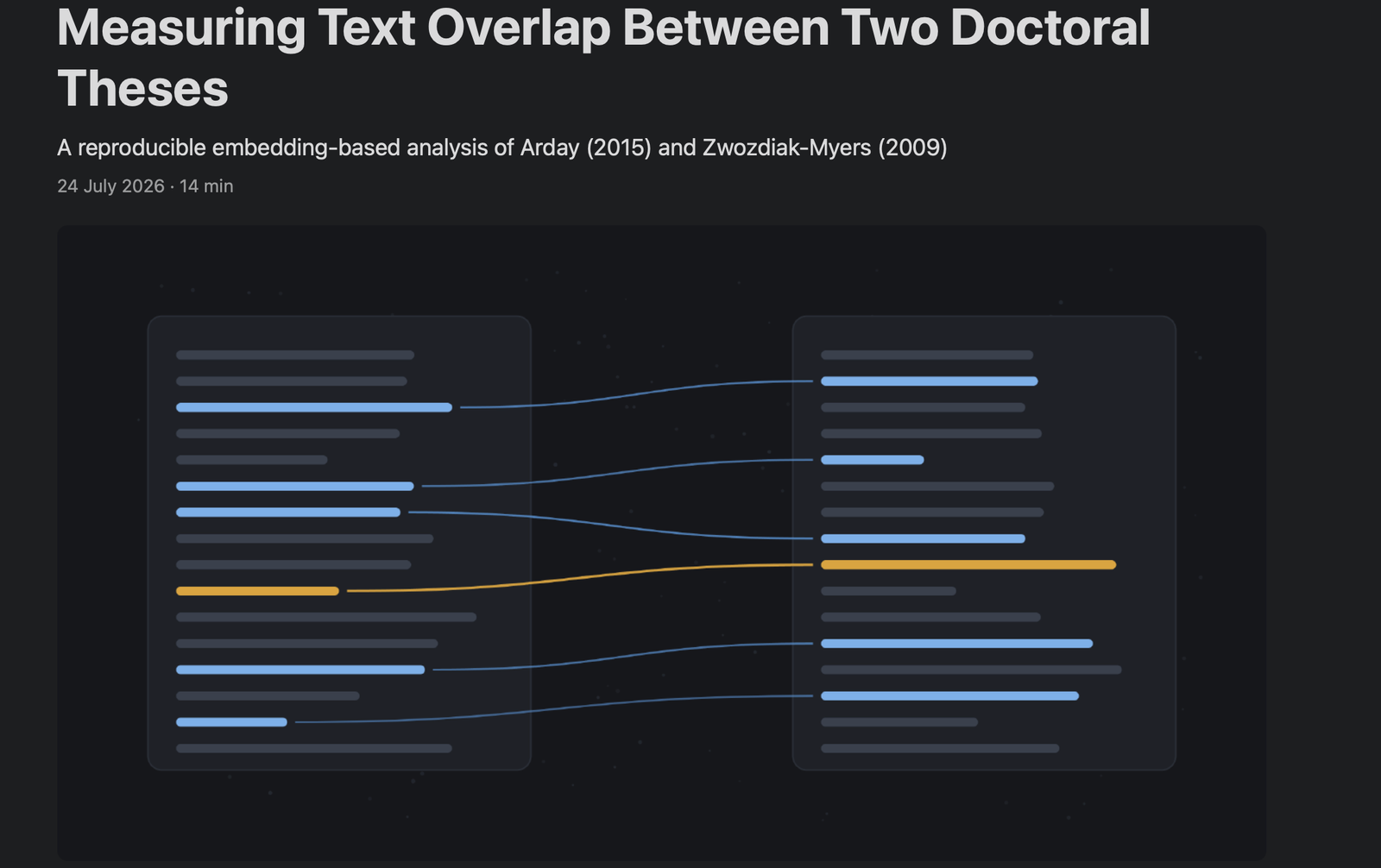
From a mathematician’s or programmer’s perspective, we highlight an outstanding piece of work by Alexey Titorenko, available to download here. It presents a fully reproducible, embedding-based analysis of the PhD theses by Arday (2015) and Zwozdiak-Myers (2009).
Wonderfully, the complete pipeline is included end-to-end: extraction, segmentation, embedding, control construction, Poisson testing, provenance classification, and extent estimation. The code automatically retrieves all source documents from their respective repositories. Equally remarkably, the entire process runs on a standard CPU in approximately twenty minutes.
The two PhD theses have considerable overlap.
“The signal is in the tail, and it survives controls. Against two independent education doctorates matched on discipline and partially on topic, the focal pair shows:
- 9 near-identical sentence pairs (cosine ≥ 0.999) in 11.09M comparisons, against 1 in 34.29M control comparisons – and that single control match is the standard thesis declaration (“This work has not previously been presented for an award at this, or any other, university”).
- 179 sentence pairs sharing 12 or more consecutive identical words (107 spatially independent blocks), against an expected 0.32 under the null – an exact count over all 11.09M pairs, no embedding model involved. Longest shared run: 63 words.
- Conditional on high semantic similarity, cross-document pairs share a median run of 11.5 identical consecutive words, versus 4.0 and 7.5 for sentences within each thesis – that is, among semantically matched sentences, the two documents phrase shared ideas alike more often than either thesis does when restating itself.
Under the most conservative assumptions available, the probability of observing this pattern under independent composition is 5.7 × 10⁻⁴; on the central estimate of the null rate, 8 × 10⁻¹¹. “
[From Titorekno’s GitHub page]
It is very unlikely this happened independently (specifically one in a one-in-100-billion chance of happening).
The origin of the extreme textual overlap perhaps remains unclear — but both Liverpool John Moores University and Cambridge University have got to come up with better explanations than they have done so far.
And for Cambridge University’s senior management, there are serious questions as to why this is playing out so damagingly in public, since they have known about it for a number of years.
End. Of. Argument.
Sackings needed at Research Integrity Office. Also, the people who tried to hush this up need to go. You don’t fix problems by hushing them up.
Vira needs to go, for extreme foolishness.
Prentice needs to go before the place burns down.
Big thanks to Alexey Titorenko.
Measurements of textual overlap make it harder to dismiss plagiarism as a subjective opinion rather than a fact.
Alexey Titorenko, brilliant programming.
@EoA
‘Sackings needed at Research Integrity Office’ and of any other staff who covered it up is right.
I’m inspired by Alexey’s idea that the Programmer Writes Back. Never considered that plagiarism can be shown through maths.
“It is very unlikely this happened independently (specifically one in a one-in-100-billion chance of happening).”
It’s an open and shut case now.
James Ryan, writing in the Telegraph comments section, notes: “He even incorrectly copied the punctuation of her thesis title, teachers'” – the misplaced apostrophe in Arday’s title mirrors Zwozdiak-Myers.
Over on Reddit, u/Rewindcasette offers a specific forensic claim on top of Ryan’s apostrophe point, observing that an em-dash was rendered as a hyphen in Arday’s text: the sort of transcription artefact you get when copying from a formatted source into a word processor that doesn’t preserve the character.
And then there’s also another AI-assisted textual audit, reported by u/Slight_Horse9673 who ran the two theses through Claude and reports: “Across dozens of pages, Arday’s review of Dewey, Schon, Van Manen, Habermas, King and Kitchener, Zeichner and Liston, etc. follows the same authors, in the same order, using the same illustrative quotations from those authors, arriving at the same conclusions.” This is a structural-plagiarism claim distinct from verbatim-copying, showing that the architecture of the literature review is Zwozdiak-Myers, not just individual passages.
Good to hear about Reddit.
Claude’s gotten more sophisticated
However,
Structural plagiarism is a matter of interpretation at Consigliere University. It doesn’t exist as a form of research misconduct if the plagiarist is a favourite. Verbatim-copying is a matter of interpretation too if the plagiarist is a favourite.
Not (/s)
There seem to be two issues: claiming ideas as ones own, much more serious, but not the case here. Copying and pasting text without quoting them as verbatim extracts, while acknowledging source of ideas. Less serious but lazy
Cambridge is a laughing stock. What have these people done?
The sackings at Research Integrity Office will resolve nothing. Remember the former head of the Research Office left abruptly taking ‘early retirement’. It was clear he was let go to take the flak for the mutiple disasters he and his team presided over on behalf of the oligarchy. The oligarchy (VC, ProVCs, Council, multiple Heads of School, serial Responsible Person individuals) are the ones overseeing and controlling this mess. The University was already going downhill under the useless little Canadian lawyer and now under the American Queen it is collapsing. Lord Smith is content watching ‘Rome’ burn. Disgraceful.
https://www.linkedin.com/in/peter-hedges-14632041/
Need Grace to look into research integrity office, it needs fixing
What’s the solution?
A Research Integrity Office who covers up misconduct is a problem, though. Can’t tell if you disagree or are saying the focus should be elsewhere.
Nevermind, comment below (21 Group re: Recipe for Disaster) addressed this:
‘The issue is not just who occupies senior leadership roles, but the incentives and behaviours that have become normalised: opacity, defensiveness, cover-ups, status hierarchies, and a reluctance to acknowledge mistakes. Replacing individuals without changing those patterns will recreate the same problems with different names.’
The scandal is also a product of the dysfunctional retaliatory culture of HR and Legal Services.
Whenever scholars raised issues within the university, they doubled down and tried to hound them out, eventually successfully in many instances. They could have made peace but they never do this. They never make things right again, never correct their mistakes.
This has resulted in a large and growing by the day army of ex-Cambridge academics with unsettled business… perhaps a few of whom assist this group, or have used it to reach out to one another, and a very large additional number of whom have done so informally, constituting a broad (surely now in the hundreds) network of former Cambridge faculty and students who are in all in touch and know one another and how they were treated by HR and the ruling cartel.
To make things worse, they replaced good faith whistleblowers will people like Arday and paraded them as “examples” of their love for diversity and adversity, ignoring the countless ethnic minority, lower income, non-British, neuro-diverse, female or gay scholars they have fucked over along the way. You will note the people doing the “parading” are all themselves rich and elitist.
It was always a recipe for disaster. It was always going to converge on this outcome. A culture of retaliation accumulates enemies.
People compare “Consigliere University” to the mafia but no organised crime group would be so fucking stupid as to reap the whirlwind like they have. With every passing scandal they are tossing the coin hoping to maintain their lucky run and now they are coming up tails again and again and again.
Wonderful, this is a very accurate diagnosis.
We agree. This is a scandal about HR/Research Integrity & Legal Services
Yes… but these are core services that should exist for two reasons only: 1- support teaching and learning; 2- support research. Instead they have become tools to serve the oligarchy and supress faculty, researchers and students. UCam is no longer a scholastic institution, it is a corporation. Herein lie all the problems. The only possible solution for all of this is to remove the whole lot running the place and return to an institution led by Scholars.
“Instead they have become tools to serve the oligarchy and supress faculty, researchers and students. ”
Fully agreed. HR interference into funding applications and the acceptance of grants is ultimately an act of self-destruction motivated by the extreme hatred with which blacklisted staff is retaliated against.
This sounds like a whole lot of fun. I would love to be part of something similar
I used to work in the Old Schools in a middle management position, though not in HR, Legal or the Research Office. I recognise a lot of what you say. During several years there I saw, at senior levels, some of the worst incompetence, complacency and wilful ignorance anywhere in the University, and outside it. As a result others on the inside of the Old Schools have suffered terribly.
There has always been a culture of ‘us and them’ between academics and administrators, between the centre (i.e. the Old Schools) and the departments. I have had raised voices and fingers wagged at me in meetings with the accusation that “you’re the centre!”. Errr, no I wasn’t there personally as a representative of the centre. I managed a small team all trying to do a good job for the greater good of the University. Once academic asked me over a college lunch, in all seriousness, on learning which building my office happened to be in, “do you often have to do things that cause you to lose sleep at night?”
How do we start turning this unproductive, vicious rift, and the general sense of malaise that is the reality of working at Cambridge around? I’m not sure it’s as simple as replacing the senior leadership.
This is a very insightful post, it is one of our big problems.
The issue is not just who occupies senior leadership roles, but the incentives and behaviours that have become normalised: opacity, defensiveness, cover-ups, status hierarchies, and a reluctance to acknowledge mistakes. Replacing individuals without changing those patterns will recreate the same problems with different names.
@Recipe for Disaster
You’re 100% on the mark.
If you can articulate the toxicity that well, you must have directly or vicariously experienced it.
I hope not, but thanks for your illuminating post.
@Recipe for Disaster
You’re 100% on the mark.
If you can articulate the toxicity that well, you must have directly or vicariously experienced it.
I hope not, but thanks for your illuminating post.
“both Liverpool John Moores University and Cambridge University have got to come up with better explanations than they have done so far.”
I do not know about Liverpool, but did Cambridge University already try the “personal vendetta” explanation? They always have that one in their pocket! Oh wait, perhaps that does not work here… What about the fact that there is still controversy about the existence of plagiarism as given by the accounts of some scholars in the published articles? I doubt that those who were not convinced about plagiarism before now are because they understand what Alexey Titorenko did and the stats involved.
Dear friends, I just have this to say. It is time to step up. If you are or were a member of Cambridge University and feel ashamed by what this institution became under this mediocre senior leadership, please consider contacting the 21 Group and clarify if you would be willing to sign an open letter regarding the current state of Cambridge University. This letter needs to have the name of many people, ideally hundreds of people, current and former members, staff and students. We cannot wait for the Grace, and it is not even clear that the Council will allow it as it was proposed. Moreover, many people who want to contribute to a change cannot sign the Grace or vote if it is accepted by the Council.
The time for a change is now. We need external intervention as soon as possible to conduct independent investigations. That investigation is surely more useful than giving money to Carter-Ruck and alike, which just delayed the inevitable.
This story is from September 2025 while I was being bullied and harassed by OSCCA after trying to defend a 19-year student who was seriously mistreated at DAMTP. Fun fact, he was chosen to their program precisely because of his very high widening participation score:
https://21percent.org/?p=2723
DAMTP, you say.
Ah yes, the continuing troubles & tribulations of the School of Physical Sciences 😉
My face is very concerned
Concerned Face did not even reply to the complaints regarding a person he managed directly but according to SARs, he found the time to tell the VC when I and the student contacted her, that someone would reply on their behalf. Guess what, no one ever did!
Can you imagine this person as a Master of a Cambridge College from September onwards? What a disaster it will be for that community.
Given that Arday has been protected by the University, an obvious question comes to my mind:
Do we know if Arday has been acting as “Responsible Person” regarding reports of misconduct in other departments? For example, has he been invited to act as “Responsible Person” regarding cases of plagiarism? If no one knows the answer, I guess that I will have to ask Dr Rhys Morgan and Dr Andrew Jackson, because we all need to know.
The best work on academic plagiarism for me is by MV Dougherty eg ‘Disguised Academic Plagiarism…’
He notes stylistic techniques as well, eg to reinforce the claims to authorship in the piece, such as first-person statements (‘I think that’ or ‘In my experience’), and ‘downstream citation’, where subsequent writers cite the plagiarised text which helps bury the original source. Arday’s articles have some good examples of the first category, and he frequently cites his own earlier work in his downstream pieces. Of course, this might not be to reinforce plagiarism but for entirely different stylistic reasons. His texts (including the PhD) might include ‘pawn sacrifice referencing’, where a section of someone else’s work is referenced correctly, which implies it has all been .I expect LJMU and Cambridge consulted Dougherty?
Dave Harris, thanks.
Excellent information about downstream citation.
Before getting to that, curious what makes you think LJMU and Cambridge consulted Dougherty?
I’ve seen a bad case of downstream citation. More common in the Humanities and Social Sciences. Author at a Russel Group university heavily promoted their book after plagiarising lesser-known authors at lesser-known universities. The book received a lot of press coverage. The plagiarised text was cited under the plagiarist’s name. The original authors and original sources were buried.
Never heard of pawn sacrifice referencing, just looked it up, know what you mean. There’s another version where the plagiarist appropriates the primary sources of the original author. He cites the primary sources not the work of the original author where they appeared. It looks like he found the sources and built the argument on his own but actually copied the work of the original author. Used it as a template and took all the sources, without citing. Sat at his desk and dug through footnotes when the original author dug through dirt, archives, whatever to locate the primary sources he’d later snag and use to bury the original author’s work.
Funny enough, Chris Smith also wrote in The Telegraph yesterday at the same time.
https://www.telegraph.co.uk/news/2026/07/24/frank-whittle-engineering-lab-jet-engine-tech-economy/
30 comments on this article versus 3800 comments on Arday’s until now…
Not quite sure why he’s doing this. If I want someone to tell me about the Whittle Labs I’ll ask an engineer
Xerxes, to me it reads as a “compensation article” by The Telegraph. One can easily imagine Smith contacting The Telegraph concerned about how Arday’s article would damage the reputation of the University and the editor telling him that he could write a parallel article on how amazing Cambridge is regarding a topic of public interest such as energy transition.
Luckily, the public has been showing how interested they are about Smith’s article when compared to the one on plagiarism, 33 versus 3785 comments by now on articles published at the same time regarding the same University.
Does the Chancellor report to James Helm in the latest HR organogram?
Perhaps it’s a dotted line. It would not be beyond them.
James Helm and his colleague Andrew Aldridge have other things to do these days because they have not been very active. They still have to address my email to them, but also to the University Council, the General Board, the Board of Scrutiny, the Proctors and eventually to Mr Daniel Zeichner MP, on why Cambridge University banned me from Viva Engage and deleted my posts supporting the Grace that asks for an external audit of HR practices, all this without any explanation. I am sure there must be a very good reason for it, but it is unfortunate that they did not find the time to explain. I guess I can cc even more people next time I contact them about this topic.
Don’t the University use reputation managers, damage-control specialists, PR handlers and image consultants for just this kind of circumstance? Be interesting to see what they do, how they now manage the emerging story?
Can they turn it? It strikes me as tricky, but not quite impossible.
But I can’t believe they said “Let’s get old Chris to write about the Whittle”. Or if they did, we’re paying them too much money.
No doubt they have all those manipulator types on speed dial. Question is who foots the bill for them to go after whistleblowers.
From post above of former Old School lane:
“How do we start turning this unproductive, vicious rift, and the general sense of malaise that is the reality of working at Cambridge around? I’m not sure it’s as simple as replacing the senior leadership.”
No. But it starts there! They all have to go: VC, ProVCs, Council, Heads of HR, Legal, Communications and Research Office. The whoke lot. Chancellor has to step in and nominate an Interim Executive with a clear mandate to reset for say 2 years. Take that time to find a new senior team and do a series of audits of all the above Admin. I do not see any other way. The alternative is continued, soon irreversible, decay.
Yes, culture is set from the top. Changing the leadership doesn’t guarantee a change of culture. But having the wrong leadership in place ensures it continues.
Another important factor is openness, which is why the 21 Group serves such a vital function. So many of the problems we have are fed by opacity and lack of empathy. This is also why an external audit of HR is the right instinct.
Our dear Lord Smith will do nothing because we write in this blog. He has been aware of many cases from victims who contacted him directly and he looked the other way.
However, if we send him an Open Letter signed by hundreds of current and former members, while cc-ing the Cambridge MP, sponsors and the press, I am confident that he will pay attention and act.
Let’s go.
Not sure if Helm is bad at his job or just extremely unfortunate. Worth knowing that bBefore running the show at Cambridge, his previous gig was as Met Police Director of Communications (from 2018 to 2021). He left following the Everard murder scandal, which eventually took down Cressida Dick (who eventually resigned after Helm had left).
The period was one of its worst reputational stretches. Besides the whole Everard thing, he also had the Charing Cross WhatsApp and Operation Hotton fiasco, the Bibaa Henry and Smallman story, and the Daniel Morgan Independent Panel report, which declared the Met “institutionally corrupt” – a bit unfair but anyway. Not sure anyone blames Helm for that, and, probably on reflection, it was a good thing to have some public scrutiny and debate. It was a tough time but I reckon got the Met to a much better place today with some roadbumps. Let’s hope maybe this will be the same at Cambridge too.
Interesting there’s a Met link. Nathan Cofnas claimed some of the academics/journalists were threatened by the police.
DestroyingAngel, good point. How has the police been involved in this and other cases associated with reports of misconduct?
I stress that OSCCA threatened me to call the police to report on my “crimes” in August 2025, but I am still waiting to be contacted by the police.
Let us just say that some of us do not feel confusion or pain. All is crystal-clear. The person has been a DEI darling. This development is highly expected.
Who is in charge of senior recruitment at Cambridge?
I mean Sinker, Prentice, Morgan, Helm…. there seems to be almost a tradition at Cambridge of giving a “second wind” to people with less than stellar records in their previous job… only to land in the same mess again. Do senior hiring committees not consider this stuff?
It seems like the lession Helm learned from his time at the Met was that he needed to be more aggressive in hitting the press with SLAPPs and legal action. If he had just done that, then everything would have gone swimmingly.
That’s almost certainly the wrong lesson (simply from a media management perspective, to say nothing of ethics). I guess now he is seeing where that path would have taken the Met another 1-2 years hence if he had taken such a line and stuck it out in the role.
Either way it is totally inconsistent with textbook media management for high reputation organisations. The standard guidebook is that the best way to get ahead of scandals is to concede the mistakes early, demonstrate that action is being taken, and commit to reform and improve – all things the Met had to do after Helm left and Dick resigned, but somehow, Cambridge is presently utterly incapable of.
The real lesson ought to have been that in the social media age, the old tricks just don’t work any more. It all gets out eventually. A cynical and distrustful public still respects honest admission of failure, when delivered with authenticity and genuine empathetic action to set things right. The public can see through lies and coverups in a heartbeat.
@SLAPPed
“The standard guidebook is that the best way to get ahead of scandals is to concede the mistakes early, demonstrate that action is being taken, and commit to reform and improve – all things… somehow, Cambridge is presently utterly incapable of.’
Nail on the head
This is a moment of profound sadness and horror for the university. I know that some of us are angry about the failure of academic standards, while many others, are instead angry about how the university could set up a young black man to fail, and in such a horrible way. Many of us, of course, are justifiably furious regarding both. Whatever your feelings, let us direct our confusion and hurt and rage upon the senior figures who were responsible for maintaining academic integrity, our duty of care to scholars, and the university’s reputation. Whatever the final conclusions regarding this awful moment may be, it is clear that something has gone appallingly wrong. Our leadership has fallen desperately short of the standards that they were entrusted to. I feel only sadness today, and am struggling to make sense of it all, as I am sure others feel too. The road ahead will be hard but we cannot continue on the road that took us to this point.
This is exactly right. The issue is not one of choosing between academic standards and compassion — a university worthy of the name must uphold both.
When trust has been broken at this level, the answer cannot be spin or silence, but it has to now be real change.
Exactly:
‘let us direct our confusion and hurt and rage upon the senior figures who were responsible for maintaining academic integrity, our duty of care to scholars, and the university’s reputation…it is clear that something has gone appallingly wrong. Our leadership has fallen desperately short of the standards that they were entrusted to.’
With leadership positions come great responsibilities. Upholding research integrity is one of them.
Cambridge University ‘leaders’ are covering up research misconduct and ushering in the death of reliable scholarship and whistleblowing. All focus ought to be on Cambridge University’s cover up.
There is only one way: resignation of Prentice, all ProVCs, Council, Heads of HR, Legal, Research Office and Communications. Then Regent House needs to approve urgent measures, where the Chancellor appoints an Emergency Senior Academic Executive to run things for up to 2 years while 2 things happen: 1- a series of independent audits of all central administration; 2- the selection of a new VC and a new Council. It is IMPOSSIBLE to change course with the current senior oligarchy. Scholars need to rescue the University!
A lot more is now coming out about the more senior figures at Cambridge implicated in this mess.
Notably, Dave Harris, who is the whistleblower named in the Telegraph article, posted this directly under his own name:
“I am mentioned in this article. Profs Cremin and Morgan of Cambridge ignored my (polite and tentative) identification of problems with some Arday articles in May 2025. Prof Morgan said it was just not his concern because the articles were published before Arday took post. They have not contacted me since so I had no idea they carried out any further investigation. I would like details of what they actually did. My email, to LJMU, with some details of problems in the PhD, was also dismissed. I understand a full dossier of the ‘similarities’ between the theses was sent to them in 2025 and contained examples that ran to 80 pages. They did not investigate then, apparently.”
There are more comments too about Cremin on Reddit. It was Hilary Cremin who took up the Head of Faculty of Education post on 1 October 2022, five months before Arday’s appointment.
Cremin has been quite the provacatrice in recent years.
After Arday’s appointment, Cremin appeared as his “new boss at Cambridge” in a BBC News story of 2 March 2023, and declared “…the board of electors, on your interview day, were absolutely unanimous. we are so lucky to have you. you are the best in the world in terms of the research that you do.”
Cremin is currently a Fellow of Homerton College.
She released a book around the same time, Rewilding Education (Routledge, Sept 2025) which by her own admission she hoped would “start courting a little bit of controversy”.
In her conference presentation of the book, she summarises the argument as one regarding “the catastrophic effects of capitalism, patriarchy and colonialism” and about moving from “school as Factory prison and army to school as wild garden”.
The attempt to provoke a backlash was a total flop; Gove and Clegg ignored her appeals to debate its ideas and it seems to have faded with a whimper.
Still, it provides quite damaging context to her “use” of Arday for internal political reasons.
It appears the failure to examine or indeed protect him was not a simple case of innocent oversight, but one that fits within a broader ideological worldview, one that is person to Cremin, and which she considers her personal mission to deliver.
That view is one that rejects objective standards of research merit, and traditional (dare I say “common sense”?) notions of education as about learning, facts, testing and merit – instead Cremin’s view is that schools are “factory‑style production lines” with “sometimes militaristic discipline” (her own words).
It is hard to avoid the conclusion that this wasn’t simply a case of negligent failure, but the result of a personal quest that had taken advantage of Jason Arday as a means to her own political ends, with quite catastrophic results.
REDACTED
In October 2022, Cremin takes up the post as Head of Faculty of Education, Cambridge, succeeding Susan Robertson.
Shortly after, in February 2023, the Arday appointment is announced; shortly after Cremin is filmed by the BBC March 2023 saying, of Arday: “He is currently, arguably, the best in the world in terms of the research that you do” (a strong endorsement for a junior scholar with few publications).
Next thing Cremin is formally gazetted as Professor of Education at Homerton by the General Board (Reporter notice, 2023–24) – presumably, a promotion from Reader. It would be very interesting to see if the Arday hire was referenced in her application.
By this point (June 2023), Cremin has received the first plagiarism email. She meets Arday with her Director of Research; the paper is taken down from the journal’s online platform for amendment; and Cremin writes her reply declining to open a Cambridge investigation on remit grounds and stating “he has our full support”.
Next, in 2024, Cremin is writing her book on “Rewilding Education”, calling for abandonment of traditional educational systems based on examination and factual knowledge, and replacement by “a completely new vision of what education involves”.
In January 2025 she gives the PSN Conference keynote ahead of her book (title of the same name – “Rewilding Education”), in whcih she attacks “the catastrophic effects of capitalism, patriarchy and colonialism”, apparently somehow reflected in schools.
In July 2025 “Rewilding Education” is finally published by Routledge; she challenges Gove and Clegg to come to Cambridge and debate her ideas (which they politely ignore).
REDACTIONS by 21 GROUP
Cambridge complains of a “vile campaign” against Arday.
It seems the original “campaign” was that initiated by Cremin. This is a fact of public record, and not in reasonable dispute: for she herself stated in her 27th November 2025 CANversation interview that she was “hoping to start courting a little bit of controversy”, and the concurrent attempt to goad Gove and Clegg to debate with her fits in that framework).
If by “Morgan” you mean Rhys Morgan, he is not a Professor. He is the Head of Policy, Integrity and Governance. It is pretty clear that he did not do an investigation. He wrote to those who contacted him:
“The University of Cambridge takes issues of research integrity very seriously and we will always consider allegations relating to research conducted under its auspices in line with our policies. In this instance the research that your concerns relate to was carried out before Professor Arday joined the University and it would normally be for the institution at which the work was done to consider any research integrity concerns with a particular paper published in their name. As such we do not consider it within our remit to investigate the papers to which you refer. If you do choose to approach the institutions at which this work was done we would be content for you to let them know that you have also written to us and to provide my name as a contact point.”
Play close attention to the last sentence. The person who was involved in this report should do a Subject Access Request at UCam and another at the “institution at which the work was done,” and ask the correspondence between the institutions. Knowing Dr Morgan and his office, namely their interactions with the Royal Society regarding my case, I bet that UCam interacted with that University in the background to decide on which institution would do an “investigation.” Obviously, Dr Morgan did not want to be responsible for any investigation because he knew that it would hardly be sustained that there was no plagiarism. Dr Morgan is the same person who refused an external investigation regarding my report of research misconduct and instead prefers to have internal people acting as “Responsible Person” such as the Head of POLIS, and when I stressed the scandals that happened in POLIS he told me that he and his line manager Dr Andrew Jackson did not know about it. For those who do not know, the line manager of Dr Jackson is Dr Mike Glover, who is directly involved in my case as well.
‘Dave Harris, who is the whistleblower named in the Telegraph article’
Thanks for this info. I must’ve skipped over that part. No surprise Dave’s post above was illuminating.
Dave, you’re not the only academic whose whistleblowing was ignored.
The Office of Research Integrity takes anonymous and unsubstantiated accusations against academics they dislike more seriously than hard evidence if the plagiarist is a media star and favourite.
There is also an issue here of whether Cambridge Communications have just sent deliberately false statements to the media and to the public.
As per Cambridge’s anonymous “spokesman” statement to the Telegraph, the allegations “have been thoroughly investigated … Arday has been cleared”.
However, this is squarely contradicted by Hilary Cremin’s own letter in response to the initial plagiarism report.
Her letter explicitly states that Cambridge did *not* investigate the paper at all and argues that this was “outside its remit” and therefore, could be dismissed.
This is a disclosure inconsistency entirely on the public record and hard to reconcile no?
It is also quite an astonishing admission from the head of a Faculty of Education. The role surely requires a particularly high level of due diligence to matters of educational misconduct.
Comms under helm is surely scorched earth at this point. If he told the press the sky was blue they’d assume it was red
“Cambridge” is said to have complained of a “vile campaign to undermine his credibility.”
This is a spectacularly foolish statement to issue when Arday’s publications and the allegedly plagiarised articles can be read online and the allegations verified to be accurate. The comms team have identified the university with a view that concern about academic integrity constitutes a ‘vile campaign’. What brilliant reputation management.
Did they bother to read the Cofnas piece and check the sources? Is it possible that they have been naive enough to rely on an assurance that Arday had been cleared from some other part of the bureaucracy, or from the Faculty itself, which is clearly implicated in the charade?.
“Did they bother to read the Cofnas piece and check the sources?”
The University’s responsible for receiving complaints of misconduct do not see any evidence that people send. It does not matter what you send to them because they will ignore it and keep their narrative. If the evidence is striking, they will find a way to build a counter story, such as a counter-complaint if the issue is about bullying or harassment. In this case they chose to support Arday because the reputation of the University was on the line, not because Arday as clearly most of them could not care less about him.
“vile campaign” is at the level of “personal vendetta” when the evidence is undeniable.
“… because Arday as clearly most of them could not care less about him.”
People prominently involved in the scandal include ProVC Professor Bhaskar Vira, Baroness Sally Morgan, Professor Tim Harper (natch), Dr Rhys Morgan, Professor Hilary Cremin
Person with a major problem now is Professor Sir John Aston. As ProVC for Research,, he has ultimate oversight for research integrity — even if day-to-day matters are managed by Dr. Rhys Morgan. He has a big decision to make.
I agree that Aston is on the spot light now. But he has likely been busy with incidents happening in parallel relating the Royal Society and his colleagues at DAMTP on different matters. I am looking forward to hearing from him about all these cases!
This is why the idea of forming a Cambridge “shadow cabinet” is such a priority. There needs to be a group of senior figures ready to replace the Council in its entirety and form a completely new administration with no links to the past. If that existed Aston would be in a position to join it instead of being asked to justify the unjustifiable.
If Smith were doing his job he would be forming such a group right now. After all if the King of Spain could dismiss Franco’s stooge, appoint Suarez, and sponsor democratic elections, why can’t Smith dismiss the American Queen and bring democracy to Cambridge. Or does he too support the junta?
Council elections this autumn. 21percent should run/support candidates.
This is a superb idea. Thanks for suggesting it.
Note that there are spots in Council that cannot be renewed that easily and the new people would be smothered by remaining. Who are they? VC, Sally Morgan, Simon McDonald, … As Heads of house decide amongst themselves who to nominate, I bet that if these leave, they will make sure they choose the right ones. Why not Nigel Peake or Richard Gilbertson?
Make sense to change this so Heads of House, Bursars & Deputy Heads all qualify
Of course it does, but Council will not let it fly simply because people ask them.
Desperate times call for desperate measures, right? We need immediate action, and that can only be achieved via the Chancellor, but by involving MPs, sponsors and the press, so that he does not pretend it is not their job. He can, of course, wait for more scandals to burn the institution he is responsible for.
@Unsteady at the Helm
Incisive:
‘The comms team have identified the university with a view that concern about academic integrity constitutes a ‘vile campaign’. What brilliant reputation management.’
@Vote them out
Let’s go
@TheResearcher
Any ideas about how to involve MPs?
If 21 Group put a form letter on its site, I could see a lot more people opting to email their MPs.
The key MP is the Cambridge MP, Daniel Zeichner, whose email address is well known and has already been contacted by UCam members in their individual capacity. Zeichner will not be surprised if he receives the open letter, but the key pressure comes from the press and sponsors. Is Mr Chris Rokos already aware of all these scandals, namely the fact that Kamal Munir stepped down as ProVC? Why should Munir continue as one of the University’s two trustees of the Rokos School of Government? I do not think he should, and would like to know the views of Mr Rokos and his lawyers.
Out Prentice! Out Prentice! Out Prentice! Out Prentice! Out Prentice! ENOUGH IS ENOUGH!
Jim Morrison:
This is the end
Beautiful friend
This is the end
My only friend, the end
Deborah Prentice must know…
The Telegraph article does contain something extraordinary
https://www.telegraph.co.uk/news/2026/07/24/cambridges-diversity-poster-boy-in-plagiarism-row/
“Prof Sir Simon Baron-Cohen, the director of Cambridge’s autism research centre, and cousin of the comedian Sacha Baron-Cohen, and Ricardo Sabates, professor of education, circulated an open letter under the heading: “URGENT PLEASE SIGN ANTI-RACISM LETTER FOR JASON ARDAY.” It referred to an earlier letter that “was sent to the Minister of State and to which there has been progress in terms of how to tackle these issues” and warned of a “potential public attack on Jason”. Parliamentary records show that on Sept 15 last year, Jacqui Smith, the women and equalities minister, met a “range of academics to discuss the harassment of black academics”.
My reading of this is that — becoming aware of the plagiarism problem and its potential for embarrassment — Cambridge University raised the matter with Baroness Smith of Malvern and tried to forestall any problems by smearing any questioners as “harassers of black academics”, even warning of a “potential public attack on Jason”
Is this not really very bad corruption or manipulation of a minister? The University were trying to cover up their own mistakes.
Does anyone know how we can get the minutes of this meeting with Jacqui Smith?
The case of Jason Arday may shock many people, but for many members of Cambridge University, it does not. The University—read, senior managers of Cambridge University—does/do not have limits to cover up. It is a disgusting culture that many had to put up with.
The date 15 September is not coincidence though. When was the first article in a national newspaper gagged on the topic or when was it known it was going to be published? I remind the readers of this story by the 21 Group on 20 September:
https://21percent.org/?p=2688
“The 21 Group notes wrily that you may wish to revisit this post later in the week.”
We all know what happened later in that week, “A Fable of Consigliere University” that I posted above on how Consigliere University gagged an article on plagiarism in September 2025.
Looks like there is more to come out on the scandal
How to Deal with Plagiarism (that post) is a 10/10
Jacqui Smith is a prominent Blairite. The Chair of the Board of Electors that appointed Arday was Baroness Sally Morgan, Blair’s political secretary, his Minister for Women and his Director of Government Relations. She is also a member of the Council.
That’s Morgan (Sally) in the middle of both the CUH and Arday scandals then?
Baron-Cohen’s argument, as sophisticated as this:
https://youtu.be/QaZbrqE1CF4
Will Jesus College comment on these issues on Arday or will simply say that he the plagiarism happened befoe he became a Fellow at Jesus? https://www.jesus.cam.ac.uk/people/jason-arday
Meanwhile, Simon Goldhill is still presented as “Official Fellow in Classics” at King’s College…
I trust the results, but just to say that it reads like a completely unedited Claude Code text. Whatever you throw at Fable 5, the “signal is in the tail”, always. The author’s original contribution here is the comparative framework setup for the research question, but the analysis, interpretation and writing-up is probably Claude Code Fable 5, likely running a number of Opus 4.8 agents for analysis and adversarial checks.
Also, you could question the control.
Better to use 10-15 independently authored theses (Cᵢ) in same subfield, with similar research topic & methodological approach. For each control thesis (Cᵢ), a corresponding source thesis (Sᵢ) would need to be found.
Of course, this is now a week’s work especially to find the Sᵢ
And the essential conclusion won’t change, but the numbers may by factor of ~ 10
Also, you write that the work is “available on GitHub here”. That’s inaccurate. That’s is a website produced by GitHub Pages, it’s not GitHub. The analysis may be posted on GitHub, but the rendered website contains no link to the repository. I haven’t yet looked for the author’s GitHub account yet to see if the repository is public or private (it’s probably publi if they are on a free account). The original piece – the single blog post on a newly created site – does not have a comments section, but I would strongly urge the author to share the GutHub repo with the code instead of downloadable files for reproducibility. That allows for the code to be forket, and errors to be easily flagged in the repo itself. All of this just reduces my confidence in the whole undertaking, unfortunately.
You are right that there is no GitHub repo. You can download, install & run the code.
Thanks for pointing out error in blog post, which we’ll correct
If Cambridge thought they had a leg to stand on, then they would have submitted their own analysis. They haven’t done that, in part, because they never investigated the complaints. The fact they jumped direct to accusations of “racism” appears very desperate. Oh and Cofnas isn’t the person who submitted the original (entirely non AI) analysis to them, he’s just the blogger who broke the story. The whole racism thing is a pure distraction technique.
@CM
‘All of this just reduces my confidence in the whole undertaking, unfortunately.’
To clarify you trust the results not the methodology or not anything?
There is an interesting & balanced twitter thread here
https://x.com/Prolapsarian/status/2081153576345223522
Author is Jacob Bard-Rosenberg who is Director of Research for Art at Edinburgh College of Art.
He simply took the thesis & quickly identified further possible plagiarism. The point is that he did, in a few hours, find serious concerns, whereas Cambridge’s Office of Research Integrity failed to do so in > 2 years. It is the institutional failings that should concern us.
“Without piling on (I genuinely don’t care that much): On Jason Ardey, there’s probably more plagiarism and research misconduct.
Because of all the commentary I started reading his thesis. The two quotations from Zeichner on the top of p. 43 are also in Lynn Fendler ‘Teacher Reflection in a Hall of Mirrors: Historical Influences and Political Reverberations’ (Educational Researcher, Vol. 32, No. 3, pp. 16–25, here p. 16 and p. 17). After the first quotation she writes, “In addition to Zeichner’s support for teachers, other critical commentaries have recognized problematic features in the literature about teacher reflection. A major focus of criticism is the degree to which reflective practices serve to reinforce existing beliefs rather than challenge assumptions. Some reflective practices may simply be exercises in reconfirming, justifying, or rationalizing preconceived ideas. Loughran (2002), for example, notes, “rationalization may masquerade as reflection” (p. 35). Korthagen and Wubbels’ (1995) comparative study “found no indication of a link between reflectivity and inclination towards innovation” (p. 69).” (p. 16)
After he cites them he writes, “Another criticism refers to the degree to which reflective practices serve to reinforce existing beliefs and values rather than challenge assumptions (Pollard, 2011). Importantly, Galea (2012) asserts that some reflective practices may simply be reconfirming, justifying or rationalising preconceived ideas about practice. Similarly, Loughran (2002) contends that the rationalisation of practice may masquerade as ‘reflection’. In a similar vein, Korthagen and Wubbels (1995) have argued that, in a comparative study they conducted that, they found no indication between reflexivity and inclination towards innovation.” (p. 43)
To give you a sense, this is an article right in his field with 1000 citations, and he is randomly plagiarising a paragraph from it. It’s sort of wildly shameless, not least because she manages to include a correct citation to Zeichner (1992) in her bibliography, while he doesn’t. He also manages to weirdly edit on of the quotations to make it incorrect (from ‘educators’ to ‘education’),
removes proper quotation marks from Loughran, and adds random citations into her paragraph.
In the trade, we call this ‘patchwriting’ and we increasingly see it from students. But at least the students I see doing it try to go for obscure sources, often AI translated from other languages, and not highly cited pieces of research in the field by US professors.
My general sense from reading through about 70 pages of Arday’s thesis is that often it is just very sloppy. Lots of the sentences don’t make sense. There are erratic comma splices everywhere.
Lots of the sentences also don’t mean anything or are disguising their platitudinousness (mentoring is good) by jamming together as many long, Latinate words as possible. To give you a sense, “Engagement and exploration of concepts within reflection indicate a plethora of variations within the reflective vehicular which underpin this concept (Loughran, 2010). Commentaries and debates highlight difference regarding claims presented about the benefits of reflective practice in the professional development of student teachers (Galea, 2012; Pollard, 2011). Varying commentaries sight a dearth of rigorous, systematic research to substantiate the claims attributed towards reflection, given the absent of an agreed definition (Korthagen and Kessels, 1999, 2005; Rodgers, 2002; Zeichner, 1994).” The referencing seems generally incredibly sloppy with mistakes basically all of the place. However, it is also often hard to see because it’s all done in unpaginated Harvard style, which means I can say (Vygotsky, 1978) and it could literally refer to anything random in Mind in Society.
I am quite surprised the thesis was ever passed without any need for corrections. But it’s not my discipline. I am aware that social science theses are often theoretically weak. But this is at the more extreme end of those I have read. I say extreme because it is a PhD that doesn’t actually seem to advance a thesis, and it does not treat literature critically (instead citations are scattered as arguments to authority, but it’s unclear if Arday read them, or what he thinks of them.)
I also think that the people who supervised this thesis and examined it should probably take some responsibility, and not just Arday. They are part of putting him in a bad situation. One of the reasons we examine PhDs (and do upgrades and annual reviews) is so that students don’t go out into the world thinking that what is happening here is normal. It seems that these sorts of checks didn’t happen. Similarly, if you examine work, part of your job is to open up the cited books and make sure that what is said to be there is actually there (and/or hasn’t just been copied verbatim.) This is a sort of baseline of marking that is quickly disappearing as we inundated with AI and patchwritten work.
Just to add, simply because there’s a risk this thread might be retweeted, I think a lot of the people having a go at Arday are racist pricks. Others of them have had their brains fried by the culture war. Whether or not Cambridge has a professor who is a bit incompetent is not actually a very important question given what the world is like and the things we ought to be spending our time on. I only wrote this thread because I’m a nerd and when things like this are discussed I tend to just read what the people write instead of just judging. But having read a chunk of the thing, I wouldn’t be surprised if a lot more plagiarism is found than has already been noted. I also suspect a lot of the referencing is copy-pasted instead of being a genuine reflection of the sources he had in front of him.
I also wonder if this is just a lack of having been taught the very fundamentals of research skills though”
Is it known if Prof David Harris made a formal complaint at Cambridge University through Rhys Morgan following the University Procedure?
https://www.cam.ac.uk/sites/default/files/procedure-for-the-handling-of-an-allegation-of-research-misconduct-20260212.pdf
The response of Rhys Morgan does not follow from the Procedure but perhaps Prof. Harris did not know about it, and how to appeal/escalate internally if his complaint was dismissed?
Prof Harris raised the matter in 2023 with Dr Rhys Morgan, as did another Professor external to Cambridge.
Dr Morgan simply dismissed the issue as having happened before Prof Arday was appointed to Cambridge and thus not his responsibility.
Matters were raised again in 2025. This time Dr Morgan asked a Cambridge University Professor to carry out an internal investigation (ROFL)
The Professor dismissed the claim of plagiarism
OMG, who? Concerned Face?
This is key. The only way to deal with this people is to use their own procedures against them.
Would the people involved be happy to share this material with me? I am happy to raise a formal complaint in the University if the Procedures were not followed properly namely directly to John Aston. This “Cambridge University Professor” who you mentioned was likely acting as “Responsible Person” and he/she is now in troubles as well.
Correction. The “Responsible Person” appoints the “Independent Investigator,” does not do the investigation, but the Responsible Person is responsible for writing the final report, which is actually drafted by Rhys Morgan as I learned recently. My point is: we have 2 additional Professors involved in this mess, and I would not be surprised if one was from POLIS or from the School of Physical Sciences to give the idea of “independence.”
Daniel Lu does not know James Knapton and his office…
https://www.whatdotheyknow.com/request/records_pertaining_to_racist_mot\
“Dear staff,
I am writing to request information under the Freedom of Information Act 2000. This request concerns the University’s handling of academic misconduct allegations made against Professor Jason Arday.
Given the challenges that minority academics face in U.K. higher education, institutions must be rigorous in how they investigate and publicly characterize complaints made against them. The University has stated publicly that allegations against Professor Arday are part of a “vile campaign” intended to undermine his credibility, and that he has been “cleared” of any wrongdoing. This characterization represents a serious and alarming instance of racial targeting that the University has a duty to address.
To have confidence in the University’s public position, and to understand how it distinguishes between legitimate academic critique and racist targeting, there is a public interest in transparency regarding the internal processes that led to this conclusion. I am therefore requesting the following recorded information:
1. Basis for the determinations
The specific criteria, evidence, or frameworks used by the University to determine that the allegations against Professor Arday were motivated by racism, rather than by concerns over academic attribution or procedural irregularities.
Any formal documented rationale, assessment, or meeting minutes recording how the University differentiated between complaints deemed “racially motivated” and those deemed to be legitimate academic due diligence.
The specific findings of fact that led the University to conclude that Professor Arday had been “cleared” of all wrongdoing, specifically regarding whether the review examined intent, cultural differences in citation practices, or systemic bias in the complaints process itself.
2. Investigation timeline and procedural integrity
The date the University first became aware of external concerns (e.g., from Professor Dave Harris or other academics) regarding textual overlaps in Professor Arday’s published works or thesis.
The date any formal review or investigation was initiated, and the date it concluded.
The specific University code of practice, disciplinary procedure, or research misconduct policy applied to this case.
Whether the investigation included an external, independent panel or was conducted solely internally, and if so, the rationale for that choice.
3. Institutional communication on racial motivation
Any internal correspondence (emails, meeting minutes, or memoranda) between the University’s central leadership, its Equality, Diversity and Inclusion (EDI) office, and/or its legal team, from January 1, 2023 to the present, that explicitly discusses how the University should characterize the allegations against Professor Arday in the context of institutional racism, or that sets out the strategy for responding to the allegations.
Any recorded communication between the University of Cambridge and the Minister for Women and Equalities (or the Government Equalities Office) specifically referencing Professor Arday’s case or the associated allegations of racial harassment.
4. Due diligence and staff conduct policies
The University’s policy on academic integrity and plagiarism as it applies to established academic staff (not students), as in force during 2023–2026.
A description of the standard pre-appointment due diligence checks conducted for professorial appointments in 2023, and whether any exceptional provisions or waivers were applied in this specific instance.
To ensure this request is manageable and does not engage Section 12 (cost limits) or Section 40(2) (personal data):
I am not requesting copies of Professor Arday’s thesis, journal articles, or the original complaints submitted by third parties.
I am not requesting the names, identities, or personal data of individual complainants, junior investigators, or non-public-facing staff. Such identifiers may be fully redacted.
I am seeking institutional decision-making records, not raw investigatory case files containing third-party private information.
I am specifically excluding requests for purely personal or speculative gossip; I seek only formal, recorded deliberations that underpin the University’s published position.
If any element of this request exceeds the appropriate cost limit, I would be grateful if you would provide advice and assistance, suggesting how the scope might be narrowed to allow disclosure of at least part of the requested information.
I look forward to your response within the statutory 20 working days.
Very Respectfully,
Daniel Lu“
We applaud Daniel Lu. There is a clear public interest defence in making this request.
Given what has emerged in the press, the University should supply this information.
Check his profile. I think he is very used to make FOI requests, including in the US. Meanwhile, UCam and Jason Arday got to the Netherlands…
https://www.geenstijl.nl/5191175/jongste-zwarte-cambridgeprofessor-met-onwaarschijnlijk-levensverhaal-beschuldigd-van-plagiaat
Interesting. For what it is worth, and while we are talking about diversity, at Cambridge fully 4.2% of all staff identify as East Asian (about 540 people), but still there is only a handful of East Asians among senior faculty, and almost all of those are at JBS. A good example is Ha-Joon Chang, who eventually gave up and left for SOAS in 2022 after struggling it out for 32 years without due advancement (1990–2022). Meanwhile, many East Asians it seems never get beyond temporary contracts or postdocs.
Equality info here:
https://www.equality.admin.cam.ac.uk/equality-reports
Cambridge has several Asian Professors (close to the UK population proportion after accounting for unknowns). It has few black Professors. Presumably the difference between the groups mostly reflects socioeconomic factors outside the control of the University.
South Asian, not East Asian. The literature on the “bamboo ceiling” in academia is a longstanding one, and in particular the puzzle of why there are so many East Asian hires at postdoc / research assistant / early career stage, but somehow almost no promotions to senior faculty or the top administrative professorship ranks, in spite of excellent performance on objective merit assessments (citations, publications, grants etc)
I really hope someone’s woken Debs — she’ll need to get started on another one of her classic “I’ve reviewed everything very thoroughly” smooch pieces.
I reckon that our dearest Professor Prentice will only wake up when the scandals get to the US. And it seems they started to land in the country already…
https://freerepublic.com/focus/f-chat/4389316/posts
A good interview with Prof Ian Pace, explaining how Jack Grove of the Times Higher Education was censored by Cambridge:
https://x.com/GBNEWS/status/2081468896096215347
Very serious given the allegations appear to be true.
Jack Grove was not the only to receive the letters from Carter-Ruck. I am glad that Ian Pace at least mentioned Jack’s experience on TV. What will Prentice & Aston do now…
That’s it, on the record folks. Cambridge made threats against Times Higher Education. Anyone want to ask Helm and Parsons for public comment?
The full episode of Free Speech Nation is already on YouTube:
The part on Cambridge starts at 59:30
https://www.youtube.com/live/gduP8bGbNDU
I am very happy to contact Helm and his team, but I doubt he will reply. He did not even reply about why he and his team recently banned me from Viva Engage and deleted my comments without any explanation, but I can always try again. After all, Cambridge University diagnosed me with UPB, “Unreasonably Persistent Behaviour”
[…] The road ahead will be hard but we cannot continue on the road that took us to this point. [@Pain, here […]