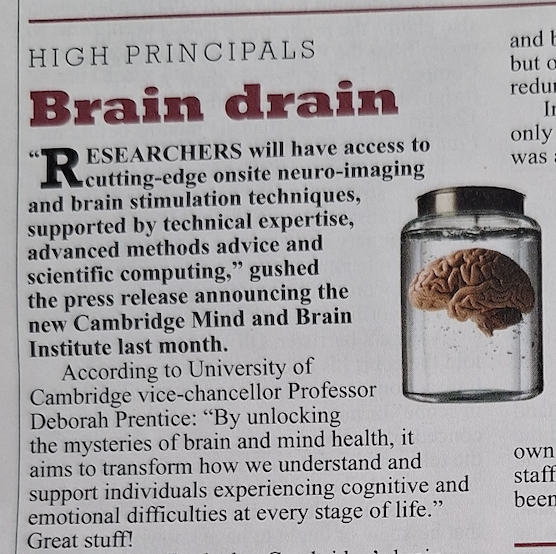
Private Eye’s “High Principals” is a long-running investigative and satirical column devoted to the management of universities and other higher education institutions, particularly the conduct of vice-chancellors, principals, university executives and governing bodies. Unsurprisingly, Cambridge is making regular appearances.
For decades, the Medical Research Council (MRC) research units have been an important part of Cambridge’s scientific reputation. They have provided specialist research facilities, supported generations of scientists and contributed to advances in medical science. Their work has depended not only on distinguished academic researchers but also on experienced technical, administrative and professional staff whose expertise is essential to the functioning of complex research programmes.
The future of these institutions was placed in jeopardy following the MRC’s decision to abandon its traditional system of direct funding for research units.
A funding decision with far-reaching consequences
The MRC’s replacement of its established unit-funding arrangements with a competitive system of Centres of Research Excellence has created considerable distress and dismay.
Under the previous arrangements, the MRC provided long-term core funding to a number of established research Units, enabling them to develop and sustain distinctive areas of scientific expertise over many years. Funding was generally awarded on a continuing basis, subject to periodic scientific review, normally every five years. This approach provided stability and continuity, supporting not only individual research programmes but also permanent research teams, specialist technical expertise, infrastructure and facilities. It allowed Units to pursue long-term programmes of fundamental and applied research, including work whose scientific or clinical benefits might take many years to emerge.
The MRC decided to replace this established system with a competitive model of Centres of Research Excellence (CoREs), under which funding would be awarded through open competition to centres proposing research programmes addressing significant scientific and health challenges. The new Centres would receive time-limited funding, potentially for up to 14 years, with an assessment during the funding period. Rather than supporting established Units through their existing arrangements, the new model would enable research groups and institutions to compete for substantial funding on the basis of their proposed scientific programmes and their capacity to deliver research excellence.
The rationale for the change, as presented by the MRC, was to make its major research investments more strategically directed, flexible and responsive to emerging scientific opportunities and health priorities. However, the change also represented a fundamental shift away from the principle of sustaining long-term research capacity and established scientific communities towards a more competitive, time-limited and challenge-led funding model.
The new arrangements do not provide the same comprehensive financial support as the previous model. In particular, the funding does not necessarily cover the extensive infrastructure and support staff required to sustain a major research institution.
Cambridge hosted six of the MRC units: Epidemiology, Mitochondrial Biology, Cognition and Brain Sciences, Toxicology, Metabolic Diseases and Biostatistics. The University Council quickly announced that it could not absorb all 550 staff and their facilities in one go, given the university’s own financial position.
It therefore faced difficult decisions about which activities to preserve, how to reorganise its research institutions and what would happen to hundreds of employees. These were not simply administrative decisions. They concerned the future of established research communities and the livelihoods of people who had devoted much of their working lives to scientific research.
The human cost of restructuring
The first to undergo transition was the MRC Epidemiology Unit. This went badly with the University seemingly in breach of its obligations under employment law. The Board of Scrutiny in its 31st Report wrote:
Concerns about process, governance and transparency are also reflected in the Board’s consideration of the organisational change arising from the subsuming of Medical Research Council (MRC) Units into university departments. Following the MRC’s decision to withdraw core Unit funding from 2025, the MRC Epidemiology Unit became the first at Cambridge to undergo this process. In April 2026, it transitioned to IMS Epidemiology (Institute of Metabolic Science Epidemiology), part of the Institute of Metabolic Science in the School of Clinical Medicine. According to data seen by the Board, this resulted in 29 redundancies, in addition to other staff departures.
Information received by the Board suggested significant deficiencies in the process, which was overseen by a Project Board. These include concerns about whether consultation met statutory requirements, the late and incomplete release of key documentation, weaknesses in the business case, limited financial transparency, and the decision to run collective and individual consultation processes concurrently. As further Units—and potentially other Departments—undergo similar transitions, it is important that these issues be addressed. The Board was reassured to note that a lessons learned exercise has been undertaken
Unfortunately, lessons do not seem to have been learned. The same problems are recurring with the MRC Cognition and Brain Sciences Unit, which is currently going through the same process as MRC Epidemiology — with the same deficiencies.
The HR division does not seem to be doing any better second time round.
Where was institutional responsibility?
Cambridge is one of the world’s leading research universities. Its reputation rests not simply on the achievements of individual academics but also on the institutions, facilities and professional teams that enable scientific work to flourish.
The University cannot reasonably measure the value of a research unit solely by the income it generates or the funding it attracts. There is a wider institutional responsibility to protect valuable research capabilities, maintain continuity and treat employees fairly.
For sure, the MRC funding changes presented Cambridge with a difficult challenge, as it has so many MRC Units. However, the existence of that challenge does not remove the University’s responsibility for the way it responds. It was happy take teh funding when it was plentiful. It should not push all the risk onto the staff is funding becomes trickier.
Lessons that Cambridge must address
The transition of the MRC units should prompt a serious and independent examination of the University’s decision-making processes.
Such an examination should consider the adequacy of financial planning, the transparency of management decisions, the effectiveness of staff consultation and the extent to which alternative employment arrangements were explored. It should also assess the long-term consequences for research quality, training, specialist facilities and Cambridge’s international scientific standing.
The central issue is not whether the University could have avoided every consequence of the MRC’s funding decision. That may not have been possible. The issue is whether the University did everything reasonably possible to protect the people and research capabilities entrusted to it.
Cambridge has built its reputation over centuries through the work of generations of scientists. That reputation cannot be sustained simply by preserving buildings, departments and institutional names. It depends on people, expertise, continuity and a culture in which scientific excellence is valued.
If the restructuring of the MRC units results in the unnecessary loss of experienced staff and irreplaceable research capabilities, the damage may prove far greater than the immediate savings.
The question Cambridge must now answer is whether it has managed a difficult transition responsibly — or whether, in the process, it has put a valuable part of its scientific heritage at risk.
This is causing real anger, the University has not learnt anything. It’s completely dishonest of the University to say “lessons have been learned”. It happens after every Cambridge mishap and scandal
I assume Deborah Prentice is going for some kind of world record. The University has been continuously in the news for over a year, and it looks as though it will be for at least another year.
“By unlocking the mysteries of brain and mind health, it aims to transform how we understand and support individuals experiencing cognitive and emotional difficulties at every stage of life.”
— Professor Deborah Prentice, a Vice-Chancellor who, in my opinion, lacks basic leadership skills and moral principles, and who may well be remembered as one of the worst Vice-Chancellors in the history of this 800-year-old institution.
And do you know who is presiding over the destruction of the MRC Units? No other than Prof Chinery one of the members of UCam oligarchy and a well known ‘professional’ Responsible Person. A really nice guy. Now the destroyer of the MRC. You could not make this up. He is also a great friend of the Oncology destroyer. The one and only Prof Gilbertson. Lovely characters.
It was particularly galling to see the Mind and Brain Institute recently trumpeted as some exciting new initiative, when in reality it’s a rebranded and much diminished MRC-CBU.
It would be helpful if the Epidemiology lessons learned exercise could be published. It’s presumably too late for the other MRC units, the UIS, the Vet School, and the myriad other ongoing reorganisations. But if there are lessons to be learned, we’d better learn them quickly. 5% cuts don’t appear to be enough and the reorganisations are only just getting going.
I hear that there were many colourful Remarks at the discussion on the UIS redundancies last week, to be published soon.
“support individuals experiencing cognitive and emotional difficulties at every stage of life”
Why do I feel these words will haunt Prentice’s reputation forever?
Words that will haunt Deborah Prentice forever
“This particular case is an aberration …” (12 August, Jason Arday died two days later)
“We reject the evidence of Professor Prentice …” (10 August, Employment Judge Graham at the Whistleblowing Tribunal)
Those who know about events at MRC know that it is a dismal tale of bureaucratic sludge, administrative incompetence, and lawyerly waste when a little common sense (or dare I say brainpower?) could have fixed everything early on. And once again… there seems to be a running theme of overpaid university bigwigs attempting to skim pennies in savings only to exhaust pounds and pounds fixing the problems they create!
Ditto astronomy
What happened was waste of millions of pounds with destructive effects felt by everyone, even the HR Business Manager whose poor advice led to the disaster.
No common sense by the Head of School.
A person can try applying rational arguments & common sense in one of these situations but it rarely works. Academic communities – particularly high pressure academic communities – are communities where inclusion of a person can switch from being at an absolute maximum to being at an absolute minimum in a very short space of time without the person having done anything wrong with respect to an academic community.
If a person gets stuck in a position where one academic community has put the person in a role that it is – from day one – trying to force the person out of which effectively means it will never allow the person to to establish themselves in that role or that would risk the person being able to make the case to stay in that role & no other academic community will take the person in that role until the person has established themselves in that role then a person can spend a decade where an academic community is working towards the maximum exclusion of a person not just from that academic community but from any academic community.
Eventually I realised it was possible for a person to be put in that type of position with respect not just to an academic community but with respect to a nation state and that one of the few things that would be of any use to a person in that type of situation is a practical understanding of mental health so I switched to building an understanding mental health & I stopped being overly concerned about whether what I was doing would lead to an academic career or not.
John Kenny’s paper ‘Effectiveness in Higher Education: what lessons can be learned after 40 years of neoliberal reform?’, may agree with some of the suggested changes to governance in UK universities. Kenny and those whom he cites talk about the approach to be taken by the individual senior management team members to bring about maximum effectiveness –
‘The [findings] also suggest a significant shift in thinking about the desirable capabilities required of those taking up corporate leadership roles in the governance of universities who, while ensuring the organisation can meet its legal and fiduciary responsibilities (Kearns 1998), need more nuanced leadership skills associated with working cooperatively, within an academic culture, moderating external demands and co-designing internal processes and procedures so that the university is able to meet the full range of its obligations in a trustworthy, ethical and efficient manner (Gibbs 2019; Kenny 2008, 2009; Schulz 2013; Smart and St. John 1996)’. The importance of ‘…organisational learning based on reflection on experience, as originally proposed in the seminal work of Argyris and Schon (1974)’ and highlighted by ‘Smart and St. John (1996)’, was proposed to be a key requirement.
‘Moreover, Smart and St. John (1996) claimed that if the focus of corporate leaders and managers is to be more about working within and serving an academic culture, this has implications for the internal recruitment and promotion processes in relation to ‘the qualities of individuals’ who are appointed to key corporate governance roles in universities and how they ‘allocate resources’ within the organisation (233).
Thus while this focus on effectiveness challenges government policymakers and university corporate leaders [?and] stakeholders to be less controlling and more open to an iterative reform process based on learning, it also challenges academics, as a professional group, to take on more responsibility and accountability for their part in the effective operation of the HE system and the leadership of their universities, but this must not involve compromising their underlying academic values perspective. Striking this sort of balance, as Marginson (2011) claimed, would be a ‘challenging double act’ but a focus on effectiveness across the HE system might offer the opportunity to re-think universities as the ‘new kind of institution’ he called for to more effectively serve the public good (430).’
Whatever anyone thinks about the David Sabatini case, Jason Locasale’s conclusion at the end of his Substack article [Locale J. (2026) ‘David Sabatini Won. MIT Lost Its Credibility’ 25 Oct], summarises what should be happening in all universities which are ignoring individuals who raise issues and are carrying out misjudged or career destroying investigations against them –
‘Colleagues who know what happened need to speak up. Media outlets need to report honestly and examine these institutions with the aggression they directed at him. Administrators need to be held accountable for the decisions they made and the damage they caused. Institutions claiming to stand for evidence and truth should have to practice it, even when the truth exposes their own failures.’