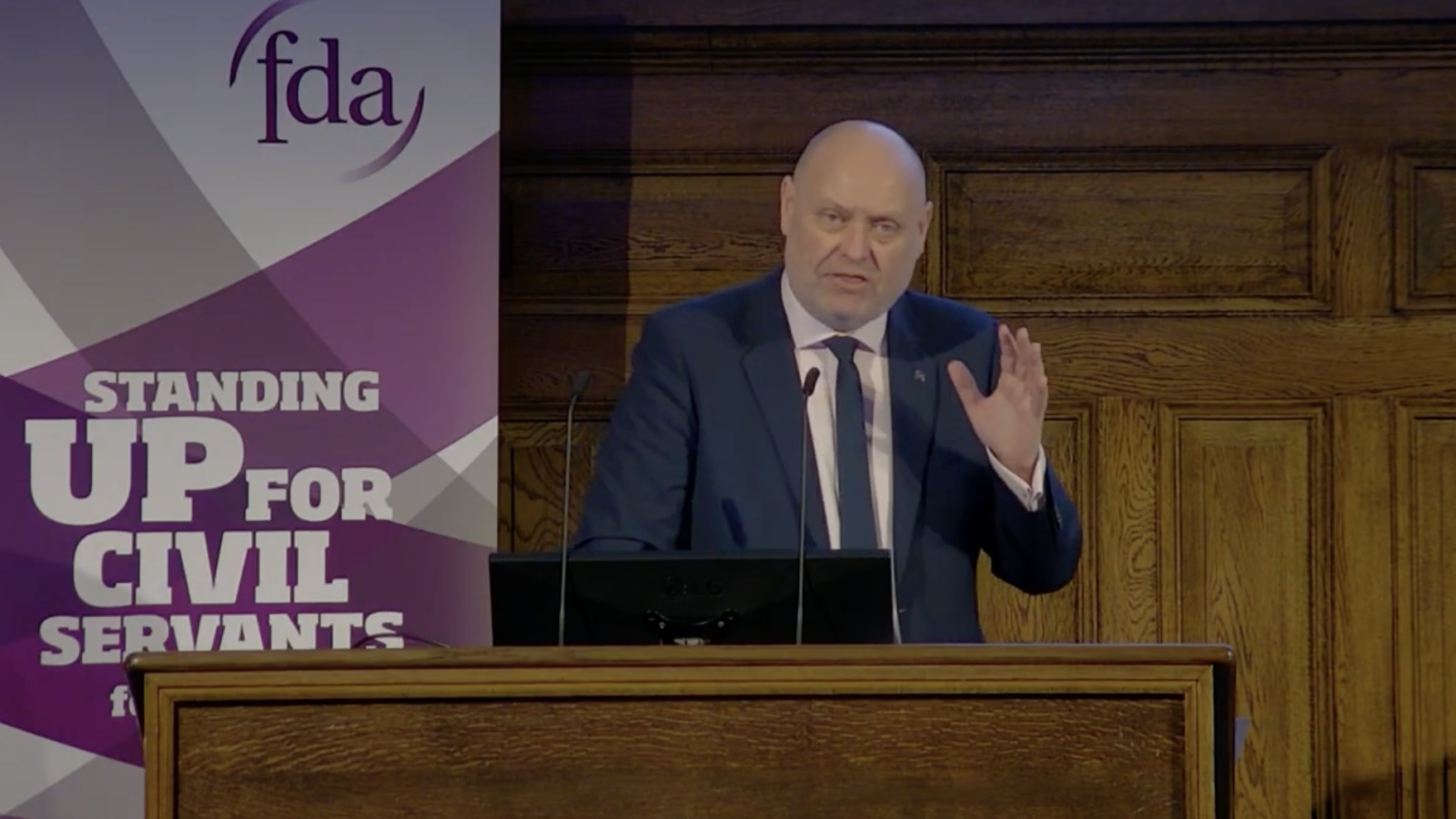
Following a request by Wyn Evans to Council, the trade unionist Dave Penman has been appointed to the Whyte Panel.
Dave Penman is General Secretary of the First Division Association (FDA), the trade union representing senior civil servants and professionals across the UK. Having begun his career as a civil servant in the Inland Revenue, he has become a prominent advocate for workers’ rights, fair pay, professional standards, and the independence and integrity of the Civil Service. He also brings considerable experience and understanding of the impact of workplace bullying.
First elected in 2012, he was re-elected for a fourth term in 2026. His address to the FDA conference in 2026 can be viewed on YouTube here. There is also an interview between Dave Penman and Caroline Wheeler, the Political Editor of the I Paper available here. Both contain some interesting and forthright observations about recent UK Governments, including those led by Boris Johnson and Keir Starmer.
The Civil Service has, in fact, recently been at the centre of a deeply distressing and serious Human Resources (HR) scandal, which culminated in the death of Chloe Moffat.
Chloe Moffat was a personal assistant at HM Treasury in London who died by suicide on 20 May 2025, the day after attending a meeting with managers concerning allegations that she had shared sensitive personal information about colleagues.
She had been called to an unannounced meeting on 19 May 2025 to discuss the allegations concerning confidential data. She was reportedly denied appropriate support and left facing considerable uncertainty about her employment. She died the following day.
An inquest in August 2026 concluded that HM Treasury had “materially contributed” to her death by breaching its own disciplinary procedures. In particular, she had not been told that dismissal was unlikely to be the outcome of the disciplinary process. An internal inquiry into the handling of her case is also ongoing.
The head of global issues at the Treasury, who was running the investigation into Moffat, said during the coroner’s hearing that she did not give Moffat prior notice of the meeting because “she did not want Chloe to worry about it”. She had also told the court that when Moffat asked in tears whether she would lose her job, she had replied that she could not predict the outcome of any potential investigation.
Earlier in the hearing, when asked if she would have done anything differently, Moffat’s line manager told the court: “No, I think we did all we could at the time with the information and advice we were given.”
But the coroner found: “By handling the matter in the way they did, Chloe was denied safeguards.
“The concern that she would lose her job did materially contribute to her state of mind and the decision to take her own life,” Crawford said. She found the Treasury played a part in Moffat’s death by not informing her that the likely outcome would be a written warning and not dismissal.
Notice that HR failed to follow its own procedures, something we are very familiar with in Cambridge University as well. Equally telling is the apparent absence of any disciplinary consequences for the HR professionals involved, despite conduct that would seem to warrant consideration of gross misconduct charges. This, too, is an all-too-familiar feature of the situation at Cambridge.
Dave Penman therefore looks to be an excellent appointment to the Whyte Panel. His experience within the Civil Service will have given him first-hand insight into the ways in which employees can be mistreated by those in positions of authority, including Ministers and senior officials. He will also understand the damaging consequences of inappropriate management practices, failures of HR procedures and the abuse of institutional power.
There are striking parallels with the problems at Cambridge University, where concerns have similarly been raised about the treatment of individuals by over-mighty senior administrators and HR professionals. The underlying issues are remarkably similar: imbalances of power, inadequate accountability, failures of due process and the potential for those responsible for protecting employees to become part of the problem.
We regard this appointment as a positive development. We encourage everyone to provide submissions to the Whyte Panel using this email address.
“Equally telling is the apparent absence of any disciplinary consequences for the HR professionals involved, despite conduct that would seem to warrant consideration of gross misconduct charges. This, too, is an all-too-familiar feature of the situation at Cambridge.”
It would be interesting to know how many grievances have been filed against HR at Cambridge over the past 5–10 years, how many of those have been investigated, and how many have been partially or fully upheld. I have a gut feeling I know what the percentage of upheld grievances against Cambridge HR might be.
Upheld Grievances against HR == ZERO
Let’s look at the matter at the Institute of Astronomy. What happened to some of the individuals criticised or implicated?
Rampton, Gone. Munir, Gone. Peake, Gone (to Disgrace College). Harper, Gone. VC, badly damaged
But no repercussions for Akroyd or Hudson. Senior HR are never held to account in Cambridge. They fuck up and others carry the can.
Bring back shame! Bring back shame!
Hudson has total immunity and is untouchable!
This gladiator knows:
1- she ignored reports that someone senior in the SCM told a junior: ” If someone crosses me I hang them upside down, slit their throat and watch them bleed to death.”
2- she ignored first and second hand reports that two seniors in the SCM jointly seriously bullied a junior to the point of making said junior feel suicidal.
I extend all my sympathies to Moffat and her family, but that is nothing compared to flagrant and reckless neglect of life by Cambridge HR. They know full well when they are putting lives at risk and are entirely happy to do so even when that risk is presented explicitly and repeatedly.
Chloe Moffat story is very shocking.
https://www.theguardian.com/politics/2026/jul/10/uk-treasury-must-change-disciplinary-process-after-workers-suicide-mother-says
“Moffat’s line manager said she was “shocked, crying at points, distressed, overwhelmed” during the meeting. The court heard that Moffat also asked for her best friend at workat various points during the meeting. “We felt this would be inappropriate,” the senior manager said.
The court heard her line manager had been assigned as Moffat’s “pastoral care” despite her direct oversight role, and that she was told not to speak to friends about the allegations and potential investigation.
Asked by the coroner Anna Crawford why Moffat was not offered a friend, trade union representative or other colleague in the meeting, the senior manager said: “Any alternative attendee would have made the meeting feel more formal.”
“Moffat’s parents asked whether it was appropriate that she was not told she was unlikely to lose her job, given that she was in such distress. A senior HR business partner at the Treasury, told the inquest that to do so would have been “unhelpful” at that stage.”
Senior HR Business Partner or inhumane ghoul