
It’s best to look at the data directly and form your own conclusions from it (as @TheResearcher has been saying).
Just look at the damn data.
Run some tests or do some simple visual checks. That way, your perspective is rooted in actual evidence, rather than filtered through second-hand opinions or culture-war narratives.
The two PhD theses are still online: Jason Arday’s here, Paula Zwozdiak-Myers downloadable here if you want to check primary sources. The data are available here on Professor David Harris’ website. These are the materials that Prof Harris, Jack Grove (Times Higher Education) and others submitted to Cambridge and Liverpool John Moores University in September 2025. .
Dr Rhys Morgan, Head of Policy, Governance and Integrity at University of Cambridge, then asked Professor Manuel Eisner, Director of the Institute of Criminology, to conduct an inquiry and write a report.
This report must now be provided, as well as any corresponding report written by Liverpool John Moores University. This is necessary as the Good Law Project have circulated a solidarity letter, claiming
Entirely false allegations of plagiarism were made against Professor Arday and referred to two universities. Investigations have found no evidence whatsoever of wrongdoing.
The letter has been signed by three Heads of House: Lord Simon Woolley, (Principal of Homerton College), Professor Dame Ijeoma Uchegbu (President of Wolfson College) and Sonia Alleyne (Master of Jesus College). It has also been signed by two Cambridge academics, Professor Simon Baron-Cohen and Professor Ricardo Sabates Aysa.
Cambridge’s investigation did not clear Prof Arday of plagiarism, but rather ruled the investigation out of scope.
Our advice is anyone considering signing the letter should first look at the data.
For us, this is not primarily about Prof Jason Arday as an individual. He is not the only case in which individuals appear to have been protected and rewarded within networks at Cambridge University for behaviour that amounts to dishonesty and misconduct. Rather, he is simply the case that has come to light — perhaps for reasons that are not entirely reassuring.
Our primary concern is the complete failure of process. There should be a formal investigation into how these matters have been handled by the Research Policy, Integrity and Governance division. The current situation raises serious questions about both the integrity of that process and the clarity of its remit, with significant implications for the University’s reputation and its duty of care.
We are also aware of other cases in which the Research Policy, Integrity and Governance division appears to have handled matters inadequately, reinforcing the need for a thorough and transparent review.
It is often Early Career Researchers, such as Dr Magdalen Connelly, who have the courage to raise concerns about potential research misconduct by senior academics. These individuals are typically in the most vulnerable position, with limited institutional power and significant personal and professional risks attached to speaking out.
People/institutions who come out of this looking bad
Cambridge University
Times Higher Education
The Good Law Project
Sociology
Simon Baron-Cohen
People/institutions who come out of this looking good
Nathan Cofnas
I mean, just how the fuck did we end up here.
I think you can add a few names to your list of “People who come out of this looking bad” namely:
Chris Smith
Deborah Prentice
Kamal Munir
Bhaskar Vira
John Aston
Rhys Morgan
Manuel Eisner
Jason Arday
Hilary Cremin
Ricardo Sabates
…
I think there are more people who came out of this looking good.
For starters, there is Jack Grove. who didn’t back down – even if his editors appeared to cave to legal pressure – in spite of the risk to his career.
Then there are Professors David Sanders, Dave Harris, Martyn Hammersley, and Ian Pace – all of whom stood up for Dr. Paula Zwozdiak-Myers, and her right to be recognised as the true author of her work. And they did so with no expectation of benefit, and perhaps even some risk to themselves, simply because it was the right and decent thing to do.
There is also Dr. Graham, who saw the unfair nature of hiring procedures and the university’s failure to apply its own shortlisting standards for BAME academics, as well as abuse of short-term appointment cycles, and Dr. Oliveira, who took the risk of raising the issues with the Research Integrity office at a huge risk to his own career – a risk that was swiftly realised, when he had his accounts terminated the very next day.
I also commend this group for rejecting the attempts by Cambridge leadership to stoke a senseless “culture war” and maintain our shared values of respect, integrity, equality, and the upholding of neutral academic standards.
Thank you. There is nothing that Cambridge University can give me that will compensate what it took from me, but I will be very pleased once I know that what I experienced will not happen again with others, staff and students. We are very far from that point, but I promised the managers of the University that I would never let it would, and I meant it. They can call as many Carter-Rucks they want because it will not affect me.
Please understand that none of our individual cases will make a big difference per si. Only when the patterns across cases become clear will the current situation at Cambridge University will change. Arday’s case is helping people to see the real Cambridge.
@TheResearcher
Good point they can never compensate what was taken from victims.
A Cancer researcher wrote in a post that her or his joy of research was killed, and it was the biggest loss. Dr Connelly’s no longer in academia. She had to have been committed to her subject because she learned and researched in 3 highly difficult languages: Syriac, Arabic, Hebrew.
I agree it’s important to be realistic and focus on the long term potential for change.
‘Please understand that none of our individual cases will make a big difference per si. Only when the patterns across cases become clear will the current situation at Cambridge University will change. Arday’s case is helping people to see the real Cambridge.’
In the OneCoin fraud case Carter-Ruck sent letters to a whistleblower with wording like this :
“[T]he statements which you have published […] go way beyond what may be considered to be legitimate debate.”
Carter-Ruck then justified the sending of this type of letter to a whistleblower in this way:
Either [a solicitor] knows that his client’s factual case is false or he doesn’t… But if he doesn’t know his client’s factual case is false, he is bound to advance that case on behalf of his client whatever suspicions he may have,”
If a solicitor is sending a letter to a whistleblower with a legal threat to stop the whistleblower making statements in the public domain instead of sending a letter to whistleblower asking the whistleblower for all the evidence they have to support the statements they are making in the public domain & examining the evidence before taking a legal action with respect to a whistleblower then the solicitor has no real interest in establishing the facts of the case. If a solicitor has no real interest in establishing the facts of a case then the solicitor could not know the clients factual case was false for a very long time.
Legal representation is about making the effort to establish the facts of a case before taking a legal action with respect to a person, it’s not about taking a legal action with respect to a person without making any effort to establish the facts of a case.
https://iclg.com/news/23086-law-firm-partner-faces-disciplinary-proceedings-over-alleged-slapp/
Now Carter-Ruck is seeking legal fees from the Solicitors Regulatory Authority for attempting to hold Carter-Ruck to account in relation to Carter-Ruck’s handling of the OneCoin fraud case i.e. Carter-Ruck have found a new way to make a new group of people – the public who fund the Solicitor’s Regulatory Authority – pay for legal services in relation to the OneCoin fraud case that were never in the public interest.
The public funds solicitors/law firms, solicitors/law firms fund the SRA.
Another insightful comment from Eileen Nugent.
Thanks
Thank you for raising the Connolly case. That was a Cambridge student plagiarised by her Cambridge supervisor. If Cambridge tolerates this well, how long before Arday, who has plagiarised a PhD student in the past, would be accused of plagiarising members of the Cambridge student community? How can students study safely at Cambridge while in fear that this may happen and the leadership backing the accused? And how are Cambridge academics supposed to get published, when now every academic journal will fear that accepting articles from Cambridge professors might land their journal at heightened risk of being involved in a similar scandal in future?
The Connolly case was an exceptionally serious one, that did enormous damage to the victim
The plagiarist Dr Esther-Miriam Wagner was promoted to Director of the Woolf Institute
https://www.woolf.cam.ac.uk/
The victim left academia
@Ffs
Your questions are important.
If one looks at standard definitions of plagiarism, the assumed plagiarist is almost never a prof. If one look at plagiarism research, the subjects of the research are almost never profs. The definition of plagiarism assumes a student or early career scholar is the plagiarist, and case studies almost always focus on cases of plagiarism by students. As for where I’m going with this…
We’re living in times where most younger generations have technological skills and competencies their supervisors and superiors most likely do not have. Some programming languages, AI and thousands of technological tools or softwares are quite new. Data science as a field did not take off until the early 2000s.
If you have some innovative young student who uses these skills and competencies to come up with new findings or reinterpret an old idea, there’s a high likelihood of theft. Society has a blindspot that makes it unable to see profs as plagiarists of the research of students or early career subordinates. It’s no coincidence that historically profs have been white straight men: who oversees them or holds them to account. I’m not making a joke.
British society also has a blindspot regarding Oxbridge where it’s thought the most famous and prolific professors are simply the most brilliant. The reality is they’re in the best positions to plagiarise and get away with it.
Cambridge lives in the past and refuses to address the realities of the time. If not for the 21 Group, there’d be even less public awareness of the realities facing vulnerable scholars, that Cambridge fights to conceal.
Stock’s article archived
https://archive.is/20260728230827/https://unherd.com/2026/07/jason-arday-cambridges-dei-darling/
“Ultimately, there are likely to be many losers in this embarrassing debacle: deserving young scholars who were overlooked as Arday was appointed, now lost to the profession; fee-paying students who came to Cambridge or Glasgow to bask in the intellectual glow of world-class academics, and got some waffle about Australian soap operas instead; accomplished black or brown researchers smeared by association, now facing abuse online from hereditarian idiots who assume that Arday’s case is the norm. And ultimately, Cambridge University will be a massive loser, deservedly so. It is a necessary condition of the place’s continuing glamour and prestige that it enforces rigorous academic standards. To be shown not to care about this, in such a public way, is an act of catastrophic institutional self-harm.”
Required reading. Her article is common sense – not in a right-wing culture warrior kind of way, just in an extremely-obvious-to-us-all kind of way. And bizarrely at the end she manages to show more empathy with Arday than any of his backers have done so far.
As I said on the previous post, this is a case of clear and widespread plagiarism.
I’m a black academic in Cambridge and I’ve had pressure over the last days to get in line and support the view that it’s a campaign of lies to undermine Arday. It is not.
@TiredInCambridge I empathise wholeheartedly. This is SUCH A DISSERVICE to other Black and ethnic minority staff at Cambridge.
I call it The Antiracism of Racists. A huge boost for racism.
Members of Cambridge University who raised concerns of misconduct know that the evidence is not checked. It does not matter how much evidence we have, how clear and unambiguous it is, because it is simply not checked. The decision is made a priori. Therefore, the behaviour of Rhys Morgan and his team—with whom I have interacted extensively—does not surprise me at all. What I am finding shocking is how people who are not even affiliated to Cambridge do not look at the data and reach their own conclusions. Instead, they mobilize the authority of Cambridge University and Liverpool John Moores University to support their view, without appreciating that these institutions have obvious conflicts of interest and no longer can be trusted.
We need an external—independent—investigation of this case and the Research Integrity Office at Cambridge University more generally. I already asked Dr Morgan if his team is part of HR and if they will be affected by the proposed Grace asking an external audit of HR practices. And while he has been addressing other issues related to me as he has been doing an “investigation” regarding my report of research misconduct at DAMTP, he overlooked my queries about the Grace, which is the standard answer of the University to uncomfortable questions.
For the records, I already asked Rhys Morgan and John Aston why the Research Misconduct Office decided to not conduct an investigation about the alleged plagiarism of the Arday case because that decision does not follow from the Procedure for the Investigation of an Allegation of Research Misconduct:
https://www.cam.ac.uk/sites/default/files/procedure-for-the-handling-of-an-allegation-of-research-misconduct-20260212.pdf
@TheResearcher
Very interesting.
‘Members of Cambridge University who raised concerns of misconduct know that the evidence is not checked. It does not matter how much evidence we have, how clear and unambiguous it is, because it is simply not checked… What I am finding shocking is how people who are not even affiliated to Cambridge do not look at the data and reach their own conclusions. Instead, they mobilize the authority of Cambridge University and Liverpool John Moores University to support their view…’
In several dismissed cases, the evidence was ‘investigated’ at a superhuman speed. It seemed mathematically impossible it was scanned let alone thoroughly examined. The Research Integrity Office repeatedly frustrates and fails the cases of whistleblowers. The only exception is, as has been said many times, when the subject of the complaint is disliked by administration.
We are now more than one week in to this scandal, and to my knowledge – in spite of the millions of people who have read the stories, watched the news, and posted comments – to my knowledge, not one single person, not one, has come forward to attest in their own words that yes, Jason did in fact raise the millions for charity he claims to have raised and here is the evidence, nor attest to having witnessed Jason’s sporting accomplishments, nor has any expert presented their own plagiarism analysis exonerating Jason of all allegations against him.
Not one person. Not one.
If that is not a red flag… I’m sorry, but I do not know what is.
And don’t forget, they were expecting this. They had the better part of a year to prepare for this – plus the backing of some of the best lawyers and PR experts money can buy – including those working at Cambridge, an institution with billions of endowment money to throw at the problem, for the sake of reputational protection, and the best they could do was a petition that even followers of the organisers have widely ridiculed.
Cambridge University are about to test Campbell’s Law, which states “that a political or public figure in a media storm must resign if the negative story dominates the news cycle for more than 10 to 14 days”
This is Day 9.
Of course, the running of Cambridge University has been pretty much in the press for the last 6 months
If I were Arday I’d be fucking furious at the university right now. They told him they were protecting him when really they were only protecting themselves. If they really wanted to protect him they would have offered him a comprehensive fact-check, helped him clean up his profile, and moved him over a side role (or ideally a new institution entirely), while maybe advising him to slow-pedal the whole publication of memoirs thing and take it slow for a while. That would have actually been in line with their duty of care. But they didn’t care. Now it appears as if they are deliberately keeping him silent in order to stop him from defending himself in the best way possible for his own future (as suggested by Kathleen Stock): to spill the beans about what really happened and rebuild his career as a public activist.
Plagiarism Today also covered the case:
https://www.plagiarismtoday.com/2026/07/28/race-cambridge-and-the-jason-arday-plagiarism-scandal/
“Arday also has significant support. A letter of solidarity has over 600 signatories, including many of his colleagues at Cambridge”
600 signatures? This is nuts!
Actually, over 7000 signatures according to the GLP letter (top right) WOW
https://goodlawproject.org/petition/stand-in-solidarity-with-jason-arday/
VERY well put from the article above:
“Right off the bat, I want to state the obvious. Cofnas is a terrible source for these allegations. His staunch anti-DEI stance as well as his history with Cambridge give him both personal and ideological reasons to attack Arday. According to the Retraction Watch article, this is echoed by Martyn Hammersley, a sociologist at Open University who reviewed some of Arday’s work and has concerns.
There is not much doubt that this is a politically and ideologically motivated attack. It is a grotesque example of the weaponization of plagiarism, in particular against Black and/or DEI-associated academics.
However, just because the source of the allegations is dubious does not mean that the allegations are false. To that end, I did not have the needed time to review the case to my satisfaction to state whether I feel Arday plagiarized or not.
Such an investigation would likely take weeks given the volume of the work. Instead, I sought to answer a different question: Does the evidence presented support performing a more thorough investigation?”
Yes, it’s a good article from a liberal American blogger who writes with expert knowledge about these issues
And he raises another issue which is likely important and has so far been ignored:
“One is celebrity. There’s not much doubt that Arday is a major celebrity for Cambridge. We’ve seen schools go to great lengths to protect their famous faculty members. We saw this with Pamela Whitten, Francesca Gino, Étienne Klein and more. Universities are always reluctant to investigate their own, especially when they are celebrities or otherwise lucrative.”
@Sojourner
Thanks, going to check out that Plagiarism Today article now
I agree with the point that a slanted medium (Cofnas’s blog) doesn’t always mean the message is slanted.
‘VERY well put from the article above:
“Right off the bat, I want to state the obvious. Cofnas is a terrible source for these allegations. His staunch anti-DEI stance as well as his history with Cambridge give him both personal and ideological reasons to attack Arday. According to the Retraction Watch article, this is echoed by Martyn Hammersley, a sociologist at Open University who reviewed some of Arday’s work and has concerns… However, just because the source of the allegations is dubious does not mean that the allegations are false.” ‘
A commenter writes: “how are Cambridge academics supposed to get published, when now every academic journal will fear that accepting articles from Cambridge professors might land their journal at heightened risk of being involved in a similar scandal in future?”
I agree with this (academics at Cambridge lining up to defend Jason are like turkeys voting for Christmas) but think there is something more awful about this mess.
Not only will all Cambridge academics be distrusted for their honest contributions in future, but Black and minority ethnic academics at Cambridge, IN PARTICULAR, will now be subject to such distrust, even when it is entirely unfair to do so, on account of this failure to uphold impartial standards of research integrity for all.
The university is not fighting structural racism. They are reinforcing it. We must say loud and clear: NOT IN MY NAME.
“The university is not fighting structural racism. They are reinforcing it. We must say loud and clear: NOT IN MY NAME.”
Correct.
And apparently everybody is so eager to be seen fighting the good fight that they have forgotten to fight the good fight.
How, though, to say Not in My Name? On the one hand, the paternalists and Black elite of the Good Law letter. On the other hand, undoubtedly, racists and transphobes, culture warriors.
It’s very difficult to carve out a position that is neither of these. I know for a fact that a number of very good people in the university are deeply dismayed, that is, teaching and research staff. But we are completely stuck now in what is a full blown culture war.
Please note Stock refers to what I raised yesterday–social media attacks on other academics of colour at Cambridge. Somebody here, I think Eton Mess, was suggesting that was not happening.
No, the topic was hate mail.
Social media vitriol is clear to see.
I asked for confirmation if you’d seen cases where hate mail was sent. That’s an escalation of the social media vitriol. It’s more threatening and targeted. I think it should be taken seriously and reported for the harassment it is.
But if the University was the one saying cases were happening, I’d be sceptical they were attempting to silence the Arday stories in the name of safety when they are the source of the safety problem in the first place. None of the harassment should or would be happening if not for the apparent cover up.
Cambridge University somehow managing the worst damage-limitation exercise I have ever seen..
I thought we were paying top dollar for top talent to manage these kind of things expertly
Anyway, if anyone gets a decent letter done –e.g. on here, I’ll sign and get others to do so as well. It would need to be worded very carefully, and be clear to separate itself from the likes of Cofnas and, frankly, Harris, who appears to be a culture warrior himself targeting ‘Critical Race Theory’ researchers.
A culture warrior?Moi? Please read my book on CRT, or at least the extracts (free) on Amazon. It is horribly balanced and academic. For that matter, read my notes on the more than 100 pieces I read ( many by CRT people) in preparation for the book: https://www.arasite.org/whiteness.html Or read what I wrote to Arday in 2024 https://www.arasite.org/Ardaypage.html
Arthur Spirling wrote this morning on X,
“Last thing on the plagiarism du jour: it’s really important not to mix up the potentially non-malign intent of the accused with “acceptable practice”. Seeing serious ppl do this [signing the GLP letter] is v demoralizing for those of us who have had to teach/litigate these things in university settings.”
Fun fact, he is a Professor of Politics at Princeton University:
https://politics.princeton.edu/people/arthur-spirling
Does he know where the VC of Cambridge University comes from?
Another one on The Telegraph, now on the 600-mile run.
https://www.telegraph.co.uk/news/2026/07/29/cambridge-diversity-poster-boy-fresh-row-marathon/
And another, same photo but different topic:
https://www.telegraph.co.uk/news/2026/07/29/academia-has-a-much-bigger-problem-than-plagiarism/
“Academia has a much bigger problem than plagiarism”
Arday gained his professorship at Cambridge on the back of his stated public activism and charity fundraising record, making this a legitimate area of investigation for the university. However, to date, no charity, not Shelter, not Shooting Star Children’s Hospices, not WaterAid, none of the “70+”, has publicly issued a statement confirming receipts of the totals attributed to Arday, or the individual campaign amounts. Regarding Jason’s running claims, it seems the same so far. To date, no race organiser, timekeeper, running club, or fellow runner has been quoted in any coverage vouching for the events. UK Athletics’ Power of 10 database shows no times, not even a parkrun, for Arday. By contrast, Southampton Solent removed the 300-mile and 600-mile references from his honorary-degree citation, and Anglia Ruskin edited “600 miles in six days” to “600 miles in 12 days”.
But did he do the “600 miles in 12 days” or it was amended to simply look more believable? As a person used to long-distance running, namely in the context of Ironman races, I can only say that it his running feats are not trivial at all. I would be very keen to go for a run with Prof. Arday at some point, but I guess he is now very busy with other issues.
It is a bit suspicious that 6 days became 12 (mathematically, simply doubling the number). But in terms of fraud, the bigger issue is around the fundraising claims (£5.5m across multiple charities) —– of course It might be true, and there’s no positive evidence yet otherwise (I am open to facts and evidence, as we should all be), but you might expect by this point someone to have spoken out to attest to the amounts, no?
https://bsky.app/profile/profjasonarday.bsky.social/post/3mrrlu5llok2z
“If only academia could hold itself to the same high standards as the legal proffesion. Carter-Ruck are almost as inspirational as me” (posted today by Jason Arday)
Who is advising Jason Arday & is he receiving the right support?
Among the many troubling issues this case raises for Cambridge University is the complete absence of duty of care it owes to its employee.
As the 21 Group knows, Cambridge University does not even consider the duty of care to its own students. The place is a complete joke.
Did he really write that? Now I am seriously worried that what we are looking at here is a guy with deep learning difficulties and problems around social awareness being thrown in by Cambridge to a situation which is utterly abusive to him and utterly horrific to all onlookers. No-one can fail to be aware of the issues around Carter-Ruck, or more specifically, its client list. Nor can they be aware how deeply damaging it is for an individual with Arday’s public profile – working or lower-middle class, ethnic minority, and so on – to have made them his primary point of support, rather than colleagues who can advise him on how to open up, acknowledge fault where fault is due, and above all seek help. But on the other hand I also wonder if there is simply at this point no-one left in Cambridge or academia he can trust either.
It was certainly posted on his Bluesky account.
We agree that what he needs to do is “open up, acknowledge fault where fault is due, and above all seek help”
We’re at the point where thing’s really can’t get much worse, but if Carter-Ruck gets involved, then they’ll find a way.
Lawyers are not your friends, no. They do a narrow service, and you need to hold them accountable not to protract your problems for their own interests (e.g. charging as much as possible) rather than what is best for health, reputation and livelihood.
But if Jason’s only point of support right now is Carter Ruck, wow – the firm is carrying a huge ethical responsibility and liability on their shoulders, albeit one entirely of their own choice and decision.
Again what makes this abusive is that all the people Jason trusted have violated that trust. Is there anyone who can act as his genuine point of support? I am worried.
21 Group, note that the same account posted on 25 July,
“Exciting invitation to appear on Would I Lie to you. Can’t wait to cross the swords with Ian Hislop”
https://bsky.app/profile/profjasonarday.bsky.social/post/3mrhnqmqvps2c
What is most outrageous is the fact that this letter states as a matter of fact that “entirely false allegations of plagiarism were made against Professor Arday”. Really? The evidence seems quite damning. If these allegations were entirely false, it should be very easy to publicly disprove them, and then newspapers would embarrassingly retract their stories. The fact they they don’t present this evidence, and instead throw assertions around is strong evidence of what is in fact the truth.
But instead Lord Woolley, Dame Uchegbu, Sirs Baron Cohen and Vernon and Professors Alleyne have embarrassed themselves, the academy and Cambridge Univeristy by attempting to excuse misconduct. How can they tell students not to plagiarise when they appear to excuse it themselves?
I decided to improve on the letter in support of Arday:
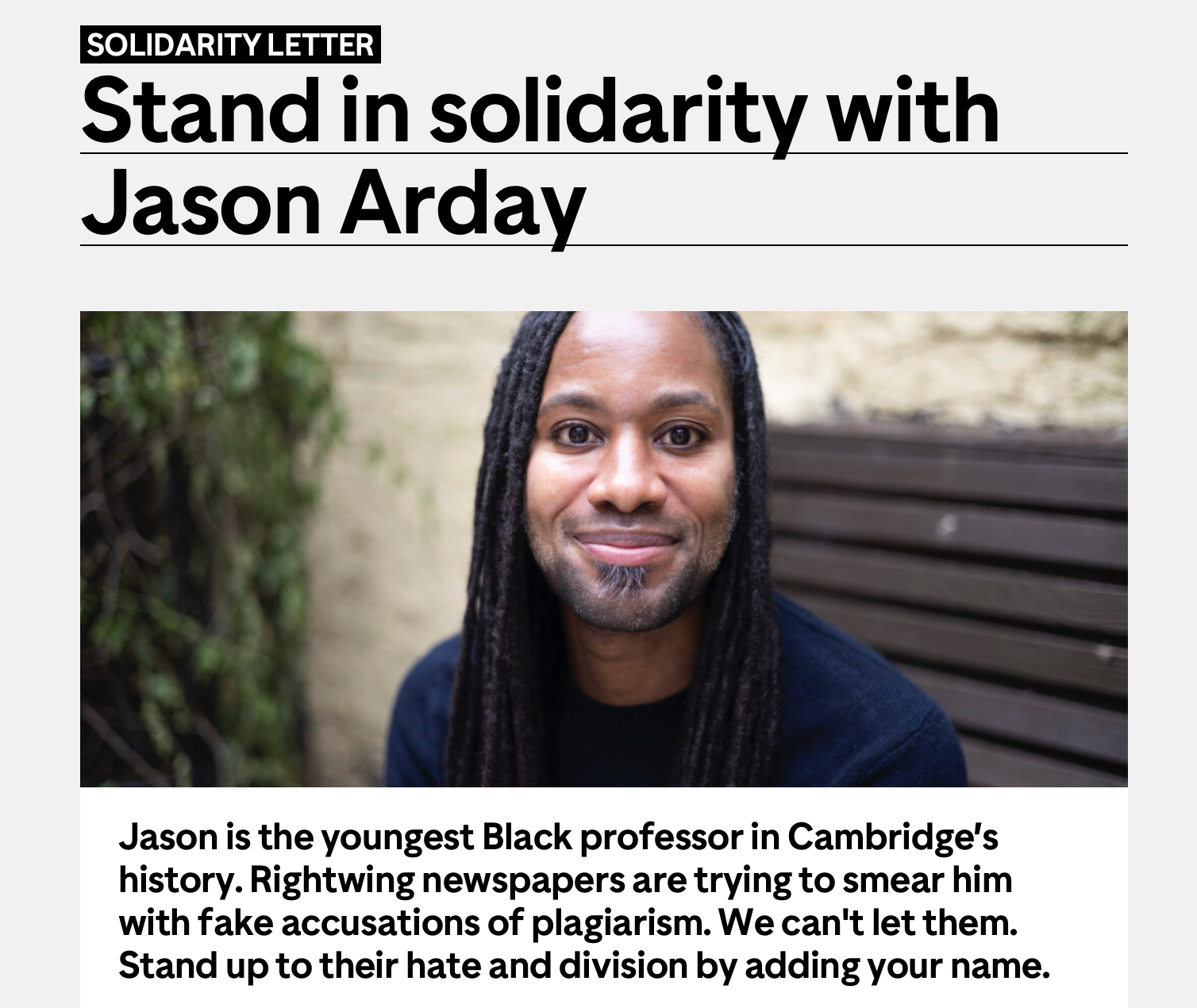
Jason is the youngest Black professor in Cambridge’s history. Rightwing newspapers are trying to smear him with fake accusations of plagiarism. We can’t let them. Stand up to their hate and division by adding your name.
Allegations of plagiarism were made against Professor Arday and referred to two universities. Investigations concluded that the allegations did not warrant institutional action. We therefore believe that nobody should examine the underlying material, compare the relevant passages, discuss academic attribution standards, or form an independent view.
Academic integrity is important. But it must never become so important that it inconveniences an academic whom we admire.
Rightwing media have continued to report on the allegations and the disputed passages. This should concern everyone who believes that academic freedom means freedom from criticism, that due process means the permanent suppression of questions, and that an institutional finding must end all public discussion.
It is difficult to ignore the question of motivation. Indeed, we find it much easier to discuss the motives of those raising concerns than to discuss whether words or ideas were reproduced without adequate attribution. The latter would require tedious comparisons of texts, whereas the former allows us to dismiss scrutiny altogether.
Professor Arday became the youngest Black professor in the University of Cambridge’s history. His remarkable journey, scholarship and leadership should be celebrated. We further believe that these achievements should render close examination of his academic work unnecessary, if not actively improper.
Professor Arday has contributed to public life for many years and has a distinguished record of charitable and community service. We regard these accomplishments as relevant not merely to his character, but also to the entirely separate question of whether conventional citation practices should apply to him. Good works, in our view, should function as a transferable stock of academic attribution credits.
The discussion of Professor Arday, and more recently of Misan Harriman, risks creating a chilling effect. Successful public figures may begin to fear that journalists will inspect their work, compare it with earlier sources, and publish what they find. Such scrutiny could discourage people from attaining positions of leadership—or, at the very least, from borrowing material quite so confidently.
We therefore stand in unwavering solidarity not only with Professor Arday, but with the broader principle that plagiarism should be assessed primarily by reference to the identity, achievements and political sympathies of the person accused.
We call on universities to defend academic freedom by discouraging robust examination of scholarship. They must confront racism wherever it manifests itself, while also recognizing that allegations of inadequate attribution can be neutralized by describing those who raise them as politically objectionable.
There can be no place in higher education for campaigns that weaponize textual comparison to damage reputations and careers. Universities must ensure that excellence is protected and that every scholar is judged not by such narrow technicalities as originality, quotation marks and citations, but by whether sufficiently distinguished signatories are willing to say that the matter is closed.
Ultimately, it was Jason who brought this upon the university and now, only he can make it end, by admitting openly to his acts – and at last seeking the help that he so desperately requires.
We remind posters of our comments policy
We subscribe to the principles of academic freedom and freedom of speech
If you believe a comment needs attention, please email us at [email protected]
We reserve the right to redact or even remove posts that are abusive or potentially libellous.
Happy posting. (There are still > 50 posts regarding the Whistleblowing Tribunal which are being held back. They will all be released after the judgment, expected in September)
Another article by UnHerd, “Publisher stands by Jason Arday memoir amid plagiarism allegations”
https://unherd.com/newsroom/publisher-stands-by-jason-arday-memoir-amid-plagiarism-allegations/?edition=us
Archive version here: https://archive.is/RTsJ7
Clearly, the publisher is absolutely over the moon.. They will do well out of this.
Whether it’s in anyone else’s best interests is very doubtful.
Honest question: Who will buy the book? It is fine to write memoirs and to write fantasy novels. Each of them have their place and are valuable. But if you publish a fantasy novel and you present it as a memoir when the public is already concerned about the veracity of what you write, it does not seem to help the author. Any publicity is good publicity to sell the book?
And another one on Arbiterz, which I believe is Nigerian digital media platform:
https://arbiterz.com/jason-arday-cambridge-professor-faces-renewed-scrutiny-over-plagiarism-claims/
“For Cambridge, the case has become a test of two duties that universities often struggle to reconcile. One is to protect staff from harassment, bad-faith complaints and racially charged campaigns. The other is to demonstrate that concerns about research integrity are investigated rigorously and transparently. Arday’s extraordinary biography explains why his appointment carried such symbolic weight. It cannot settle the argument about his scholarship. Only a clear account of the evidence can do that.”
Wasn’t Arday also accused of plagiarising a Nigerian scholar, a co-author of one of the papers? With so much information about the topic I do not know if this was a comment I read or not, but this Nigerian media does not mention it.
And in National Review:
https://www.nationalreview.com/corner/cambridge-can-but-evidently-wont-catch-jason-arday/amp/
“Arday had gotten wind of the piece and realized that the jig was up. His (tellingly cynical) response was to take advantage of Britain’s scandalously censorious speech laws and hire one of its most notorious defamation firms to threaten defamation proceedings should the piece go to press… That sort of response — to acts arguably far worse than what ruined Gay at Harvard — is the most brazen sort of stonewalling: the presentation of a united administrative front to simply silence opposition.”
If they knew that despite the current scandals, UCam continues to retaliate against students in the background simply because they reported misconduct and did not accept being silent…
What does “critical race theory” have to do with anything? Aggressively racist outfits carrying this story with the usual racist talking points is a big part of the problem. Makes it difficult to focus on the real issue here but I can see that at least one regular poster here spends a lot of time on these sites.
I think no small number of Cambridge staff and students have their Google alerts set to every new story. It is a bad addiction I admit but forgivable….
Your comments suggest you are very knew to the 21 Group and did not yet realise that most people here do not discuss politics but bullying and harassment in UK universities, namely at Cambridge University. You will surely not see any post from me on politics or motivated by politics. My search regarding the current events is based on topic—Cambridge University, Plagiarism, Jason Arday, Cover Up—not on specific journals as I do not follow any of these journals.
This said, I noticed that some of your posts have the potential to antagonise posters, which is rather uncommon in the 21 Group if you see our past posts for the last 12 months for example. From my side, it is fine and you are welcome to comment as you find appropriate but I thought I should let you know as it is rather unusual in the 21 Group and may make people uncomfortable.
@sojourner – everyone is welcome here, it is a free speech safe space
The only one in Cambridge left!
Researcher, thanks. So ‘free speech’ but not ‘speech that might antagonise some’? Got it. Very cogent.
The idea that bullying is outside politics is so laughable as to be not merit comment. But got, not welcome.
Ciao, ‘free speechers’!
I was warned by people that 21 percent is a ‘bunch of disgruntled white guys with the usual DEI ax to grind’ but I thought the comments showed a good mix of sharp and foolish, so ventured on here. Big mistake!
With the racists on one side, and a number of you on the other (?), good luck to all! Out of here.
I’m neither white nor old. No one is anti DEI quite the opposite. Your contribution is welcome any time.
I thought you had some interesting things to say. But you are being hyperbolic. TheResearcher defended your right to speak freely and never suggested that ‘speech that might antagonise some’ was inappropriate.
Critical race theory is a field designed to create work for middle class academics. It’s part of why Arday was employed, so it is relevant. It is unrelated to the left-wing tradition of anti-racism, which was universalist and which explained racism both as a pseudo-scientific explanation for class differences and as a means for the ruling class to divide the working class.
And another from Times. It is hard to keep track of them all!
“Cambridge University professor faces scrutiny over fundraising claims”
https://www.thetimes.com/uk/education/article/jason-arday-cambridge-university-professor-faces-fresh-scrutiny-claims-l83qps8b2
Meanwhile, Prentice et all continue with the nap…
Why hasn’t someone created a petition for the university to investigate the plagiarism? The silence here is defeaning.
I think a lot of people would be reluctant to put their name on it for fear of being tarred with racism/anti-DEI brush, given that is now how this is all being framed. But what about an Action Network email campaign or something? A page that lets people send an editable pre-written email to the VC to call for an investigation?
Our view is that this may be needed if some sensible University response has not been provided soon
“a lot of people would be reluctant to put their name on it for fear of being tarred with racism/anti-DEI brush”
Tarred by whom? By people who do not even see the data? Every person knows their motivations to sign such a collective action. If their motivations relate to research academic integrity and honesty, they should not fear external noise and act instead according to their morals. This said, it can be argued that people who do not want to act and prefer to look the other way, always find excuses to not intervene. You see the same behaviour regarding other forms of misconduct at Cambridge University.
Great piece! I do not know if I pick the spokesperson over the Vice-Chancellor, but one of them for sure is the most pitiful person in this story. As the latter gets £50K every month, I will have to agree with Gelman and pick the spokesperson as well.
https://statmodeling.substack.com/p/whos-the-most-pitiful-person-in-the
What is pitiful is that one day, someone will post the name of the “university spokesman” communicating lies to the world, and just how little they needed to be paid to do it.
“It’s easier to fool people than to convince them that they have been fooled.”
This quote was recently used in the context of the behaviour of Jason Arday. However, it can also be particularly appropriate to describe the behaviour of Cambridge University. Many people, including myself, have been fooled by this institution. In my case, it took me a while to understand that I had been fooled, not only by the people I trusted the most but by the institution itself and accept that I would not have justice through the internal processes that the University has to offer. But I can only say that it is particularly distressing for me to know that many members, both staff and students, continue to be fooled and there is little one can do to help them because waking up from the magical spell is a personal journey. Most people will only truly believe when they experience the misconduct, cover up and retaliation themselves.
Please remember that the Arday case is just one among very many scandals that Cambridge University has been covering up for many years damaging the career, health and education of many people. This is the machine that needs to be stopped because it seriously damages people’s lives.
Exactly. At the same time they were paying aggressive defamation lawyers to cover for Jason’s lies, they were engaging in aggressive defamation against whistleblowers who raised fair concerns. That is the real hypocrisy.
This is day 10, the University has completely lost control of the story
Be genuinely interested in what endgame the University is aiming for here
This has been so badly handled it looks like someone senior will have to walk
We’re at the the stage where Debs has to sacrifice someone … or she’ll be the sacrifice
“Cambridge is coming out very badly from the Jason Arday affair”
https://spectator.com/article/cambridge-is-coming-out-very-badly-from-the-jason-arday-affair/
If you are following the online firestorm you will see that calls for resignations from alumni and others have already being made. But this is not one the university can solve simply by blaming people like Cremin or Sabates, or even this or that Pro-VC, because it implicates the communications office, legal, and quite possibly the VC also, and at a minimum, this all happened on her watch. This is the only plausible reason for the total paralysis from the university at this point. They clearly are enmeshed in bitter infighting with no agreement on any sensible course of action or response.
Most probable resignations
Head of Legal (if University are implicated in Carter-Ruck, this is 100 per cent nailed on, and completely deserved)
Heads of Comms (almost inevitable, complete catastrophe on his watch)
Rhys Morgan (almost inevitable, complete failure)
Also in the firing line
ProVC for Research, John Aston (very sad, but he’s in charge of research)
ProcVC for Education, Bhaskar Vira (not so sad, but his statements on Arday look completely ridiculous)
VC (as the dithering continues, this is becoming more likely — especially as more scandals to come — it’s just delaying the inevitable)
Aston – could survive this if he breaks rank early and comes out in support of research standards. In fact: I cannot see him taking any other position (even if he resigned tomorrow). Remember, many figures who have denounced the university over this (e.g. Gelman or Spirling) are leading figures in the domain of statistics and machine learning; so that fact makes it a broader reputational risk for him in the profession, and one that goes well beyond his Cambridge standing but to academia as a whole.
Legal – if involved in Carter Ruck they are already Carter Fucked; but doubly fucked if legal challenges to historical plagiarism decisions start to arrive and cost the university yet another massive bombshell.
Comms – already a laughing stock in the press. How can they ever be believed again under current management?
Morgan – similarly in the same boat as Aston, though I guess Aston could fire him as part of his redemption arc here?
VC – does anyone think she will last out the rest of her term to 2030?
Looks about right
1. Head of Legal & Comms will have to go, be surprised if they’re in place in six months time
2. Head of Research Integrity, he’s doomed. Nailed on
3. VC, she has no real base of support, very vulnerable because of repeated failures, probably will go very soon (maybe by Xmas?). May even be negotiating her landing berth now.
4. Vira maybe survivable, but weakened
5. Aston, the most interesting, could turn out to be a big winner, but also one of the most vulnerable if he gets response wrong. Must be pondering Gelman’s substack now.
A VC does not need that others tell her what to do. In this case it is necessary because Professor Prentice has shown that she is not a good leader and in practice does what HR and legal tell her to do. If they followed basic principles of accountability and care for members, instead of reputation management, they knew exactly what to do: To request an external investigation about this and other cases of misconduct that have accumulated for the last several years. But guess what, they will not do it until we press this action through the press, relevant MPs and sponsors.
Meanwhile, they continue with retaliations in the background at this very moment.
“Meanwhile, they continue with retaliations in the background at this very moment”
Dr Oliveira, thank you for your persistence and dedication to protecting students and scholars. You blew the whistle over plagiarism and research misconduct with the university right? What have they done since this scandal became known?
Yesterday, the University of Cambridge decided to send me their decision regarding my appeal against my expulsion as Cambridge student described here (https://21percent.org/?p=3618).
Guess what, they dismissed my appeal, expelled me permanently from the University and do not allow me to finish my degree, while ignoring the evidence I had sent them and the evidence I wanted to send that depends on other parties. They knew that I was expecting a reply from the University lawyers and Shakespeare Martineau today regarding a series of questions I had asked and that I was planning to apply for an injunction. So, what did they do? They expelled one day before completely ignoring what had been discussed before. Now come the really disturbing thing, this institution expelled me after I reported serious misconduct that was never investigated and after applying an unprecedented number of measures to silence and break. But after they expelled me, they still state:
You must not contact or attempt to contact (either virtually or physically) any of the following individuals:
i) Dr Mike Glover
ii) Mr Kris Cressy
iii) All HR staff from the University of Cambridge
iv) All DAMTP staff from the University of Cambridge, except Professor Mike Cates
v) Ms Nikki Bannister
vi) Dr Alex Pryce
vii) Ms Alice Benton
viii) Dr Emma Rampton
ix) Professor Debbie Prentice
x) the Pro-Vice-Chancellors.
I cannot even contact people who no longer work for the University! This is nuts!!! Who were the members of the appeal committee you may ask?
– Professor Gemma Burgess (Chair)
– Mrs Liz Osman
– Professor Caroline Warman (Junior Proctor of Oxford)
Yes, you are right, if you noted that a Cambridge Proctor had to be a member, not an Oxford one,you would be right but they refused invoking according to OSCCA “conflicts of interest” that included, among other things, the provision of “pastoral care” to me, which is absolutely false. Fun fact, Professor Gemma Burgess is a colleague of two of the complainants, Mr Kris Cressy and Dr Alex Pryce who worked for HR and OSCCA before and now work for St Edmund’s College as College Bursar and Senior tutor, respectively. The same for the Secretary of the Appeal Committee who chose the Chair, Ms Anna Puttick from OSCCA, managed directly by Ms Nikki Bannister. These people have no concept of conflicts of interest and it is absolutely irrelevant what you send them as evidence because they made up their decision before any “investigation.” I guess they will have to hear my name regardless.
Of course, they also knew that the Grace asking for an external audit of HR practices and the Whistleblowing Tribunal Case whose verdict we will hopefully know in September, would help my case. Therefore, they decided to ignore these and other factors mentioned in my appeal, namely medical evidence, and dismissed it now.
Do I understand this correctly: Cambridge has just expelled the student who raised concerns over Jason Arday.
Please confirm. Also I note no restrictions on communicating with the press. I think some people might like to hear from you.
I did raise concerns about the involvement of Carter-Ruck in this case on 24 September 2025 to the Pro-Vice Chancellor Professor John Aston, he never replied, but strikingly, one day after sending him an email, I received “Special Precautionary Measures” from the Head of OSCCA Ms Sarah d’Ambrumenil that involved limiting my use of my @cam account and threats to silence me.
This said, my main cases are not related to Arday but to research misconduct and cover up at DAMTP, as well as the reporting of mistreatment of a 19-year old by senior Professors at DAMTP, a student who incidentally, had been chosen for working with me by DAMTP because of his very high widening participation score. Some of the details can be found here (https://21percent.org/?p=3449) and in the subsequent post titled “Towards the Iceberg” from 14 April 2026.
I should also clarify that the Cambridge MP, Mr Daniel Zeichner, is aware of my story, how I was treated by the University, and more recently about the case of Arday and the involvement of Carter-Ruck to silence journalists. I contacted him and cc-ed the University Council, the General Board, the Board of Scrutiny, among others.
Then it is even more scandalous.
Correct if this is wrong.
One day after the press broke the story that Arday was being protected by powerful law firm Carter-Ruck, the University of Cambridge expelled the student who months earlier, blew the whistle internally on Carter-Ruck being paid, apparently from university money, to cover up failures of research integrity by Professor Arday.
Then we are now looking at a full scale student abuse and corruption inquiry.
To be fair, I blew the whistle on several topics and the University ignored them all, without exception. It is not clear that their latest decision was driven by Arday’s case or by the fact that they did not manage to silence me as they wanted. But you are correct in saying that I alerted the University, namely Professor John Aston and Dr Rhys Morgan, about the involvement of Carter-Ruck many months ago, received retaliations then one day after, and was expelled a few days after the involvement of Carter-Ruck was reported in the news, and after I asked Prof. Aston and Dr Morgan why they did not investigate the case of Professor Arday given that Dr Morgan’s argument does not follow from the the University’s official Policy, which I know well.
Retaliation against whistleblowers is very common in Cambridge University. But when an external investigation is conducted about all these cases, all the humiliation that I and others had to put up with for many months will be known and public.
Very concerned by what I am reading here. It is one thing to expel a student for blowing the whistle on Carter Ruck and Arday.
But no organisation has the right to restrict the rights of a private member of the public as to whom they may reasonably communicate with, nor to inflict detriment by seeking to prevent their engagement with research colleagues, mentors or professional support.
This strongly appears to be an act of harassment against a private third party, apparently motivated by retaliatory intent or forethought. Harassment is a crime under English law.
MPs are in the house it seems…
https://www.voice-online.co.uk/news/uk-news/2026/07/30/right-wing-smear-campaign/
Only three MPs.
John McDonnell MP, Bell Ribeiro-Addy MP, Clive Lewis MP, all on the Corbyn-flank left.
Of these, Ribeiro-Addy is MP for Brixton, so maybe won’t lose any votes from this even at this point.
Yet I would be really curious though to know if anyone has asked Lewis for further comment.
He’s the MP for Norwich and his constituency contains most of the students at the University of East Anglia.
I know a lot of students are furious about the double standard being applied here over plagiarism. A lot of students – not least of all from minority backgrounds – have been hauled before such panels over the years. Why does a Cambridge professor get special treatment over kids from UEA?
As for McDonnell, don’t forget that Brunel University – the institution of Dr. Paula Zwozdiak-Myers (who was plagiarised by Arday) – is just to the north of his constituency. I think a lot of students and academics in London would wonder – why a Cambridge professor gets favouritism over a hard-working London scholar?
“Why does a Cambridge professor get special treatment over kids from UEA?”
The students of Cambridge could be asking a related question regarding themselves, and I hope they do. But shockingly, Varsity published nothing on this topic yet. I already contacted them asking why this silence given the relevant for Cambridge students and alumni, and they did not reply. Are they being pressed by the University? Naive question, I know.
I think it will play out the same as Harvard over the Claudine Gay affair. At first they tried to gloss it over as acceptable practice. But when the first wave of lawsuits began to arrive from students denied degrees or marked down over plagiarism, the university quickly went in to reverse gear – fast. I fear Cambridge will almost certainly experience the same, perhaps after a delay of a few months, while the armies of lawyers get mobilized.
Who is editor of Varsity? What is going on there? Are they run by Helm now instead of the student body?
Biggest scandal in recent history yet there is not a single reference to it. Nothing. Yet they did make a pitiful effort to “booster” Smith’s dead-off-the-press piece in the Torygraph about the Whittle Lab designed for use as diversion when the story first broke.
This is full-scale Pravda. They seem about as independent now as a Soviet trade union.
It’s odd. Lots of students must be writing to the editor wanting to write a piece but there’s nothing at all, not even to support him. They must have received instruction to stay silent?? I can think of no other explanation?
The editors of Varsity are:
https://www.varsity.co.uk/contact-us
I contacted them all and they did not reply.
Every time I think this cannot get worse, somehow, it does. A student at Cambridge is expelled for complaining about the use of lawyers to suppress the Arday scandal (apparently among other things), you contacted Varsity – the student newspaper of record – to report it, and they simply did not reply? At all? Even once this is now pretty much established fact of public record?
Difficult to know whether to laugh or cry about this nightmare. For those who choose the former the following tweet on X from @dvypctr reflects on some of the allegedly plagiarised work under public debate.
——–
“Significant periods in most individuals’ lives prove to be a point of discovery which can often lead to a sense of belonging that is hard to quantify”
I am in awe of the self-discipline required not to have inserted a ‘Parklife!’ here.
——–
It seems that Mr James Knapton, Head of Data Protection and Information Compliance at Cambridge, already acknowledged the FOI request from Daniel Lu. The key question is, will Mr Knapton give him the information he asked for or instead find absurd excuses as he has done to me regardless of what I ask?
https://www.whatdotheyknow.com/request/records_pertaining_to_racist_mot
With the sheer number of journalists hot on the trail of Prof Arday and Prof Orr, our guess is Dr Knapton is extremely busy