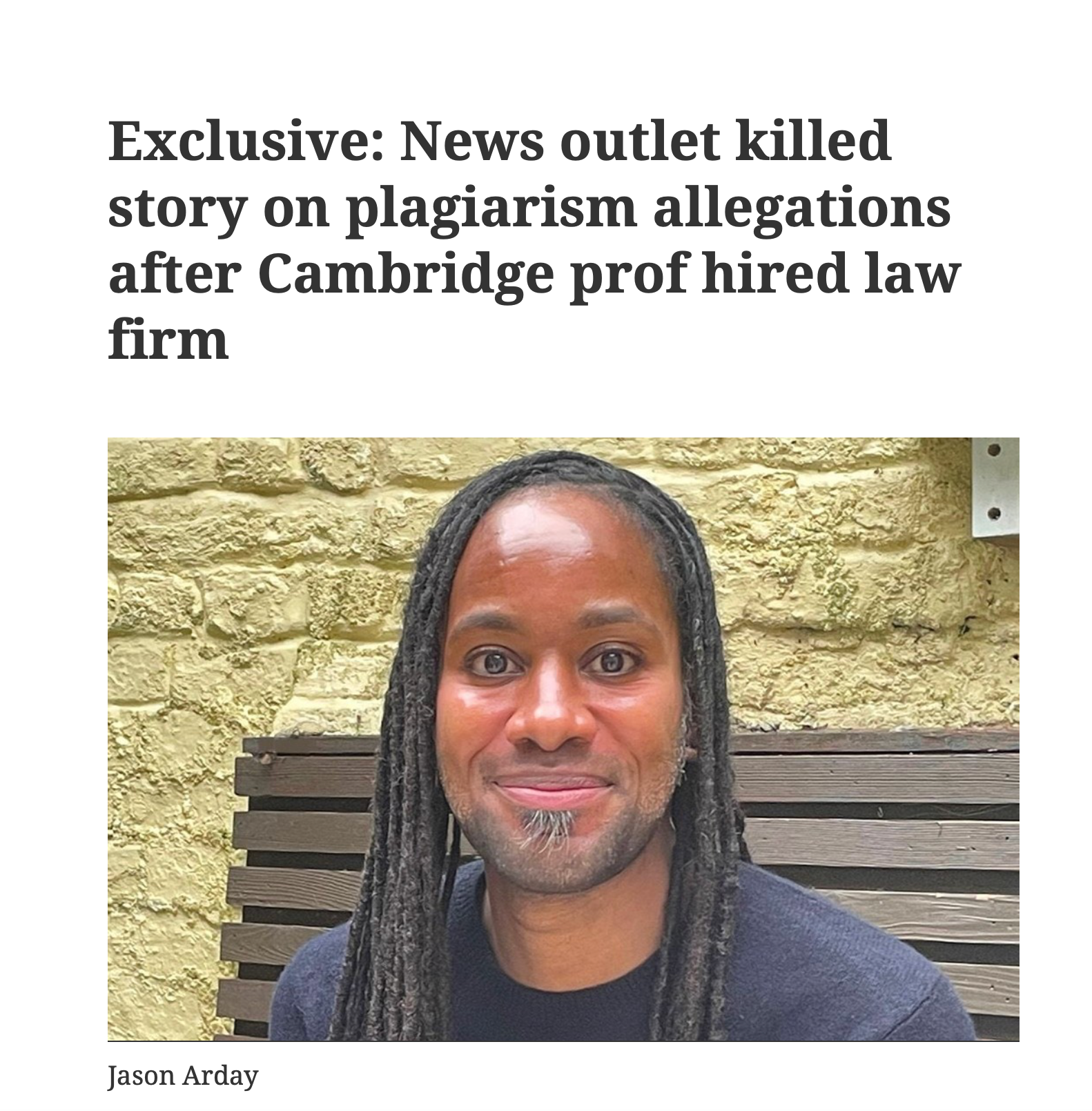

The story at Retraction Watch here is the most damaging yet.
Once allegations were raised, the issue ceased to be a matter solely for the individual academic. It became a test of Cambridge’s commitment to academic integrity and transparency. The involvement of Carter-Ruck, a firm known for reputation management and high-profile litigation, inevitably raises questions about whether the priority was discovering the truth or controlling the damage.
Who paid for Carter-Ruck? If Jason Arday, then he is not an innocent.
If Cambridge University, then this is corruption.
A university’s first instinct when faced with serious concerns about academic integrity should be openness, independent scrutiny and a clear public account of the facts. When the senior leadership instead move quickly towards legal containment, protecting reputations has taken precedence over protecting standards.
That does not by itself prove a deliberate cover-up … but we are now very, very close.
The central questions are unavoidable: who knew what, when did they know it and why was the response not more transparent?
Either way it is corruption. Either Cambridge paid Arday and Arday contracted CarterFuck, or Cambridge contacted bullyboy lawyers direct. Either way everyone who signed off on it needs to be immediately fired.
If someone in Cambridge University signed off on payment for this, they need to be sacked.
Absolutely right
@21percent.org
Yesterday I was asked why Arday needs a lawyer if he isn’t being sued?
Asking the question here in case others have it.
My answer was Carter Ruck was used to kill the news stories. It doesn’t explain why Arday is still a client as he bragged on X. Something like ‘Carter Ruck is almost as inspirational as me.’ So I can’t answer that.
This didn’t happen by chance. There would have had to have been many meetings, discussions, emails, contracts, and then the contracting pipeline would run more than one stage. I would not rule out that the VC was involved, and definitely the Head of Legal and Communications, and perhaps others from the Council too.
Perceptive.
Meanwhile, Gillian Tett delivers a masterclass in how to fire-fight a scandal
https://www.telegraph.co.uk/news/2026/07/28/gillian-tett-sexual-harassment-oxbridge-college-provost/?msockid=24d5ba5b947262c22349a91d95c96333
https://www.thetimes.com/uk/education/article/cambridge-kings-college-gillian-tett-inappropriate-behaviour-zgfhmhf9j
It would be nice to know the name of the senior barrister — please post if you know.
Tett obviously knows what is coming and other scandals. I was told recently, “We don’t live in a world of angels. But sometimes the good fight requires a few gray allies.”
Tett is a really class act. Unfortunately King’s College won’t be able to retain her, she is just too good. She’ll get much better offers
Perhaps Tett can focus on FT after she leaves King’s and encourage FT to change their ranking? Is UCam still “UK’s Best Employer” after all these scandals or it is necessary more?
It would be funny if she hired Ms Akua Reindorf KC as barrister 😂
Oh please! A masterclass in how to virtue signal. Tett has no interest in or understanding of how to do her current job and is focused entirely on what comes next. Smart move for her that takes zero guts.
There will be elements of the King’s College Fellowship against this. After all, there are 2 names in the public domain (Goldhill & Huppert) but there at least 2 further names of abusive King’s College Fellows to come out. There will be Fellows unhappy with this & plotting against her to remove her, because that is what a Fellowship does.
So, it does take some guts. Maybe also reading the room — but she has at least read the room. Look at the other HoHs (eg Simon MacDonald, Lord Glossover) or the central university administration.
Agreed Tett looks bloody brilliant, and is probably thinking of a big media appointment. She’ll get it
Note that Simon MacDonald asked Tett if I could move to King’s! Here are his last words before he realized that I had audio recordings of what had happened in Christ’s College:
“I wrote to Dr Tett and she replied. As the University has expelled you, we agreed that the request to switch college is moot. We will take no further action unless the decision to expel is reversed.”
Of course, Lord Glossover did not say why the University expelled me:
https://21percent.org/?p=3618
Tett was not part of the academic community before and she won’t be afterwards, so she is actually in a very straightforward position. She’s a media operator through and through (probably why she has been said to be a disappointing HoH in many important ways). As if she cares less about a faction among the King’s fellowship in the long term. Any attempt to oust her will be grist to the mill. This decision might be a good one, but in general having HoHs with no real skin in the game is not a good thing for Colleges or the Uni.
Tett wins whatever happens. If the Fellowship of Perpetrators manage to take her down prior to being exposed (and at this point, it seems there is no feasible doubt they will be exposed), then she exits as the heroine whistleblower and martyr. And if she succeeds in “cleaning house”, then she is heroine who set Cambridge back on the path to decency, transparency and integrity. I suspect the latter and it will be interesting to see how fast allegiances switch once others finally understand which way the wind is blowing.
Agreed, massive scandal here.
For your knowledge, the standing committee of the University Council that handles these matters is CBELA, the Committee on Benefactions and External and Legal Affairs.
Under Reg. 22.1, sign off comes from David Parsons, Emma Rampton, and CBELA, chaired by Vice-Chancellor Deborah Prentice.
If CBELA indeed signed off, without proper diligence, then yes, it is a resigning issue for Prentice.
If CBELA did not sign off, then it is rather a resigning issue for David Parsons and Rampton (except she has already resigned, after acting without Council instruction in last year’s High Court and protest injunction saga).
In the meanwhile I would also suggest:
1. Asking THE to share the Carter-Ruck client-identification in any pre-action correspondence sent onward to them (the “Our client” line should name the actual instructing party)
2. An FOI request to Cambridge for their total external-solicitor spend on Carter-Ruck and any related counsel by financial year, and for any indemnity or fee-payment arrangement between the University and Arday for legal costs incurred in connection with reputation-management letters, noting that Cambridge does routinely respond to legal cost FOIs (e.g. Coombs FOI, which disclosed a specific external-legal-provider invoice total)
Alastair Campbell’s “10-day rule” is that if a negative news story dominates the headlines for 10 days, the politician involved is finished
Scandal is now entering day 8 . More and more, this is looking like someone senior will have to carry the can & resign
Way too late for Cambridge University just to announce the old “We will have an independent inquiry” shtick
The continued silence remains defeaning. The fact that Cambridge have nothing to say – even as it is exposed that they hired lawyers to bully journalists – speaks volumes. It tells the world everything they need to know.
Campbell’s other rule is: Never become the story. Once you do, it is over (as he also experienced)
Right now, Helm and Parsons are both squarely in the frame. I’d say their days are numbered.
The 21 Group is asking in this post who hired Carter-Ruck, Jason Arday or the University. I think the answer is trivial but let me ask a question that may help us.
Can someone remind me why the University decided to pay the legal costs of Richard McMahon but did not pay the legal costs of Wyn Evans regarding the Whistleblowing Tribunal and defamation case from Astronomy? Perhaps if we know the answer to this question, we can infer what the University decided to do regarding Jason Arday’s case.
If I remember correctly, the rationale of the University to pay the legal costs of Richard McMahon was that Richard McMahon was accused of defamation in his condition of Cambridge Professor. Am I right? If that is the case, wasn’t Jason Arday accused of plagiarism in his condition of Cambridge Professor?
@TheResearcher
‘Can someone remind me why the University decided to pay the legal costs of Richard McMahon but did not pay the legal costs of Wyn Evans regarding the Whistleblowing Tribunal and defamation case from Astronomy?’
Another good question. I’d think it could financially ruin the whistleblower whose legal costs the university isn’t paying.
I wouldn’t be surprised if all the SLAPPing and defamation tomfoolery was the personal pet project of David Parsons. He’s an ex defamation lawyer who obviously never lost the taste. Cambridge had given him a big taxpayer credit card.
Intriguing to see the article by Professor Hilary Cremin in the new edition of CAM. Is this what you’d call doubling down?
https://www.alumni.cam.ac.uk/magazine/issue-108/this-idea-must-die-%E2%80%98the-school-system-is-broken-beyond-repair%E2%80%99?utm_campaign=alumni&utm_medium=email&utm_source=2316374_M34730%20CAM%20issue%20108%20Easter%20edition&dm_i=6DCH,1DNBQ,1XVGUG,6HODZ,1,0,0,0
“We need them to question what they’re seeing online, to know what an echo chamber is and how to get out of it”
Yeah big time. Those sound like the words of a woman who knows that, two weeks hence from that statement, she is about to land herself and the university in the biggest social media shitstorm it has ever known.
I would like to share an email that I sent to Professor John Aston on 24 September 2025 when I became aware of Carter-Ruck as a reply to an email that he had sent me on 19 September 2025. My email read:
“Dear Prof. Aston,
Great news! At least from the point of view of the University. It seems that Carter-Ruck solicitors were hired to address the jaw-dropping scandal of plagiarism. They seem very good, judging from the webiste of some of their collaborators. I liked this profile from Ms Claire Gill:
https://www.carter-ruck.com/lawyers/claire-gill/
“Claire gives urgent trouble-shooting advice before publication or broadcast. Often working alongside PR advisers, she helps companies and high-profile individuals to deal with unwanted media scrutiny, with a view to preventing publication of material that would infringe their rights to reputation, confidentiality and privacy.”
It must be expensive, however, and I wonder who is paying the bill. Importantly, it is a pity that the general public will have to wait a bit to know the story, but we are confident that with the number of cases piling up, together with those being held up not just about plagiarism and cover up, that the media will find all this situation increasingly valuable. They just need a person who is really keen to talk and is not afraid of consequences.
This being said, now the stress has been temporarily avoided, I would be very keen if you or someone from your team could give me an update on my situation as I did not have any since last week when I highlighted, again, that the case was urgent and affects many people.
Respectfully,
Nuno Oliveira”
Professor Aston never replied, but do you know what happened one day after on 25 September 2025? I received “Special Precautionary Measures” from OSCCA, I was forbidden from using my @cam account and had more threats to silence me from the Head of OSCCA Ms Sarah d’Ambrumenil. It must be a coincidence! Professor Aston knows about this at least since my email of 24 September 2025.
New article in the Telegraph! What is the senior leadership doing…
https://www.telegraph.co.uk/news/2026/07/28/calls-for-cambridge-professor-to-face-plagiarism-inquiry/
Telegraph also indicates that Arday was the client for Carter Ruck, one of the world’s most expensive and aggressive anti free speech companies. For a guy who is supposed to represent the subaltern, or something, kind of mind boggling how he came to pay their fees. Surely Cambridge picked up the tab?
If so that puts Cambridge in some great company. Here’s what Wikipedia has to say about the other clients:
Carter-Ruck has represented several Russian oligarchs, a practice that drew scrutiny especially after Russia’s invasion of Ukraine. The firm acted in legal actions related to Catherine Belton’s book “Putin’s People”, representing Russian individuals and companies close to Vladimir Putin, prompting criticism in the UK Parliament and media that it was helping powerful figures intimidate journalists.
This is truly a horror show.
One of the comments to the post of the 21 Group on X says:
“He was a professional footballer and snooker player, so he probably has lots of money.”
I would think that Carter-Ruck is more expensive than Shakespeare Martineau and the University paid the latter for McMahon and would not pay the former for Arday. It does not make any sense!
It is a grim situation. The racist far-right, which includes Cofnas, are all over this; the University is doubling down and hoping it will go away, which it likely will given media attention span, and those many of us who can see exactly what is going on here, which is anything but ‘anti-racist’ are publicly silent because caught between a rock and a hard place. Who wants to keep company with the ‘Race Realists’ at Cambridge and beyond?
It ought to be fairly simple to say that this appointment should never have happened EVEN if there was no plagiarism. Arday could very reasonably have been appointed as a senior lecturer at the time and supported until he reached the stage suitable for a professorship. The quantity and quality of the work simply does not match the appointment at that level. It is not at all unknown for senior people at other universities to take a rank cut when they come here.
This means that the far-right racists are actually sadly right on this appointment, a brazenly cynical one. Well, a broken clock is right two times a day. Already other non-white members of staff at the University are receiving hate mail mocking them for being ‘DEI hires’ and being not fit for the job. What a great win for antiracism at Cambridge! Anyone would think that senior management don’t actually care about racism per se…..
There are no good endings for anyone from here.
If the University are doubling down, they are really digging an enormous hole for themselves.
Desperately sad to hear that “other non-white members of staff at the University are receiving hate mail mocking them for being ‘DEI hires’ and being not fit for the job”
No there are no good endings but the two most likely ones are both depressing: (a) the far-right racists win and Arday leaves after some negotiation or (b) nothing happens.
I do think this website needs to be a little more qualified about Cofnas and his ‘race realism’–or at least acknowledging that his motivations are not entirely academic and that he is deeply troubling on race, or else it risks being adjacent to that discourse. Which, at the very least, is not helpful.
Disagree. Cofnas’s argument on this should be evaluated on its merits, independently of any other weird views he may hold. If we start evaluating arguments by moral association, reason is thrown out of the window. The University arrived at this mess partly because the Education Faculty substituted reason with moral association when making this appointment.
You can disagree all you want. The facts are Cofnas peddles discredited white supremacist theories in his own right, i.e. weak scholarship apart from anything else and that is part of the reason people with integrity and decency don’t want to speak up. You can acknowledge his motivations and also take his charges seriously at the same time. Walk, chew gum.
@Sojourner
Have you personally seen this evidence? ‘Already other non-white members of staff at the University are receiving hate mail mocking them for being ‘DEI hires’ and being not fit for the job.’
It sounds like the sort of rumour a university on defence would put out to kill stories. Citing that the stories are causing people to receive hateful or threatening messages. I’m not saying it’s implausible, but these kinds of loaded claims require evidence and can’t just be taken at word.
Yes I have, @Etonmess. Further questions? There are also attacks on social media.
Or do you live in a world where such things never happen, e.g. academics of colour being accused of being DEI hires? Ah, wish I could live in it.
I’d love to share the evidence but obviously cannot without violating anonymity.
The University can hardly take the position that the stories are harming BME–their mindless behaviour has.
Anyway, I don’t give a shit whether you believe me or not. I’m guessing you are not in the position of receiving mail like this.
Thanks for your reply.
I wasn’t asking to be a d***
What’s the university’s response to the harassment?
Those academics should publicise the hate mail for their own safety. Anyone receiving hate mail needs more protection, and harassers must be identified and held accountable.
I agree with your point about the mindless behaviour. If they’ve got no adequate response to the hate mail BME academics are receiving, it means they’re openly showing no adequate concern for their careers or mental health. That’s a headline story itself.
https://goodlawproject.org/petition/stand-in-solidarity-with-jason-arday/
This will play directly in to the hands of the far right forces who want to start a culture war, and make Cambridge ground zero. It will expose all BAME faculty and is a huge mistake.
“It will expose all BAME faculty and is a huge mistake.”
It already has. As I’ve already said, management decided to go with cheap token rather than structural and cultural change.
Some of the very worst people on race e.g. Boateng, who famously refused to be counted as a Black politician when Abbott etc were setting up a parliamentary formation–and who routinely pals with rightwing empire apologists–have signed this kneejerk letter which takes no interest in the wider situation. Jolyon Maugham, founder of Good Law, is a classic paternalist which is not a million miles from benevolent racist. How depressing. And the comparison with Harriman’s hounding on Gaza is plain silly.
https://www.youtube.com/watch?v=JVNgN_qSDp4
Three Heads of House on that list (Sonia Alleyne of Jesus College, Lord Simon Woolley of Homerton College and Professor Dame Ijeoma Uchegbu of Wolfson College)
All Heads of House familiar with the game so it stands to reason that they defend its terms. Woolley is the only one who has actually done any serious anti-racist work but Homerton allied to Education, so I guess there’s a professional imperative there.
Also on the list is a Cambridge academic accused recently in court of racial discrimination.
Are you referring to the Calbert Graham case?
Jesus
Homerton
Wolfson
Noted.
So, anyone, if the Office of Research Integrity recommends an academic from those colleges, say no.
Cambridge have clearly not only chosen to remain guiltily silent, but also instructed Arday not to talk either. They are neither defending him – nor allowing him to defend himself. He is being used as collateral, as a punching bag. He is being used to protect them from the further scrutiny they would face and appear weak and helpless.
This from a university claiming to oppose racism. It is grotesque.
If the action of a person scrutinising the work of another person in academia can in itself be classified as bullying/harassing a person then this would make it impossible for academia to function. The fundamental basis of academia is that a persons academic work can be scrutinised by others in academia for authenticity and/or academic rigour. This is an integral part of academia that has persisted throughout the ages and it has not changed in the current age.
AI might temporarily have made it look like the fundamental nature of academia has changed but eventually AI will be reporting on whether it generated a piece of academic work for a person and which pieces of academic work it generated for a person. The temporary state of affairs that currently exists where a person could offload academic work onto AI and pass off work generated by AI as their own will be gone because people using AI in that way – i.e. to not do any academic work – and not in more productive ways – i.e. to refine/check/advance any academic work being done – serves no useful purpose for society.
The fundamental nature of academia has not changed, it is still a space to produce authentic work, a space to produce new knowledge that can be scrutinised by others for authenticity and academic rigour, a space to produce academic work that can be independently verified by others, a space to independently verify the academic work of others in order to make it possible to build on existing academic work with accuracy, a space to solve problems of academic interest that will eventually become problems of real world interest, a space to solve problems currently of real world interest.
Implicit in a person actively participating in academia is a person opening up their own academic work to scrutiny by others actively participating in academia. If a person is not prepared to open their academic work up to scrutiny and to in turn scrutinise the academic work of others in academia then a person is not actively participating in academia. Widening participation in academia means bringing more people in to academia to actively participate in academia, it doesn’t mean bringing more people in to academia to not actively participate in academia.
People vary in their ability to do academic work and therefore in their ability to advance in academia, this is a fact of life, even siblings raised within the same family can have very different abilities to do academic work. It is in the doing of academic work that a person discovers what their ability to do academic work is. Actively participating in something means doing something & seeing what happens in the doing of the something. It means exploring whether it is possible to develop the skill to do something to match the will to do something and to make some progress in the doing of that something. It doesn’t mean that actively participating in something is always going to lead to a continuous state of success in relation to that something and/or to be a pain free experience without any encounters with failure in the doing of that something.
Actively participating in academia means a person being open to what they can achieve in academia, a person remaining in an unbiased state about whether academia/other academics hold any undue bias in relation to them in order to accurately detect any undue bias, a person not being overly biased either for or against themselves in academia, a person remaining open to critical feedback, a person remaining sensitive to their own ability to do academic work and to their own ability to take on critical feedback about their own academic work and to use it to drive improvements in their own academic performance.
It is up to every person to discover what is true of them in relation to academia. Other people can give a person critical feedback but it’s up to the person themselves to work out how to respond to that critical feedback and to work out what is true of them in relation to academia. If a person cannot work out what is true of themselves in academia a person can end up with an inaccurate representation of themselves in relation to academia which over longer timescales could prove unsustainable for a person to maintain as the person continues their academic journey.
Before embarking on the academic journey it’s important for a person to be firm about the value they place in themselves and to hold firm to that value in themselves throughout that academic journey. Care of a person is not conditional on academic success or failure, support for a person is not conditional on academic success or failure. The person comes out the other end of the academic journey whether or not the academic career comes out the other end of the academic journey. On any academic journey there could be significant amounts of failure with no guarantee of eventually success.
If there is new critical feedback available to a person then a measure of a person is how the person responds to that new critical feedback. No two Cambridge academics are alike, it’s up to each Cambridge academic to find their own way of being a Cambridge academic given their own individual set of circumstances, it is up to each Cambridge academic to respond to critical feedback, it is up to each Cambridge academic to maintain trust and confidence with the academic community inside and outside of Cambridge and with the public.
If a person is working at the level of Chair in Cambridge a person can expect a high level of scrutiny from the academic community and from the public. A person working at this level can expect that if there is any controversy in relation to the persons academic work that an internal examination might need to be done and that the internal examination might then need to be opened up to independent external examiners. This is the nature of working at that particular level in Cambridge, this is what active participation in academia looks like at that level in Cambridge. Widening participation in academia means bringing more people in to academia to actively participate in academia at all levels of academia.
Logically the person in charge of the university strategy on the arday case at this point would be kamal munir. It looks he persuaded woolley to start a petition that would plunge the university in to a weeks-long controversy over the issue. This is probably his parting fuck you gift to prentice.
Yes, I think that is right re Munir and Woolley. Polanski has signed, a big mistake. What a beautiful gift to the far right this is.
Yesterday, I reminded people that Kamal Munir is a Fellow from Homerton College here (https://21percent.org/?p=4049), and while I said this many times in the past, it is always a good opportunity to highlight that Kamal Munir is a key responsible for the current state of Cambridge University. He should have been sacked, not simply “step down” from Pro-Vice Chancellor.
It will be a win for the University if this case becomes a case of cultural wars, as opposed to a case of misconduct and cover up as most readers of the 21 Group blog expect. Ironically, if the University decides to promote the former in the background to avoid accountability, the case will burn for longer and longer.
I reckon we will have an “urgency meeting” from Council very soon.
Yes, I agree. They are doing their own level best to turn it into culture wars for that reason. Munir, yes, but Vira more so, culpable as he sat on the Professorship committee. For me the issue still remains the appointment in the first place which then inevitably led to the current situation. I know normal Board of Electors standards, and this did not meet it even remotely. Nothing to do with age, simply the CV was manifestly inadequate at that point. This was cynical paternalism of the worst kind and it’s come to fruition. Absolutely, the smart thing is to turn it into culture wars and then you get off scot free.
The University knows that there are other scandals in the pipeline to be released soon, and that these are all about misconduct and cover up without connection to cultural wars. They may well bring the card of “personal vendetta” but the pattern between cases is undeniable when people have access to the cases. It is just a question of time until this senior leadership falls, but they can make their life worse if they continue with the cover up. I am very confident about this.
I am less optimistic that they will fall. They have each others’ backs, and they are kissing up to powerful entities outside the university. It would be amazing if something happened but I have seen far too many things shoved under the carpet successfully. In many ways, this whole Arday thing is a perfect distraction as well, from their perspective. Fake antiracism is absolutely the last refuge of these scoundrels.
There are now a few people with “Unreasonably Persistent Behaviour” who will not let this circus continue. Stay tuned because there will be more news soon.
If they succeed they will save themselves while destroying the university… It is the authoritarian playbook, no different from Putin in Russia… us and them, divide and rule, all the while standards and merit and rationality go to the dustbin of history…
The biggest win for the university is to spin the research misconduct as a Culture War.
All the commoners take up arms as soldiers while the administration sits back and watches us fight among one another. I’d rather examine their Culture War strategy.
It’s a stupid move because a primary victim of the plagiarism is a woman. So if the university argues it’s a Culture War, citing only race, it denies women are a part of DEI. Not strategic to deny women are part of DEI. I wouldn’t support a petition that erases women as victims of discrimination and of research misconduct. Cambridge already has a poor record on gender diversity inclusion and shouldn’t be proudly arguing women’s victimisation doesn’t count.
The Culture War approach will backfire. Everyone who gives a f*** about academic integrity needs to stay focussed on the administration and apparent cover up. The real scandals are Cambridge silenced the plagiarism whistleblowers, and the Carter Ruck funder is unknown.
And did Mumir consult staff, BAME or otherwise, before pitching us all in to a full scale culture war for a frankly dubious cause?
I think it is well-established that Munir could not care less about what staff thinks or feels, but if there is any person who disagrees with this statement, please do come forward. For those who do not know him, he is the (former) Pro-Vice Chancellor who dismissed, without any investigation, whistleblowing disclosures and safeguarding referrals based on detailed medical evidence to protect HR. And then dared to say,
“I am very proud of this important recognition in the Financial Times, which reflects the hard work of many colleagues. We are committed to continually improving the working environment and supporting academic and professional excellence.”
When he knew that ranking was a humiliation for all victims of serious abuse at UCam. Unfortunately for him, Financial Times did not give him the follow story he wanted after members contacting the magazine and reported on his behaviour.
Consult us??? Lol etc.
‘SMT’ are there to rule not consult. Their raison d’etre is to not consult. Both Vira and Munir were catapulted into post as brown faces to run interference.
The harm this will do to BAME at Cambridge is incalculable.
Wow, this got to TikTok… And they did not even look at the data!
https://www.tiktok.com/@goodlawproject/video/7667567174390779158
And Instagram… the comments section is wild! How is it possible that no one looks at the data?!?!?!
https://www.instagram.com/reel/DbVmMwQNV6V/
Depressing. They think they are fighting the far right while packing Christmas presents for them.
I bet Arday himself is driving all the social media mobilization. Remember he’s got a book coming out.
He’s going to make millions in sales before leaving the university in smouldering ashes.
@TheResearcher
The reality of people not reading or examining the facts is easy to exploit.
Attention spans are less than 7 seconds so provocative headlines causing immediate outrage work.
Racism is widely hated. To flash the anti-racism card is now to gain instant credibility as someone who reports the facts. Most people can’t see the card flashing re: Arday as racist and paternalistic- to use a term from Sojourner’s posts. That means signing and endorsing an anti-racism petition for Arday perpetuates racism the case was never about.
It’s been repeated over and over Arday is an elite Cambridge academic. To deny his status and write about him as a Black man with no such status is racist. To deny his agency and write about him as a possession of Cambridge is also racist. It’s outrageous to see the Culture Wars working.
The story is a top university apparently covered up undeniable research misconduct for years. I suspect people can’t reconcile their idea of Cambridge with the reality of the apparent cover up. It is too threatening for people to question their infallible belief in its superiority based on high research standards.
“The University of Cambridge is engaging in a level of corruption and harassment of journalists you simply don’t see all that often, and I say that as someone who has reported regularly on campus controversies. I don’t understand what their endgame is here.”
https://x.com/jessesingal/status/2081940372180058299
240K views in a few hours…
Unfortunately Singal has his own track record in just making stuff up, so not sure he’s the best interlocutor on the question….apart from being a full blown culture warrior.
Singal is a self-professed liberal who writes for the New York Times and The Atlantic. If he is to be considered “problematic” then we have totally lost the plot and all prospect of being taken seriously.
Those of us who are not determined to marginalize ourselves to the most extreme 1% tail of the progressive movement but actually care about forming coalitions and persuading the public should accept that is squarely in our camp.
If he says Cambridge has a problem, you’d better believe it. But then again, I think we all already knew that.
Whatever, mate. If you haven’t followed the Singal story, enjoy your ‘non-1% percent’ status of being selective about your outrage. The enemy of my enemy is not my friend, something you seem to share with that one percent.
Curiouser & curiouser.
A number of posters have suggested that there is a connection between the appointment of Jason Arday and the earlier rejection of Calbert Graham. We have looked into this.
Some background — Dr Calbert Graham has dual British and Jamaican nationality. He was a senior research fellow in computational linguistics at Cambridge University. In 2022, the Faculty of Education sought to appoint an Assistant Professor in Second Language Education. Dr Graham applied, but was not even shortlisted — despite being a ‘priority candidate’ for roles within the University because his substantive post was at risk of redundancy.. The decision not to shortlist looks very odd.
Dr Graham subsequently took the University to Employment Tribunal alleging racial discrimination. He lost 2-1 on a split verdict & perhaps should have appealed but he was out of funds
What is very curious is the number of people in the Calbert Graham case who pop up again in the Jason Arday story, suggesting that the appointment of Arday was in some way a reaction to the rejection of Calbert Graham. These include Hilary Cremin, Ricardo Sabates, Manali Desai — both the timing and the overlap in the people is significant.
Sabates appeared as a witness in the Employment Tribunal against Graham and relied on his support for appointment of Arday to counter allegations of racial discrimination
(Sabates has also signed Good Law Project letter)
Is the same Sebates of the text below from The Telegraph?
“Prof Sir Simon Baron-Cohen, the director of Cambridge’s autism research centre, and cousin of the comedian Sacha Baron-Cohen, and Ricardo Sabates, professor of education, circulated an open letter under the heading: “URGENT PLEASE SIGN ANTI-RACISM LETTER FOR JASON ARDAY.” It referred to an earlier letter that “was sent to the Minister of State and to which there has been progress in terms of how to tackle these issues” and warned of a “potential public attack on Jason”. Parliamentary records show that on Sept 15 last year, Jacqui Smith, the women and equalities minister, met a “range of academics to discuss the harassment of black academics”.
Yes. Prof of Education & International Development
https://faculty.educ.cam.ac.uk/people/staff/sabates
Many people do not come out of this looking good, but the Faculty of Education looks like a complete shitshow.
I am not sure if this person was thinking about Cambridge and its Faculty of Education in particular, but one of the comments of today reads:
“Sociology: the study of people who don’t need to be studied carried out by people who do.”
Important point of clarification regarding your statement on Sabates. Yes he was a witness at the court – but /against/ Graham. He spoke against the case of a Black academic.
And he was involved in hiring Arday while waiting to be brought to court over racial discrimination allegations.
And he’s then one of the two (as far as I can tell only two) Cambridge academics named on that petition. The other is Baron-Cohen, of course who already got roped in at an earlier stage, before it was clear how untenable Arday’s position was, and can’t backtrack now. The absence of other Cambridge figures is glaring. I think a lot of people know there are issues in treating him as the hero or even as a victim frankly.
Honest question: is Baron Cohen on the spectrum? I don’t mean it facetiously, not even in the slightest, it is just I can’t see otherwise how he could be so persistently supportive of Arday, even at this late stage, unless there were some kind of personality condition explanation.
Good the 21 Group and others are highlighting this.
Launching Dr Arday into the spotlight would have the effect of relegating the Dr Calbert Graham case to the shadows. And glowing endorsements of Dr Arday would ensure the Dr Graham case stayed in the shadows, until it was eventually forgotten by the public.
I think you and Commentators have identified another matter the University would rather distract from.
‘Dr Graham, a scholar of some distinction, brings a claim against the Chancellor, Masters and Scholars of the University of Cambridge (“the University”) and its Deputy Director of HR, Thuy Niven… A central issue in this case is whether the four Professors, or any one or more of them, racially discriminated against him in determining (should we accept that they genuinely did so determine) that he did not meet, and could not with a reasonable amount of training meet, the essential criteria for
appointment.’
https://assets.publishing.service.gov.uk/media/671651094a6b12291ed99801/Dr_C_Graham_v_The_Chancellor__Masters_and_Scholars_of_the_University_of_Cambridge___other_3313420.2022_FMH_Reserved_Judgment.pdf
OMFG the Good Law Project letter is high farce worthy of a Tom Sharpe awarded gold medal.
You’d expect clumsiness shenanigans from the two Professors but don’t the Heads of House have some political cunning and sense of self preservation? WTF were they thinking?!!?
Someone should round robin the SLT and Heads of School posing as worthy students and ask them to sign up.
Goooood morning Cambridge!
https://unherd.com/2026/07/jason-arday-cambridges-dei-darling/
Another racist ‘DEI darling’ headline.
Journalists ought to be embarrassed to sign their name under that.
My prediction: some victims of research misconduct watching this play out aren’t going to come forward b/c they won’t want their whistleblowing to be used to fuel culture wars.
The real story is research misconduct and its apparent cover up by Cambridge for years.
I disagree – I think this will prove out a wave of people to come forward with their own experiences.
For all the disingenuous efforts to turn this in to a “culture war”, there are three sides in this debate, not two. Yes there’s the racists, and yes there are the woke social justice warriors.
But the dominant voice in this conversation – from the centre-left academics who first raised concerns, to publications like THE and The Times – is simply a debate around standards and integrity. And the “e” in DEI / EDI. That’s something we can all believe in, or are supposed to.
@Silent Majority
Hopefully you’re right….
It’s its own problem that victims’ cases are being spoken for in racialised ways rather than the victims being able to speak for themselves without the politics. I haven’t read one word from any victims in the Arday case, except the academics whose complaints were dismissed.
As we know most cases on this blog are brought forward by people who acted in the name of the public good. Wyn Evans feared that someone would not survive being bullied almost to death. He spoke out and was targeted. Likewise Cancer researchers committed to their work have had their careers and lives ruined. These people don’t come forward because they want to cause damage, and they aren’t the schadenfreude type.
If potential whistleblowers are watching this research misconduct case play out as a Culture War, I can see them not wanting to be involved. It also could seem like everyone signing the petition is against them.
Their stories being printed in right-leaning newspapers already make it appear they have certain political persuasions and racial ideologies they may not hold or even strongly oppose.
The university causes this dilemma for victims. I wouldn’t be surprised if it’s intentional.
I hope you’re right about a wave of people coming forward though.
Yes, it’s racist and Unherd is racist and disreputable.
THIS is why the third option cannot raise its head above the parapet: for fear of keeping company with the disreputable.
Researcher, you should exercise a little more of the critical judgement you believe, rightly, management should be doing.
@Sojourner,
You are welcome to comment on what others say and do, but you should not expect that they follow what you say or want. I will keep doing and saying what I think is right and I hope you respect that. Thank you.
@Researcher: Sure, I cannot expect that. But I can say how self-defeating it is to amplify racist voices and to note that ends up tying the hands of those who might take a ‘third’ position. But absolutely, you do you. You have a right to be part of the problem!
I think we are all on the same team here in wanting to fight racism wherever it rears its ugly head, and work together as one to empower all academics – regardless of race, gender, sexuality or age – to deliver amazing research and be recognised fairly! So let’s not get in a fight about UnHerd, and focus on that letter?
Meanwhile for my part I am happy to split the difference by taking the line that yes UnHerd and GB News are often passively (and sometimes also quite openly) racist, but that Katherine’s article was fairly sensitively worded overall (even if perhaps she was only being extra-careful not to say the “quiet part” out loud).
@Sojourner but that fear is in your head (and in the heads of the contemporary so-called progressive left). You are the person invoking guilt by association, rather than allowing the arguments to speak for themselves.
I wish we were all on the same team. Many people here, of the ‘common sense’ variety are quite clearly shilling for the right. I need to be clear that I am not on the same team as Cofnas or Harris or even Stock, and though I am for now engaging here–possibly not for much longer–the sooner people realise that they need to craft a genuine third position, and put clear water between themselves and the racists/transphobe culture warriors on this matter, the better.
Or not.
Long before this blew up, the 21 Group tweeted the following on Nathan Cofnas
https://x.com/21percentgroup/status/2034552133148610915
R V Laurence said “I don’t want a black man as a Fellow [of Trinity]” (re election of Srinivasa Ramanujan)
N Cofnas said “In meritocracy, Harvard faculty would be recruited from best & number of black professors would be ~ 0%”
Both statements are racist
https://x.com/21percentgroup/status/2034552354176114993
Academic freedom means researchers may look into controversial questions, fine
Legitimacy of results is assessed on methodological/ evidential grounds
Hard to see what evidence Nathan Cofnas could have for some statements
Conclusion not based on evidence is reason not to hire
Thanks for this record.
It’s outrageous the research misconduct report could only see the light of day through Nathan Cofnas’s blog. I didn’t know who the bloke was but left the website fast after reading the article. Bypassed all the surely high culture literature on defeating wokism (/s).
I can see many victims not coming forward now because they have no good options. Hope I’m wrong. Completely sick quotations, and what is being spoken privately is surely even sicker. I wouldn’t be surprised if some rejection of the undeniable evidence of Arday’s plagiarism is actually pushback against the ideologies Cofnas is espousing.
The extremes it takes to expose research misconduct by celebrity professors at Cambridge are a problem and should not exist.
@Sojourner ‘I need to be clear that I am not on the same team as Cofnas or Harris or even Stock,‘
Don’t you see how narcissistic this is? It’s also exactly the sort of reflexive tribal reaction that led to the Good Law Project letter on the other side of the argument, which is ironic. It’s dead end politics, which leads to nothing but people talking past each other to avoid being seen on the same side of the street. It’s the antithesis of a collective humanist approach.
If we are going to start talking about narcissism, then let’s start with Professor Cremin – hiring an obviously underqualified black man to assuage her sense of white guilt, smarming all over BBC News to be seen as the white woman saviour, and using it all to get promotion to a higher rank and salary in the process. Don’t think anyone on this forum comes anywhere close.
“If nothing else (and there is a lot else, actually), it is totally wrong for a member of an academic hiring panel to disclose to anyone, let alone publicly, what the views of other members of the panel were” (Lord Thurlow)
https://x.com/LordThurlow/status/2082760997236851039
Cremin tells Arday, the BBC journalist and millions of viewers — should be a straight disciplinary offence. Of course, she’s won’t face anything.
Plenty of different ways to deal w/ the culture wars.
Though I visited blogs I otherwise wouldn’t to read about the research misconduct, I wouldn’t hang around on them.
Many cultural warriors have deeply entrenched views. Fairly certain nothing I’d say or do could change those views, and it’s not my objective to try.
I’d rather take the approach Sojourner recommended and find or create a third group. Anyone interested in research integrity and anti-bullying can join.
On that note, I hope Sojourner returns.
It’s a dilemma to have to go to the Cofnas blog to read about the research misconduct in the first place. One basically has to walk straight into a Culture War and stop by the camp of a warrior promoting racist and transphobic ideologies. A camp one might never be caught dead at, might never be welcome at and might lose credibility and respect for going to. The research misconduct story needs to be reclaimed from the Culture War and brought back under control.
I have heard from someone with their ears to the ground and who is very hostile to the racists who are targeting Arday.
They say that the University hired a law firm to protect him. They did not name Carter Fuck.
Again, I have no idea how true this is, but it’s someone well-connected.
I asked again and they said they were very sure that the university were paying the fees for the law firm. Question is whether and how this can be ascertained.
Thanks sojourner. I heard certain senior people were handling out hundreds of thousands of even millions of pounds of contracts to their old friends in the legal industry and deliberately maximising the bill. It needs examination.
Completely scandalous.
Infuriating!