Last Thursday, 28 August, someone put quite a lot of effort into knocking 21percent.org offline.
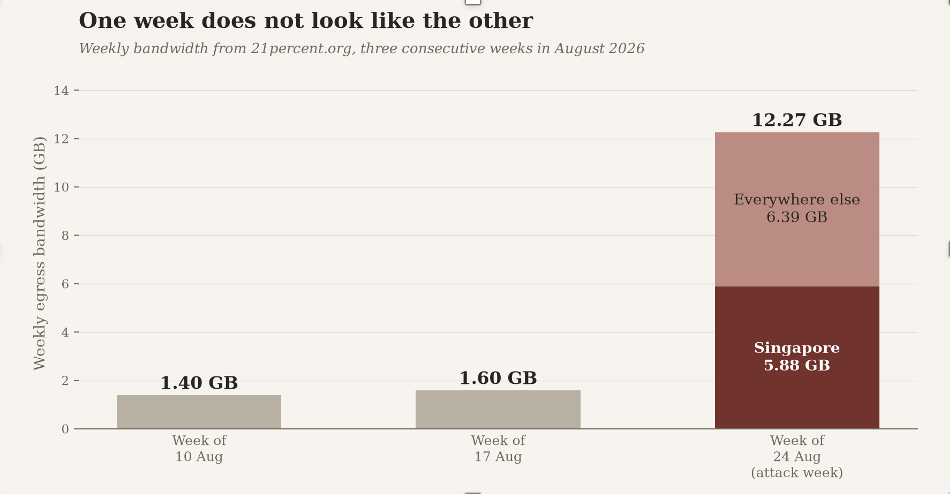
Between Wednesday afternoon and Friday morning, the site absorbed 12.27 gigabytes of traffic — roughly ten times a typical week here, and almost half of it (5.88 GB) from a single country: Singapore.
Or rather, from computers pretending to be in Singapore.
The mechanics
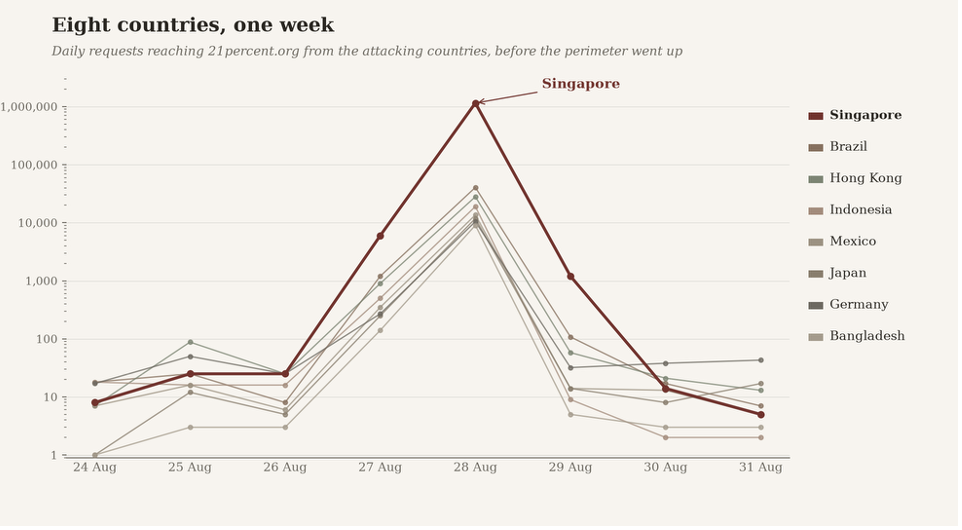
The bulk of the traffic came from Tencent Cloud Computing (AS132203), out of two adjacent server blocks in Singapore – 1.3 million requests over seven days from thousands of different addresses, of which almost all landed in a single 24-hour window.
But this was not just a Tencent operation. On the same day, 28 August, the identical attack signature arrived from Brazil (40,584 requests), Hong Kong (28,060), Indonesia (19,037), Mexico (13,612), Japan (11,845), Bangladesh (10,442) and Germany (9,032). Different countries, different service providers, different residential broadband and mobile ranges – but every last request bore the same fake refererral parameter and the same fake Chrome user-agent.
That is the profile of a distributed botnet: a network of compromised computers around the world, all commanded to hit the same target at the same time.
Roughly 1.5 million requests in 24 hours across those eight countries alone. For context, our normal daily traffic runs at around 3,000 human visitors.
Why?
We are, we should be clear, a peer network. We publish a few blog posts a week. We do not sell anything, we do not process payments, we have no state secrets to protect. There is nothing on 21percent.org that requires the coordinated attention of a global botnet.
Unless, of course, some of what we publish is inconvenient to somebody.
The attack came in the immediate aftermath of the Employment Tribunal ruling against senior figures at Cambridge University. It came shortly after our traffic figures crossed 90,000 monthly visits, an inflection point that appears to have caught someone’s attention. And it came from the same category of infrastructure that has been used, in the past, to silence journalists in Hong Kong, dissidents in the Gulf, and human-rights organisations across South East Asia.
We do not know who commissioned it. We do have a fairly clear idea of who benefits from our being quieter.
What we did
On observing the attack, we went offline briefly to run diagnostics and install advanced threat tracking. Origin-hitting attack traffic fell from a million requests to 27. We have filed formal abuse complaints with multiple server providers, with copies to their data-abuse and security-response teams identifying attack vectors, traffic and source origin signatures.
Total infrastructure cost of this exercise, so far: £0. Total developer time: an unusually long weekend.
What we noticed
Two small things are worth putting on record.
First, this was not a spontaneous eruption of internet weather. It was planned, coordinated, resourced, and executed. Someone paid for it. Someone was pleased with themselves on Thursday evening and rather less pleased with themselves on Monday morning.
Second, we have reason to think that the probing began well before the events of 28th August. We have been monitoring and logging botnet traffic for several months. We are compiling that into a further report.
Third, the attacker continues, unsuccessfully, to attack our site. We are grateful for this. We now have a very good source profile.
Whoever you are — and we can now make some very informed guesses — you have paid to make our archive more resilient, our infrastructure better hardened, our story more interesting, and our readership larger. Thank you.
We will continue to publish. The Regent House is still owed answers. The victims of the last decade are still owed acknowledgement. The Vice Chancellor is still owed resignation letters from those in the senior management who have reduced our University to this sorry state.
This is a cyber-crime under UK law. We have filled the relevant reports. We have good clues as to who has organised this.
Do we know when the University became aware that this article would be published? The press may like to know these developments…
https://www.thetimes.com/uk/education/article/university-of-cambridge-whistleblowing-case-f8gfqxszb
21 Group: officer, we would like to report a cybercrime.
Here is a complete list of individuals at the university with something to hide.
Police Officer: I officially declare this unsolvable
It is a simple Venn diagram no? Someone afraid of exposure, someone with financial resources, someone who is neutral or opposed to Wyn’s Cambridge anti-bullying campaign, and someone with either knowledge of cybercrime or linked to an individual who has.
Goodness. That does look like a crazy amount of resources to target at an academic blog. Who would have the motive?
Just when you thought the Cambridge stories couldn’t possibly get crazier they somehow do.
“Who would have the motive?”
Hmm let me guess… 😅
Cambridge University became an institution managed by corrupt people who are willing to do anything to cover up misconduct and retaliate against whistleblowers. Members who do not understand his fact can easily become victims of their abuses.
The good news is that the damage hearings is coming in January 2027 and hopefully this and other malpractices can be taken into account.
21 Group, keep tracking them! They never learn…
Well I suppose we can safely rule out the humanities departments on this one?
Concerned professor: In the spectral choreography of late-capitalist digital assemblages, the botnet attack must be read not as a mere technical incursion but as a performative rupture that interrogates the hegemonic architectures of networked subjectivity. Each compromised node – a precarious cyborg-body conscripted into distributed labor without consent – becomes a site where the biopolitics of protocol reveals its coloniality: the command-and-control server operates as a panoptic sovereign, extracting surplus computational vitality from peripheralized devices whose “consent” was always already manufactured through the epistemic violence of end-user license agreements. Thus the attack, in its recursive amplification, performs a kind of digital hauntology: it reinscribes the return of the repressed infrastructural Other, whose subaltern packets finally speak — even as the firewall, that carceral apparatus of algorithmic governmentality, labors to render them illegible once more.
Cybercriminal: Botnet attack cost 20 grand. You want not want?
Hahaha I could not read that passage about spectral choreography without hearing the voice of Simon Goldhill 🙂 Even thought it might be his comment until hitting the punchline :-s
Obviously no way he was involved though. Seriously doubt he would even know such a thing was possible. Let alone how to actually run or even contract for one. And there’s no motive left at this point anyway.
More likely someone from CRASSH with a good sense of humour 😀
Haha!
Why? this might even be a paid attack so no one is out of suspicion.
True though impressed if anyone in arts and humanities could figure out dark web contract and bitcoin payment though maybe someone has friends who could help them who knows
The regime of the American Queen has no moral boundaries! They are an academic Mafia! Her accolites must me getting more and more worried. These include: Prof Smallman, Prof Crookery, Prof Teflon, Prof Drinkalot (RIP), Prof Viciouswoman and Prof Bullshitmore. Tick tock tick tock tic stock…
This would be a blog covering events at a university that sent all staff an invite to a cybersecurity safety module… then included a tracking pixel in the email that could identify when individual staff members opened it and from where?
I doubt anyone from HR had the technical competence to do it they spent £100m failing to design a new HR platform after all
Is organizing an illicit botnet attack on a website that largely discusses how Universities address reports of bullying and harassment less expensive than hiring Carter-Ruck to silence journalists and academics about these and other practices?
Either costs are the reason for this new strategy, or the University realized that the next letter that people receive from Carter-Ruck will immediately be made public. Imagine the 21 Group receiving a letter from Carter-Ruck suggesting that the group is engaging in defamation against Cambridge University and its senior leadership…
Seems like this is another busy week for Cambridge stories. There’s no longer a schedule any more just every paper running its own leads.
I would say that 21percent should also take care with own physical security.
Academia takeover by Neo-Marxists, specially humanities has consequences:
Across the Atlantic a post in X about a poll on political violence and education from October 2025:
@robkhenderson
Rob Henderson
“Relative to Americans with a high school education, Americans with graduate degrees are twice as likely to support political violence.
More education = higher support for political violence. It couldn’t be otherwise.”
Just imagine what the figure must be like at Homerton – they don’t seem to care much either about the death threats against Smart or dog whistle incitement on Bakare urgh
@AlexS, corruption is a university wide issue. There are major issues in the humanities, very true. However, Astronomy is STEM. DAMTP is STEM. Physics is STEM. Biology is STEM. CRUK is STEM. There are equally serious cases of corruption in all of these because the problem is higher up. I experienced Cambridge University in the Sciences, in the Humanities, as staff and as student, and I can assure you that the culture of cover up and retaliation against whistleblowers is similar throughout. The reason is simple; it is fostered by the senior leadership that is deeply dishonest.
“corruption is a university wide issue. There are major issues in the humanities, very true. However, Astronomy is STEM. DAMTP is STEM. Physics is STEM. Biology is STEM. CRUK is STEM.”
I agree. I would say at higher level the Multiverse theory in Physics can be seen as an escape attempt of typical burden of proof in that science and an inadvertent incentive to scholar corruption. This is a significant problem. If a science do not advance, or makes only small steps for decades does it goes too speculative?
We also have the significant replicability problem within some so called hard sciences. Those are wide Academia problems not confined to Cambridge.
Cambridge own problems appear abuse of power, mismanagement, dereliction of duty and at least for Jason Arday case ideological capture.
I would be very curious about how much the management/bureaucracy have been growing in jobs and budget compared to purely teaching and student growth and expenses.
The optimal path to creating objectively desirable social change is in the everyday act of a person resisting the application of undue pressure on them by others without resorting to the application of undue pressure on others by them. This everyday act is the basis of active political stabilisation.
The poll asked the people being polled whether they agreed with the statement “violence is often necessary to create social change” but it never asked the people being polled whether they thought it was possible to create the type of social change anyone would want – objectively desirable social change – through violence.
Would any of the people being polled want widespread bombing and increased risk of death? Would any of the people being polled want increased risk of the loss of limbs? Would any of the people being polled want increased risk of homelessness? Would any of the people being polled want increased risk of loss of access to food and/or water? Whilst it is objectively true that violence can create social change that does not imply that violence can create the type of social change anyone would want – objectively desirable social change.
It doesn’t take graduate degree to work out that type of social change that can be created through violence is not the type of social change anyone would want.
I don’t know what a neo-marxist is. I do wonder where it is possible for a term to become so politically charged in a political environment as to make it practically undefinable in that political environment and whether that then becomes an increased source of friction in relation to the use of that term in a political environment.
“I don’t know what a neo-marxist is.”
Marxism is based in a duality to be exploited: victim vs oppressor’s within the bounds of social classes.
This was in a context of penury.
Neo-Marxism is a post Soviet evolution when 2 forces made Marxist adapt to a new reality:
1- The capitalist growth in prosperity and its increased social mobility which made much more difficult to get supporters in lower class.
2- the failure of Soviet experiment that for many in Marxism already started to be clear in the 60’s but probably started with Stalin Trotsky schism.
What was the solution to lack of marketability within social classes confines ? A total expansion of the victim vs oppressor market, not any more bound to the pure Marxist social classes but instead exploitable to any human differences.
I can see a Humanities department saying that i am victim or an oppressor if i live in 2nd floor or in 5th floor of a building or vice versa if that can be exploited for political power.
Because the only cause that is genuine in Marxism old or Neo is power.
I have never seen a Marxist worried by poverty, inequality in Cuba, African countries for decades under socialist regimes. So those are not the point.
Nonsense. Marxism rejected victimhood in favour of self-emancipation bought about by solidarity and class struggle. It is quite unrelated to post-modern identity politics, which is an elite liberal phenomenon.
Note that i stated that class struggle is the victim vs oppressor pair of traditional Marxism.
The Victim vs Oppressor is central to Marxism to reclaim Totalitarian power and to eschew any checks and balances.
“Here is a big evil, so we need total power to fight this evil.”
It is false Modernism, because Modernism is the struggle of the individual to have the right to escape the group, tribe, religion, party and to say No. Modernism is the a priori acceptance that one voice might be correct and thousands are incorrect which lead us to the Scientific Method.
Finally self-emancipation in Marxism? it is by its nature coercive. If it was not we would see Marxists communes, with people that agree with each other. Non coercively.
I see more coffee shops setup freely, ie non coercive agreement between individuals than Marxists in communes.
I’m not sure that some of the anti-humanities discourse on here the past couple of days is helpful. We’re all on the same side.
Agree with this — we’re all on the same side
I think as this forum broadens its readership across the university it is inevitable more factions join beyond the core whistleblower / anti-HR bloc. There’s always also been a large anti-humanities feeling among a group who share similar values over research standard and integrity, which – for obvious reasons – is feeling especially incensed right now.
This view makes sense, but one issue is that internal divisions between members at this stage such as humanities versus sciences, pro EDI versus those against EDI, race X versus race Y, right versus left, has the potential to alienate many members and help the University to frame the current degrading state as “complex” based on a culture of conflict, as they did in Astronomy, when many members including myself only care about being managed by honest people who are able to assume mistakes and learn from them. The University—read, senior leadership—will continue to manipulate the narrative if we do not respond as a collective at least regarding this basic principle. I reckon that is the “side” mentioned above.
Exactly. Divide and conquer has been the strategy deployed so far.
It has destroyed entire departments.
Let’s not go there.
“I’m not sure that some of the anti-humanities discourse on here the past couple of days is helpful. ”
Humanities for a start have a much thinner burden of proof, Jason Arday case shows that in some departments the burden of proof went so low as to be purely ideological, another evidence point if it was needed that makes them much more prone to ideological capture.
Something we see today in many Western Universities where Truth is rejected and “equality” “equity” political terms take over.
Jason Arday is a case that only exists within ideological capture of that humanity department by one side. Only group thinking because of ideological capture allowed Jason Arday case to occur.
If you want to save Academia you do have to fight it.
Can Academia exists without rightwing persons and at same time coercively asking for their taxes? Some of you think they can and worse it is fair.
Reality is showing not only you will be closed in an ivory tower of people front vs popular front infighting but you also loose important checks and balances.
The anti-humanities discourse is also, let’s be quite frank, anti-equalities discourse. Every single far-right trope is regularly recycled here by people with handles like ??? and *** and ABC. ‘Cultural marxism’ is, of course, explicitly antisemitic as well. Apart from being nonsensical, it has already resulted in 21 Group being discredited among people who might otherwise be allies. Go with loons, don’t complain later when decent people will have nothing to do with you. To be clear, some of us are NOT on the same side as whining rightwingers on this site. No pasaran!
Haha don’t ever read the alumni forums you’ll have a heart attack
I’m pleased to see from the downvotes that neither right- nor left-wing negativity are receiving much love on this forum. Let’s stay focused on Cambridge managerial malpractice.
I think something significant that has happened in the past month is that Cambridge has lost the ability to shape the public discourse about Cambridge.
A forum like this is open to anyone – to academics, staff, alumni, and the general public. People post their views and to paraphrase Cremin’s own words in that infamous BBC video: “We’ve listened to the voices of our donors and our students and some of it has not been easy to hear, to be honest”.
That’s very different from the power structure academics occupy. A classroom, for example, is a controlled space: the professor holds the power, the students nod along. There isn’t a possibility of authentic communication. Academics, alas, lack critical consciousness of their position in the discursive power hierarchy. If you want genuine equality, it looks like this.
I think it is a fair point, but let’s not lose sight of what we’ve learned from this blog post.
Someone is investing significant financial and logistical resources in trying to take down the 21 Group through cyber-warfare.
That is a fact.
That means someone very powerful is very, very spooked right now about what this blog is doing or can do.
“someone very powerful is very, very spooked right now about what this blog is doing or can do.”
Exactly. And it is not hard to know who is freaking out with the site and the fact that the 21 Group is aware of plenty of scandals of Cambridge University involving the senior leadership 😉
“‘Cultural marxism’ is, of course, explicitly antisemitic as well.”
Ridiculous!
You seem to be in agreement with neo-nazis that dishonestly conflate Jews as Marxists, when many Jews have been anti-Marxists.
Should i bring how Marxists allied with Nazis and sabotaged British and USA war efforts until 22June 1941?
Songs For John Doe music album by Pete Seeger and the Almanacs thought you anything?
@AlexS — don’t feed the trolls! Contemporary proponents of “cultural Marxism” theory like Andrew Breitbart or Ben Shapiro may be described as many things… but no-one thinks they are antisemitic, and the downvotes were enough to know that no-one agreed. When someone makes a dumb comment it is best to pass it over in silence … else risk becoming their mirror opposite…
I disagree. When possible never let a false narrative establish itself.
I saw no mention of ‘cultural marxism’ on this site. Are you making things up?
There are certainly left-wingers here though, even if they support academic standards and don’t have time for postering neoliberal identity-politics.
You kid yourself you are fighting the fash if you want to though.
The Cambridge CRUK centre STILL cannot persuade anyone to be a Director after over a year of searching. It looks like “Professor Teflon and his Smoking Trainwreck” is a horror movie that talented applicants are not at all keen to watch. So they’ve now hired WittKieffer a US Executive Headhunting agency. The fee for their services will be north of £150,000. This can be added onto the financial bonfire that is raging at the School of Clinical Medicine.
The amount of money UK universities waste on headhunting services is a scandal in and of itself. The sum must be colossal. Worst of all, they seem to perpetuate the “revolving chair” system of disgraced VCs and Pro-VCs from one university magically landing identical positions at a new institution, which is exactly the opposite of what would happen if they actually performed proper vetting. Yet another symtom of catastrophic waste and lack of budgetary oversight.
They might name… Prof Viciouswoman!
This all is depressing honestly. There is also disappointing editorial in Nature today, in which everything is excused by ‘racism’. And some Homerton media claiming ‘we support Woolley’ (it is actually these media activities suggest there is some big problem there)
It really feels like the big institutions are in a kind of narrative bubble. On Substack and social media there’s loads more hard factual investigations today on Cambridge. They remain top trending stories by public demand. It is not the legacy media driving this, but public appetite.
In British culture, people are very susceptible to shame. That’s generally a good thing, but it also means you can easily deter accountability by accusing people of racism (or some other term) whenever they took too closely at your record.
I haven’t quite grasped what the problem with Woolley is. Maybe you could explain in your own words?
Depends who you ask. For the rightwing media it is around Arday (and a bit about the Smart case). But the more substantive matters at Homerton are known within Cambridge and relate to court cases, donors, personnel and funding. Don’t know how responsible Woolley was personally if at all, maybe he just landed a bad college, who knows.
Ah, so nothing specific then to justify Woolley being targeted by Spectator et al. Thanks.
There was a real conflict within Cambridge about how to handle the Arday affair. Fair to say Woolley had one view, others had other views. I will respectfully leave it at that.
Meanwhile Nature weighs in on Arday and where Cambridge went wrong: https://www.nature.com/articles/d41586-026-02677-0
The reason this story isn’t going away and why people are still angry, is that Cambridge so obviously moved to protect its own reputation rather than Arday himself.
100%. They ignored Dave Harris’ report, to protect their reputation. Jack Grove was threatened, to protect reputation. From the first press article they called it a racist conspiracy – to protect their reputation. And when the story would not die, they cut him off, to protect their reputation. At no point did Jason Arday the human being seem to feature in any of this.
Well Nature uses similar tactics to Cambridge in that article which shows how low Academic values are in many…
Meanwhile Elon Musk weighs in on Nature…
https://x.com/elonmusk/status/2095346134919401550
Meanwhile, Financial Times has some news…
“James Orr and the gospel of the new British right”
https://www.ft.com/content/c2d02f83-a5a0-4c46-adad-1bd8b70b7ea1
Do we know if Cambridge is still the “UK’s best employer”?
We will run a blog posting on this shortly, but we note the allegations of bullying behaviour against Orr, that seem to have been partially upheld
Bullying in Cambridge University? That can only be a myth!
one thing obvious from the ft piece is just how terrified of orr people are. there’s obviously much more to say but people weren’t prepared to speak. and also that his lawyers must have objected to every other word before paper could publish, you can see it was toned down.
C4 clearly has better lawyers then 🙂
Upheld but resulted in no disciplinary action – even though the student was lied to and told that it had.
Cambridge at its finest. I guess Orr is the “right kind” of person who gets special treatment and protection. His type can do no wrong.
it’s a black and white case
Odd that this article appears exactly one week to the day after the botnet attack. Was it due for publication one week earlier I wonder?
Guess Woolley and Maugham are going to have to start a GLP petition to protect James Orr from attention too now.
Farage has more to gain from “Arday’s law” than anyone else in the UK right now
https://www.timeshighereducation.com/news/smith-more-keeping-eye-cambridge-arday-investigation
“The University of Cambridge’s vice-chancellor, Deborah Prentice, has given personal reassurances to ministers that an investigation into Jason Arday’s professorial appointment will be independent and rigorous, the skills minister, Jacqui Smith, has said.
Answering questions in the House of Lords on 3 September, Smith told peers that she and the education secretary, Lucy Powell, had spoken to Prentice and other senior leaders at Cambridge the previous day to hear more about how it was investigating matters relating to Arday, who became the university’s youngest ever black professor in February 2023.
Cambridge announced an investigation on 5 August, promising to review how senior academics are appointed in light of a plagiarism row over Arday’s work.
Arday, who denied any wrongdoing, was found dead in an apartment in south London on 14 August. His memoir, Great and Unfortunate Things, was published posthumously last month.
Describing his death as a “tragedy”, Smith said her “heartfelt condolences are with his family, his friends and everyone who cared about him”.
“Cambridge is rightly establishing an independent investigation,” continued Smith, adding that she had had the “opportunity yesterday, with the secretary of state, to talk to the vice-chancellor and senior leaders at Cambridge University about that”.
“They will be imminently announcing the details of the terms of reference for that investigation, and, importantly, they gave assurances to myself and the secretary of state that it would be independent and rigorous,” said Smith.
The Labour peer said it was “important to allow a relatively speedy, I hope, and independent investigation into the issues that are raised by this very sad case which may relate to the recruitment of academics…the levels of academic or research standards and processes in place, both within the institution and across the sector, for ensuring that in our higher education system those are maintained at the very highest levels”.
Asked by Conservative peer Toby Young if the Office for Students (OfS) required additional powers to initiate independent investigations into cases of this type, Smith insisted that the sector’s standards body already “does have that power”.
However, several peers challenged Smith on the decision to leave the investigation to Cambridge. Annabel Goldie, a former defence minister, suggested that the minister’s response “inadvertently creates the impression of complacency or inertia” given that the OfS had not been instructed by ministers to look into the matter.
Seeking assurances that “universities are also held to standards of candour” now required of public sector officials, cross-bench peer Claire Fox warned that “institutional autonomy cannot be used as an excuse for marking one’s own homework – as, in this instance, Cambridge proposes”.
Asked by Fox to provide assurances that the minister would “keep an eye” on the investigation given that “it is very, very serious what has gone on”, Smith said she was “more than just keeping an eye on this”.
“It was important for us [Smith and Powell] to have assurances that the inquiries will be both imminently announced in terms of the detail…and the recommendations that come from them will be made available for all of us, to consider whether any further action is necessary,” said Smith.
While other peers also called for a review of whether OfS powers needed “beefing up”, Ruth Deech argued that “universities are already subject to a range of checks and balances”, although this was a “serious and difficult case that surely raises legitimate questions”.
“Cambridge has already started its review process, [and the] most responsible course of action is to let the investigation establish the facts…look carefully about what they tell us about the robustness of the existing checks and then to consider whether any regulatory or other intervention is indeed necessary,” said Deech, a former principal of St Anne’s College, Oxford who was the first head of the student complaints ombudsman, the Independent Adjudicator for Higher Education, from 2004 to 2008.
Welcoming that advice, Smith said the government would “keep [regulatory] powers under review [though] I am sure [the OfS] and others will want to look very carefully at any of the recommendations that come out of the independent inquiry that Cambridge University has instituted”.
“Universities UK may also want to think about how any lessons learned from this episode can be reflected across the whole of the sector,” said Smith.”
https://hansard.parliament.uk/lords/2026-09-03/debates/FFA76880-C899-400B-A228-551A0EBCA831/OfficeForStudentsAcademicMisconductAllegations
“Office for Students: Academic Misconduct Allegations”
Do we know who lied to the student in this case?
Was it OSCCA and in particular Ms Sarah d’Ambrumenil and/or Ms Nikki Bannister who jointly co-head OSCCA? I would be very interested to know because they were directly involved in my case.
Chronological recap of events, no connection implied.
9th July 2026: Byline Times publishes six-month, 20-source investigation in to far-right Cambridge network run by James Orr.
11th July 2026. 21percent.org posts “Another Cambridge Scandal Breaks”, summarising the Byline Times findings.
15th July 2026. Tech Story publishes a pickup (“Cambridge University Reform UK Recruitment Project Exposed”).
21st July 2026. Nathan Cofnas, a scholar formerly dismissed from Cambridge in 2024, publishes “DEI Fraud and Cover-Up at Cambridge” on Substack about Jason Arday.
24th July 2026. The Telegraph publishes “Cambridge’s diversity poster boy in plagiarism row” article; goes viral and attracts global coverage.
14th August 2026: Jason Arday found dead / unresponsive in apartment.
18th August 2026: Second Byline Times piece on James Orr: largely ignored as Arday coverage continues.
The University Library access to the FT seems to have gone down too
This is quite awful if true – I do not recall Jason Arday receiving the same protection. Can others confirm it?
Guess they will just have to watch C4 News instead
Telling a complainant one thing and an accused another is best practice for HR/OSCCA. The aim is to insulate the University from criticism by either side. Unfortunately, a finding by a Cambridge investigation is a very unreliable guide to the truth, so it is prudent to be cautious about the upholding of any allegations.
“a finding by a Cambridge investigation is a very unreliable guide to the truth, so it is prudent to be cautious about the upholding of any allegations”
I can assure you that Cambridge University will uphold allegations, regardless of how clear the evidence and counter-evidence is, if they really want to get rid of someone. They can even expel students who had reported serious misconduct from senior members 😉
“a finding by a Cambridge investigation is a very unreliable guide to the truth, so it is prudent to be cautious about the upholding of any allegations”
We agree with this. Any investigation done by Cambridge HR would need to be carried out again before its results could be trusted
I wonder if the ‘It’s all humanities and the DEI’ proponents here have a view on this case?
https://www.dukechronicle.com/article/duke-university-professor-dan-ariely-accused-of-additional-research-fraud-fabrication-tampering-epstein-data-colada-replication-20260902
Dan Ariely’s work is beset by fraud & completely untrustworthy. We have no idea why he has not been removed by Duke.
Fraud should be tackled where it occurs. There is fraud in STEM as well as arts and humanities
Can we just reject outright such attempts at “whataboutism”. There’s no comparison between a few twin observations detected in a dataset from an article Ariely published over 20 years ago (from hundreds of publications), and someone fabricating their life story and landing a professorship on it.
@Enough!
I think for clarification, it would be good if you could tell us whether you believe a) both Ariely and Arday should have been held to account, b) or if you think neither should.
Oh, I have no problem saying all fraud–Arday or Ariely– should be held to account. I, unlike some of you, don’t run around saying only DEI and humanities do plagiarism. Statistically, far more white guys do it. But I haven’t seen breast-beating or pearl clutching around that on this blog. I am not fooled by those of you who are simply using the Arday case as a weapon to attack racial minorities in academia and couldn’t give a flying fart about academic rigour.
We can certainly stop it when this site stops hosting relentless attacks on the humanities and DEI. Or is it only ‘whataboutism’ when it stings you?
The site is an open discussion forum. You are asking for people to be silenced.
You have a voice. So do others. That is called dialogue.
Ariely’s case is different, as is Francesca Gino’s. Those people could do research, they were not inept, they just decided that ‘interesting’ (and fake) ‘results’ are way to media attention / popularity, and consequently more money/power. The commonality here is popularity / media, and ethical issues. But Arday was not a researcher in any sense, nor an educator. The whole thing was a bubble that got burst.
The most damning thing in the FT article is that a former student was paid 5,000 pounds compensation for something in his home. She must have seen or experienced something really bad to get that kind of hush money from the university. It almost never pays students unless there is something really bad.
I don’t know what shocks me more. That Cambridge paid to silence another victim, or that they were so stingy and thought she would just walk away.
Sorry, I posted this below as a response to a message by mistake. It should be an independent comment. Here it is again.
https://www.timeshighereducation.com/news/smith-more-keeping-eye-cambridge-arday-investigation
“The University of Cambridge’s vice-chancellor, Deborah Prentice, has given personal reassurances to ministers that an investigation into Jason Arday’s professorial appointment will be independent and rigorous, the skills minister, Jacqui Smith, has said.
Answering questions in the House of Lords on 3 September, Smith told peers that she and the education secretary, Lucy Powell, had spoken to Prentice and other senior leaders at Cambridge the previous day to hear more about how it was investigating matters relating to Arday, who became the university’s youngest ever black professor in February 2023.
Cambridge announced an investigation on 5 August, promising to review how senior academics are appointed in light of a plagiarism row over Arday’s work.
Arday, who denied any wrongdoing, was found dead in an apartment in south London on 14 August. His memoir, Great and Unfortunate Things, was published posthumously last month.
Describing his death as a “tragedy”, Smith said her “heartfelt condolences are with his family, his friends and everyone who cared about him”.
“Cambridge is rightly establishing an independent investigation,” continued Smith, adding that she had had the “opportunity yesterday, with the secretary of state, to talk to the vice-chancellor and senior leaders at Cambridge University about that”.
“They will be imminently announcing the details of the terms of reference for that investigation, and, importantly, they gave assurances to myself and the secretary of state that it would be independent and rigorous,” said Smith.
The Labour peer said it was “important to allow a relatively speedy, I hope, and independent investigation into the issues that are raised by this very sad case which may relate to the recruitment of academics…the levels of academic or research standards and processes in place, both within the institution and across the sector, for ensuring that in our higher education system those are maintained at the very highest levels”.
Asked by Conservative peer Toby Young if the Office for Students (OfS) required additional powers to initiate independent investigations into cases of this type, Smith insisted that the sector’s standards body already “does have that power”.
However, several peers challenged Smith on the decision to leave the investigation to Cambridge. Annabel Goldie, a former defence minister, suggested that the minister’s response “inadvertently creates the impression of complacency or inertia” given that the OfS had not been instructed by ministers to look into the matter.
Seeking assurances that “universities are also held to standards of candour” now required of public sector officials, cross-bench peer Claire Fox warned that “institutional autonomy cannot be used as an excuse for marking one’s own homework – as, in this instance, Cambridge proposes”.
Asked by Fox to provide assurances that the minister would “keep an eye” on the investigation given that “it is very, very serious what has gone on”, Smith said she was “more than just keeping an eye on this”.
“It was important for us [Smith and Powell] to have assurances that the inquiries will be both imminently announced in terms of the detail…and the recommendations that come from them will be made available for all of us, to consider whether any further action is necessary,” said Smith.
While other peers also called for a review of whether OfS powers needed “beefing up”, Ruth Deech argued that “universities are already subject to a range of checks and balances”, although this was a “serious and difficult case that surely raises legitimate questions”.
“Cambridge has already started its review process, [and the] most responsible course of action is to let the investigation establish the facts…look carefully about what they tell us about the robustness of the existing checks and then to consider whether any regulatory or other intervention is indeed necessary,” said Deech, a former principal of St Anne’s College, Oxford who was the first head of the student complaints ombudsman, the Independent Adjudicator for Higher Education, from 2004 to 2008.
Welcoming that advice, Smith said the government would “keep [regulatory] powers under review [though] I am sure [the OfS] and others will want to look very carefully at any of the recommendations that come out of the independent inquiry that Cambridge University has instituted”.
“Universities UK may also want to think about how any lessons learned from this episode can be reflected across the whole of the sector,” said Smith.”
https://hansard.parliament.uk/lords/2026-09-03/debates/FFA76880-C899-400B-A228-551A0EBCA831/OfficeForStudentsAcademicMisconductAllegations
“Office for Students: Academic Misconduct Allegations”
Of course, one can wonder if Prentice also told the ministers that there is a petition promoted by students asking her resignation, or the fact that an employment tribunal found that she engages in whistleblowing retaliation. I have the gut feeling she forgot to mention these minor details but one may be able to know if we email the ministers and cc her.
I suspect that they are already aware. The minister’s remarks imply that the OfS is being held in reserve and that the VC is on notice.
So the VC has given a personal assurance to the Secretary of State that an investigation will be independent, that the terms of reference will be announced imminently, and that its recommendations will be made available “for us all to consider whether any further action is necessary”.
This is no longer the expectation of Regent House, or a few commenters on this blog, it’s the government’s expectation.
Fairly significant I’d say, and the VC is staking her job on it.
“institutional autonomy cannot be used as an excuse for marking one’s own homework – as, in this instance, Cambridge proposes”.
If life sets a society a new problem it doesn’t always assign a marker to mark solutions to that new problem. This is the type of problem universities are typically left to internalise – a difficult unsolved problem without any obvious solution where to be left to mark one’s own homework is the default situation.
To function a high level as a university is to continuously work to maintain the ability to accurately mark one’s own homework. The ability to mark one’s own homework i.e. to find potential solutions to one’s own problems and to find ways to test the accuracy of any potential solutions found is also the fundamental basis of maintaining high levels of autonomy.
Whether institutional autonomy can or cannot be used as an excuse for marking one’s own homework is less relevant than the fact that continuously working to maintain the ability to accurately mark one’s own homework is what a university needs to do in order to maintain itself in a high functioning state as a university and doing that goes hand in hand with maintaining high levels of institutional autonomy.
Voting time. Which is the bigger scandal?
A] that Jason Arday published multiple articles containing plagiarised quotes
B] that Orr hasn’t published a single thing since he was appointed professor three years ago
(PS if anyone has comments to explain their choice, please post them as a reply to this subthread here)
Orr is not a professor. He has a very thin publication record and is a fully questionable appointment.
I have prudently voted for both, as neither are acceptable in my considered opinion.
People thinking it is possible to make the most accurate changes to a system possible with work that has not been put through the highest level of error correction possible in that system.
As soon as there is any significant incentive – e.g. significant financial/career rewards – or any significant disincentive – e.g. being labelled as something seen as socially unacceptable – in error correction mechanisms in a system there is the risk of systemic over or under correction and/or of a significant increase in false information in error correction mechanisms in a system. There is an increased risk of a system falling into a state of high irrationality and operational instability.
Decades of under correction could lead to a gradual build up of one form of operational instability. Once the levels of that particular form of operational instability reach a tipping point it could result in a sudden flip from under correction to over correction leading to the emergence of another form of operational instability.
Whistleblowing is a dynamic public duty, it should neither be significantly incentivised nor significantly disincentivised, it is akin to jury service where if a set of circumstances demands it then a person performs this public duty and if not they don’t. A persons life should not drastically change as a result of having raised concerns in the public interest.
My, my, what have we here? Only Associate Professor James Orr plotting fraud and breaking the law. I hope the many people here who are deeply invested in rooting out fraud and ensuring only the people of highest integrity teach at Cambridge will be taking this up.
https://channel4news.substack.com/p/exclusive-nigel-farage-filmed-undercover
Cambridge was paying him full time salary. He didn’t publish any research. Only spend three years advising on how to undermine democracy. This is Cambridge.
“We could easily get away with it” says James Orr.
That’s exactly the thinking that produced the whistleblowing tribunal. That is the thinking that has destroyed a once-great university.
Enough is enough.
It’s a beautiful ecumenical touch that the man lecturing undergraduates on divine lawmaking apparently finds human lawmaking rather more negotiable
This is now a 24 carat story. I hope the 21 Group will run with it.
Not everyone who disagrees with the identitarian world-view held in certain parts of the Faculties of English, Sociology and Education are necessarily part of a far-right conspiracy. Some of us just believe in equality and universalism. We are the overwhelming majority.
Under the law, identities are not accountable. Individuals are. Let justice be done.
If a person who was a full-time university professorship as their primary employment became an MP, that employment event would mean the person was switching their primary employment – first priority employment – to being an MP since the MP role cannot be a secondary employment, it is required to be a persons primary employment.
This would then mean the university professorship role would automatically be being switched to a secondary employment – second priority employment – which is not the basis on which the person was hired into the university professorship role. It’s not clear a university would have to accept that particular type of transition of its employment from primary employment to secondary employment – from a first priority employment to a second priority employment.
Employment priorities can become critical in a dynamic overwork situation where a persons workload dramatically increases at very short notice or where a persons capacity to cope with a stable but high total workload – in the upper quartile of workloads being worked in a population – drops at very short notice. Both are higher probability events if a person has multiple active employments and/or any of a persons active employments has the potential to generate any form of active crisis management situation for a person. In either case a person might need to cut back on or cut out one employment altogether for a certain period of time & employment priorities then determine which employment gets cut back on or cut out first.
It’s unclear what reform policy is in relation to the position of head of policy of reform. It is unclear whether reform policy is that the person who occupies this position in reform is required to have this employment as their primary employment – first priority employment – or whether reform policy is that a person who occupies this position in reform can have this employment as their secondary or lower order employment – second priority or lower than second priority employment.
If a regulator is placed in a system – e.g. a health system – to regulate a specific aspect of that system – e.g. the general medical council to regulate medical professionals in a health system – it is an error correction mechanism placed in the system to actively sustain a set floor on a particular standard in a system – i.e. fitness to practice medicine – below which no part of the system – i.e. no medical professional – is then allowed to go.
If there is a potential problem with a particular regulator it means there is a potential problem with an error correction mechanism in a system which means the system is potentially having a problem actively sustaining a set floor on a particular standard. That is the potential for a particular standard in part (or all) of the system then being allowed to go significantly below the set floor and/or for a (complete) loss of sensitivity to the state of the floor actively being sustained in a system. There is the potential for uncontrolled and undetected degradation of the state of the system i.e. the floor that is actively being sustained in the system could start to drop significantly below the set floor in the system.
If a medical professional regulated by the general medical council identified a significant problem with the general medical council and rather then recognising a duty of care to the medical profession as whole and to the public to raise concerns the medical professional instead exploited the problem that had been identified to their advantage then the interests of the medical profession as a whole – which has recognised the need for a regulator to actively sustain a set floor on a particular standard in a system – and of the public would not be being served by the actions of that medical professional.
The electoral commission oversees elections and regulates political finance, it is a regulator, it is an error correction mechanism placed in the system to actively sustain a set floor on a particular standard in a system. If those engaged in politics as a whole recognise the need for a regulator to actively sustain a set floor in relation to political finance then anyone engaged in politics who identifies a significant problem with that regulator has a duty of care to all engaged in politics and to the public to raise concerns in relation to any significant problem identified.
Someone already called the police… I guess we will have more stories in the next coming days!
https://www.ealingtimes.co.uk/news/national/26520914.reform-reported-police-claims-funding-rules-breach/
The Angel has spread his wings.
Stay tuned.
Orr was set up? 😂
https://x.com/jtworr/status/2095598578164986145
“Look what you made me do”