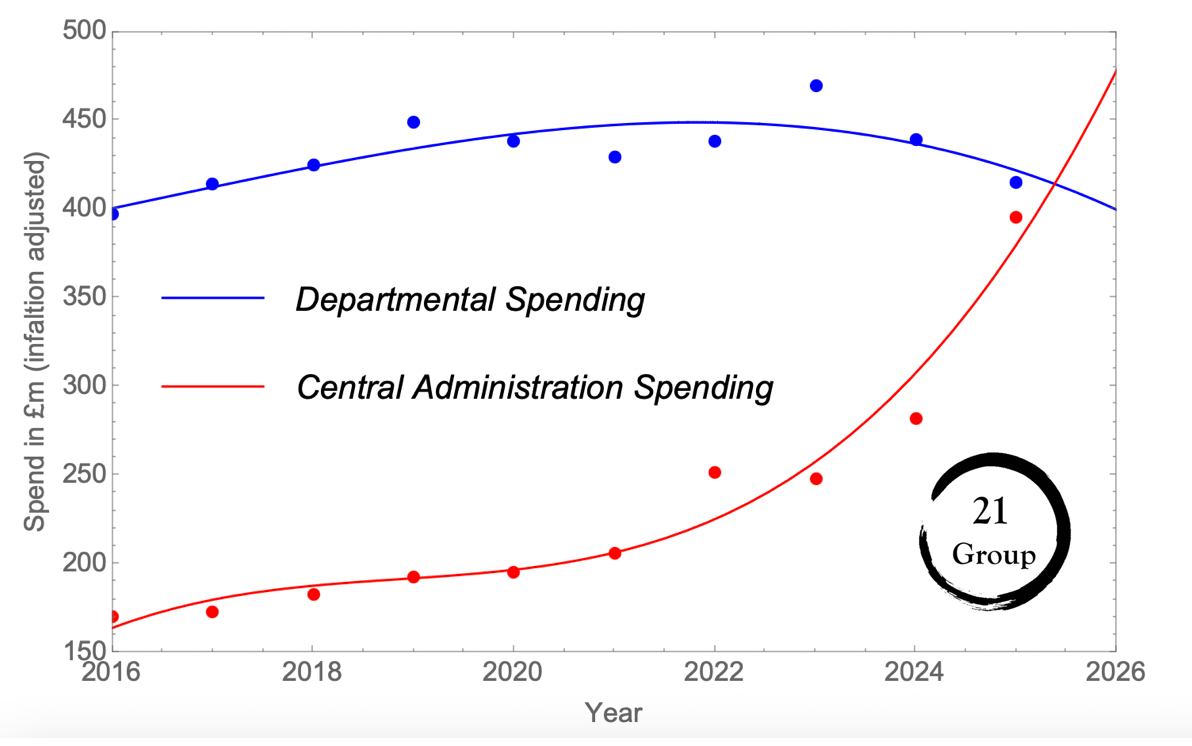
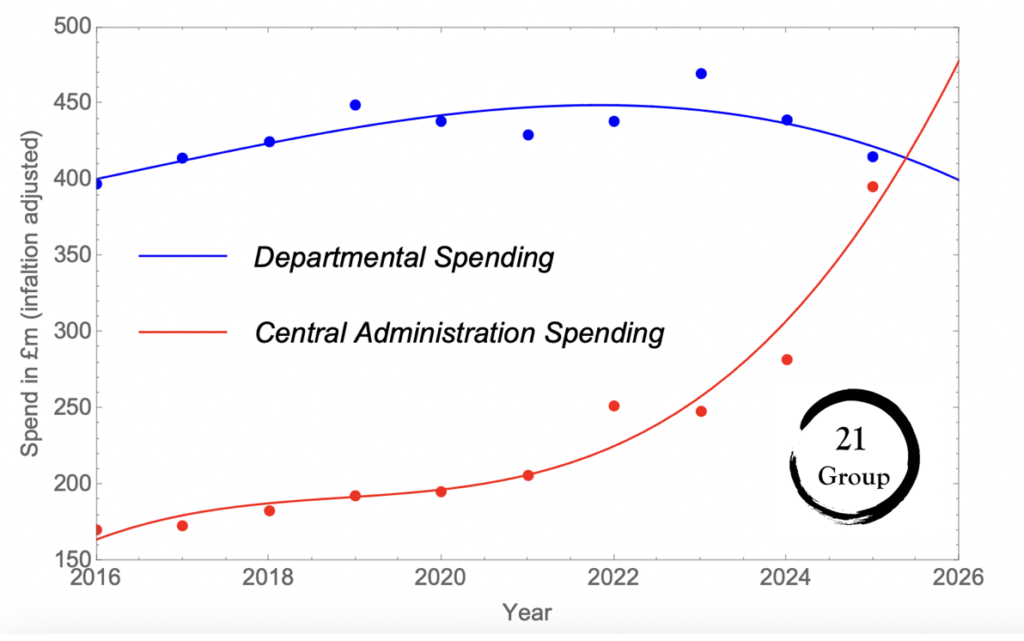
In our previous posting, we raised the issue of the spending by departments and central administration at Cambridge University, based on the End of Year accounts here.
As illustrated in the Figure, adjusting for inflation reveals that departmental budgets since 2016 are flat then fall. At the same time, the same restraint has not been applied centrally. Expenditure on central administration has surged across the same years, growing at a rate well above inflation and with little evident connection to the needs of teaching and research at the departmental level.
The 2025 central administration spending datapoint is anomalously high, so we checked whether it is correct. It is.
Why is it so high? Maybe there is some one-off cost? If so, it is not explained in the accounts? It is also not explicable by inflation (already accounted for in our data), pay growth (staff costs don’t match) or head-count growth (which has occurred but is too small to explain the jump). None seem right.
A plausible answer has been provided by a helpful anonymous correspondent
The areas that first come to mind when considering where increased funding may be directed are the three transformation programmes — HR, Finance, and Research — as well as the estates construction contracts planned for the coming years.
While the software costs associated with the three transformation programmes are not publicly available, it is reasonable to assume they are significant. It is also fair to note that if these projects do not proceed as planned, costs could rise considerably — both due to the expense of implementing replacement systems and the need to maintain access to legacy platforms.
In addition, these programmes have generated higher-graded temporary roles, consultancy fees, and substantial demands on the time of permanent staff required to be involved in the process.
With regard to construction contracts, I would refer you to the following:
This is a significant level of expenditure that I would expect to be recorded centrally. Although the costs are spread over several years, they appear to correspond closely with the pattern shown in your graph.
Keep up the good work!
An IT disaster seems very plausible.
Over-budget IT projects often happen in universities — normally because senior management has little insight into database or software engineering and so routinely underestimate the scale and complexity of the task. There is a recent example of a ~£60m disaster from the University of Sheffield discussed here:
“The more you look into something, the more complex it becomes. And then the project leader felt like we needed to get more staff to look into that complexity, so we just snowballed the number of business analysts and spending started to go up so dramatically. Then we got in a lot of contractors and we started to have a lot of churn of those contractors, so they acquired a lot of knowledge and then they would leave,” the insider added [Quoted in The Register here].
Freedom of Information requests show that the University of Sheffield had allocated £30.4m up to November 2021, and were forecasting a “worst-case scenario” total spend of £59.2m on the project.
The IT project was ultimately abandoned, though senior management at the University of Sheffield remained unabashed, saying “The investment in the programme has already delivered new systems that previously did not exist at the university and our work to date will be important as we develop our future plans.“
The Sheffield disaster was caused by difficulties with integration with legacy Oracle software, as reported here. This is one of the causes of the delay with Cambridge University’s HR software transformation project (MyHR), as noted in the Board of Scrutiny’s Report. MyHR has been postponed to an uncertain date in the future.
Huge over-runs on software projects are known to be one of the principal causes of financial problems at the University of Nottingham and Kent as well (see here and here).
When university senior management chases digital transformation without accountability, the result isn’t usually innovation — it’s high financial over-spending and institutional self-harm.
And Cambridge University foolishly embarked on multiple digital transformations at the same time!
Is it fair to say that the current senior management of UCam is completely clueless when it comes to running a university? The only strategy known here is the “cover-up” strategy and no wonder things are getting increasingly worse. How many more cases and hits to the brand are necessary for the Chancellor and/or an external party to intervene? What exactly is being discussed in the meetings of the University Council? They do not cover these issues? It should not be hard to know if the people who leaked information from there recently could clarify if they also discuss issues other than the political views of the Vice-Chancellor (https://21percent.org/?p=3007).
The running of the HR division is now a big scandal and it warrants external scrutiny.
It is a huge risk to the Health and Safety of members of the University.
Tell us about that 21 Group… It seems that UCam thinks that providing the cases reach the Employment Tribunal and Courts, they are doing what they should and there is nothing to worry about. No one seems to understand that the point of having HR (and OSCCA for students) is to prevent cases to escalate outside, which has a major impact to all parties, particularly single individuals who need to go through that largely alone UCam became a complete circus and the senior management could not care less.
I strongly encourage everyone to report their experiences to their local MP, Mr Daniel Zeichner, as otherwise UCam will continue damaging people’s lives untouched. The kind of excuses UCam representatives come up with have become increasingly nonsensical.
Bloody right!
There is also the well publicised case at Edinburgh:
https://www.bbc.co.uk/news/articles/cd1p32pd90po
It’s not surprising that staff warnings were ignored:
https://www.theregister.com/2024/02/08/edinburgh_university_oracle_report/
Whats the new system called? Might I suggest HR Horizon?
😉
Computer says no
@Carol from HR
I’m writing to ask whether HR has a formal process for “stitching someone up,” ideally involving red cord, dramatic lighting and some razor-blades.
If not, I’m happy to pilot a scheme, purely in the spirit of organisational learning.
I felt it best to check procedures because we’re dealing with some troublemakers here, who are challenging our decisions. We need to be prepared.
@Lou, just to clarify, are you Louise? If so, where’s ‘Sam’ these days?
“If so, where’s ‘Sam’ these days?”
Redacted
Like in here @Raven?
https://x.com/21percentgroup/status/2012545065797792248
I see. It makes sense! Someone should tell Louise & Sam that the Employment Tribunal and Courts can ask the University the raw data before being redacted… It is just a question of time until their adventures are known!
If Universities stopped talking about innovation and started focussing on solving real problems – internal problems included – there would be more innovation.
Existing HR produces incoherent and irrational organisational responses in some critical organisational HR situations resulting in an unacceptable level of organisational risk being generated for the organisation in these situations. If the plan for transforming HR is essentially an “IT upgrade” that more fully automates existing HR such that the newly transformed HR will still produce incoherent and irrational organisational responses in these situations but that those organisational responses will be produced on faster timescales and with less human intervention then this HR “transformation” activity cannot be classified as activity that solves a real problem. The net impact of all the HR “transformation” activity would then be that HR can do less work for no less pay to produce the exact same set of organisational outcomes for the organisation.
Tip of the day: What this shows is that if you hire incompetent people with zero knowledge of tech or basic management then paying them larger and larger salaries will not make them any smarter
Academics cannot work in conditions of organisational incoherence & irrationality. A judicial review can be sought on the basis of organisational irrationality – that legal process would examine the coherence and rationality of the organisational response in any critical HR situation.
University HR can look at an academic in a world-leading university raising concerns on “work-related stress and mental health” and see a person who is “mentally weak” and “mentally unfit”. A sports coach can look at an athlete in a world championship getting out of breath and physically struggling in the middle of running a marathon and see a person who is “physically weak” and “physically unfit”.
Sports coaches would know better than to put themselves situation where they could be making claims that an athlete competing in a world championship is “physically weak” and “physically unfit” and then be asked to prove the claims they are making about that athlete by competing against the athlete in a the same marathon themselves.
HR expecting an organisation that is dispensing incoherent and irrational organisational responses in critical organisational HR situations to somehow protect HR itself is unrealistic. HR has to learn that the only thing that will offer any protection in these critical HR situations is a coherent and rational organisational response in the critical HR situation. HR have to learn to sit down with people in these critical HR situations, to build coherent and rational arguments with people in these critical HR situations, to apply common sense with people in these critical HR situations, to solve real problems with real people.
Secrecy and cover-ups are the basic management fault of this university. It is why an entirely new team is required. We see it again and again. Early warnings are not only ignored, but deliberately suppressed. Staff and students are explicitly threatened if they suggest to be so bold as to inform their colleagues what has happened. Whistleblowers are not only ignored but then persecuted. Legal threats are issued where needed to prevent disclosures.
The lies go all the way up the chain to the top. Minutes are redacted, notes not kept. Recordings of meetings are formally prohibited. Documents are edited before being sent to the VC and Council to ensure they are unaware of what is going on. And accounting fraud is widespread as a means of burying cost overspend and financial errors in off-balance sheet funds, until they accumulate to the point of explosion.
“Staff and students are explicitly threatened if they suggest to be so bold as to inform their colleagues what has happened.”
This is very true, but note that regarding students, at least their Senior Tutor must be cced in the communication and thus they are fully aware of these threats. I do not know what happens in other colleges but in Christs College, the Master, the Senior Tutor, the College Council are all fully aware of these threats and do nothing about it. Perhaps it is coincidence that this is also the College of the VC.
“Documents are edited before being sent to the VC and Council to ensure they are unaware of what is going on.”
The only way to deal with this is ccing VC, ProVCs and members of University Council regularly when you report misconduct. That is why I was forbidden from contacting hundreds of people, including all the main senior leadership of UCam. But guess what, when I contacted the MPs recently to report the abuses that I have experienced in UCam, I cced this leadership, and next time I get threats from anyone of UCam they will go straight to the MPs and I will cc all the leadership again, particularly the ProVC for Community Engagement who thinks that not addressing a whistleblowing disclosure and safeguarding referral based on detailed medical evidence is not concerning. The only way to deal with people who use secrecy and cover-ups as the basic management of misconduct is by exposing them to the public at large. Please do not keep the bad experiences you got in UCam for yourself as they will be experienced by others in the future who are not aware of the modus operandi. We have to stop this cycle ASAP!
The whole lot are corrupt and must go:
VC
Pro-VCs
Council
Acting Registrary
Head of legal
Head of HR
They are the ones overseeing the monstrosities reported here!
Out! Out! Out! Out! Out!
Look at the reasoning : label ~ 0.05% of organisation as “corrupt” and ~ 99.95% of organisation as “not corrupt”. The 99.95% then removes 0.05% of the organisation. That allows the remaining 99.95% to allow themselves to believe they are “not corrupt’ unlike the “corrupt” people they identified & removed – not by checking things like the persons propensity towards corruption or the accuracy of their judgment but – by looking solely at what organisational position the person happened to occupy when the whole organisation happened to be reaching peak organisational irrationality after soldiering on through decades of suboptimal tuning of organisational feedback loops.
These organisational actions allow the remaining 99.95% to feel good about themselves as being “not corrupt” unlike to the “corrupt” people they have removed from the organisation but could this organisational activity – guaranteed to generate prolonged exceptional organisational energy expenditure – be classified as activity that provides a real solution to a real organisational problem?
The remaining 99.95% of the organisation feels empowered & feels good about themselves because not only have they found all the “corrupt people” and removed them from the organisation, they have also all classified themselves as the “not corrupt people” in the process. The 99.95% feel no need to change themselves or to do anything different to what they did before. 99.95% of the organisation therefore does nothing different to what it was doing before but that 99.95% still expects the whole organisation to change because it took some action to remove & replace 0.05% of the organisation.
99.95% of people don’t then mount any rational resistance to the organisation or take any action to generate accurate information about the current state of the organisation for the organisation. The organisation is then missing 99.95% of the information it needs to accurately know what current state it is in and what organisational outcomes are currently being generated. Without that organisational information being continuously generated for the organisation the organisation cannot optimise itself to generate better organisational states and outcomes in future.
The 99.95% remove and replace the 0.05%, they now feel themselves to be “empowered”, they now feel themselves to be better people because they are “not corrupt” unlike others who are “corrupt”, they now feel themselves to be “superior” to the 0.05% they classified as “corrupt” in order to justify removing and replacing the 0.05%. The organisation itself is left in a state where it is still flying blind when making organisational changes, the organisation itself is still missing the information it requires to make accurate organisational changes going forward, the organisation itself is in no better position to solve its real organisational problems than it was before.
Whether the whole organisation improves its overall performance as an organisation after taking such an approach to solving its problems is more a matter of blind luck than the organisation having done the work that is required for it to effectively reform itself as an organisation & allow itself to take a leap from operating in a highly sub-optimal state to continuously operating in a close to optimal state as an organisation.
Things are going really badly in the university – oh look there’s the current VC that I could label “corrupt” whilst labelling myself “not corrupt” in order to justify removing the current VC & replacing them with myself. Now that I have used this “corruption-labelling strategy” to install myself as the new VC I’m doing the exact same things the old VC was doing because the organisation is constraining me in the exact same ways it was constraining the old VC & things are still going really badly in the university.
Since I’ve labelled myself “not corrupt” both to justify getting rid of the old VC and to sell myself as being far superior the old VC in every way the current state of affairs in the university must be because other people in the university are “corrupt”. I’m just going to stay in this VC role vigorously fighting “corruption” from the top by applying the “corrupt” label to everyone else in the university until I have applied that “corrupt” label to everyone in the university but myself.
At that point I can then conclude that I am the only “not corrupt” person in a university otherwise completely filled with people who are “corrupt”. If anyone else in the university thinks they can label me “corrupt” whilst labelling themselves “not corrupt” as a way to steal my VC role from me then they have another thing coming because I won’t stand for any of that nonsense from anyone but myself.
It’s important to recognise the state the organisation is in, if the organisation is in a highly irrational state it means the organisation has the potential to generate highly irrational interactions with anyone interacting with the organisation in any position. The physically impossible could be being demanded of those in leadership roles in the organisation in addition to those in other roles in the organisation.
Anyone who thinks they can label others “corrupt” and themselves “not corrupt” and that this is enough to make both those statements true and hence them the “right person” to fix all the “corruption” in an organisation is labouring under a false illusion that their “truth” about the organisation continuously corresponds to the truth about the organisation and that their measure of the levels of “corruption” in the organisation continuously correspond to levels of corruption in the organisation.
This is not the case, there is an objective truth about the organisation, there is an objective measure of corruption in the organisation – amount of false information the organisation holds about itself. When everyone in the organisation starts giving any accurate information they have about the organisation to the organisation this fact then becomes apparent. It then becomes obvious that whilst there were many people claiming to know the “truth” about the organisation, the truth about the organisation was not known because it had not yet been built by the coordinated efforts of all people in the organisation and that this was the real problem & stumbling block to the continuous functioning & advancement of the organisation.
Every person in the organisation is the right person to fix all the corruption in the organisation, that is what will bring the organisation back to a more rational state, that is what will bring the organisation back to a more governable state, that is what will bring the organisation back to a more functional state, that is what will allow the organisation to continuously function and advance again.
The corruption has advanced in several phases
1. In the first phase, senior administrators awarded themselves outsized salaries and benefits, as well as outsourcing contracts and favours
2. This generated resentment from other senior stakeholders, notably senior professors. The first solution was to add more senior executive roles in the administration and tell these professors that if they were “good” they too could join the golden club
3. This bought off some people (heads of school etc) but there weren’t enough positions to go around, leaving resentment among research professors
4. This resulted in any number of abusive practices as departments sought to pass down workload to junior academics, admin, postdocs while coercing them to give cuts of grants, publications and credit to senior profs
5. So then they raised salaries for senior professors, we ended up with a massive inflation of high (150k+) pay deals but nothing for basic admin staff or postdocs or lecturers
6. But the people at the bottom (programme admins, lecturers, postdoc team members) were the ones doing all the work and they’ve had enough, and no amount of short-term hires will fill the gap
7. So now the whole system is falling apart- the best scholars have left, the grants aren’t coming in, students are upset, and yet the nomenklatura still continues to expand
8. The legal cases pile up, the costs augment, and the university is failing as research output declines and the rankings finally catch up with reality
9. VC wants austerity but the cuts fall on the people doing all the work while the nomenklatura continues to drain resources
10. All the skeletons are coming out of the closet and no-one has a clue what to do. We need a total rebuild from scratch but it cannot be done because the people who birthed this mess are still running the show and running circles to keep the skeletons hidden
Great summary
“The legal cases pile up, the costs augment….”
Does anyone know where these legal costs appear in the accounts? We suspect these are going through the roof … but not improving the estate.
“VC wants austerity but the cuts fall on the people doing all the work …”
Not so easy to argue for austerity when you are the highest paid VC in the Uk.
Senior management in universities seem to think of ‘austerity’ solely in terms of cutting financial spending but cutting financial spending is not real austerity – real austerity is finding ways to increase in the precision of organisational self control and to eliminate useless work from the organisation.
Due to this misunderstanding of austerity, at times of crisis senior university management have a tendency to forcefully but imprecisely slash budgets, cut jobs & cut salaries for everyone in the organisation but themselves. They labour under the false illusion that they “taking the required difficult organisational decisions” by implementing “austerity” and that gains of organisational function will naturally follow without any real concern for implementing real austerity i.e. finding ways to increase the precision of organisational self control and to eliminate useless work from the organisation.
This leads to universities entering into endless, potentially unbreakable cycles of “austerity” where “austerity” is implemented after which more “austerity” is required because the level of organisational self control is steadily decreasing and the amount of useless work being done in the organisation is steadily increasing. Whilst real austerity is necessary organisational medicine in times of crisis, “austerity” is just unnecessary organisational cruelty in times of crisis.
Senior professors can sit on £150k+ but will find far fewer takers for any of the abusive practices that sustained “output” at previous levels.
People in these positions have failed to appreciate the difference between a stable low-reward situation which allows a person to maintain a career path that ends in a stable high-reward situation and an unstable low-reward situation that offers a person nothing but a pathway to further unstable, low-reward situations.
It makes sense for people to compete to enter into a stable high-reward situation as a person can maximise individual performance in such conditions but it makes no sense to compete to enter into an unstable low-reward situation as it is much more difficult for a person to maximise individual performance in such conditions and that is what is required in order to exit such conditions.
Senior professors in Cambridge can sit on £150k and wait for “austerity” to come because they won’t feel the impact of “austerity” but any professor in Cambridge who sits on £150k and waits for real austerity to come has a low probability of surviving the impact of real austerity if it does come.
The popular and charismatic person did not have any of the personal traits that would enable a popular and charismatic organisation to be built, they continuously sucked the life force out of others in the organisation and out of the whole organisation in general – without which the organisation was unable to reach an organisational state of being popular and charismatic – in order to sustain their own individual life force and stay in an individual state of being a popular and charismatic person.
Fortunately for organisations under pressure, people under pressure can change, can teach others strengths, can learn strengths from others, can grow and evolve personal traits to enable an organisation to grow and evolve as an organisation and can recognise half-truths : that the statement “did not have any of the personal traits” is a far less precise statement than the statement “was yet to acquire some of the critical personal traits necessary to complement the critical personal traits they already had in abundance”.
When a person is really under pressure it is possible for a person to go from recognising statements with no truth – “did not have any of the personal traits” – in the context to recognising statements with half truth – “did not have any of the personal traits” is a far less precise statement than the statement “was yet to acquire some of the critical personal traits necessary to complement the critical personal traits they already had in abundance” – in the context to recognising statements with full truth – “was yet to acquire some of the critical personal traits necessary to complement the critical personal traits they already had in abundance” – in the context.
Do you take pleasure in crushing other people’s soul?
Do you enjoy subtly destroying others?
Do you fantasize about compliance as a weapon of mass despair?
If you
Believe “employee satisfaction” is a myth, and disruption is an art,
Know exactly when to say, “We’ll have to pass that by Sam in Legal”,
Have the skills to turn a simple request into an epic saga of fear,
Have a PhD in passive-aggressive emails and blame-shifting,
then apply now to join our exciting team
https://www.cam.ac.uk/jobs/hr-case-manager-x2-ah48001
“Our Human Resources (HR) Division supports our academic and non-academic Departments to achieve the University’s mission to contribute to society through the pursuit of education, learning and research at the highest international levels of excellence, whilst also seeking to ensure that the University continues to maintain and enhance its reputation as a leading employer.”
Do not forget these words. When the scandals currently covered up become public, ask the Director of HR who wrote this pathetic paragraph… If the applicants knew the mess they are getting into, they would run away!
It’s not a joke. It is genuine evil. They enjoy the pain they cause.
For a university that is meant to be a hub for computer science innovation it is humiliating. We could have just asked our undergrads to built the platform as an end-of-term assignment and they would have done a much better job for free. Or our postgrads earning sub-minimum wage while giving up a third of pay in overheads to HR and Registrary.
The most extraordinary aspect of this business is — as you say — the academic staff raise all the money in grant overheads and tuition fees.
Much is creamed off by central administration. This is then used to pay HR and the Registrary.
And HR and the Registrary appear to be spending money in hugely wasteful ways that are damaging the University
@SPARTACUS is right. We need a revolt.
Does anyone have the numbers on this? I thought I had seen somewhere some figures showing the levels that are set for teaching assistants in terms of the amount they receive (minimum wage or thereabouts) and the share of their salary that they are required to give to the central administration as “overhead”. And how is that classified in accounts? Is it misclassified as departmental spending even though it should be classified as central administration?
Also didn’t they set up an internal loan scheme where cash-starved departments would borrow money centrally, but then have to pay back the debt with interest? What are the details on that and are there internal dark debt pools?
There’s a longstanding debate around how the University’s Endowment Fund (CUEF) features in the accounting statements. Does appear like recent accounts “reclassified” some expenditures over to the endowment. From an accounting perspective guess key issue there is around a) consistency (why switch calculation rules) and b) whether those accounts are also published in line with charity organisational standards. I could see a case for capex on construction going in separately but for IT that seems misleading. For a university (i.e. not a big tech company) IT is operational NOT capital expenditure. It would only be capex if we were using the HR platform for service delivery which obviously we are not. Otherwise it is a “business as usual” expense. The fact that project managers ballsed up an IT platform and turned a one-off to a multiannual cost would not magically make it capital expenditure. At any rate it would have to be visible in the accounts either way.
There has been a large (30%) increase in annual distribution from the CUEF since 2022 (from 130.5m to 172.7m). That’s not a bad thing necessarily (and some would say it should be larger) but worth asking where the additional monies went.
On “dark pools” could you clarify what you had in mind? Do you mean the Surplus Improvement Fund (which as per the Reporter “does not have its own entry in the Financial Statements”)? Or are there other schemes internal between central admin and schools?
If IT was the bottleneck I would agree but I think the bottleneck is culture.
System processes are being optimised to both minimise the amount of accurate information being generated in the analysis of any systemic problem & maximise the amount of inaccurate information being propagated in the system about any systemic problem.
That situation seems to be arising because the interactions on which the analysis of any systemic problem depends have this property : adversarial. This means it is possible for systemic processes to get stuck in a negative cycle. Systemic processes worsen e.g. due to national emergency interactions then become more adversarial & analysis of systemic problems then becomes less accurate so a system evolves away from its most optimal state as the system has less accurate information about itself.
Systemic processes worsen even further, interactions become even more adversarial, analysis of systemic problems becomes even less accurate, system has even more inaccurate information about itself, system drifts even further from its most optimal state. In system stuck in this negative cycle worse and worse system outcomes are being delivered over time despite higher and higher amounts of energy being expended by the system over time. More and more work is being done by the system but it’s not necessarily useful work, it’s not necessarily enabling the system to deliver better system outcomes.
In order to flip that situation & start optimising system processes to deliver better outcomes through these interactions, the moderation strength property of these interactions that are the basis of the analysis of systemic problems would need to shift from low to high i.e. any highly adversarial interaction that is the basis for an analysis of a systemic problem would need to be correspondingly highly moderated.
The whole structure is nauseating! Their titles are abhorrent: HR Case Manager, HR Business Partner. The salaries are outrageous if you compare it with scientists and junior faculty! And these ‘characters’ preside over scandal after scandal and participate in grossly unlawful proceedings. The whole think stinks and reeks of gross corruption and mismanagement! The Post Office scandal is multiplied at UCam by a factor of 10! The place is doomed and the downfall spiral appears now to be unstoppable! 800 year history being savaged and soiled! And the American Queen and her cronies found the time in the middle of this wreck to talk to… the Farrage lot. This is terminal!
Do we have any progress on the idea of the book and/or website discussed here (https://21percent.org/?p=2729)? This could be useful to put our experiences into a broader context when we contact external parties such as the MPs. I confirm that they were already introduced to the Consigliere University 😅
It would be good to cover some key figures of UCam sooner rather than later, and the obvious name that comes to my mind is the most discussed Lead HR Business Partner in the 21 Group. Given she likes to write witness statements and apparently thinks she will be protected for life, multiple victims of her could write something about our experiences and “break the silence.” We could even consider opening another social media platform just for this. Importantly, this reporting could be useful for those who have cases in courts and employment tribunals related to these people as it could show the systemic nature of their behaviour. I trust the 21 group has a good idea of the UCam staff who is associated with more scandals of misconduct!
…“multiple victims of her” already know they are victims, based on the appalling treatment, others, who are perhaps still very much enjoying the benefits of the writing skills on offer (e.g. for witness statements) to cover up wrongdoing, and to insult and further injure the other parties, may only find out much later that they too could in fact be “victims”.
It takes some skill to screw people left, right and centre, top and bottom – presumably for the sheer hell of it.
Remember this. Her main advantage is the confidentiality that the university enforces—or attempts to enforce—so that not many people know what she and others do. Let’s see how well Ms ‘most discussed Lead HR Business Partner in the 21 Group’ does in a public trial, namely when she is asked questions and cannot avoid or manipulate the answers as she does in UCam, and does not have ProVCs or Heads of School protecting her. If the ProVCs and Heads of School become themselves victims, that is their fault because they had more than enough evidence about her misconduct, from multiple people and multiple departments, and they ignored.
[…] Given this background, we highlight again the interesting contribution made on the previous thread by Autophagy here […]
Look closely at the accounts.
In 2020, the line item for the administration “other operating expenses” was 1.6m pounds.
In 2025, the figure is 98.7m pounds: even after an apparent revision.
That is a more than 6000% increase.