This week, the growth of Human Resources (HR) has been in the news because of a publication from the centre-right think tank Policy Exchange. Its report on the growth of HR has received widespread attention, eg in The Times and BBC Radio 4. The most striking claim is that the UK now has almost twice the workforce employed in HR as the EU, and 60% more than the US.
The HR Review is a news and information resource for human resources and related professionals. It somewhat gleefully agrees that the number of HR staff has grown substantially in the UK. In fact, it has claimed that the number of staff working in HR has overtaken those in the medical and legal professions here.
It is certainly true that the United Kingdom is an international outlier with its dominant and rapidly expanding HR sector. It ranks among the largest in the world, second only to the Netherlands. While HR employment has been steadily increasing across most Western countries, the UK is a leader in the field. According to the Labour Force Survey (LFS) from the Office of National Statistics, the sector experienced an 83% growth, rising from just under 300,000 workers in 2011 to over 500,000 in 2023.

Criticism of the growth of HR from a centre-left perspective is available as well, for example in The New Statesman
“Why were recruitment processes taking so long? To ensure fairness. Who decides what’s fair? The Public Sector Equality Duty, in precedents set by courts and interpreted or pre-empted by employment lawyers and HR advisers.
Why were so many employee grievances settled at such great expense, before and after employment tribunals? Because there were so many transgressions of HR policy, often by the very people who had codified the rules”. [Pamela Dow in The New Statesman, from which above infographic also comes]
So, what has been happening in Cambridge University?
The UAS (Unified Administrative Service) is the central administrative body of the University that provides core professional services across many functions such as finance, governance, estates, legal services and HR. It operates under the authority of the University Council and is led by the Registrary. The Human Resources Division is one of the divisions within the UAS.
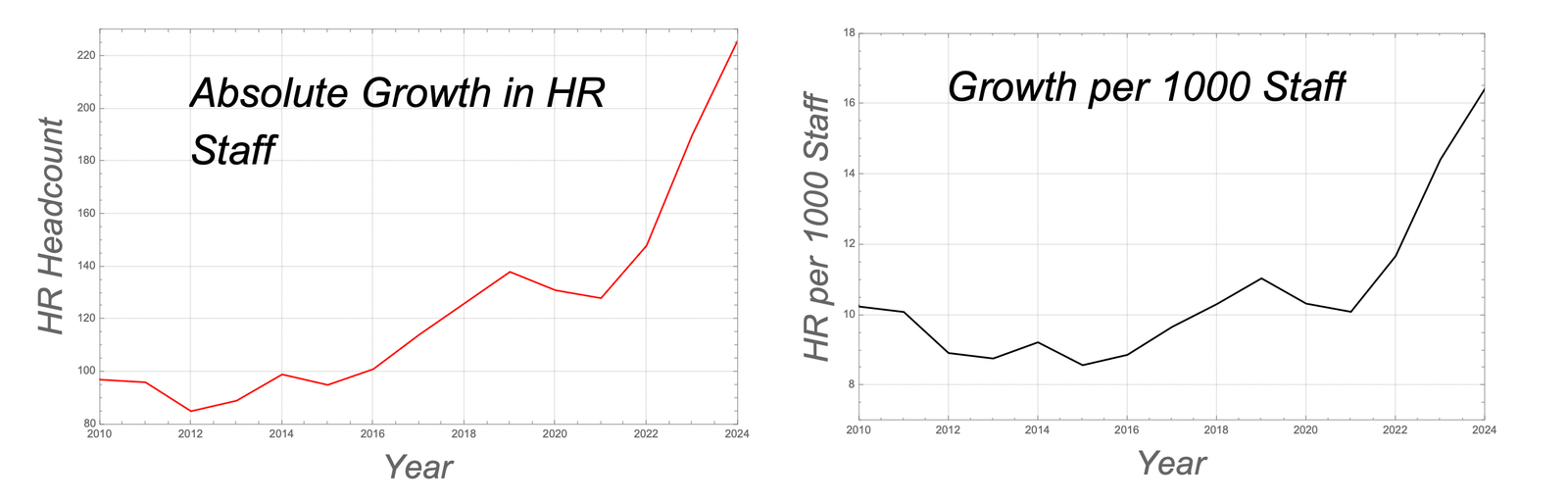
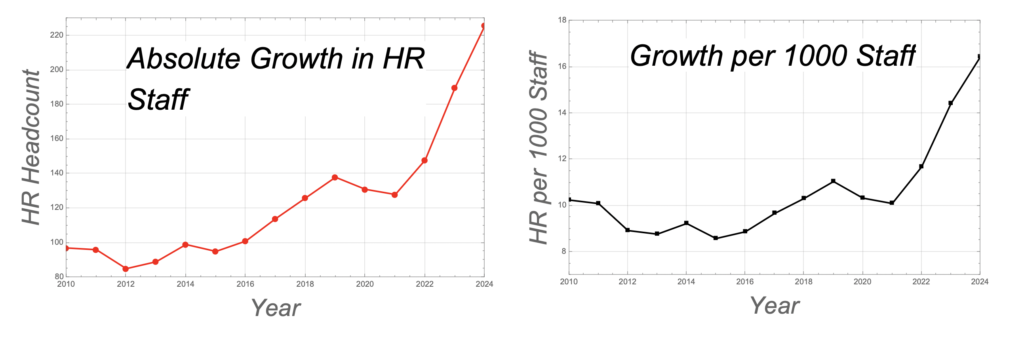
The HR headcount in the UAS of Cambridge University increased from 97 in 2010 to 226 in 2024. This is a net increase of +129 staff and an overall growth of ~133%.
Another way to look at the data is to plot HR headcount growth alongside total university headcount (that is, the total number of established and unestablished posts). This visual helps illustrate that HR staffing grew proportionally faster than overall university headcount during the period from 2010-2024. Both plots show the key transition point, which is the substantial post-2021 expansion in HR. This was part of the mission of the former Registrary (Ms Emma Rampton) to transform professional services in the University.
To be clear, these numbers only refer to HR staff that are members of UAS. The numbers do not include those performing HR functions in the departments. There are ~150 departments in Cambridge University. In practice, larger departments like Physics or Engineering have several local HR professionals (roughly 5–10), while smaller departments like Astronomy might have 2–3 local HR staff. This suggests that at minimum, there are a further ~ 500 staff working in HR services at the University. For fairness, it must also be pointed out that HR services need to be provided to postdoctoral staff who are not included in the university headcount numbers.
While the UK has seen a 83 % rise in HR employment over the past decade, Cambridge University has outpaced even that, with HR staff more than doubling since 2010. The machinery of people management has grown faster than the people it serves, underscoring just how pronounced the local expansion has been.
Each new HR layer generates more processes and problems, which in turn require additional HR to manage them, creating a self-reinforcing cycle (the so-called HR Death Spiral). The greater the inefficiency or incompetence within the HR leadership, the faster this cycle occurs — shortening the ‘doubling time’ of the HR workforce.
Another observation in Pamela Dow’s New Statesman article is this:
The majority of HR workers are university graduates, a rise in recent decades similar to other administrative sectors. Perhaps more surprising is the shift towards HR roles as a first occupation on completing a range of degrees. We might have guessed this would be a career destination for psychology and business studies graduates, but did those 18-year-olds, as shown in the table opposite, choosing history, English, politics, languages or philosophy expect to be HR officers? This may illustrate “elite overproduction” in the social sciences, or in other words, of too many humanities graduates and not enough jobs for them. It’s worth noting that HR has been the beneficiary in Britain, rather than, for example, teaching. Alongside good pay and job security, in many organisations HR allows influence on high-status topics, incommensurate with position: global social justice and identity campaigns.
What is throttling the British economy is a combination of a) decades of regulatory additions and b) a total failure of enforcement and/or clear case precedent.
a) means that no one really has a clue what the rules are, and managers cannot manage without consulting HR (typically for career protection – even though the ethical decision is often screamingly obvious), while
b) means that cases take years to reach court and then settled prior to judicial outcome – offering no clarification under common law that should guide future HR decisions
The solution is to prioritise enforcement (and clarification!) of current rules and deal with employers who exploit the weaknesses of the current system.
The new Employment Rights Act 2025 could have done that if whistleblower protection were enforced and sanctions for case delay augmented.
Either way it has to come in with strict targets like we have for NHS waiting lists – including significant new spending to employ additional judges and court staff (perhaps instead of hiring HR personnel?) and fast-tracking of the worst cases to court faster with firm final rulings – so that employers finally realise it will be less costly to comply with the law than pay HR “professionals” to help them game the system.
Teaching … what’s that compared to the thrill of destroying a person?
The university pretends it is a place for cultivating minds, but the true sport lies in finding the weak seam in someone’s confidence, tearing it open and breaking them down.
Selecting the victim, fabricating the evidence, writing the “independent” report, seeing the victim slowly becoming paralysed with fear and madness. There’s nothing they can do. They’re trapped.
There’s no risk, everyone at the top knows we’re killers. They’ll always back us. Often they’ll help us choose the next victim.
Our loyalty is entirely to the HR division, not the university.
Who cares what happens to the university, whether it falls in the rankings? Who cares about the students, the staff, the university’s reputation? That doesn’t interest us at all.
Their increasing number does not worry me as much as their decreasing quality, and by that I do not simply mean they are incompetent but also corrupt and malicious. It seems clear that many members of UCam already view HR as seriously incompetent, but the issue is much worse than that. Challenge their practices and see what happens next.
You rightly emphasis integrity, and we agree with you that lack of integrity is a serious problem in many university HR divisions. However, the numbers do have an effect, both in universities & the wider economy (as @0.02c indicates). The relentless growth of HR personnel across both private and public sectors is weighing on the economy, driving up the cost of goods and services and eroding the purchasing power of every tax pound.
As Pamela Dow’s article says “If we could track trends towards higher retention, happier workers, fewer grievances, this growth would be welcome. If there was a correlation with HR and improved outcomes it would be rational for leaders to invest more. There is evidence for the opposite. As HR roles have increased so too have the number of tribunals and days lost to work-related illness, while productivity has flatlined. HR expansion is not coinciding with desirable things and appears to be coinciding with undesirable ones.”
We certainly know in Cambridge that the increase in HR personnel correlates with increased DSARs, increased Occupational Health referrals, increased counselling referrals, increased sick leave & increased numbers of Employment Tribunals. There seems no sign that the University senior management has noticed this correlation and tried to understand what is driving it.
In my view there is a very simple means of unblocking our beleaguered Tribunal system: to broaden the scope for public interest reporting in the press.
The current system has introduced a perverse effect of undermining compliance by forcing claimants to stay silent for years while cases grind through the works. We saw with the Post Office scandal what that meant – a failure of open public debate, no accountability, and the attempt (almost successful) to exhaust victims financially.
The real reason employers game the system until the final moment is fear of exposure. So that’s what needs to change. Journalists in the UK have to comply with strict defamation rules and that means little risk of prejudice in letting them break those instances where the evidence is overwhelming, and employer delays simply waste ET time and resources. The result would be a huge increase in amicable agreements and a rapid clearance of case backlog.
True. Even on this forum people avoid stating the facts in comments, out of fear of legal retribution, even though everyone has a right to state the truth. There needs to be a right to freedom of speech.
Indeed, we need a First Amendment: “Congress shall make no law respecting an establishment of religion, or prohibiting the free exercise thereof; or abridging the freedom of speech, or of the press; or the right of the people peaceably to assemble, and to petition the Government for a redress of grievances.”
We try and prioritise free speech in the blog comments. There’s too much repression in universities already, despite the Chancellors & Vice Chancellors of Oxford and Cambridge repeatedly emphasising the importance of free speech
Correct me if I am wrong but it is my understanding that the truth is an absolute defense against defamation claims. The University of Cambridge is very welcome to sue me if I have stated here or in my emails to internal or external parties anything that is untrue about how OSCCA, HR and the senior leadership have treated me. I am still waiting for a “cease and desist” letter and it has not arrived yet. Rest assured, I will make post it here when/if it does.
I believe that is correct but regrettably, there is a pattern in British public life showing how major national institutions like the Post Office, BBC (Savile…) or universities (recent Oxford scandals) place pressure on journalists and civil society groups to prevent such facts coming to light. Ironically doing so does not “protect” reputation but has the opposite eventual outcome. If Savile was exposed in the 1970s then by now, no one would remember him. Oxford had plenty of time after the Degrees of Abuse story in Al Jazeera to set matters straight. The key facts of the Post Office scandal were known a decade or more in advance, but only Private Eye would report, and that only because Private Eye, too, is a strange kind of national institution with an informal “free pass” to report what others will not.
Even if you publish and you are right, you will still lose money if it goes to court. The Guardian versus Noel Clarke is an example.
https://www.theguardian.com/culture/2025/sep/23/noel-clarke-ordered-to-pay-initial-3m-in-legal-costs-to-the-guardian-after-losing-libel-case
So Clarke has been ordered to pay The Guardian‘s costs, with an initial payment of £3m. But, Clarke is now bankrupt, so he can’t pay.
https://www.standard.co.uk/news/uk/noel-clarke-declared-bankrupt-guardian-libel-case-b1266928.html
The Guardian was vindicated, winning both its ‘truth’ and ‘public interest’ defences. But it will have lost millions
The British system is the worst of both worlds. Rich people and businesses can afford to pay millions to intimidate journalists and activists with phony “cease and desist” letters. But ordinary people have no such protection – they can’t afford it. So scandals at the top go unreported while Joe and Jane Bloggs are subject to tabloid nonsense and retaliatory rumour. In my opinion you either need a system like Scandinavia where it’s a criminal offense so ordinary people are protected the same or like America where everyone can say whatever the hell they like but powerful people are exposed as well. Not sure what I prefer but either would be a lot fairer.
With reference to the Statesman piece:
“While there is demand from graduates, HR job supply is conditional on the HR function having the power to sway employers’ choices.”
“Professions – law, surgery, accountancy – have a status which depends on specific criteria. They rightly require expertise, combining objective knowledge and practice: learned, assessed and accredited. They are distinct in contributing a shared civic good, necessary for a safe and fair society, and so valued outside a market. These factors beget a collective interest in standards, trusted ethical codes, and representative bodies to regulate entry and exit.
HR and its representative bodies have built the apparatus of a profession but without these crucial defining criteria. Specialist HR knowledge can be acquired on the job, and once was, usually by non-graduates. In most cases it isn’t objective. If it was, we wouldn’t see so many successful challenges to the application or misapplication of HR policy.”
The most worrying aspect is the coexistence of power (or pretence to) within an organisation and the absence of objective criteria determining the skills, expertise, achievements and remit of any one HR practitioner, at any one level.
So, unaccredited, un-assessable and unregulated personnel practising and learning on the job can end up advising Heads of Department and Heads of School, can end up defining processes and policies, can end up influencing decision-making of committees recruiting the next Head of Department, or determining promotion and reward within entire schools, confidently citing “conflict of interest” or “propriety” while having no idea what they actually mean. They can end up creating an aura of knowledge, expertise and privileged access to “legal advice” which is nothing but the fantasy of an overinflated ego.
And yet, key personnel in universities end up relying on these individuals for advice, decision-making, response-letters and witness statements, believing (or so it seems) that what they are receiving is “expert advice”, and that the source of this expert advice is therefore worthy of the trust they are given.
Unaccredited, un-assessable and unregulated HR staff will also have access to all the very confidential information pertaining to the processes on which they “advise”. They will be able to delve into the depths of any employee’s very personal personnel files. Undefined HR “expertise” defines the trust to handle such confidential and sensitive information “appropriately”. It also justifies decision-making as to who else should have access to it, and who shouldn’t.
Concerns have been raised about HR performance in our university, this time with objective criteria such as documentable evidence. The refusal by those in charge (whoever they might be) to investigate should give us an indication of how worried we should be.
“Concerns have been raised about HR performance in our university, this time with objective criteria such as documentable evidence. The refusal by those in charge (whoever they might be) to investigate should give us an indication of how worried we should be.”
It works both ways as it also tells us how worried they are about the issues. Professor Kamal Munir, for example, knows that many people already complained against the Lead HR Business Partner Ms Louise Akroyd, and with documentable evidence, but he dismissed the complaints sometimes even without conducting any investigation and following her advice. The consequence? An increasing number of people knows about his behaviour, knows what they should expect when they raise a complaint through him, and hopefully Prof. Munir will have the chance to explain his behaviour in the Tribunal. Surely, if the evidence was non-existent and the complaint was “vexatious,” they would not mind to conducting an investigation, at least one of their fake ones. However, this is no longer an option because the complainants will no longer buy it, and the University cannot afford an external investigation because the evidence is overwhelming. In this case, their refusal to investigate is indicative of how worried they are about the issue. What worries me the most is that I know what Ms Akroyd and others can do, and at the moment I can do little to prevent that what happened with me happens with others.
I think HR as a profession has been naive with respect to its own development as a profession. HR professionals seem to have accepted as reality a situation where there was significant professional reward with seemingly little to no significant professional risk – at odds with reality.
To achieve that state – significant professional rewards with seemingly no significant professional risk – HR professionals effectively coupled themselves to in-house Legal professionals in organisations and the subset of external legal professionals advising them on anything HR related.
What this means is that the overall risks and the reward-risk ratio of the in-house legal professionals that HR professionals coupled themselves to (+ external legal advisors on HR related matters) then changes as the legal professionals are taking on additional professional risks not associated with their own profession and not associated with any rewards they themselves are receiving.
Significant new risks then arise for legal professionals because they are then handling the professional risks of two professions – HR and Legal – when they should only be handling the professional risks of one profession – legal profession – risks which can in themselves be extremely difficult for legal professionals to manage in any complex organisational situation without taking on the professional risks of another profession – HR.
It is then significant extra work for legal professionals to get their organisational judgments right in any organisational situation because that situation in of itself – HR coupling to Legal – creates dynamically shifting conflicts of interests in any situation with both HR and Legal elements. An in-house head of Legal could then be left trying to manage their own professional risks – which they have maximum control over & is normal situation for legal professional – and the professional risks of the head of HR – which they may have very little control over & is an abnormal situation for legal professional.
This creates additional professional risk for legal professionals – risk that is inherently much more difficult for them to manage as it is not the professional risk they have been trained to manage by their own profession – for no extra reward. The creation of an unbalanced risk-reward situation for HR professionals leads to the creation an unbalance risk-reward situation for Legal Professionals that HR professionals have coupled themselves to manage their professional risk.
Legal is then under the maximum pressure to do the right thing in any organisational situation generated by HR professional not meeting professional HR standards – in higher risk, lower reward position with respect any HR generated situation. In order to minimise their own professional risk they need to minimise HR professional risk but will get no extra reward for doing so. Since legal does not have control over HR, it is reliant on HR – in lower risk, higher reward position – to do the right thing to manage their own professional HR risk in any situation generated by HR themselves.
Since HR have the most conflicts of interest in any HR generated situation then for HR to do right thing in that specific type of situation – manage its own HR professional risk – is going to take a maximum work/effort from HR. HR are under the minimum pressure to do that maximum work in relation to that specific type of situation because they appear to face low to no professional risk themselves for not doing the maximum work in that type of situation. HR are also the ones in the organisation to whom reward for managing any HR-related organisational risk will accrue when others in the organisation – legal professionals – manage their HR professional risks in any HR generated situation in addition to managing all other aspects of that HR-related situation for the organisation, including their own legal professional risks and the legal and HR risks to the organisation that accompany any HR generated situation.
The problem is HR are naive enough to think that a situation where legal professionals manage their professional risk is sustainable over the longer term. It’s not sustainable for legal professionals because it distorts their own risk-reward and professional risk management conditions. It can put legal professions under undue pressure to either
(i) actively manage the professional risks of HR professionals i.e. legal professionals over control HR professionals and by extension organisational HR in order to actively manage HR professional risk in addition to actively managing legal professional risk leading to a permanent overwork of Legal professionals and permanent feelings of being overly controlled by others for HR professionals – an overwork- over control Legal/HR situation at the operational governance epi-center of an organisation to sustain the abnormal risk-reward and professional risk management conditions. Legal learn how to do two jobs – Legal and HR – putting themselves in overwork conditions. This has the appearance of minimising legal risk and HR risk for an organisation but both overwork and over control are significant HR risks and have the potential to generate significant correspond legal risks that legal may not then be in a position to manage themselves so in reality this approach has not minimised organisational HR risk and legal risk in the longer term.
or
(ii) plaster over any problems with HR professionals – ignore problems with HR and an organisational risk arising from HR – in order for legal professionals to achieve a normal risk-reward and normal professional risk management conditions for themselves in the shorter term putting both legal professionals and the organisations they legally represent at increased risk in the longer term. This the opposite type of response, an underwork, under-control situation that also doesn’t minimise legal risk and HR risk in an organisation but that result is less surprising in this case – underwork, under control – than for the overwork over-control situation above.
The above is not sustainable for legal professionals, it’s not sustainable for organisations and it’s not even sustainable for HR professionals themselves in the longer term.
I think this is why HR organisational risks are currently so difficult for legal professionals to manage because in managing them legal professionals are taking on the combined risks of the HR profession and the Legal profession and that skews the risk-reward balance for both HR professionals and Legal professionals in any HR generated situation and that can in turn distort the organisational response in any HR generated situation away from an optimal organisational response that minimises both HR and legal risk for the organisation.
This was something I never understood. If I were to meet an in-house head of legal in Cambridge, I would expect to meet a person with extremely high professional standards. If I were to meet a to meet the head of HR in Cambridge, I would expect to meet a person with exceptional sensitivity in handling difficult and complex HR cases. I couldn’t then understand how that particular combination could go so wrong for an exacting organisation until I saw the possibility of this overwork over-control situation due to an abnormal professional risk management situation.
The head of Legal could have extremely high professional standards and the head of HR could have extremely high sensitivity in handling difficult and complex HR cases. Both could be exceptionally well matched candidates for their individual roles in the organisation. The head of legal is expected to manage HR professional risk in additional to legal professional risk – this seems to be the case for legal & HR professionals in the UK – this is an abnormal professional risk management situation.
That abnormal professional risk management situation means the head of legal will tend to overwork to over-control the head of HR in proportion to the absolute level of their own professional legal standards, the higher their absolute professional standards the higher their level of overwork to exert over-control over the head of HR. That then tends to reduce the level of control the head of HR has in any difficult and complex HR situation and the overall HR sensitivity with which the head of HR can respond in any difficult and complex HR situation in proportion to the absolute level of the professional standards of the head of Legal.
Professional standards then have the opposite impact on sensitivity than one would expect. If the head of HR were responding to a HR situation in proportion to the absolute level of their own professional HR standards where the overall HR sensitivity would then increases in proportion to the absolute level of HR professional standards as one would expect. Higher professional standards should translate into higher sensitivity in any situation where the professional skills associated with the professional standards are being exercised.
Here the abnormal professional risk management situation and the resultant abnormal Legal-HR coupling means that higher professional legal standards resulting in overcontrol of HR is leading to a reduction in HR sensitivity. One set of professional standards is suppressing another set of professional standards because of the abnormal coupling between them arising from the abnormal professional risk management situation. There is then the possibility that one set of high professional standards could completely cancel out another set of high professional standards in a situation where both sets of high professional standards are required to precisely manage a situation e.g. a particularly difficult and complex HR-Legal situation.
This overall reduction in HR sensitivity in proportion to the absolute level of legal professional standards increases the probability of a difficult and complex HR case going wrong for the organisation as difficult and complex cases are where the reduction in HR sensitivity is most keenly felt and where HR sensitivity is most needed to work out the correct organisational HR response in the situation and prevent that situation from spiralling out of control.
If as a result of reduced HR sensitivity in an already difficult and complex HR case an exceptionally difficult and complex HR case is generated for the organisation to manage that in turns means the head of Legal will tend to engage in higher levels of overwork and higher levels of overcontrol of the head of HR because there is then more HR organisational risk and also more Legal organisational risk to be managed.
Head of HR sensitivity then tends to be suppressed even further as the head of Legal continuously tries to raise the absolute level of legal professional standards in response to an increase in organisational legal problems. That combination then increases the risk of an already serious organisational problem worsening. That is a particularly vicious HR-Legal cycle for any head of Legal and head of HR to jointly enter into and a particularly difficult cycle to break out if entered into.
The introduction of a HR-legal obligation to regulate work-related stress will have increased the absolute viciousness of that cycle – overwork, over-control – but will also have offered a way to understand that cycle and to break out of that cycle – was a double edged sword. Whilst the former impact will have immediately been felt by anyone actively experiencing that vicious cycle it takes much more time to understand the existence of the latter impact.
The introduction of that particular HR-legal obligation – legal obligation to regulate work-related stress – will have been felt like extreme pain with no gain in sight and no prospect of their ever being any gain in sight when in fact that is not the case, there is HR-legal gain for HR-legal pain as one would expect for any rational HR-legal obligation but significant amounts of new understanding with respect to that new HR-legal obligation are required to see that is the case.
If both the head of legal and head of HR in an organisation are exceptionally well matched for their professional roles in an organisation that combination is likely to produce an exceptional result of some kind for an organisation but unfortunately for organisations an exceptionally good result is not the only kind exceptional result possible. That combination can also produce an exceptionally tragic result for an organisation.
If the result produced for an organisation from the combined efforts of two individuals in professional roles in an organisation doesn’t reflect what two individuals are capable of in their individual professional roles in an organisation but instead reflects how an abnormal professional risk management situation interacts with having exceptionally well matched heads of HR and legal in place in an organisation that itself has exacting organisational standards at a time when that abnormal professional risk management situation happens to exist a tragic outcome for an organisation is then possible.
If the result produced for an organisation further reflects how the introduction a new HR-Legal obligation can seriously worsen an organisational problem it has been introduced to fix before eventually making it possible to fix that organisational problem – one that has arisen due to the existence of an abnormal professional risk management situation – then an exceptionally tragic result for an organisation and for everyone in that organisation is possible.
The Head of HR at UCam is poor! She runs an unprofessional bunch that constantly breach the Statutes and therefore the law! The American Queen and before her the Little Canadian Lawyer have protected her because they only care about one thing: their huge paycheck and the lavish benefits. UCam is therefore doomed! Rotten decay is what we all observe!
A growing HR department costs money without generating any.
Worse, it diminishes the parts that generate revenue through teaching and research.
So, damage done by an HR department of N people grows super-linearly, It’s at least an N^2 effect
I would say it is not so much a problem of HR in general but rather of the HR department we have. A good HR department engages with staff from the ground level, engages in patient work to understand the issues around their careers, and then, proposes sensible solutions so that overall performance can be improved. Some obvious blockages at Cambridge include struggles with cost of living, lack of staff retention, excessive overheads, poor salary and career advancement, industrial disputes, poor internal communication, and lack of managerial guidance.
Alas the HR we have does little of this. It floats above the Colleges and Departments and is blissfully unaware of what goes on there. Instead it appears to live in its own bubble, making contact only with the rest of the central administration. Instead of correcting problems it makes them worse by assisting toxic managers to cover their abuses and then colluding with legal services to undermine those who persist with their complaints.
At other universities things are typically otherwise. Unions elsewhere ensure proper staff representation, but at Cambridge, almost no-one is a member (adhesion is as low as 10%?) Complaints procedures operate effectively and result in proper hearings. HR intervenes when things go wrong and brokers a resolution most of the time. Matters are handled fairly and efficiently. Our HR does none of that and is not held accountable by management to answer basic questions – how well are you doing on staff morale or student satisfaction? What is the sickness rate? How quickly are complaints being handled?
Agree with almost all of this
“At other universities things are typically otherwise …”
Not sure that this is true, Oxford obviously as bad or even worse than Cambridge (with gargantuan SH/rape problems stemming from repeated cover-ups)
But, we have reports of extremely dysfunctional University HR departments from Warwick, UCL, KCL, QMUL, Newcastle, Leicester, Keele, Bristol, amongst others.
Seem to be a lot of people leaving Cambridge HR at the moment. Anyone know why?
Of course, it’s probably a grim place to work, so high staff turnover expected. We should always bear in mind that the state of HR is a symptom, not a cause. It’s a symptom that many at the very top don’t care and want Cambridge HR to behave like this. Blame stops with VC, proVCs, Registrary & Academic Secretary.
“Seem to be a lot of people leaving Cambridge HR at the moment. Anyone know why?”
There will be a few Tribunal and Court trials in 2026 that may help to explain why some Cambridge HR are leaving. I hope that it is not just HR though.
There is a problem with UCU and that is part of the reason problems in higher education have persisted for so long. UCU doesn’t think like a union, which is part of the reason it only has 10% membership in Cambridge.
Take the Catherine MacKenzie case, it doesn’t matter whether Catherine MacKenzie is a member of UCU or not, that decision not to re-engage after a substantive unfair dismissal in that case is a decision that affects all UCU members as re-engagement/re-instatement after an unfair dismissal is the safety harness for enforcing all employment rights for all university staff including all UCU members. If that – substantive unfair dismissal followed by ignoring re-engagement/reinstatement order of permanent academics – becomes pervasive in UK higher education then UCU as a union will be totally ineffective for UK academics. If a person cannot ground themselves in employment – stay employed – while they attempt to get a resolution to employment issues with their employer – it is not possible to enforce any employment rights it is only possible to get payments – from funding that has been allocated for higher education – for violations of employment rights.
For anyone on a fixed-term contract trying to get recognition of permanency a system where payments for violations of employment rights is the only option is fairly useless to them, they are unlikely to want higher education funding to be used to pay them for useless societal work : violations of employment rights. That useless societal work has no positive real world impact – to be paid out of funds allocated for higher education for the useless societal work of a higher education organisation having violated your employment rights – they are more likely to want higher education funding to be used to pay them to do real work with positive real world impact, for the real state of their employment to be recognised – permanent – and to be fairly and reasonably compensated for that real work.
UCU mounted no serious resistance to the refusal to comply with a re-engagement order from an employment tribunal after a substantive unfair dismissal. UCU wonders why people are less likely to join it in Cambridge and why when it puts pressure on the university the university is not particularly responsive or in any rush to recognise it as a union or to engage with it. It’s not because of its lower membership, it’s because UCU is not in a high state of functioning as a union not just in Cambridge in the whole of the UK. UCU doesn’t think like a union and because it doesn’t think like a union, it doesn’t act like a union and it cannot apply pressure to employers like a union that thinks and acts like a union does. It is not enough for a union to call itself a union to be a union, it must think like a union and act like a union and UCU doesn’t do that.
What it enabled Huddersfield University to do to in the Jonathan Duxbury case is even worse. There had already been two overwork deaths of academics in Cardiff University and that was the UCU response to an unfair dismissal for raising a clearcut sudden excessive overwork situation – fund an employment tribunal to permanently stress a UCU member for years as an unfair dismissal for raising overwork is slowly rubber stamped in an employment tribunal – a painful years long court administered unfair dismissal process. What about all other UCU members? How is anyone in UK academia supposed to raise overwork? That was the safety harness case for health in academic employment. UCU lost two safety harnesses in one case that UCU funded – at that point it’s not functional as a union, it has no level of function as a union.
UCU calls itself a union but it doesn’t think like a union and it doesn’t act like a union. When there is a serious issue – a unifying issue – that impacts every member UCU cannot produce the laser focus required to deal with that issue. UCU has lost its focus by spreading its focus on countless issues that are not unifying issues, that don’t impact every UCU member and that are only arising because UCU won’t fight for the right combination of safety harnesses : safety harness for enforcing all employment rights and the safety harness for enforcing health and safety rights in employment.
UCU won’t give UCU members the combination of safety harnesses each member would need to ground themselves in employment while they themselves get resolutions to the issues that are important to them – and that should be resolved by employers – but are not important to all UCU members, are not unifying issues. UCU calls itself a union but it doesn’t think like a union and it doesn’t act like a union.
What I experienced was a breakdown in employment law in the specific context of academia – that is where an employer and those working for the employer are fairly conscientious in following employment law but employment law itself is breaking down in the specific context – academia.
Cambridge the wrong way on the decision on re-engagement after a substantive unfair dismissal of a permanent academic and the introduction of a new legal obligation to regulate work-related stress was then the straw that then breaks the camels back.
In this type of situation if I had to choose between Cambridge or an employment tribunal to get it right in the case I would choose Cambridge despite the additional conflicts of interest that would make it significantly more difficult for Cambridge to get it right in a case it has generated than an employment tribunal but if Cambridge doesn’t trust itself to get it right in the case then it doesn’t matter whether a person trusts it more than an employment tribunal to get it right in their case.
Ordinarily it would make very little sense to trust the organisation that generated a case to get it right in the case that it generated more than an employment tribunal but in my case the problem is a breakdown in employment law in the specific context of academia and it then makes very little sense to trust an employment tribunal more that Cambridge to get it right when it is clear employment tribunals have no solution to this type of case in the specific context of academia and an employment tribunal is less likely to produce a solution to this type of case in the specific context of academia than Cambridge.
I would trust Cambridge over all UK courts for the reasons outlined above but the problem is that Cambridge doesn’t trust me and it is not possible to force a person or a group of people – an organisation – to trust you.
It is significantly less effort to get one organisation in a sub-optimal state of functioning to improve its level of functioning to solve a problem than it is to get a whole collection of organisations in a suboptimal state of functioning to each improve own level of functioning and the functioning of interfaces with other organisations such that they can effectively work together to solve a problem.
The comments above are limited to a highly specific case of a highly specific type of case. I am not saying that I would not trust UK courts on all other cases or other types of cases or that I don’t trust UK courts in general as that is not the case. I see no particular reason to not trust UK courts in general, UK courts are not problem free, but no courts are.
I am also not saying I would not trust an employment tribunal on all other cases or all other types of cases or that I don’t trust the employment tribunal system in the UK in general as that is not the case. I see no particular reason to not trust employment tribunals in general, they are not problem free, but no employment tribunals are.
The comments above are limited to a highly specific case of a highly specific type of case.
I think the difficulty is not that existing employment law is not optimal for academia in respect of unfair dismissals. I think the difficulty is arising because academia is applying existing employment law in respect of unfair dismissals in a way that is not optimal for academia.
I think that is why it is so difficult for the courts to deal with this particular highly specialised type of case that is now entering the courts from academia unsolved. It is academia itself that is the block the solving of the problem. Employment law is flexible enough to allow academia to solve its own problems with respect to an appropriate remedy in a substantive unfair dismissal but academia itself is not flexible enough to solve its own problems within existing employment law that is itself flexible enough to allow it to solve its own problems.
UK employment law is flexible enough to permit something that is necessary for a self-governing academic community to maintain itself in a self governing state. It gives a self-governing academic community the power to end a relationship with any permanent academic if that relationship is generating significant amounts of unnecessary stress for a whole self governing academic community and the whole academic community wants the relationship to end.
It protects self-governing academic communities from a situation where a whole academic community disagrees with the assessment of an employment tribunal as to whether what happened in a case was a substantive unfair dismissal and/or whether a re-engagement/reinstatement is therefore an appropriate remedy in a case.
UK employment law is flexible enough in relation to its handling of unfair dismissals to permit the maintenance of consensual employment relationships which is what is required for a self-governing academic community to maintain consensual relationships within itself – a necessary condition for self governance. It means that no one permanent academic can continuously force themselves onto a self-governing academic community – some of which have existed for far longer than employment law – using an employment law mechanism and external courts.
If a person wants to be a member of a self governing academic community that person has to continuously work to maintain a relationship with that self governing academic community and cannot not force themselves onto that self-governing academic community using an employment law mechanism and external courts with no concern whatsoever for their individual impact on the rest of the academic community.
If a person wants to be an independent scholar a person can do that outside of any academic community, a person can then say whatever like without any potential impact on the independence of any other independent scholar. If a person wants to be an independent scholar inside an academic community then a person has to do that in a way that doesn’t unnecessarily jeopardise the independence of all the other independent scholars in the same academic community.
Joining a self-governing academic community in order to push the rest of that self-governing academic community off the academic community platform so a person can stand on that academic community platform all alone is not joining an academic community it’s a person entering an academic community to steal a platform that academic community has built for academic community use. If a person wants a platform all for themselves all of the time then a person will have to go to the significant effort of building it for themselves outside a self-governing academic community.
The problem with the Catherine MacKenzie case was that the academic community was not consulted when it came to the decision on compliance with the re-engagement order from an employment tribunal despite the fact all the legal action that lead up to that critical organisational decision was done in the name of the academic community.
The court action against Catherine MacKenzie was even done in the name of Catherine MacKenzie herself because her name was not excepted in the court documents in her case. To go into a court against Cambridge on a particular set of issue is to be both for and against yourself with respect to a particular set of issues i.e. to self regulate with respect to a particular set of issues. If to go into a court against Cambridge is to self-regulate then I fail to see the point of ever going into court against Cambridge because to self regulate doesn’t require a court.
The only problem with self regulating with respect to these really difficult and complex academic community/employer issues is that it can start to consume a persons overall capacity for self regulation in every domain of their lives including their everyday life e.g. there can be a loss of self regulation when it comes to e.g. paying an everyday bill at an agreed time which then has consequences for the relationships a person has with others in the rest of their lives outside of employment/the academic community.
New article at Financial Times, “Staff rate the institution’s image but unions raise some concerns.”
https://www.ft.com/content/6ce8bb29-824b-4ce5-a459-2ead769737e2
And Kamal Munir continues with his nonsense. Is he really a Pro-VC in Cambridge currently?
““It’s not easy to recruit people,” says Professor Kamal Munir, Cambridge’s Pro-Vice-Chancellor for University Community and Engagement. “Our reputation helps but to maintain it, we have to work very hard every single day.””
“The university told the FT that it “takes allegations of all forms of inappropriate behaviour, including bullying and harassment, seriously, and we aim to stop any inappropriate behaviour identified as quickly as possible.” The university says it has also, since the survey results were published, improved processes and training in this area to support staff”
The “university” or Munir specifically? The 21 Group will love this article, they even talk about what was published in the Guardian in April 2025… I wonder if FT responded to the 21 Group as they did not reply to me yet. I may have to send another email and cc more editors and Munir himself again.
After sending another email to the editor of Financial Times Bethan Staton today, she replied to me and cced Kamal Munir and the Cambridge MP. If you are not happy with these articles, please contact her and she will put you in touch with those responsible for the them as she was not involved directly.
If sufficient people contact her/FT, I trust Financial Times will address the issue. Otherwise, they will continue to let Munir to say whatever he wants without being challenged.
There is obviously some awkwardness about the FT piece. I think for the university it is easily something that could backfire. If they were in the top 10 or top 50 they could use that to advantage but now the attention is squarely upon the issues raised here and what really happened to jump them from 500+ last year to number 1. The quotes from Munir are similarly awkward. He talks about the business school rather than central university. Presumably distancing himself from the mess unfolding around HR?
Do not worry. I linked him to the mess in my email to the editor of Financial Times, and cced him. I do not think he liked what I wrote.
Even the quote seems not quite right. It is easy for the university to recruit people. The problem is retention because once there you have to confront crazy overheads, measly pay, and paltry benefits. The solution is to bring donations and grants… but that sets you up for endless hours battling insiders who want their own slice. The secret to survival is to find a quiet spot…. and never, ever attract attention.
FT article here
https://www.ft.com/content/6ce8bb29-824b-4ce5-a459-2ead769737e2
It starts with a picture of St Johns College and labels it as “King’s College, one of Cambridge’s 31 colleges” 🙂 [Now fixed]
Here’s the typical boiler-plate from Comms at Cambridge University
Founded in 1209, the University of Cambridge is one of the world’s oldest universities. The University comprises 31 autonomous colleges and more than 150 departments, faculties and other institutions. Cambridge has more than 24,000 students from over 140 countries. Among its alumni, staff and affiliates are 126 Nobel Prize winners, 47 heads of state and 217 Olympic medallists. Notable alumni include Isaac Newton, Sylvia Plath and David Attenborough.
And here is the FT article:
Founded more than 800 years ago, the University of Cambridge comprises 31 colleges and has produced 126 Nobel Prize laureates, 47 heads of state and 217 Olympic medallists, with alumni including Sir Isaac Newton, Sylvia Plath and Sir David Attenborough. Today, Cambridge has about 25,000 students and, as well as a seat of learning, also serves as a centre of commercial and technological innovation.
So Comms are heavily involved in this article, they certainly contributed material, they may even have dictated parts.
The FT then goes onto say
“Staff reported particularly high satisfaction with Cambridge’s image and working conditions. “Everyone wants to come here. So we get really cool students. We get really good colleagues,” says one current employee in the management school”
This is circular logic: the institution is assumed to be exceptional because people believe it to be so. If that is the standard of argument in the Judge Business School, then it needs urgent help.
“The management school employee praises the university’s childcare provision — his children attend one of the university’s four nurseries. “The quality of the staff is phenomenal,” he says. “One of the key people in charge has two master’s degrees in child development and another has a first-class degree in child development and psychology. The nursery is rated outstanding by Ofsted.”
It is a pity that this “management school employee” is not named. However, for his own professional reputation, he is well advised to remain anonymous (though we think we may have guessed his name). 😉
Next Prof Kamal Munir, himself of the Judge Business School, materialises:
“It’s not easy to recruit people,” says Professor Kamal Munir, Cambridge’s Pro-Vice-Chancellor for University Community and Engagement. “Our reputation helps but to maintain it, we have to work very hard every single day.” He explains: “We are constantly competing for the best talent, and yes, of course, for academics that includes Oxford or even JPMorgan and Goldman Sachs. But when it comes to our professional services staff, we’re competing with the likes of AstraZeneca, which is a very large employer in Cambridge. How do we compete with them in terms of salaries? It’s a for-profit organisation and we’re a charity.”
As noted, it’s a bizarre quote that seems to apply to the Judge only. Cambridge University is wealthier than many countries, so the bleats of “How do we compete in terms of salaries?” rings hollow. We love the way senior management say that we “work hard every single day“. Do they think the rest of us laze in hammocks, pausing only to sip cocktails?
Then we get “Munir highlights access to “the best students in the world” — in 2024, 4,760 undergraduates were offered a place, out of 22,153 applicants — alongside support with accommodation costs. This includes the Eddington housing development, north-west of the city, offering subsidised accommodation to eligible university and college employees.”
This is equally strange, as the article talks about students, then switches to postdoc/staff accommodation in Eddington (which needs a blog posting of its own, given all the problems there). There seems to be no real logic in the article, it’s a clear Third/Fail.
Finally we get to:
“The university told the FT that it “takes allegations of all forms of inappropriate behaviour, including bullying and harassment, seriously, and we aim to stop any inappropriate behaviour identified as quickly as possible.”
This quote, which is very clearly untrue, is attributed to “the University“. Who is meant by “the University”? The only person who could reasonably refer to themselves as “the University” is the Vice Chancellor.
However, this quote does sound like something Kamal Munir says all the time.
Also, our understanding is Kamal Munir is either being sued or is appearing as a witness in a number of forthcoming Employment Tribunals
If a person is likely to give evidence, or is personally involved in a dispute, then quoting them as a neutral authority can be misleading.
In that situation, good journalistic practice is to: disclose the connection, e.g. “Professor Munir, who is expected to give evidence in a number of forthcoming cases …”
It is certainly good practise to avoid presenting such an individual as independent commentary.
We will raise this point in a second letter to the FT.
“This quote, which is very clearly untrue, is attributed to “the University“. Who is meant by “the University”? The only person who could reasonably refer to themselves as “the University” is the Vice Chancellor. ”
This is what I stressed to the editor of Financial Times earlier today and asked who made that statement. I am looking forward to getting the answer. I really hope it was not Kamal Munir because it would be an absolute shame from him saying that after he dismissed whistleblowing disclosures without any investigation to protect University HR that continue their misconduct despite several people tried to complain about them and were ignored or had to undergo retaliations from the University.
The journalist is a freelance, she has occasional pieces in the FT. Her bio on LinkedIn says: “Covering parenting for The Times, careers for the Financial Times and property for the Daily Mail”
https://www.linkedin.com/in/laura-whitcombe-6a2bb414/
She has placed the article on LinkedIn for comments.
“So Comms are heavily involved in this article, they certainly contributed material, they may even have dictated parts”
– Just imagine if comms were also due in court to account for their actions… presumably the backstory to this article would also be in focus too ……
Why is the FT publishing freelance copy? I thought they had a proud tradition of doing all their reportage in house – precisely to avoid the risk of becoming a public relations tool
I think the difficulty here lies in the fact that who “the university” is depends both on the situation and on why “the university” is being asked who “the university” is before “the university” is being asked to speak on something – internal or external to the university – to the external world as “the university”.
In some situation:why couplings “the university” is e.g. Regent house i.e. nothing can be said by any spokesperson of “the university” to the external world on a particular situation – internal or external to the university – until Regent house has first finished saying what it has to say on that same situation.
This type of situation:why coupling typically occurs when “the university” is being asked to say something in a situation where either the situation itself relates to the academic community in “the university” or in order for “the university” to speak to the external world in relation to a situation an academic community first has to make some decisions as to what type of academic community it wants itself to be going forward.
No one person in “the university” can in that situation:why coupling speak for the academic community in “the university” or make decisions for “the university” as to what type of academic community the academic community in “the university” wants itself to be going forward & hence no one person can speak for “the university” in that particular situation:why coupling until Regent House – the body that currents exists in “the university” that is most representative of academic community in “the university” – has gotten itself together as an academic community and worked out its position on a situation that relates to itself and/or has made some decisions for itself as to what type of academic community it wants to be for itself going forward.
The Vice Chancellor is a member of the academic community and not a detached leader who sits outside the academic community. In some situation:why couplings the Vice Chancellor is – to a good approximation – “the University” whereas in other situation:why couplings the Vice Chancellor is not – to a good approximation – “the university” and the academic community which includes the Vice Chancellor is “the University”. The Vice Chancellor is always “the University” so it’s more a case of whether it’s a sitiuation:why coupling where the Vice Chancellor needs others to stand with them in the task of being “the university” or not.
The whole academic community could gather round the Vice Chancellor to graduate every student – it would certainly be a unique graduation experience for every student assuming every student survived the overcrowding in Senate House – but would it really be practical? It’s a high building so perhaps the architecture department could work up some new internal 3D spatial architecture? inspired by the nature .. a honeycomb structure like a beehive? or not .. capsule rooms with screens …. anyone for more screens …. screens instead of seeing something in real life …. screens for sale …. will anyone buy these screens for sale by selling all their real life experiences? or perhaps the academic community could agree that in some situation:why couplings the Vice Chancellor is – to a good approximation – “the University”.
These are reciprocal relationships, if an academic community is not prepared to stick with a VC and/or academic community pro VC when things get tough and/or a VC and/or academic community pro VC is not prepared to stick with academic community when things get tough then when things get tough these critical reciprocal relationships have very little chance of holding and the academic community itself has very little chance of holding at a time when an academic community most needs to hold – when things get tough.
An academic community can then fall apart at the point when there is the highest probability of an academic community failing apart – when things get tough – which is what an academic community could reasonably expect to be a possibility in that situation – for there to be some probability of an academic community falling apart when things get tough – but what an academic community would hope to be strong enough as an academic community to be able to avoid in that situation – for the probability of an academic community falling apart when things get tough to be extremely low.
One society enabled me to get a higher education and to come out highly educated and free of financial debt by combining part-time paid work with higher education commitments in a way that didn’t impact the standard of the higher education reached. Another group of societies made additional contributions to that educational outcome. I will not go into a court in one society of that group of societies that made additional contributions to my education to extract significant amounts of money from the higher education system in that society something which would make it harder for those in that society who are currently getting higher education in that society to get a higher education and to come out highly educated and with the minimum amount of debt possible for them.
I am not wealthy and I have burned almost all my financial reserves in this situation but I have a husband who can financially support our family in this situation – limit the impact of the situation on our child – until I can get back to a state of also financially supporting our family and rebuild the financial reserves I would typically hold.
I don’t have to go to the courts to get money to live on and I don’t have to continuously rely on any societal support mechanism to get money to live on. I am not being deprived of any necessities in not seeking any financial compensation in the situation and I am also not being deprived of doing what I want to do e.g. a trip to a museum – donate as much as you feel able to donate to keep that experience open to others in future – and regular trips to see family. I never did have a strong preference for experiences that cost a lot of money over experiences that don’t, whilst the correlation between enjoyment and cost did seem to be very strong in the case of some experiences for other experiences there seemed to be almost an anti-correlation between cost and enjoyment.
Since I am not seeking any financial remedy/compensation in the situation in the UK courts for the reasons outlined above then the only other reasons to go into a UK court would be to (a) get a ruling on a substantive unfair dismissal – in addition to a list of other employment rights violations – and to further convince an employment tribunal – should they rule there to have been a substantive unfair dismissal – that a reinstatement to a lectureship role in the university is an appropriate remedy. It would then be possible to use that resultant reinstatement order from an employment tribunal to put pressure on the university to restore an academic career path in the university by reinstatement to a lectureship role in the university (b) comply with a legal obligation to the university to raise concerns regarding the regulation of work-related stress & education-related stress.
Since the decision on any reinstatement to a lectureship role would ultimately rest on the academic community – Regent house – accepting there was in fact a substantive unfair dismissal and agreeing reinstatement was in fact an appropriate remedy and to therefore comply with the reinstatement order from an employment tribunal then I fail to see the need to spend significant amounts of higher education funds going into a court to get a judgment in a case where ultimately it is the judgment of Regent House that matters and not the judgment of the court. It’s what Regent House thinks of the situation that matters in that particular situation not what the court thinks, it’s whether Regent house thinks there has been a substantive unfair dismissal and/or a breakdown in trust and confidence between the academic community and one member of the academic community and/or whether any breakdown in trust and confidence between the one member of the academic community and the academic community was cause by that one members own actions and not the actions of other members of the academic community or not that matters.
There is even less point in my going into the courts given the current situation in the university as it stands because even if the court judged there to have been a substantive unfair dismissal in my case and judged reinstatement to be an appropriate remedy, I would not accept a situation where I was reinstated to a lectureship role in the university and Dr Catherine MacKenzie was not re-engaged to a lectureship role in the university. Nothing further is needed from the UK courts for Regent House to make a decision in the case of Dr Catherine Mackenzie, the UK courts have already judged there to have been a substantive unfair dismissal in that case and for re-engagement to a lectureship role in the university to be an appropriate remedy.
In terms of going into UK courts to have concerns regarding the regulation of work-related stress & education-related stress addressed again it goes back to the Catherine MacKenzie case. If members of the academic community had strong protection from substantive unfair dismissal when raising any serious concerns with the academic community, something only Regent House and not UK courts can give members of the academic community then “the university” would have to deal with serious concerns raised by any member of the academic community. Everything in the case goes back to Regent House so I fail to see the point of going into UK courts with this highly specific case of a highly specific type of case in academia.
I am happy to be an independent academic outside an academic community. I am happy to be an independent academic inside an academic community. I don’t feel the need to force myself on an academic community if that is not what that academic community feels it needs and/or wants. As a result of having been in an academic community when that academic community felt that is what it needed and/or wanted I had a legal obligation to that academic community to raise any serious concerns I had about that academic community with that academic community but that doesn’t give me the right to continuously force myself on an academic community if that is not what that academic community feels it needs and/or wants.
And so, a whole new concept of the Cambridge fables emerges…
Bind and gag, and carterfuck, those whose reports and hard facts threaten to tarnish your image…
Find a storyteller, put on a show, with fluff and bullshit and costume changes, quoting for evidence your own website content and “the university” for a bit of authoritative decor (pantomime horses clippity-clopping in the background, the show was excellent)
The FT headline reveals I think something important. Staff (not necessarily staff at Cambridge) rate the university’s image – i.e. the data underlying this is just a subjective perceptions measure from people not at the university, not even in academia.
Before the financial crisis US banks had a great image for risk management. Before the Epstein leaks Bill Gates had a great image for probity and integrity. Before the emissions scandal Volkswagen had a great image for regulatory compliance. The list goes on. The job of a real journalist is to do some serious investigation and expose the truth behind the image, not engage in cover up puff PR.
It’s not easy being a freelance journalist. Work is scarce and underpaid and you have to top up where you can. Not wholly unlike the average academic these days, I might add. Freelancers are the journalistic equivalent of college teaching officers or temporary lecturers. They aren’t the ones taking the big salaries but hunt for scraps like the rest of us.
To her credit it does seem like Laura might have asked a few tricky questions: such as, why are central admin managers on massive six-figure salaries, when core departmental teaching and administrative staff cannot make rent? (this is the context I assume for the reply that “when it comes to our professional services staff, we’re competing with the likes of AstraZeneca, which is a very large employer in Cambridge. How do we compete with them in terms of salaries?”) One must hope that she continues asking questions (if only to avoid questions being asked of her)
Agreed re freelance journalism, though the article is still not great.
However, the really important thing is to get the data off the FT.
If the FT refuses to release the data, we will submit a complaint to IPSO in writing via their complaints form.
It seems Statistica (the origin of the data) claim that they are a data aggregation company, not a polling company. So they are not even a member of the British Polling Council.
The provenance of the data is actually very unclear
“our understanding is Kamal Munir is either being sued or is appearing as a witness in a number of forthcoming Employment Tribunals…In that situation, good journalistic practice is to: disclose the connection, e.g. “Professor Munir, who is expected to give evidence in a number of forthcoming cases …”
If this understanding is true and in good faith, then you could refer it to the Independent Press Standards Organisation (IPSO), along with any relevant evidence to substantiate this understanding of events.
Clause 1 of the Editors’ Code of Practice states: any “misleading statement or distortion must be corrected, promptly and with due prominence”. In my personal opinion failure to disclose that a named and quoted individual had a conflict of interest in relation to court matters would be viewed as misleading. The person can still be quoted and they have the right to speak freely, but, the reader ought to also have the right to know the true context in which their statements were issued for publication.
Hence if your concerns are true then the simple solution would be an amendment of the nature you suggest. It is standard practice in journalism, and maintains Munir’s right to pursue prior publication of claims without any harm. Even if those become statements he may later rely upon formally, for the newspaper, such a clarification carries no presumption of guilt or innocence, only establishes its neutrality. They have already amended the incorrect picture caption so this is clearly standard practice. Meanwhile it would benefit the Financial Times in upholding its own longstanding reputation for journalistic integrity. The key is that no person is harmed nor any judgement made. It is only about ensuring readers are fully informed in line with the highest of media standards, nothing more.
If the “staff” the article refers to from the survey were not Cambridge staff, perhaps not even employed in UK higher education, then the article is also misleading.
It seeks to convey this as the opinion of Cambridge staff – but this inference is not clear from either the survey conducted by Statista, nor the single anonymous individual who is quoted to represent the views of all 20,000 employees.
Has anyone been in touch with the comms team at Microsoft UK? I think they’d also be asking questions about why they were bumped from the top spot in the list of top UK employers 🙂
I do not think that is the right approach. The proper way to deal with this is that suggested earlier on this thread: contact the editor of the newspaper, provide opportunity for clarification, and if reasonable to do so, make representation to relevant regulatory bodies such as IPSO. Of course I have no doubt that there are others with questions to ask, or that other newspapers may see opportunity in this affair. But that is their business and to begin it is best to seek explanation from the FT and Statista.
This email was just sent to Mr Oliver Ralph and Ms Bethan Staton from FT, ccing Prof. Kamal Munir and Mr Daniel Zeichner MP, as a follow up from my previous emails to them. Please consider contacting FT and voice your concerns, namely regarding on the University deals with bullying and harassment claims. If we want a change in this place we really have to tell the public what is happening at the University of Cambridge without fears of retaliation. We cannot allow that others experience what some of us did. Therefore, please consider contacting FT. Thank you.
“Dear editor of FT Oliver Ralph,
I received your email below (blue).
No member of the University of Cambridge can talk on behalf of the University, only the Vice-Chancellor. I am sure the Pro-Vice Chancellor Prof. Kamal Munir who was interviewed in the context of your article and is cced here, can clarify if I am giving you incorrect or misleading information. It is actually Prof. Munir who normally tells us information like the one in your statement mentioned above. I invite you to visit this website (https://www.breakingthesilence.cam.ac.uk/breaking-silence-university-statement) and read what Prof. Munir tells us:
We are crystal clear that harassment and sexual misconduct are unacceptable. We have an obligation to prevent it, and everyone at the University has a role to play. That’s why it’s important that all our staff understand our policies and what is expected of them, including what to do if they receive a report.
Professor Kamal Munir, Pro-Vice-Chancellor for University Community and Engagement
Unfortunately, it is the same Prof. Munir who dismissed, without any investigation, a whistleblowing disclosure and safeguarding referral based on detail medical investigation, regarding the misbehavior of senior members of the University. I believe that FT was already contacted by other parties noting that particular statement you published is not true and must be corrected because it is a humiliation for the victims of serious abuses at the University of Cambridge who were ignored or had to undergo retaliatory actions from the University.
Can you clarify who was the “spokesperson” in the university press office who said that and if you (FT) would be willing to give voice to the victims who are able to step forward and challenge this view? At Cambridge we are encouraged to “break the silence” in campaigns like those I showed you above. Therefore, I would appreciate if you could consider our perspective in addition to the perspective of a spokesperson who cannot talk on behalf of the University.”
I had to make copy/paste of his email to the general thread I had initiated because he started a new one. I wrote it in blue and that is why I made reference to it above as the blue section. Here it is:
“I was forwarded a message you sent to my colleague Bethan Staton, asking about the source of the university’s statement in response to allegations of inappropriate behaviour. That statement came from a spokesperson in the university press office, and as such represents the university’s official position on the issue.”
The 21 Group has now written to The Financial Times making a formal request for the data and clarification of the role of Prof Munir.