The real story is: Who made this recording at Council and then leaked the story to the press in an attempt to discredit the Vice Chancellor? And why?
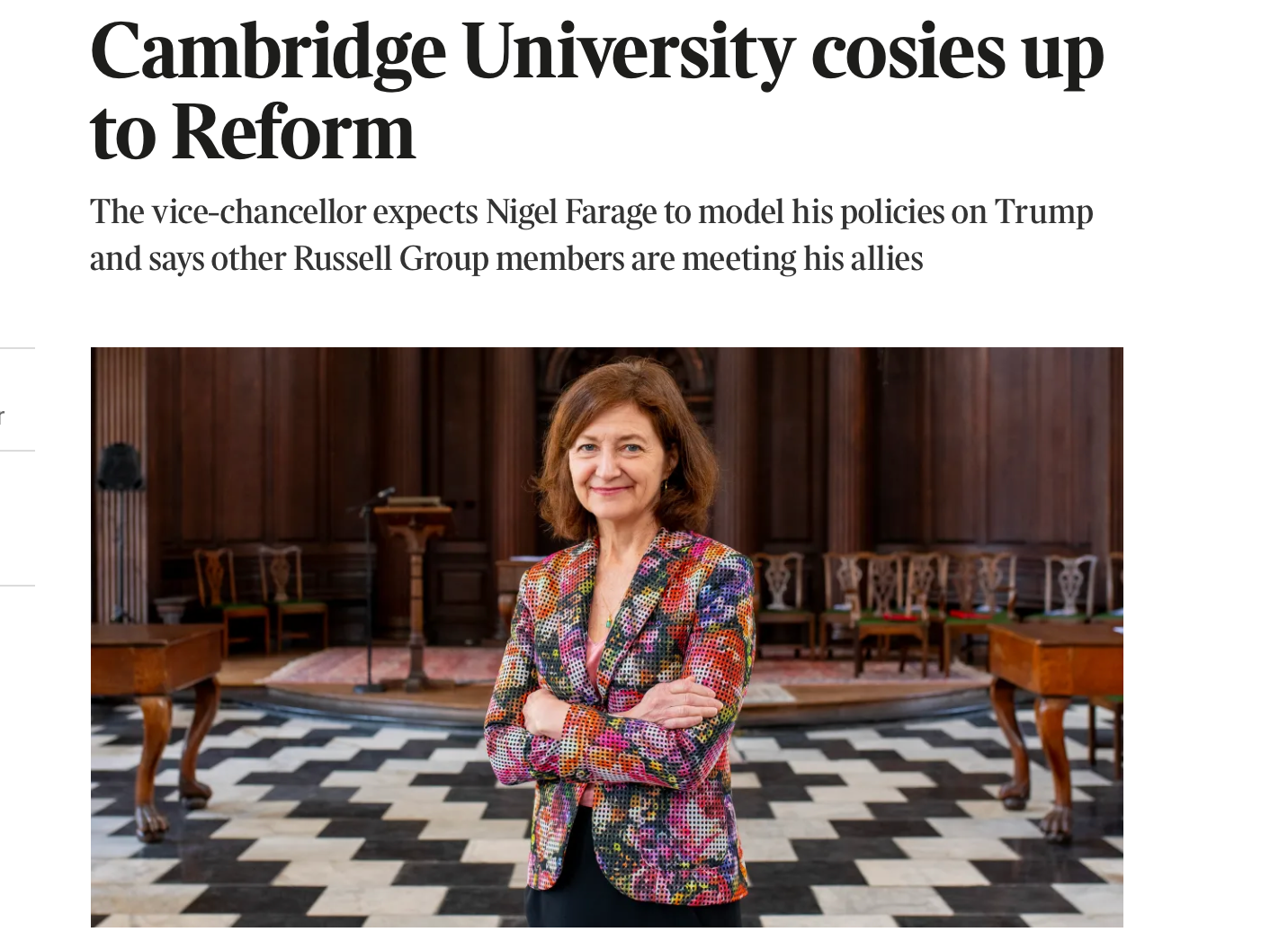
According to a leaked recording obtained by Varsity and The Sunday Times, at Monday’s meeting of Cambridge’s University Council – the University’s policy-making body of college heads, senior academics and student representatives
The ABC of Leaks is;
A – Leaks happen if shared purpose & trust has gone. The present senior management has lost the confidence of large parts of the University, though this process was well underway before the present Vice Chancellor took office. In our opinion, the real damage has been inflicted by long-serving senior administrators, such as the Registrary and the HR Director.
B – A leaker generally wants to damage the reputation of a leader they dislike. This leak was likely made (or encouraged) by someone who wanted to personally discredit the Vice Chancellor. It seems to be motivated by a power struggle at the top. The name of the leaker is of public interest and should be revealed.
C – Leaky organisations sink. Drastic changes are needed at the top of Cambridge University. The VC has an opportunity to get a grip — we must hope she either takes it, or makes way for someone to clear out the wrongdoers.
The story is in Varsity, the Times and the Daily Mail.
Can we have the link?
https://www.varsity.co.uk/news/30787
The Times requires subscription.
Revolutions happen when reformers inside the system finally realise that they are safer working with moderates from the opposition, than they are in continuing to protect the hardliners directly responsible for its worst crimes. I call upon all those inside this system to stand on the right side – express your position and make amends, because the old guard has no future, knows it, and are getting desperate.
In general leaks are a good thing no? But it would be better I suspect if we could learn instead the secret conversations between HR, the Registrary, and the figures responsible for all the ongoing scandals.
The secret conversations between HR, the Registrary, the Legal Department and the pro-VC would be fascinating
Anyone with any information on them needs to get in touch with the 21 Group immediately, [email protected]
In general, we agree — leaks promote openness. A leaker though may have an agenda. Selective leaking may not present a fair picture.
The title in the Times and Varsity — which is heavily slanted — suggests a leaker with an axe.
Agreed. There’s obvious public interest in knowing that a university which touts in public its commitment to the Labour government’s policy agenda (e.g. over the Oxbridge corridor) is secretly engaging in back-channel negotiations with Reform. But there is greater public interest in knowing about the abuse scandals and associated wastage of student fee, donor, and taxpayer money, to protect insiders who are obviously now terrified of facing accountability.
Interesting this went to The Times and not, say, the Grauniad, where this kind of story would have had a more serious impact. Suggests someone on the inside track with them who has an agenda of their own? Of course often these things are just happenstance. But I do note that The Times is completely absent from coverage of recent scandals unlike Bloomberg, The Guardian, FT and even The Telegraph. The mind boggles.
am I the only one who notices the irony of people who for years have accused us of disloyalty for maintaining our fight and refusing non-confidentility clauses over serious abuse cases suddenly being A-ok with leaking Council meeting transcripts to the press
“I give confidential press briefings; you leak; he’s being charged under Section 2a of the Official Secrets Act“.
We remember that the inspiration behind ‘Yes, Minister‘ is Microcosmographia Academica, which describes politics at Cambridge University
@hmmm
you forget the other irony here.
HR and their adorable little grievance minions are so very fond of telling students and staff we are not allowed to make recordings of meetings (a practice that always raises the question of why – if there is nothing untoward to hide?)
but oh how different it all becomes when they have something to lose! They magically convert to whistleblowers.
Or at least, just so long as required to save their little (or not?) paycheques and expense accounts from those nasty nasty financial auditors
It is clear: the top oligarchy at UCam is rotten to the core, with several vicious and ruthless individuals. The whole lot must go before it is too late. The number of scandals other than this fiasco are too many to silence! ET and the High Court will be busy!
The American Queen, a.k.a. Madame Clueless, has been betrayed by one of the dirty characters that surround her! Which ProVC or member of Council is Brutus??
Or was it the Registrary or the Head of HR?
We are in ‘Death of Stalin’ territory.
Was it Nikita Khrushchev or Lavrenti Beria ?
Hmm. Well, Registrary is usually secretary to the Council, so would be interesting to know who attended in that role last week. Presumably planned in advance, if someone had to start a recording beforehand. So that narrows it down no? In theory it is the perfect ruse because one can point the finger at others very easily – but not really, actually, because these things are always driven by motive, and the most obvious motive here is something around involvement in whatever Registrary has been hiding. Which includes a hand in the mismanagement of all the cases referred to so often on this forum.
Sounds plausible. If the VC can rid us of the Registrary & the Director of HR, she’s worth 500k a year
Once we end their reign of error we can liberate millions from:
budgetary overspend
excessive administrative overhead
pointlessly protracted cases
unsupervised consultants
torpedoed grants
and last but not least: the phenomenal waste of everyone’s valuable time spent dealing with never-ending grievances, review committees, sickness absences and pointless internal politics when we should instead be doing the work we love.
“If the VC can rid us of the Registrary & the Director of HR, she’s worth 500k a year”
…and include Sam & of the most discussed Lead HR Business Partner in the 21Group into the package too?
I made sure that the VC knows about the character of the most discussed Lead HR Business Partner in the 21Group and guess what, she ignored it. Moreover, her ProVCs even use the word of the most discussed Lead HR Business Partner in the 21Group as supporting evidence to ignore whistleblowing disclosures and safeguarding referrals despite the person is conflicted. This said, once the Registrary and the HR Director are gone, I doubt the most discussed Lead HR Business Partner in the 21Group will choose to stay as she will no longer have her two best friends to protect her.
If it was from the Registrary then I presume they already knew they were done for. Seems more like a petty “parting shot” from someone whose days here are already coming to an end and they’d know this was sealing the deal.
If that’s the case here it does reveal a lot though. The same pettiness with which they retaliated against whistleblowers is exactly how they treat the people they fawned over not so long ago. You can trust honest people who oppose you because then you know they have integrity by their willingness to disagree. You can’t trust anyone who pretends to be always at your service.
Sounds like there is no answer so far so not pointing any fingers here. But what I think a lot of people would agree with is that if you have people at the top of the administrative structure who have spent their entire careers betraying the people who work under them, then it would be the least surprising thing in the world to discover they can also betray those above them.
To paraphrase J.K. Rowling, “if you want to know what a person is like, take a good look at they treat their inferiors, not their equals.”
Any updates?
I wouldn’t covertly record any meeting. If I wanted to record a meeting I would ask to record it e.g. if there was a finite chance that decisions and/or assessments being made in the meeting might form the basis of evidence submitted to a court. If HR refused to let me record a meeting then I would get a pen out and write down every word that was said in the meeting, at the end of the meeting I would get HR to read over the meeting notes and sign that it was an accurate record of the meeting. If HR refused to sign the notes as being an accurate record of the meeting then I would email the organisation with a copy of the notes from the meeting and ask the organisation to accept them as an official record of the meeting that took place. If the organisation didn’t accept then I would ask for the HR meeting to be repeated on the basis that there is a disagreement over the official record of the meeting which means the meeting is then void. If the organisation refused I would then take all the evidence from the meeting and the organisational response to it and get a notary to certify it. I have then done everything possible to make an accurate record of the HR meeting that could be submitted as evidence to a court. There is an accurate record of the HR meeting that took place and the organisation would find it very difficult to dispute that this is an accurate record of that meeting. If the trust & confidence has broken down this is what may be necessary to get an accurate record of a HR meeting.
I never did this for any HR meeting in the university but that is what I would have done had I wanted an official record of a HR meeting in the university. I had one HR meeting in 14 years of working at the university and it was very difficult to tell whether that HR meeting made any difference, it was a meeting with one HR person where I brought another person whose judgment I trusted for support. Towards the end of my time in college – when I was resigning my fellowship and leaving employment in the college – the college organised a meeting that included HR and all relevant parties in college to coordinate on departure for health and safety reasons – hung university concerns processes generating excessive work-related stress over which the college had not control – and that was a much better meeting. This seemed to be a better way to work with HR staff and also to get things done.
One hung university concerns process – student safeguarding concerns : university examination processes : lack of an automatic entitlement to a further first opportunity for examination for final year students in cases of severe ill health – was blocking me from carrying out student safeguarding duties for the college and I was suffering ongoing excessive work-related stress. The college was still paying me for these safeguarding duties. Since the university was blocking the concerns process I felt it was a waste of public funds to continue to pay me for duties I could not undertake. As a college trustee I was obliged to take action to reduce wastage of public funds so I left the whole collegiate university to enter into a state of unemployment supported by my personal savings.
It is actually the “no recording” policy of HR that needs legal review. In the United States, the National Labor Relations Board (NLRB) has ruled that blanket “no-recording” policies by companies are frequently unlawful. As per the NLRB the policy interferes with worker rights and is often deliberately intended as such (“the NLRB has affirmed that employees have a right to record conversations to document unsafe working conditions”).
In general two key conditions apply.
The first is the one-party consent rule, i.e. were you yourself in that meeting. There is a huge difference between recording someone else’s meeting remotely, and recording a meeting in which you were a participant. If you are a participant then you were a party to the meeting, so by default, one participant in the meeting had consented to the recording.
The second is exemption for categories of public interest such as journalism, whistleblowing, and labor rights. In a recent 2023 case against Starbucks, the state in question was an exception to the one-party consent rule (i.e. that consent was needed from all persons present) but even so this was overruled by the NLRA as this rule does not apply “when such recordings were made to police the parties’ collective-bargaining agreement or preserve evidence for use in a future proceeding, including a possible grievance”.
For this reason covert recordings are commonly submitted at tribunal and courts have repeatedly upheld this principle.
There is also an exemption for disability if the recording was needed as a means to keep personal notes but this is less commonly invoked.
Eagle – I strongly agree here. In any encounter where HR are even remotely suspected of being involved (at any University), *record everything*. In all likelihood it may be the only thing that matters further down the line. We have seen this in countless cases in the courts.
Record everything even when you are accompanied by a union representative. On occasion they cannot be relied upon. I’m aware of a case where a union rep was brought to an internal hearing by a whistleblower that was being targeted in a malicious HR attack to have them unfairly dismissed. The reps job was specifically to act as a witness in case the written record was corrupted. Of course it was, and extremely seriously so. The union rep then developed a strange case of total amnesia about what was said in the hearing… and the rep was taking detailed notes too… In that situation, how can you prove the corruption without a recording? You can’t, and then you are in even deeper trouble.
And make no mistake, HR and even all the panellists etc on such corrupt hearings are recording everything too!
Agreed. Golden Rules are
(i) Never meet HR, or Head of School, or Head of Dept, or proVCs alone on these kind of matters. Always take a companion.
(ii) Always go wired up, with a phone that can record.
Last Meeting with HR at Cambridge, it was perfectly clear that the “note taker” was running software on the computer to record everything. Always examine what the “note taker” is doing.
Remember, they will all lie through their teeth, they are recording you, they are trying to stitch you up.
You won’t walk out alive if you go unarmed.
Is it possible they do this without the consent of committee chairs and departmental line managers?
It is a whole new order of scandal if they
a) secretly instruct the meeting chair in advance what to say
b) record the meeting in secret
c) retain it for later use so that they can blame their chosen stooge
I do note that HR are oddly quiet in every meeting they insist on attending (even when obvious red flags arise on which they are supposed to intervene).
I wouldn’t go into a HR meeting with any preformed ideas about what is going on i.e. that they will lie, record you or are trying to stitch you up. Having these type of preformed ideas will make it very difficult to have a normal HR meeting and that is what the HR meeting could turn out to be. It’s a case of going into a HR meeting and being sensitive to what is going on in that meeting. Assuming there is a problem with a HR meeting has the potential to create a problem with a HR meeting. It’s being sensitive to a HR meeting that allows you to detect a problem with a HR meeting. If I wanted an accurate record of a key HR meeting that could be submitted to a court as evidence then I would get an accurate record, it might be a very slow process getting it but I would get one.
I would ask to record the meeting because this is preventative, it reduces the risk of further problems, it reduces the risk of escalation, it reduces the risk of further detriment which is what I would want.
Covert recording is relatively less preventative, there is a higher risk of further problems, higher risk of escalation, higher risk of detriment.
I include potential impact to all parties in the assessment of which is the better approach to meetings.
I had a legal obligation to the organisation so I chose the approach I thought would reduce the probability of further problems in the organisation. I made a small number of recorded meetings where this was agreed at the start of a meeting but I made no covert recordings of meetings.
One point that I think it might be difficult for HR staff to understand is that when someone is a in a high-risk situation they might remember a HR meeting in great detail. If the HR person doesn’t appreciate the reciprocal risk in these situations i.e. that organisation is also in a high-risk situation and that they are in the one on the frontline for the organisation in that high-risk situation then the same meeting might barely make an impression on the memory of a HR staff member.
Due to this memory disparity HR staff might not recognise information being presented to them as being an accurate record of a HR meeting. They might then assume that it is they who have the more accurate memory of the meeting and that
the person in the high-risk situation is the one with the inaccurate recall of the meeting because they were the one with the “mental health” condition at the time of the meeting. If someone is in a high-risk situation they might remember a meeting in great detail to make sure they never end up in the same situation again.
Eileen – I agree that it may be best to go into such meetings or hearings without any pre-judgements, and with a kind of ‘cautious positivity’. But precautions must always be taken, given the current state of how HR processes are being abused and mishandled. If however, the process is handled with integrity, then any recordings need not see the light of day. If it isn’t then they should.
It’s also worth noting that as the meetings are being recorded by HR etc anyway, and if the victim has no such recording, then the victim can be accused of lying, if they cannot remember accurately what was said. This is far too dangerous, especially for victims that may not have support or are in a state of distress.
Why wouldn’t you just have a policy of asking all participants if they are ok to have an AI transcription tool for the meeting that is set to automatically send a copy to everyone afterwards? This is standard practice in a lot of companies these days and offers definitive protection against disagreements later over what was said or agreed or not. It would also avoid the cost of hiring extra people to attend and the time spent producing minutes.
Agreed. There are many AI tools that can provide ‘on the fly’ minutes and of course it is easy to take recordings. So there are plenty of easy ways of getting an accurate record. This is not done deliberately.
The University wants to have an inaccurate record. HR pass the minutes through Legal before we see sight of them.
The record can then be falsified, awkward matters for the University omitted. If something is not minuted, it did not take place (“There’s no record of it in the minutes”)
The whole meeting can be sanitised and made safe.
The 21 Group is waiting for some minutes for a meeting at the moment (on behalf of someone we are assisting). The meeting took place over 4 weeks ago. The delay is deliberate, so everyone’s remembrance is patchy.
AI tools are ok in some situations (and even then only if they are immediately available to all participants), but in my opinion, shouldn’t be relied upon in high-stakes hearings, like malicious conduct hearings etc. They do not capture tone etc.
In some instances, *how* things are said can be almost as powerful as *what* is said. It can work both ways, so always be cautious.
For example, you wouldn’t want to be accused of being ‘aggressive’ merely for making a valid point firmly but respectfully, nor ‘arrogant and overly assertive’ for more or less the same thing, or even saying something just a little bit too loudly by accident – where you would then be accused of being a raging and aggressive lunatic for shouting and screaming at HR and the panel!
Never underestimate the depths that these individuals will go to to stitch you up, made especially dangerous when they work in collusion.
Whenever I’ve been in a meeting with HR present they never say a word either. All they do is spend the whole time looking at the meeting chair. It is like their purpose in the room is not to ensure compliance with the law; but rather, to serve as as a watchful eye ensuring whatever hapless academic they have instructed is going along with the ridiculous script provided. The whole situation is absurd and embarrassing.
Record Everything! – I think the points you are making are good ones. I was stating the approach that I took with the university, others might be constrained by the nature of a situation to take the covert recording approach. I felt like it was possible to take an alternative approach with the university that did not involve any covertly recording meetings and to offer a robust defence of the actions that I took to comply with a legal obligation to the university. Others in the university may have covertly recorded interactions with me if they felt that was necessary to comply with their legal obligations to the university. It is up to others to provide a robust defence of the actions they took.
On reading your comments : I am reminded of a case in an NHS hospital where two medics were recording videos of each other on their phones such was the breakdown in the working relationship. This is a rare event and not representative of NHS medics but it goes to show how bad things can get when trust breaks down in an organisation. Do staff in that position get any real time off or do they just spend their time off mentally processing ongoing grievances and dysfunctional organisational grievance processes? It seemed like a stressful way to live a life and an inefficient way to deliver high-quality health care.
I don’t see how higher education providers can be analysed in terms of both the quality and value of the education they are providing without a functional and efficient higher education regulator with continuous environmentally-matched regulatory power i.e. higher-risk environment = higher regulatory power.
Such a regulator should be a prescribed body i.e. set up to take concerns relating to higher education providers directly from those studying and working in higher education facilitating an analysis of ongoing concerns in the sector with speed in any rapidly shifting environment to maintain effective regulation of higher education providers.
A regulator that is continuously underpowered for its environmental conditions will descend into a state of dysfunction and inefficiency. A regulator in such a state will then drag every organisation that it regulates and the whole sector it regulates down with it as it goes down as a regulator. These regulators have to be continuously attuned to the environmental conditions i.e. extremely sensitive to current environmental conditions in the sectors that they are regulating to detect problems in these environments at an early stage.
Since universities have a particularly high organisational capacity for self-regulation i.e. typically exist in a state of high autonomy for any regulatory approach to be effective it would need to be sensitive to that particular sector-specific detail which means extremely high levels of coordination between the regulator and the organisations being regulated when any new regulation is being put in place, when any existing regulation is being adapted or when any organisational intervention is being considered.
The problem with suddenly stripping universities of funding for research is that there is then a surge in mental energy available in universities and where is that newly available mental energy going to be directed. It’s going to be directed at the source of the blockage that is preventing one person from e.g. proving a new cancer treatment is worth taking through clinical trials & another person from e.g. proving a new type of solar panel is worth commercialising. Philosophy might look like a safe bet until a person working in that field who is being blocked from working on philosophical explanations of trust – essential to understanding mental health – discovers their inner barrister. Suddenly stripping funding from universities is a regulatory approach that has a low probability of success, a high probability of backfiring and is an extremely inefficient way to regulate a university because it indiscriminately takes individuals down with no assessment of performance, capability and ongoing societal impact.
The one thing that trying to build a better understanding of mental health taught me was that there are unexpected connections between knowledge in different subject domains – at different times I was relying on knowledge from different subjects to make progress : physics, maths, chemistry, biology, engineering, medicine, law, philosophy, languages, English literature, history, classics, materials science, psychology, politics, economics, business studies, education, social sciences, art. The more enriched a university environment is with different subjects and the more intellectually intense it is and the higher the probability of discovering these unexpected connections and new societal knowledge.
Oxford continues in the news… We need this to happen in Cambridge asap. Bring EHRC!
https://www.thetimes.com/uk/education/article/oxford-university-third-academic-resign-misconduct-claims-6cwwsp87h
Seems like Christmas is coming early this year
From the article
“Campaigners against misconduct in higher education said the spate of cases warranted an independent investigation by the Equality and Human Rights Commission (EHRC).”
Exactly what is needed — external regulators need to get involved in what is happening at Oxford & Cambridge
Obviously, more to come out at Oxford
“The Times is aware that another senior professor has been banned from entering an Oxford college because of serious allegations against him. At a different college, allegations have been made about the conduct of three longserving academics.”
It is ironic that this guy is, as per his wiki page, a specialist in “moral relativism”…
I think a number of people might say that “moral relativism” is precisely what has landed us in this mess
And “legal relativism” even more so
Universities offer courses in politics and members of political parties are the people with the greatest political insight so it’s no surprise that members of universities interact with members of political parties and benefit enormously from these interactions. Universities also teach non-equilibrium statistical physics and feel well equipped to self-regulate on the teaching of non-equilibrium statistical physics and if a university has someone who is making great progress in understanding non-equilibrium statistical physics they expect that persons research funding to continue uninterrupted and un-impacted by the latest developments in politics.