Cambridge’s problem is not lack of money. It is where the money goes.
Over the past decade, the university has steadily starved its academic departments in real terms — while allowing the central administration to expand at pace. The result is a university increasingly run around teaching and research rather than for them.
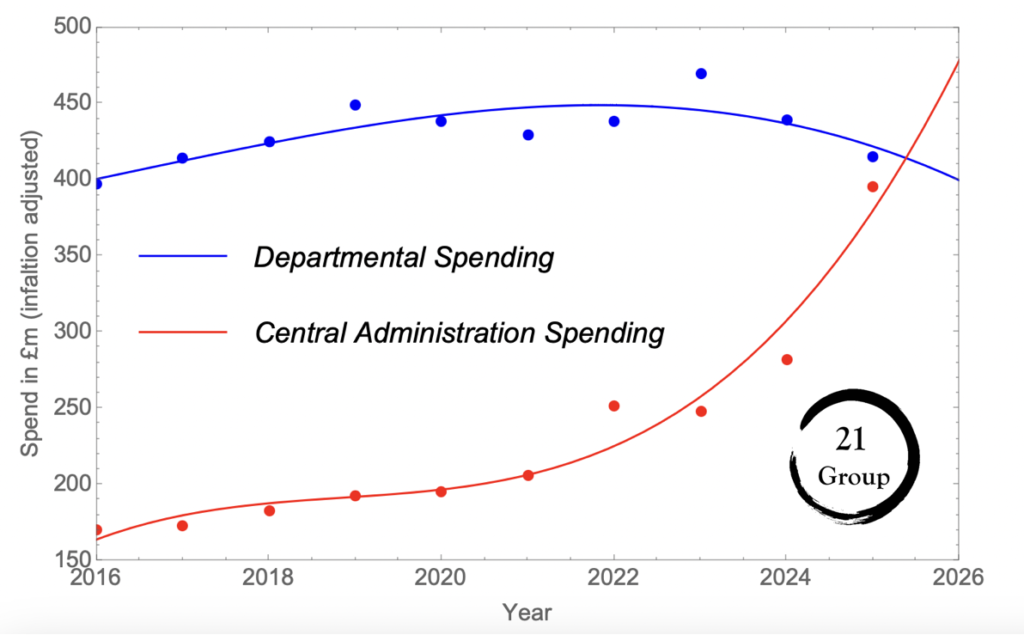
The plot uses data taken from the University’s Financial Statement for year ending 31 July 2025 here. We have accounted for inflation using the Consumer Price Index.
Let’s start with the people who actually teach students and produce research. As the Figure shows, once inflation is taken into account, departmental spending from 2016 to 2023 is roughly flat. Then it falls sharply. So, departments are expected to absorb more students, more compliance and more administrative work — with no real increase in resources
While departments have been told to tighten belts, central administration has not. Spending by the central administration has ballooned over the same period. Growth far outstrips inflation and bears little relation to frontline academic needs. Layers of management, strategy units and compliance offices proliferate. If departments are flat-funded, why isn’t the centre?
This is not just a financial story — it is a governance one. Resources have been pulled into the centre. Decision-making has become increasingly top-down. Departments are left to implement strategies they had little role in shaping. The university now spends almost as much on managing academic work than on enabling it.
We are often told that these trends are unavoidable — the result of external pressures or modern university life. They are not. Cambridge chose to protect and expand the centre, to shift cuts and pressure onto the departments. Other priorities were possible. Different outcomes were possible.
Cambridge does not have a funding crisis. It has a priorities crisis.
Teaching and research are being quietly squeezed. Bureaucracy flourishes luxuriantly. The academic mission is treated as a cost to be controlled, not a purpose to be served.
Until this imbalance is confronted, no amount of rhetoric about excellence or world-leading status will fix what is going wrong.
.
27 Comments
Jay · 10 January 2026 at 01:07
Another title for the graph could be: Why Emma Rampton had to go?
21percent.org · 10 January 2026 at 10:29
Executive Summary is
(i) In real terms, departments are no better off than they were in 2016
(ii) In a healthy organisation, the blue and red curves should be in step. As the University spends more on core activities like research & teaching, so it should spend more on administration. This is roughly the case prior to about 2020.
(iii) Since 2023, the spend on teaching & research has dropped while the expense of administration continues to increase.
(iv) We have checked the 2025 central administration spending datapoint. It is correct. It would be interesting to understand why it is so high. Maybe there Is some one-off cost which is not explained in the Annual Report? It is not explicable by inflation (already accounted for in our data), pay growth (staff costs don’t match) or headcount growth (which has occurred but it seems too small to explain the jump). If someone knows the answer, please post it.
(v) Taking the 2025 datapoint at face value, for every £1 the departments are spending on research & teaching, the University is now spending £1 on central administration.
TheResearcher · 10 January 2026 at 12:13
@Jay, these trends are not the result of a single person. The fact that Ms Rampton as Registrary “stepped down” will make little difference when the Vice-Chancellor is the same, the Pro-VCs are the same, the Academic Secretary is the same, the Director of HR is the same, the Director of Legal Division is the same, etc, etc, etc.
UCam needs external intervention, namely from a proper Ombudsman, as soon as possible, as otherwise the problems will continue to pile up. This is what should be discussed in the University Council, but obviously, they prefer to discuss the weather!
Bloody right · 10 January 2026 at 14:00
Bloody right!
Eileen Nugent · 10 January 2026 at 12:31
In Cambridge if there is any hint of any form of weakness – vet school – others (Regent House) will not respond collectively with any form of defence. The vet school is going through a rough patch and under significant pressure but it’s not permanently weak and has the potential to be exceptionally strong – anyone who has interacted with those working in the vet school don’t have to be told this, that is an exceptional school going through a temporary rough path. The survival instinct in Cambridge is unbelievably low & if the university did not have the resource reserve it has I estimate it would be in the OfS regulatory high-risk category at this point in time.
Regent House seems to be full of people who don’t know when it is time to set aside individual/departmental interests & start mounting an extremely strong collective resistance for the overall & longer-term good of the organisation. If the vet school is closed, what then? Think the university will never close [x] department that is less essential to the basic overall functioning of the UK than the vet school, until they do propose closing [x] department & there’s no one in the vet school to mount a reciprocal collective resistance for [x] department because the vet school tried with all its might to effectively resist its own closure & [x] department did nothing to effectively resist that closure on its behalf so the vet school was closed with little to no resistance from those in other departments.
Some of the London based universities have the potential to permanently overtake Cambridge because they currently seem to have much better survival instincts.
Eileen Nugent · 10 January 2026 at 12:38
Look at that graph above, how can any decisions be being taken on the closure of the vet school when that is the overall trend in spending in the university, bleed departments dry of funds to inject more and more funding into central administration & for what – where is the overall increase in the functioning of the university?
Eileen Nugent · 10 January 2026 at 12:56
Cambridge can ignore the concerns of the National Farmers Union at its own peril. Regent House in Cambridge may outcompete the National Farmers Union in academic problem solving but when it comes to survival instinct the National Farmers Union has the edge. Whilst continuously modelling food production is necessary & useful to both society & farmers to optimise farming for sustainable food production over longer time scales & continuously stabilise farming this is not the same as continuously producing & having access to food which is more fundamental to survival.
21percent.org · 10 January 2026 at 14:02
Agreed — the debate about the Vet School is part of the reason why we have produced this plot.
We are told the Vet School needs £20m to survive. This is a big number, yet it is dwarfed by the annual *increase* in spending by central administration over 2024-25 and 2023-24 that passes largely without comment or debate.
Isis · 10 January 2026 at 16:01
Similar graph for Oxford here
https://x.com/jackaspi/status/2010010402474864691
Courtesy of Jack Aspinall
Cuts · 10 January 2026 at 21:07
It’s not a funding crisis. It’s a corruption crisis.
Those in charge took and took until there was nothing left. They paid themselves more and more and built a useless administrative empire to inflate their egos.
Now there is nothing left and they are shutting down core research and educational programmes. Let’s call it what it is and see it investigated and charged as such.
Eileen Nugent · 10 January 2026 at 23:07
It’s inefficient political processes generating inaccurate governance information leading to organisational decisions that are suboptimal coupled with error correction mechanisms – inefficient legal processes – generating further inaccurate governance information leading to organisational decisions that are even more suboptimal which is why some organisations are now hitting the police-intervention buffers on exceptional cases indicating they as organisations they are operating in a highly sub-optimal state and there are significant gains in organisational function to be had. It’s a sign that it is now technologically possible to increase both the efficiency & precision of organisational governance but that what is being done needs to be optimised for outcomes by varying process rather than sticking rigidly to process that is leading to worse & worse outcomes.
Eileen Nugent · 10 January 2026 at 23:16
People tend to think of “corruption” as being a type of behaviour & something that is exclusive to people in particular positions in a system – “those in charge” – but this misses a fundamental point that everyone at every position in a system has access to unique information about the current state of the system they are interacting with/have a unique relationship with & minimising corruption in a system – i.e. minimising the amount of false information entering into the system – is more about every person continuously engaging in a certain amount of rational resistance to the system – i.e. effectively resisting false information entering into the system from whatever position in the system they happen to find themselves in.
Eileen Nugent · 11 January 2026 at 00:38
What is being observed in that graph is not particular to one university or organisation in the UK – it’s spread throughout the system. There are major increases in governance precision & corresponding gains in societal function to be had. For the system to improve is is necessary for people interacting with the system at every different point in the system to mount some rational resistance to the system i.e. put accurate information into the system & resist the entry of inaccurate information into the system.
When people had no better ways of mounting some resistance to the system people in the past developed many different ways of doing this – strikes, protests, blockades : where the numbers of participants in those resistance activities gave some crude information about the fraction society impacted by particular issue & the actions of individuals gave some measure of the potential depth of feeling around a issue – but these are now relatively imprecise & inefficient ways of continuously mounting resistance to the system & maintaining a system in its highest state of function possible.
It is now possible for people to mount rational resistance to the system without every member of the system having to go through the systemic chaos of e.g. protests that have the potential to turn violent & which could potentially leave e.g. a society reliant on its last societal safeguards – large scale police/military interventions. Taking people out of certain positions in a system is not the same as changing the constraints on the system & sometimes what is constraining a system is a behaviour or the lack of a behaviour of every single person in the system.
Eileen Nugent · 11 January 2026 at 02:57
Those in universities think they there is the potential for personal loss when mounting rational resistance to a university – an academic career, an academic job – and this is true but there is also the potential for personal loss from not mounting any rational resistance – mental power, a mind – because without continuously mounting some amount of rational resistance to a system the rationality of the system will decline over time and that will happen in tandem with the rationality of all those interacting with the system something which has consequences for the minds of all those interacting with the system. A mind is a more fundamental thing to lose than an academic job. If a university is behaving irrationally & without any common sense in its relationship with a person, the best thing the person can do for both themselves & everyone else in the university is to mount some rational resistance to the university.
Peter Bohuš · 11 January 2026 at 11:03
The University’s core governance has deviated from its founding principles.
The 1231 Writs of Protection were formally returned on 3 December 2025. They too were declined by the present stewards.
The institution has drifted from its origin. Student rents are increased sharply, support mechanisms are reduced or denied, and students are required to sign declarations confirming sufficient funding, while subsequent university-driven cost increases are not accounted for.
Contractual commitments are increasingly treated as discretionary rather than binding. In the present case, governance failures were such that Bayer US was compelled to withdraw from the arrangement.
https://caseboard.io/cases/15619afb-30ea-4dd5-a3d9-5dcf43825aa6
This is not a marginal issue. It reflects a systemic erosion of stewardship, contractual integrity, and institutional responsibility.
Eileen Nugent · 12 January 2026 at 00:54
I think this statement is accurate. For example : if a student was from the US, was using the high-interest federal student loans to fund their course of study & had already accumulated substantial student debt they were blocked from applying for most scholarships being awarded on the basis of academic merit after they had already joined the university on the basis that they had already signed this declaration confirming sufficient funding.
That is irrational because some of these students from the US had significant amounts of student debt, much higher than any UK home student or student from any other country could accumulate & during the pandemic financial constraints on these students & their families had the potential to shift rapidly as with all students during that time. They were blocked – not allowed to be judged for scholarships on the basis of academic merit because they had signed a declaration they had access to sufficient funding without which they could not begin their degree course.
Eileen Nugent · 12 January 2026 at 01:05
Some seem to think students deliver their best academic work in conditions of high student debt and/or severe consequences for degree failure but I have found that students tend to deliver their best academic work in conditions of high interest in what they are doing & high student debt and/or severe consequences for degree failure are often just unnecessary stressors that impede a students academic progress & reduce the overall quality of the academic work that a student can achieve in conditions of high interest in what they are doing.
Eileen Nugent · 12 January 2026 at 01:47
The one thing I noticed about the US system in particular is that some of the US students with the highest interest in what they are doing are the ones who prepared to take on the highest student debt to follow that interest. Students in that position – high interest in a particular subject & taking on high student debt to follow that high interest – can be some of the students with the most energy, the most drive, the most passion, the strongest will to overcome any barriers to understand something they are interested in & to make academic progress.
Whilst there is a higher risk of students in this position subjecting those in student support roles to inaccurate criticism the fact that they tend to give the system a good hammering should they encounter any significant systemic problem does partially make up for that higher risk of being subjected to inaccurate criticism when supporting students in that position.
Auditwatch · 12 January 2026 at 15:45
You have missed several other key points from the recent financial documents.
The figure for central administrative spending for the previous (2024) year was significantly revised. Note the asterisk in the table on page 75 (https://www.cam.ac.uk/system/files/university_of_cambridge_group_annual_reports_financial_statements_2024-25.pdf)
This was apparently due to reclassification of spending to the Cambridge University Endowment Fund.
Regardless the year on year increase in administrative spending is incredible. It reflects a 44% increase in spending year on year, an increase of around £ 120,000,000.
What accounts for such a massive overspend? Surely this was not planned.
This is at a time of a so-called funding crisis in which schools are being closed, educators laid off, and research budgets shut down.
21percent.org · 12 January 2026 at 19:22
Many thanks for pointing this out.
A number of people have also contacted us about the data. No-one has any credible explanation for (as you put it) the “massive overspend”
Rx / acaricide · 13 January 2026 at 04:17
Thanks for this blog. just started reading now after they decided to shut us down. Like most of us living with my head in the sand and fingers in my ears.
Binging on your posts you nailed it from the start. Two years ago you knew they were going to send us all under (https://21percent.org/?p=1020). And now they have.
21percent.org · 13 January 2026 at 08:28
Thanks, a reminder to all readers in Cambridge University that there is a Discussion on the attempt to close the Vet School today (13 January)
“Those wishing to join the Discussion by videoconference should email UniversityDraftsmanATadmin.cam.ac.uk from their University email account, providing their CRSid (if a member of the collegiate University), by 10 a.m. on the date of the Discussion to receive joining instructions”
https://www.admin.cam.ac.uk/reporter/2025-26/weekly/6808/section1.shtml#heading2-2
If you can’t attend but wish to comment by email, you must also do so before 10.00am
“Alternatively contributors may email their remarks to contactATproctors.cam.ac.uk, copying ReporterEditorATadmin.cam.ac.uk, by no later than 10 a.m. on the day of the Discussion for reading out by the Proctors“
Eileen Nugent · 13 January 2026 at 15:06
I think the problem is this, if the amount of money person is paid in a system becomes decoupled from the amount of useful work the person is doing directly for society or indirectly for society by keeping the system in a functional state to continuously maximise the amount of useful work the entire system can do for society & money can also be used by a person to bias the system towards their own personal interest then the entire system can continuously drift away from being able to do useful work for society. People may think that universities do no useful work for society but the determination of the most accurate information and the discovery of new information – role of universities – is ultimately the some of the most useful work that can be done for society because that is what allows a society to continuously solve it’s problems – which are always evolving – in new and/or more accurate ways & to advance as a society.
I think this is why e.g. those in care roles are undervalued, those who teach others to care well for themselves, teach others to care well for others and who are capable of caring well for others should become unable to care for themselves do a great service to society and are often undervalued in a society that puts money as the end goal & not a mechanism for reaching a legitimate goal : an advancing society that can continuously care well for all its members by setting up the best reciprocal relationship possible with each of its members & also allowing members to set up the best reciprocal relationship possible with each other.
Eileen Nugent · 13 January 2026 at 17:56
The fundamental basis of human rights is accurate representation, a person strives to maintain an accurate representation of themselves as a person, of other members of society as people, of a society they are interacting with as a society & of the work society needs to do collectively as a society to continuously stay functional & keep advancing.
Accurate representation is what then makes it possible for a person to continuously set up reciprocal relationships with society as a whole & with other members of society which is what gives a person their maximum individual freedom possible to explore their own environment – to go different places, to meet different people, to find their most optimal role in a society, to follow their own interests.
It is not necessary for people to all become exactly the same in a society or for a society to force inaccurate representations on people in a society for a society to continuously stay functional and advance. In fact people all becoming exactly the same in a society or a society forcing inaccurate representations on people will do the exact opposite of driving societal progress as advancing societies rely on increasing specialisation & differentiation of people in those societies coupled with improving relationships facilitated by increasingly accurate representation of people. It is only necessary for people in a society to share the same purpose – keeping a society in a functioning state & finding ways of advancing a society.
Societies previously worked with stereotypes – crude ways to estimate what is true for a person based on what was thought to be true for a group of people the person was a member of – when deciding who to invest – a limited & fixed pool of societal resources – in when training people to perform specialised useful roles for society that then gave a person status in a society. The problem with this system is that elevation in status can then become the primary motive in taking a societal role and not interest in performing the societal role. It is a persons interest in a societal role and not a persons interest in the status the societal role confers on a person that maximises : a persons sensitivity to the societal role, their determination to work out all the details of the societal role & their performance in the societal role.
Society no longer needs to work in crude stereotypes to estimate what is true for a person in society as this can often lead to society building an inaccurate representation of a person. Society can now afford to work out what is true for each member in a society in a continuous dialogue with each member of society. Society can afford to invest societal resources in each member of a society & it is a society continuously investing societal resources in each member society that is ultimately the gateway to continuously increasing the pool of societal resources available to invest in all members of society. Each member of society then has the opportunity to find the societal roles they are most interested in, the societal roles that they can then maximise their own performance in & society has the opportunity to find the best people in society for all its societal roles and to continuously maximise societal performance by giving every member of society the conditions in which they can both be their true selves & maximise their own performance.
Eileen Nugent · 13 January 2026 at 22:00
I think much of the current ongoing stress in society is being generated by people who are trying to get away from old societal stereotypes that led to inaccurate representations of people – something which both unnecessarily restricts individual freedom & the contribution an individual can make to the ongoing functioning & advancement of society – by establishing new societal stereotypes in addition to the old ones which is then leading to inaccurate societal representations of an increasing number of people in society & not inaccurate societal representations of a decreasing number of people in society. If the intention is to truly improve the functioning of society & advance society this is not the way to do that.
When society is capable of understanding each individual in society for who they truly are such stereotypes are no longer needed. A person is not then limited by a societal stereotype – a crude societal representation of a group they are a member being applied to them leading to an inaccurate societal representation of them as a person – but instead contributes to the ongoing accurate societal representation of a group they are a member of by maintaining an accurate societal representation of themselves as a person whilst they are also contributing to the continuous functioning & advancement of a society.
Cambridge and the IT Trap? - 21percent.org · 22 January 2026 at 08:25
[…] our previous posting, we raised the issue of the spending by departments and central administration at Cambridge […]
“I Want Money, That’s What I Want” - 21percent.org · 27 January 2026 at 15:26
[…] more than doubled (£195m → £395m), while funding for academic departments fell by 8%, as shown here. In 2019, £2.33 went to teaching and research for every £1 on admin. Today, it’s just […]