Dear Editor
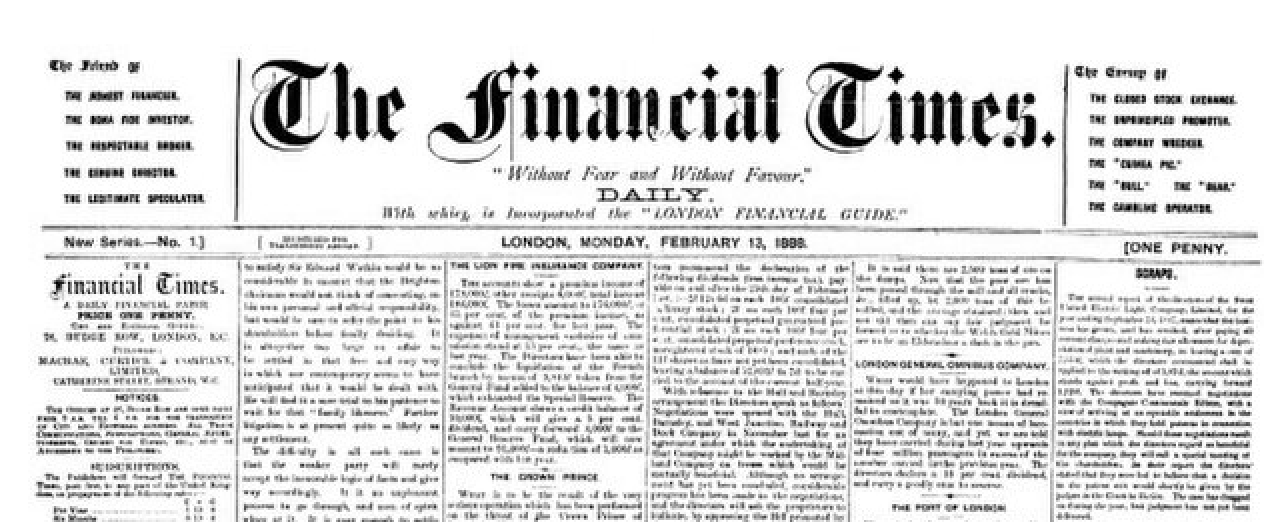
The Financial Times’ recent ranking of the UK’s “Top 400 Employers” has been greeted with interest and puzzlement.
Several results appear curious. For example, the strong performance of organisations facing well-reported financial and governance difficulties or even near-collapse, including the University of Dundee, is striking. The generally high placement of universities sits uneasily with the widely reported structural and financial pressures currently afflicting much of the UK higher-education sector.
Such results naturally prompt a data-literate reader to ask what features of the methodology might be producing such bizarre outcomes.
The published description indicates that the rankings combine direct employee responses with indirect recommendations. Such an approach risks introducing significant prestige or reputation bias, particularly for well-known institutions, and therefore may diverge from the lived experience of employees. When organisations appear to perform exceptionally well in rankings despite widely reported internal challenges, it becomes important to understand how the data were collected, weighted and aggregated.
More broadly, the publication of headline rankings without release of the underlying dataset makes it impossible for readers to evaluate issues such as sampling bias, response rates, weighting procedures or representativeness across sectors and regions. In survey research and opinion polling, transparency of this kind is regarded as essential. Bodies such as the ‘British Polling Council’ emphasise the importance of releasing sufficient methodological detail and data to permit independent scrutiny and replication.
It is unclear why so little information has been released alongside the rankings. If the exercise is intended to inform public understanding of the UK labour market, the case for transparency is strong. Without access to the full dataset — including the underlying responses, weighting procedures and sectoral breakdowns — readers cannot assess whether the results reflect employee experience or are largely driven by external reputation effects.
Accordingly, will the Financial Times now publish the complete survey dataset and full methodological documentation underlying the “Top 400 Employers” list?
Immediate release would allow independent researchers to examine the results properly and would help ensure that such rankings meet the standards of transparency normally expected in statistical reporting.
Yours faithfully,
The 21 Group
It’s Important to get the underlying data — if this fails, then maybe a Freedom of Information request?
We notice that the University of Cambridge has been making good use of the publicity.
https://www.cam.ac.uk/news/cambridge-named-uks-top-employer-by-financial-times
Prof. Munir should be ashamed of these words. Seriously, how is it possible that he does not understand that his words are a humiliation for the victims he ignored? is unfortunate that the 21 Group did not take the opportunity to highlight to the Editor of Financial Times that the Pro-Vice-Chancellor for University Community and Engagement of the “UK’s employer of the year” dismisses, without any investigation and following the advice of conflicted people, whistleblowing disclosures and safeguarding referrals based on detailed medical evidence.
I am wondering whether anyone on this space knows what is going on with the annual remuneration report. It is usually published at the end of February, but it seems did not appear in the latest edition of the Cambridge Reporter. If I am not in error I had been of the impression that publication of the report was mandatory and, given recent concerns over senior administrative pay, such a lacuna raises suspicions that I would hope, may eventually prove mistaken. Thank you for your consideration.
We noticed this as well. It should have appeared end of February.
As you say, there has been quite a lot of attention to exorbitant pay by 21 Group & others … presumably it has been pushed back to end of March. If anyone knows more, please post the info
If professor Munir is indeed involved in multiple court cases, is he allowed to be speaking out in press releases making claims that would prejudice cases at court? If he has not responded to staff privately or to comments on this forum but instead is engaging in a pre court press campaign is that allowed? If so can everyone now speak out?
They will get all the publicity they could ever dream of.
Hearing of major perturbations in Cambridge … despite it being best employer in the universe or whatever
Some of these people should become whistleblowers — email [email protected]
What kind of perturbations? I thought there was meant to be some of announcement this week, but once again nothing.
“No person no problem” is pretty much the first line of the HR handbook
Why? Are they deporting people to Siberia?
No need for KGB when you have local police to do it for you…
Earliest HR manual is Malleus Maleficarum
“If the accused refuses to confess, the judge may have recourse to torture, according to the customary laws.”
The so called ‘elites’ protect the Cambridge oligarchy! Nothing is surprising here! UCam=Post Office!
So it is not a staff survey at all, but a perception rating from across employees elsewhere, most of whom do not work in academia and have no interaction whatsoever with the university In short, a reputation survey. A reputation that has been fiercely protected by the hushing of scandals and silencing of whistleblowers by whatever means of coercion possible, and hilariously aggressive threats to journalists at other major newspapers that also ought now to be published on basis of public interest.
I seem to spend more and more of my life working nights and weekends, sitting alone at my desk. The truth is that most of it comes back to Louise.
Somehow, wherever Louise goes, confusion and anger and distress follow.
Forms get filled out the wrong way, procedures are not followed, messages are passed along half-correctly, documents are edited wrongly, people are misrepresented and perfectly ordinary situations turn into scenes and rows and upsets that go on for years. There are upset or angry colleagues demanding explanations, multiple grievance procedures and even legal actions. The problem may have been small to begin with but by the time Louise has “helped”, it has usually multiplied into a mountain of paperwork: incident reports, emails, corrective forms, and endless bureaucratic steps and still things can never be back the way they were.
@PoorNigel, interesting names and events you have here. They reminded me of my experiences with Louise Akroyd and Nigel Peake from the School of Physical Sciences at UCam. Of course, it must be coincidence…
Earlier today, I sent my own letter to the Editor of Financial Times expressing my concerns about their ranking and how it does not reflect my experience at the “UK’s best employer.” I cced Mr Daniel Zeichner MP and Prof. Kamal Munir who does not seem to be embarrassed by the current state of the University and even dares to congratulate himself for the ranking of Financial Times. Please consider contacting the Editor of Financial Times Bethan Staton if you, like me, feel that this ranking is a humiliation for all those who experienced serious abuses at the University of Cambridge.
Did the FT reply? While there are surely tens (hundreds?) of Cambridge scholars who deserve an explanation as to why the world’s best employer ignored their grievances and prefers to pay lawyers instead, surely, an even bigger explanation is owed to women at Oxford and the scores of hard-working staff at Dundee being made redundant. What is really odd about all this is that they didn’t ask Bethan if there were any reasons to crosscheck before putting these places up there? Or Gillian? Or maybe they did?
***********************
One more thing to flag.
***********************
If you look at the 2025 list (https://www.ft.com/content/644e1c4f-372b-46e9-93cd-5b44a3910575) it is clear that something radical has changed, in a way that cannot reflect objective reality.
1. In 2025, neither Cambridge nor Oxford made the top 500.
So either they radically transformed in 12 months – jumping from nowhere to the top 10 (or #1 slot!) – or something went radically wrong in the methodology here. I am going to take a guess on the latter.
2. In 2025, only one UK university made the top 500 (University of Westminster at #346).
I know nothing about Westminster (university), but the total absence of every other university from the top 500 seems highly consistent with the absolute chaos going on in UK higher education.
For the record only two government departments made the list and that seems consistent with reality too (other than the question of why two and not zero).
3. It seems like the 2025 list had more “rising star” companies where good work culture is likely a big factor in their success. The likes of Revolut and Monzo make the list. This time the dominance of big corporations raises questions about PR gaming of results.
4. Last time the FT gave a shout to media competitors like Telegraph and BBC (but not the FT sadly). Curious to know how that stands this time…
Some great spots, thanks.
We covered the University of Westminster in an earlier blog posting
https://21percent.org/?p=1456
It’s a very unhappy place.
This is estimated rank volatility (average movement year-to-year). University sector is by far the most volatile
Strongly suggests university scores have smaller sample sizes, so much noisier, hence hugely increased volatility in rankings.
If we wanted to analyse the FT tables rigorously, the best model would treat employer score as:
Observed Score = True Workplace Quality + Sampling Noise
If we can get the data off the FT, we should be able to demonstrate this.
The sector composition is more stable than individual firms. Healthcare & social care dominate both years, finance and professional services heavily represented, tech firms consistently near the top. This suggests the ranking may capture industry-level workplace quality more than purely company-specific factors.
~66% of employers appear in both lists, Spearman rank correlation ≈ 0.63. So the two tables are moderately strongly correlated but still allow significant year-to-year turnover.
Any statistician knows that having only two observations, so far apart, implies the results are entirely noise and not signal.
Most likely what happened here is that academics weren’t surveyed at all. The result is based on perceptions of those employed in industry, and who gave a warm boost to alma mater (Oxford and Cambridge) based on hazy undergraduate memories rooted in a time decades prior to the current systemic collapse and with no awareness of the pain and abuse and precarity of staff
Why did that not happen the previous year ?
What you say is probably correct, but there must be some methodology change from 2025 to 2026 as well to account for very different performance of universities as a cohort, no?
My heart bleeds, poorNigel, you sound like one of our directors, throwing her hands in the air whinging, “if we don’t get correct HR advice, what can we do?”
When this busybody HR person consistently makes life more miserable for all involved except for herself, why do you keep listening to her, signing her drafts, following her advice?
Is it Andi or Sam who tells you to, or is it Kamal? And will you continue to whinge rather than act like a sensible, responsible person, until all departments in your school have been made so dysfunctional they can barely operate?
We had a department once which was thriving and a lovely place to work. And then Louise came along with her strategic insight and her head the size of a pumpkin and instructed the Head of School to allow its director to turn it into a pile of shit.
As you say, things can never be back the way they were.
The current leadership will not do anything because they know that they have been protecting people like Louise for many years. Several members of staff and students tried to complain about her for example, and it is useless, regardless the evidence one presents about the misconduct we experience or witness. It does not matter what we submit as evidence because it will be ignored at best and complainants really need to understand this fact as otherwise, they may get into a self-harming psychological loop. This said, it seems increasingly clear that there is a large number of members who have been negatively impacted by her and these members may pass a grace in the Senate House asking for an external review of the performance of University HR, namely the most discussed Lead HR Business Partner in the 21 Group.
“These members may pass a grace in the Senate House asking for an external review of the performance of University HR”
Hallelujah
If you want to talk about “crimes against statistical science” then let’s start from here:
1. The FT “score” for Cambridge was a perfect 100.00.
Oh yes, that’s right! Not one single data point from their entire sample to indicate anything other than total and complete perfection.
2. Let’s say the “true” rate of staff contentment is not 20%, 40%, or 50% as prior surveys suggest, but in fact the almost unachievable rate of 99% happy staff. We’ve been wrong all along and things are as our fearless and without favour leadership wants the world to believe.
3. Fine. So. What is the probability that over 20,000 random draw interviews, Statista would not encounter one single member of staff expressing the slightest modicum of discontent?
4. The math here is not complicated, but allow me to give you the number….
0.000000000000000000000000000000000000000000000000000000000000000000000000000000005057%
Hmmm.
5. But of course, the figure of 100.00 for Cambridge could be due to rounding. Perhaps there were a few unhappy respondents but still the final score “rounded out” to 100.00. What is the probability of that? With rounding down it is:
0.000000000000000000000000000000000000000000000000000000000000000000000000000000005057%
Spot the difference? Care to explain why? Clue: (1/20000 = x)
(bonus: what is the figure rounding up at 2 dp?)
6. With two hypotheses available I will let you do the rest:
H1: Statista did amazing work and Cambridge is the best employer in the universe
H0: The survey was mismanaged, corrupt and deserves serious and sustained audit to figure out how it was gamed by universities mired in scandals
Deadline for submissions is Monday have a good weekend
0.99^20000 =
0.000000000000000000000000000000000000000000000000000000000000000000000000000000005057%
Clue: (1/20000 = x)
I.e., the smallest possible change in the score is 1 response out of 20000.
So the difference between 100% and 99.995% is only one respondent, which still rounds to 100.00
The 100% figure isn’t a meaningful statistic though because it isn’t a response rate of any kind. All that happened was obviously the:”statisticians” at “Statista” rescaled their data soup at the end to an index from 0-100.
In that data soup there were obviously no objective indicators of any kind like:
1. Rate of staff churn relative to sector benchmark
2. Rate of real salary progression
3. Court cases per 1,000 staff
4. ICO complaints per 1,000 staff (already online, Oxbridge near the top)
5. Suicides per 1,000 staff
6. Health/sickness rate per 1,000 staff
Anything they couldn’t have found online Statista could easily have requested via FOI for the top 100 or simply top 10 organisations at the top of their list before sending back to FT. But hey what do we know we only write the books on how to conduct this kind of research properly.
Do other papers (Times, Bloomberg, Telegraph etc) run similar exercises? Very curious to know the rankings based on objective indicators instead.