During any appointments process, candidates should disclose any current or pending Employment Tribunal proceedings in which they are a party where such proceedings could reasonably be considered relevant to their prospective employment or to the interests of the organisation.
In the meanwhile the University is announcing the investiture of the Chancellor Lord Smith! He like Nero is just enjoying the burning of Rome!
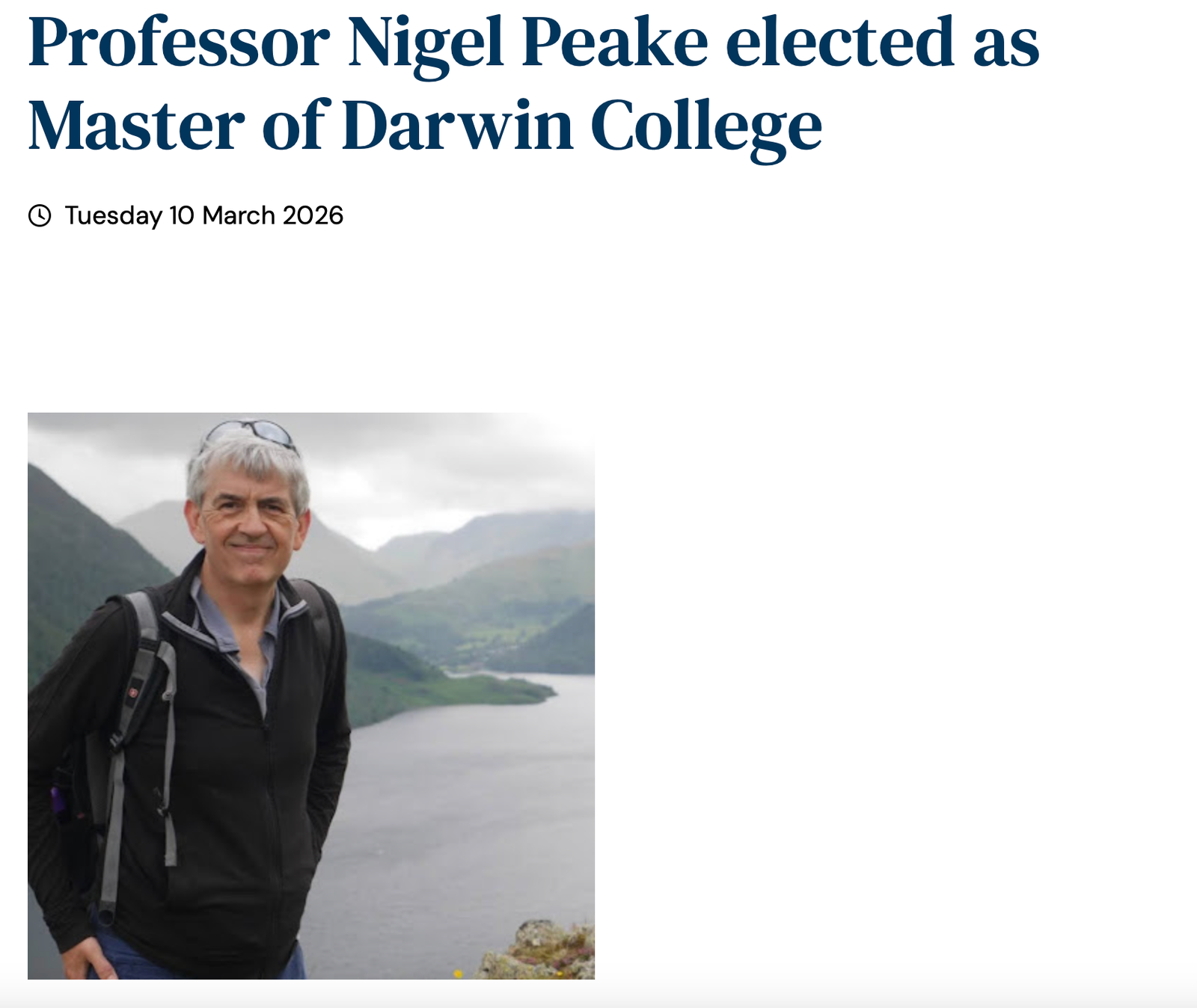
Nigel Peake now. Richard G before. How low can the place descend?? American Queen looks away. Lord Smith has already lost the plot. Deep rot!
I sent the following email earlier today:
“Dear Nigel,
It just came to my attention that you were elected Master of Darwin College. Congratulations. I am writing to ask you if you mentioned in your application to Darwin the upcoming tribunal cases of members of your School against the University of Cambridge, namely for retaliation against whistleblowers and your involvement in these cases? For example, did you mention this particular story (https://21percent.org/?p=1608)?
It is not sensible to think that the University will be able to gag these cases so that the general public and the press do not attend the trials because these stories will be known regardless of how much the University tries otherwise. You should all be ashamed about the lives you damaged, including my own, but I give you my word that no one silences me. People who do not assume their faults will make the same mistakes with others and it is my responsibility to make sure that what I experienced does not happen with others. I trust you read my email to the University Council and the General Board today? Note that I only mentioned the name of ****** in that email and not yours to avoid causing you even more embarrassment. I can assure you, however, that if your Fellow colleague of Emmanuel College ***** tries to silence me with more “precautionary measures” and threats, I will make sure the Fellowship of Emmanuel knows her behaviour and what happened in the School of Physical Sciences with me and others. This person should not be a Fellow of any Cambridge College and the fact she interacts with students is very concerning. You may want to discuss the matter with the Master Mr Doug Chalmers because he is already aware of it.
See you soon,”
Failure to act on bullying and safeguarding concerns is generally considered to be a serious disciplinary offence in most workplaces
Such failures can breach an employer’s duty of care, legal regulations, and internal company policies, often resulting in disciplinary action ranging up to summary dismissal for gross misconduct.
True. Unfortunately, that does not seem to apply in UCam. Ask Prof. Kamal Munir! Seriously, the fact they think that people will simply forget what they have done and carry on is simply mind blowing. They chose the wrong person to attempt to cover up misconduct this time.
Oh wow, PoorNigel, you’ve done really well for yourself, congrats!
Great timing too, after a second term, keeping things under wraps.
Do you remember those cautioning comments that were made, you know, the ones you thought were really really good, about the Head of Department who would turn a wonderful thriving department into a pile of shit.
What did you do about those, PoorNigel? Nothing, nothing!
Do you remember those cautioning comments that were made, you know, about the one who’d made the comments about the Head of Department (who was now busy turning a wonderful thriving place into a pile of shit.)
She’d been retaliated against violently. She was on the brink.
What did you do about those, PoorNigel? Nothing, nothing!
What happened, PoorNigel? Did you change your mind? Or did you just defer to those who now make all the decisions, on confidentiality, on propriety, on freedom of speech?
Since you’re now ready to sashay into the sunset, sipping a glass of port as you proceed, do us a favour, PoorNigel, do take your co-conspirator with you. We all need to breathe.
Nigel Peake has a right to defend & explain his actions at the forthcoming Employment Tribunals.
The important point is: did he disclose these matters in the appointments process for the Mastership?
If not, then Darwin College may wish to carry out further due diligence.
For “co-conspirator” please read “puppeteer”.
In agreement with the comments above, about the right to defend and explain one’s actions, the question at stake is how positions of power can be rendered powerless and delegated to gross HR overreach.
While the responsibility for any actions nonetheless remains with those dancing on a string.
I fully agree with the comments by @MetaStatic and @TheResearcher that those responsible for the very serious harm done to so many in the School of Physical Sciences by its management must be named.
The proper venue for that is the Employment Tribunal, where evidence can be examined carefully and the individuals responsible held to account through due process. Only in such a setting can the full facts be established and the experiences of those affected be properly heard.
Until that process has taken place, it is important that the focus remains on supporting those who have been harmed and on ensuring that the structures and practices that allowed such conduct to occur are addressed and reformed.
Transparency, accountability and a commitment to fair process are essential if trust within the academic community is to be restored.
“do take your co-conspirator with you.” Yesterday, I believe this section read “******.” It is important that people know who these individuals are. And note that if we simply manage to push them outside Cambridge, they will continue their deeds outside. The systemic nature of their behaviours in Cambridge strongly suggests that it is in their character and they will not change. They will likely continue to damage the lives of others but now in other place. In my view, it is the responsability of all who experienced their malpractices to make sure it does not happen again with others, regardless of who they are.
[Note added by 21 Group. The names of the individuals involved in the contested events at the School of Physical Sciences at Cambridge University will become public knowledge at the Employment Tribunals. The first of these is now very soon.]
HR in Cambridge should look to history to get a sense of the academic community HR is likely to encounter in Cambridge. HR should take a figure from history – Srinivasa Ramanujan – and give some thought as to what it would mean to put pressure on a person like Srinivasa Ramanujan to sign an Non Disclosure Agreement (NDA) and stop speaking about a situation where they thought something was wrong in exchange for financial compensation.
HR in Cambridge should give some thought as to how much thought it is possible for a Cambridge mathematician to give to whether zero probability means impossibility. The long pause in the case of a Cambridge mathematician might not then be a sign that there is a high or even a non-zero probability of an NDA being signed in exchange for financial compensation but rather a sign that a deep search for the answers to some quite difficult mathematical questions has been unwittingly triggered by the actions of HR in Cambridge.
“I gathered also (i) that R. V. Laurence had been saying that he wasn’t going to have a black man as Fellow; (ii) that ‘grave doubts’ were being expressed about his mental state.”
[pp. 136 of Littlewood’s Miscellany (Cambridge University Press, 1986) describing appointment of Ramanujan]
https://en.wikipedia.org/wiki/Reginald_Vere_Laurence
There is no evidence that Srinivasa Ramanujan ever put undue pressure on any other person to share the same set of beliefs as him. Srinivasa Ramanujan was able to communicate a set of beliefs to another person whilst not putting any undue pressure on that other person to share the same set of beliefs as him i.e. was able to protect the set of beliefs of another person whilst communicating his own set of beliefs to that other person such that the other person was free to share the same set of beliefs as Srinivasa Ramanujan or not with no excess of pressure either way. A set of beliefs can turn out not to be self-consistent which can then lead to instability & hence it’s important for a person to be able to communicate a set of beliefs to another person without putting any undue pressure on that other person to share the same set of beliefs. Whilst there is evidence to suggest that Srinivasa Ramanujan struggled with mental health, there is no evidence to suggest Srinivasa Ramanujan was ever a risk to others.
When it comes to decisions about mathematicians in Trinity, it’s what the mathematicians in Trinity think that counts, it’s the relationship one mathematician has to the group of mathematicians in Trinity that is important. The mathematicians in Trinity always get their mathematical fellow.
Note this statement has been made by a person who has never been a member or applied to be a member of Trinity college Cambridge.
Statement above should have read :
Note also this statement was made by a person whose only possible claim to being a mathematician is to hold a masters degree by research in applied mathematics and to have published one first author paper in applied mathematics which has had less than average impact on the field (FWCI = 0.76, less than 1). I am not surprised by the eventual field impact of that paper as I myself found the conclusions in it to be unsatisfying. Due to time and funding constraints i.e. to being a slow-motion mathematician and not a high-speed mathematician I had had to stop that research when it was in a state where I was not satisfied with it and to write it up as accurately as possible together with the unsatisfying conclusions in order to move on to the next degree – DPhil in experimental physics – to try to build the physical system I was attempting to model the behaviour of with applied mathematics. The resultant experimental physics papers – product of the combined effort of an experimental physics group – did have more satisfying conclusions and also had a higher than average impact on the field.
At the time, the Trinity Fellowship in physics & mathematics/philosophy contained some pacifists and left-wing figures (albeit from a rather patrician background) : G H Hardy, Arthur Eddington, E H Neville, C D Broad
It was still a huge battle to elect Ramanujan, not least because the expulsion of Bertrand Russell after his conviction under the Defence of the Realm Act 1914 had poisoned the atmosphere in the College. Russell was reinstated and then resigned (or was placed in a position in which he was forced to) in 1921 due to his private life (divorce). (JBS Haldane was also formally dismissed from Trinity College & university in 1925 for his “gross immorality” or divorce).
The trick Hardy and others used was to elect Ramanujan to the Royal Society and then confront the Trinity Fellowship. Rananujan was already an FRS when he was elected a Trinity Fellow in October 1918.
The romanticism of Ramanujan’s story is fine, and clearly Hardy and Neville behaved with honour, but Cambridge in 1910-1920 was very hostile — which is why it is worth remembering RV Laurence saying that “he wasn’t going to have a black man as a Fellow” as an illustration of the casual racism of the time.
RV Laurence’s remark has a clear descendant in “In a meritocracy, Harvard faculty would be recruited from the best of the best students, which means the number of black professors would approach 0 per cent” (Nathan Cofnas, 2024, then Fellow of Emmanuel College).
I am not saying that Trinity College Cambridge did not then have or does not now have any of the same problems other highly competitive academic environments worldwide do when it comes to unnecessary discrimination but if I was a mathematician who shared the particular mathematical interests of mathematicians in Trinity College and I wanted to go to an academic environment where there was some of the lowest probabilities of experiencing any form of unnecessary discrimination whilst working in mathematics then Trinity College Cambridge is one of the places that I would apply to be a member of.
Mathematics is not in any case an academic field where a person has to worry about there being a high probability of experiencing unnecessary discrimination (relative to other academic fields) and if a group of mathematicians want to make something happen they will find a way to make it happen. The mathematicians of Trinity College Cambridge trusted Srinivasa Ramanujan and that fact together with their ingenuity as a group was enough to get Srinivasa Ramanujan elected to the fellowship there against a backdrop of the significant resistance to that happening that existed at the time. JBS Haldane later took the reciprocal trust action to Srinivasa Ramanujan of joining a mathematical community in India – Indian Statistical Institute – which shows that the reciprocal trust action in relation to an Indian mathematical community was also possible. There were Indian Mathematical communities in existence at the time also capable of the similarly high magnitude acts of trust and of being trusted.
I am not sure there are limits to what one person might say to another person in Oxford/Cambridge but one person in Oxford/Cambridge saying something to another person in Oxford/Cambridge doesn’t make what has been said true. One person in Oxford/Cambridge saying something also doesn’t mean that all other people in Oxbridge/Cambridge think exactly the same thing and are just too afraid to say it. I don’t think people in Oxford/Cambridge are particularly afraid to say what they think either in absolute terms i.e. the probability of a person in Oxford/Cambridge saying what they think to others in general or in relative terms i.e. the probability of a person in Oxford/Cambridge saying what they think in Oxford/Cambridge relative to the probability of that same person saying what they think in other academic or non-academic environments. Whilst one persons biased judgment or the biased judgement of a whole group of people might alter another person’s life path, it doesn’t necessarily alter a persons’s life path for the worse or lead to a worse overall outcome for the person.
Had Srinivasa Ramanujan’s path to a fellowship at Trinity College Cambridge been more straightforward and without any significant resistance he would have had no sense of just how much trust other Mathematicians there placed in him or of how far it is possible for one group of people who have placed high trust in a person to go to overcome the biased judgments of another group of people in relation to that same person.
Great point about Haldane and the Indian Statistical Institute.
Highest probability of generating a problem can be a sustainably survivable state but only if coupled to highest probability of generating a solution to any problem generated.
“RV Laurence’s remark has a clear descendant in “In a meritocracy, Harvard faculty would be recruited from the best of the best students, which means the number of black professors would approach 0 per cent” (Nathan Cofnas, 2024, then Fellow of Emmanuel College).”
Society in a meritocratic state is still subject to evolution, evolution doesn’t stop as soon as a society enters into a state of “meritocracy”, means cannot make statements to effect “in a meritocracy, [x] university faculty would be recruited from the best of the best students, which means the number of [y] characteristic professors at [x] university – implicitly assumed to always have the power to attract applications from every “best of the best student” in existence – would approach some [z] per cent.”
There is an Implicit assumption that for a society in a meritocratic state that the coupling between [y] characteristic & the probability of being “best of best student” & the coupling between the probability of being “best of best student” and the probability of applying to enter [x] university are both static and therefore number of [y] characteristic professors at [x] university will tend to some fixed value over time but this assumption implicit in that statement makes no sense.
A society in a meritocratic state is highly dynamic, it’s continuously changing, one group could discover e.g. have a higher probability of a particular micronutrient deficiency that when properly understood by that group & then corrected through the collective actions taken by that group results in overall gains in group health supporting significantly higher levels of mental resilience & mental stamina – with impact on the speed & complexity of academic learning possible – than were possible without that academic discovery in relation to that group, overall gains in group health that are then seen as overall gains in academic performance for that group.
Academic freedom can be self-given – autodidact – and/or given by another independent academic and/or given by an academic community by continued acceptance of an independent academic within a community of independent academics. Academic freedom cannot given by a judge in a court of law when acting in capacity as judge in a court of law and not in capacity as an independent academic. Persons own independent academic judgement can free a person academically and/or the sum total of the independent academic judgments of the independent academics that make up the academic community person a member of can free a person academically.
An academic freedom case in an academic community is fundamentally different to a freedom of speech/expression case. In an academic freedom case – where a persons academic freedom within an academic community hangs in the balance – it’s up to the members of the academic community to determine whether academic freedom is given to a person or not. This means all members of an academic community have to do real academic work – reading a persons academic papers alongside any other relevant writing, formulating any concerns in relation to the academic work, talking directly to the person regarding any concerns in relation to the academic work & formulating an independent academic judgment with respect to whether the person should be given academic freedom within the academic community, listening to the independent judgment of others in the same academic community – formed in the same way – with respect to the person. This is where college environments in places like Cambridge – with more manageable numbers of people – can come into their own because it is practically possible to do this with that size of academic community.
Academic freedom is not solely something a person can demand from others in an academic community to remain in own personal/academic comfort zone within an academic community it is also something that a person may have to give to others in that same academic community when doing so puts a person into their own personal/academic discomfort zone within an academic community. Equality is not solely something a person can demand from others when doing so is convenient, it is also something that a person may have to give to others when doing so is inconvenient. Power equality in relation to others in a situation is not solely something a person can ask others to recognise in a situation when doing so is convenient to the person themselves, power equality in relation to others in a situation is also something that a person may have to recognise for themselves in a situation when doing so is inconvenient to the person themselves.
If a person’s academic freedom hangs in the balance in an academic community, it’s up to each member of that academic community to do the necessary academic work to form an independent academic judgment with respect to the person. It’s up to each member of the academic community to make an independent decision as to whether to give or not to give that person academic freedom in that academic community. Taking a persons academic freedom in an academic community is a serious thing to do to a person – it’s something more akin to removing fitness to practice from a professional working within a professional community e.g. lawyer, medic. If there are those in an academic community who are not prepared to do the necessary academic work to form an independent academic judgment in relation to the person when a person’s academic freedom within an academic community hangs in the balance & who instead opt to apply undue pressure on a person whose academic freedom hangs in the balance using public media channels without having done any of the necessary academic work to formulate & give a reasoned independent academic judgment as to why a person should or should not be given academic freedom within an academic community then that is a serious problem for an academic community & one that has the potential to substantially worsen over longer timescales.
An academic community can find itself in a state where it is unnecessarily restricting a persons academic freedom within an academic community e.g. a person is asked to leave an academic community before all members of that academic community have done the necessary academic work to each form an independent academic judgment with respect to a person whose academic freedom within that academic community hangs in the balance. The net result of doing so is that an academic community has left itself in a state where members of that academic community have not built up the academic skills to judge a persons academic freedom in that academic community when a persons academic freedom hangs in the balance. If an academic community cannot precisely judge academic freedom, it can’t then – as an academic community – precisely push on the boundaries of academic freedom to see where those boundaries currently stand.
The boundaries of academic freedom are not static, the boundaries of academic freedom shift dynamically in response to changes in the overall state of academic knowledge that continuously make it possible to ask new academic questions, academic questions that were previously both un-ask-able and un-answer-able. An academic community that cannot precisely judge academic freedom is less able – as an academic community – to seek out and explore the newest pose-able and potentially tractable academic questions that have been uncovered as a result of changes in the overall state of academic knowledge. An academic community lacking in the ability to precisely judge academic freedom is less able – as an academic community – to push back the frontiers of academic knowledge for a society in the most sustainable way possible such that (a) it minimises the potential risk to society of any academic work being done for society by minimising both the risk of inaccurate information about society being generated for society and the risk of any information being generated – accurate or inaccurate – being inaccurately communicated to society (b) it maximises the potential benefit to society of any academic work by generating accurate information about society for society which is then accurately communicated to society such that society can understand what work has been done for society by the academic community and why that work has been done.
800 years of history down the gutter! The place is unsalvagable and in terminal decline! That characters such as this guy and false pediatric oncologist get to be College Masters tells you everything you need to know! 🤢🤢🤢🤮🤮🤮