Our colleagues in Oxford University are showing us the way.
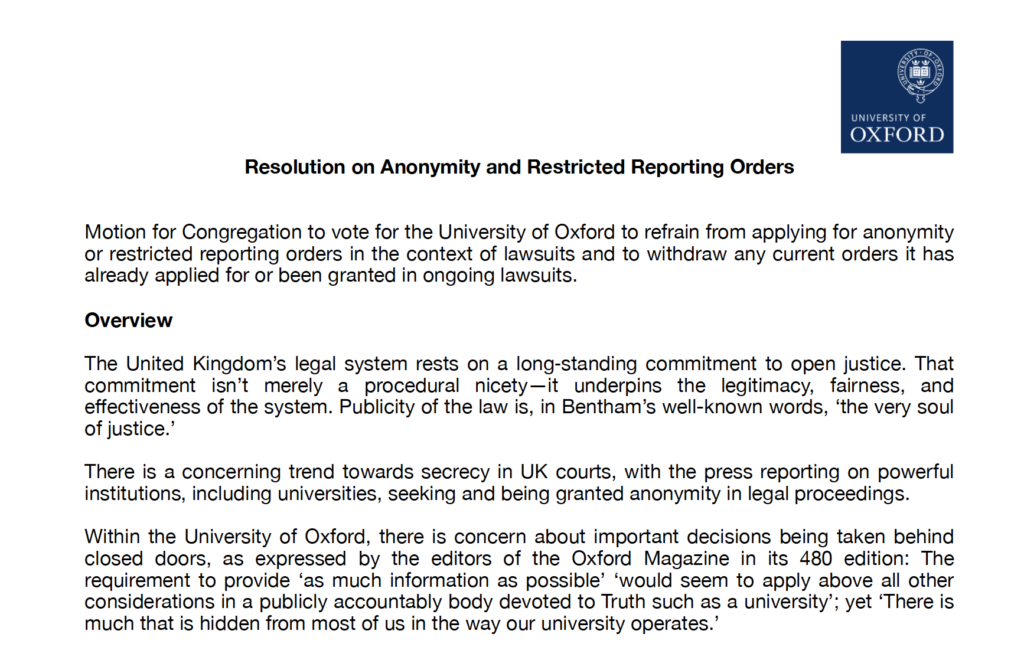
As another article appears on sexual harassment in Oxford in The Times, we learn that Oxford academics are now putting a motion to Congregation on the secrecy about bullying and harassment, protesting the use of gagging orders, non-disclosure agreements and corrupt investigation practices.
We need to do the same.
Our bullying and harassment stories need publicity, our bullies and harassers need naming in the press and we need to take to our own motions to Regent House.
There are so many administrators in Congregation (more so in Oxford than Cambridge) that any motion needs a lot of academics to vote through anything the University doesn’t want.
We remind readers that there are two votes open at Cambridge University (deadline 5pm today) initiated by Regent House members calling for transparency of the names on the Guild of Benefactors and the opposing the use of injunctions.
Voting for Regent House members is possible here
The 21 Group is in favour of greater openness and it opposes the funnelling of money for teaching & research to lawyers.
We also note there is a Nature editorial on bullying and harassment in research, out today
https://www.nature.com/articles/d41586-025-03908-6
It begins “What do you do if your country has a serious problem with bullying and harassment in academic research? The United Kingdom is among those with such a problem …
A key problem is that although harassment is against the law in the United Kingdom, workplace bullying is not. At universities, complaints are mainly dealt with through internal grievance processes, and data on such cases are hard to come by because there is relatively little involvement of external bodies such as regulators. As a result, in the past decade, organizations have been set up to support people being bullied in academia, among them the 21 Group and the Academic Parity Movement. These are calling for more external scrutiny of what is happening in universities.“
The Nature editorial is nice to see out there. Good that recognition finally being given to this issue in the scientific establishment. But as per earlier comments on this blog: one needs to be clear that this is not just about bullying, it is about retaliation. People called out serious problems in British scientific life such as nepotism, plagiarism, harassment, discrimination and breaches of labour laws and instead of being heard were subject to career termination, removal of their research funds, and all manner of specious threats.
Ehsan Masood of Nature is sympathetic. We are encouraged by the editorial and we are confident that Nature will return to this matter, bearing in mind forthcoming legal cases.
This is the statement we provided to Nature.
Oxford University’s Professor Miles Hewstone FBA led his department’s Athena Swan application between 2012 and 2014, earning a Silver Award. Yet Bloomberg has since revealed him to be a serial sexual harasser—clear evidence that such accolades offer no guarantee of a safe or equitable workplace. At Cambridge, a professor implicated in misogynistic bullying was likewise permitted to front one of our Athena Swan submissions. The problem is that universities—and the predatory or bullying individuals within them—have learned how to game the system.
In evolutionary biology, protective mimicry occurs when a toxic species adopts the appearance of something harmless or beneficial, allowing it to evade scrutiny and carry on unchecked. The assessment of “research culture” in universities often works the same way: equality branding can become a form of institutional camouflage, shielding harmful individuals, making victims less likely to be believed, and enabling misconduct to persist.
Formal equality assessments—whether Athena Swan, the Race Equality Charter, or similar schemes—risk turning “culture change” into a bureaucratic box-ticking exercise that can stifle the very values they aim to promote. They have their uses, but they are far too crude and unreliable to be incorporated into the REF.
What does need attention is accountability. Self-regulation has failed too many students and staff. Given the prevalence of harassment, bullying, discrimination and abuse of power—and the extent to which institutions can be complicit or negligent—it is unrealistic to rely on internal processes or voluntary good practice alone. A strong external regulator is necessary to set minimum standards, require transparency, and hold universities to account. This responsibility should fall squarely within the remit of the Office for Students.
There should be an independent regulatory agency as Masood suggests. It is critical that this agency, unlike the various other toothless regulatory bodies out there, be absolutely incorruptible and dedicated to its zero-tolerance mandate. A good first step would be to recruit the officers of this agency from whistleblowers who have a track record of standing up for justice already, as well as experience of the failures of our academic system firsthand. On appointment all would have to declare in full the individuals and organisations responsible for their own mistreatment: then follow a strict rule preventing them from investigating matters involving their previous institution, or any individuals from that place they have dealt with, should those persons subsequently move elsewhere. They would have nonetheless the peace of mind in knowing that another officer, who will and must always remain strictly unknown to them, shares their sense of universal service to justice in its ideal form, and will similarly be investigating theirs and related matters with the same unrestricted collection remit.
We need a radical change of paradigm – from a culture of silence and secrecy to one of voice and transparency.
Regulatory reform is the way forward. For example, in the UK the Financial Conduct Authority (FCA) imposes strict requirements on the companies they regulate in order to ensure that legal compliance can be fully audited and enforced:
“All voice calls must be recorded, including those using mobile phones. So, whether your staff are working at home, travelling for business or office-based, you’ll need to be able to provide recordings of every conversation.”
(https://www.croftmsp.com/article/fca-call-recording-regulations-everything-financial-firms-need-to-know/)
There ought to be a similar rule for workplace relations – with copies made fully available to all participants in line with GDPR.
That is obviously the case for disciplinary meetings and internal tribunals. But it should also cover any meeting in which HR are present, because that fact in itself suggests prior belief on the part of the employer that an employment law compliance issue was going to be salient in that context.
Transparency is the best means to prevent foul play and it protects everyone – including employers and managers – by keeping everyone honest and playing by the rules.
“copies made fully available to all participants in line with GDPR”
The Information Compliance Office of Cambridge has an incredible capacity to retain information that they do not want to share while kindly encouraging you to contact ICO if you are not satisfied. The same people who illegally retained information in the past continue in the office as if this is a standard practice. This story published many months ago is illustrative of what happens in the Information Compliance Office: https://21percent.org/?p=1608
“The university and its information officer (Dr James Knapton) have already been taken to court for failure to comply with GDPR and had to acknowledge fault.”
While covert recordings give an opportunity to expose what they are really up, to it is definitely fairer to have a policy like this. That gives managers too a chance to avoid implicating themselves and a stronger basis to push back against instructions they knew all along were wrong.
“Our bullying and harassment stories need publicity, our bullies and harassers need naming in the press and we need to take to our own motions to Regent House.”
I agree. The University of Cambridge became a health hazard for many people, namely for those who report misconduct of senior members and end up experiencing systematic retaliation that aims to break and silence whistleblowers. We can reach out to Anna Bull who is quoted in the Times article, and here (https://www.personneltoday.com/hr/resignations-oxford-ehrc/) perhaps?
Prof Anna Bull of the 1752 helps victims of sexual harassment in universities
https://1752group.com
Victims of sexual harassment should certainly reach out to the 1752 Group
Associations are as bad as academic institutions: The EASP released a statement, calling victim testimony hearsay. After an investigation into Miles Hewstone’s violations of the EASP Code of Conduct, to which multiple people submitted reports, the outcome was never communicated to the victims or EASP members. Instead, they now state “We regret that EASP was unable to do more. However, the Association could only rely on hearsay and did not have any evidence for the misconduct, which limited the range of possible actions substantially.” In short: Retraumatizing victims, no outcome communicated, now dismissing their evidence hearsay – disgusting.
https://www.easp.eu/getmedia.php/_media/_archive/20251202113925.html
We guarantee that the British Academy will do nothing as well
https://bsky.app/profile/21group.bsky.social/post/3m6yme2lqkc2w
Chief Executive Hetan Shah is all over Bluesky and at every conference telling us how important culture is. And he’s in charge of implementing the Code of Conduct Policy of the British Academy.
He seems not to understand that by doing nothing the British Academy is encouraging poor behaviour.
We recommend readers on Bluesky let Hetan Shah know that the time for doing nothing is over.
At UCam the whole oligarchy apparatus is geared to one objective: whatever the oligarchy decides a priori must be the final outcome. So HR, Registrary, Legal and ‘compliant’ faculty are deployed to ensure the chosen victim is crushed! By whatever means! So of course they don’t want recordings, they deploy barristers in internal investigations and don’t allow the chosen victim to get legal representation in the proceedings, and they then drag grievance appeals for years. This is all unlawful but until several cases are exposed by the press, or ET, or the High Court everything will remain as it is now!
This was probably always like this but until about 10-15 years ago there were enough Faculty with competence, rigour, honour and integrity prepared to keep it controlled. Then it got out of control somehow and even though 90% of the Faculty are still ‘good people’ the current oligarchy lack competence, integrity, rigour and honour and are not controlled by the Faculty anymore. The current VC thinks she is the University ‘queen’ and things are now so bad that she and her top management team must all go!
@SPARTACUS: “and don’t allow the chosen victim to get legal representation in the proceedings”
It’s even worse than this (although I do not speak for Ucam in particular). When it dawns on those overseeing the execution of an innocent staff member on their hitlist, that the target is more than capable of defending themselves and exposing the corrupt and bizarre farce for what it is, *they* will bring along a solicitor for extra protection, while of course denying the victim the same privilege.
Or worse, they will load *the panel* with one of their internal solicitors!
HR may not even turn up at all during the proceedings (perhaps to try to deflect blame or avoid being overheard saying something that they shouldn’t – see discussion here https://21percent.org/?p=3007).
Believe it. This really is happening out there, and the situation is totally out of control at our Universities.
They’ll generate a generation of barrister academics. Bringing a solicitor and preventing an academic from bringing a solicitor tells them nothing about the pool of legal knowledge that the academic is wired up to. No solicitor worth instructing in a case would agree to sit in a meeting as a legal representative where legal representation in the same meeting was being blocked for the other side of the case – that is not conducive to resolving a case and it is not in the public interest.
I can one of these solicitors attempting this with one of the ‘non-academic’ staff members in a university only to discover that the “non-academic’ staff member is an academic at heart and in the process doing an employment-law learning sprint.
Universities have a library, law is a subject that has its own dedicated section & every member of a university has access to the library.
James Croll was a Scottish 19th century scientist who held a position as a cleaner in a museum in a university when he accessed the university library to do the academic work that he become known for “a theory of climate variability based on changes in the Earth’s orbit”. It is possible for people to engage in high-level learning in a university from any position in a university.
https://en.wikipedia.org/wiki/James_Croll
“…that is not conducive to resolving a case and it is not in the public interest.”
Indeed it is not in my view too, on both counts. If anyone else has witnessed this, or can point to specific Employment Tribunals or other cases in the courts where this case has been made, then please post it here or let 21Group know.
Willing to give the VC some more time to show she can get control of the situation. When I met her, I was quite impressed. She’s seems quite sensible (compared to some of the pro-VCs). The Registrary & HR Director have been here a long time & they are responsible for the really terrible state of affairs. They need to be held to account for what they’ve done.
@HannahMontana, the key word here is “seems.” Feel free to get in touch with the 21 Group and ask them my contact details so that I can show you how sensible the VC really is. For 29 months, I have met many people who seemed sensible, to later find out that was fake. The Registrary & HR Director are not the only responsible for the degrading state of UCam. I really wish they were because in that case the issue would be relatively simple to address. Systematic retaliation against whistleblowers requires the consent of many people, implicitly and explicitly. More generally, concealing and manipulation of information that affects the reputation of senior members is a cultural issue in Cambridge that one finds in the University and Colleges. To be clear, this claim comes from a person who interacted with the VC at the University and College level because we are from the same College.
I expect her experience has been the same though especially with registrary and HR. People say she is a good listener but she has been listening to the wrong people.
An accurate diagnosis, we fear 🙁
They were dancing in the streets of Princeton when she got the Cambridge job
A different Registrary was in place when the original decision not to comply with the re-engagement order in the Catherine MacKenzie case was taken so this is an important organisational lesson to learn – if an organisational decision that was taken before you occupy a position and is being queried while you occupy a position then it is important at the point in time that past organisational decision is being queried to re-analyse the case that is generating the query from scratch to make sure nothing was missed in original analysis of the case which could have influenced the outcome of the case and prevented the current query relating to the case from reaching your desk.
A university can always move to hold a non-confidence vote in a current VC and to then test its organisational ability to secure a new VC having terminated its working relationship with its previous VC in that manner, except for an exceptional case where an organisation cannot do so because a non-confidence vote in an individual for not taking action in a situation that has been generated by an organisational fault in which that individual cannot intervene because of the position they hold in an organisation is an abuse of an organisational process.
Should have listened to the chair of the Board of Scrutiny, a qualified barrister, back when they were offering free legal advice to the organisation all them years ago.
Mainly I think what has happened here is that there has been new societal and organisational learning on effective employment regulation and on effective work-related stress regulation after a significant organisational stressor – a global pandemic.
Criticising an organisational decision in hindsight and with fuller information of future consequences of that decision is an easier position to be in than to be in the position of having to make that original decision for the organisation. The fact that people can criticise the original decision from that position doesn’t necessarily mean that those doing that would have avoided the same organisational error were they faced with the original decision at the time it arose. It is no disrespect to the people making the decisions at the time to criticise the original decision, it is just a recognition of the fact that the organisation needs to learn and to avoid making the same organisational error in future.
I would have thought that in such cases of unfair dismissal involving the chair of the board of scrutiny that the legal advisors to the university would advise the university in-house legal team on whether to comply with any re-engagement order obtained or whether to further contest it in the courts, the advice is then passed to the Board of Scrutiny which then takes the decision on behalf of the university on whether to comply with the re-engagement order or to further contest in the courts & the Board of Scrutiny then coordinates any subsequent university action on compliance with a re-engagement order in the university should it remain in tact at the end of all the subsequent court action.
Toope had a similar experience and the oligarchy forced him out via media leaks. It would be consistent if they tried the same thing for Prentice. But I posit this time is different because the oligarchy is at the core of the story when it comes to harassment, retaliation and all the various cover-ups, so, anything they do to feed press interest on other matters (Council meeting leaks etc) eventually brings more focus back to them. We need to hold them to account and put the long-term interest of our university first. That means independent audit, commitment to change and ensuring proper standards and fair treatment of students and staff.
They could try to force the current VC out – generate another substantive unfair dismissal for the organisation. Would generate even more evidence of the same operational organisational fault – an organisational inability to recognise, prevent & effectively remedy substantive unfair dismissal situations – that would still be there if the current VC is forced out, just like it was still there when the previous VC was forced out. Can’t retaliate against an organisational fault to silence it, can’t harass an organisational fault out of the organisation, it will still be there wasting organisational time, wasting organisational money, waisting organisational energy & draining all the life out of the organisation until it is addressed by the organisation.
The gigantic scandal at UCam School of Clinical Medicine/CRUK involved everything @SPARTACUS refers to and more! World leading research has been destroyed and a fantastic research group has been decimated!
I think what is happening here is that organisations are accepting situations where private personal problems of people being employed in the organisation are being translated into an organisational professional problems by not having clear guidance on the formation of consensual sexual relationships in an organisation and how the formation of a consensual sexual relationship in an organisation has the potential to automatically change an existing professional organisational relationship.
People in organisations such as universities are not employed to have any form of sexual relationship, the maintenance of working relationships is critical to employment but a working relationship is completely distinct from and independent of any consensual sexual relationship that people in an organisation might voluntarily choose to enter in to. If one person in an organisation is putting undue pressure on another person in the organisation to enter into a sexual relationship and that other person wants that undue pressure on them to stop then the whole organisation, which could be ~30,000, is within its rights to bear down on that first person to bring an end to that undue pressure.
If e.g. a PhD supervisor and a PhD student want to enter into a consensual sexual relationship then that means the PhD supervisor is resigning their supervision of the PhD student and the PhD student is making an application to change their PhD supervisor. That mutually agreed decision is then being communicated to the organisation. A PhD supervisor cannot use power derived from a professional position in an organisation to place undue pressure on a PhD student to enter into a sexual relationship with them and then trap the PhD student in a position of being coercively controlled in a personal relationship using power that is derived from a professional relationship in an organisation for the remainder of the PhD.
It seems to be that rare occurrences in organisations are being left unaddressed by the organisations to generate significant hardship and difficulty for everyone in these organisations but for those who had control over the rare occurrences and who could have done something to prevent the rare occurrences.
Yes, but ‘rare’ is probably not quite the right adjective.
In Cambridge, it is probably 20-35% of Grievances that are ending up in this state, causing substantial waste of money, time & energy.
The ‘rare’ in that post was referring to the probability of a particular type of case e.g a PhD supervisor being in a sexual relationship with a PhD student that they are currently the supervisor of – occurring in an organisation relative to the total number of active PhD supervisor – PhD student relationships in the organisation. I think that this is a rare occurrence.
In terms of Cambridge grievances, Cambridge hit the pandemic with that organisational fault – outstanding re-engagement order – that was impeding effective organisational employment regulation baked in to the organisation. I wouldn’t be surprised if 20-35% of grievances are ending up in that state because the pandemic will have put additional pressure on the whole grievance system and that could then have contributed to the generation of a backlog of unresolved grievances.
I found it impossible to reason with those who were tasked with handling the grievances/concerns processes on behalf of the university in Cambridge. I have no problem with people wanting to shut down a case as quickly as possible but doing that without actually solving the case makes no sense. How many members of Regent House does it take to explain to those handling these grievance/concerns processes on behalf of the university that there is a problem with the processes before they will accept that there is a problem?
It’s up to legal to do an organisational reset of the grievance/concerns processes. The Registrary is not in a position to do a reset of grievance/concerns processes and also not in a position to block an organisational reset of the grievance/concerns processes when one is needed. The head of HR is also not in a position to reset the grievance/concerns processes.
There are certainly many grievances that do not lead to extreme cases of institutional corruption, either because the respondent was not a very senior member whose reputation strongly correlates with the University’s, or in cases when the claimant accepts the original conclusions of the University despite knowing they are incorrect and decides to move on. If the claimant does not accept the conclusions and escalate the situation, the percentage of these cases that lead to systematic retaliation must be extremely high because UCam does not know how to assume responsibility, address the issue and move on. The key strategy is to cover up, to cover up, and to cover up.
Are there any instances of senior faculty being held to account by students or young scholars? Even one single case ever?
@TigerWhoCametoET, I honestly doubt but the 21 Group may know examples. The reason I doubt is simple: that is not the culture of the place so more often than not they will simply cover it up. And because it typically works, they keep doing it. Perhaps if several students had problems with the same senior faculty, something was done, but this version can only be very rare.
@Tiger, at Cambridge University, we do not know of many cases, certainly none initiated by the University.
Possibly the long saga over Dr Peter Hutchinson at Trinity Hall might count, though this was primarily a College matter regarding treatment of women in supervisions.
The dealing of sexual harassment complaints at the College eventually led to the felling of the Master, Jeremy Morris. All the media articles are collected here
https://www.dobetteracademia.co.uk/index.php/university-wrongdoing/university-sexual-misconduct-in-the-media/trinity-hall-sexual-misconduct-scandal
It was surely no coincidence that shortly after all this, Trinity Hall appointed its first female master (Mary Hockaday) who has a specialism in media.
We have more information on this matter & plan to run some blog pieces in the New Year.
Lean In tells us how common it must be in (https://21percent.org/?p=2628):
“Over the years I have served on many committees at the university tasked with the miserable job of handling student complaints. You may wonder what happens on such committees to produce such unfortunate results.
First, please understand: no complaint was ever taken seriously. As soon as it is handled the immediate discussion centres around how it must be dismissed. The student is immediately presented as “troublemaker” and the fact of their having made a complaint presented as evidence that this must be true. At no point has anyone ever considered whether we are the ones who need to reflect and learn.
Second, no evidence is ever taken from any person who raises an issue. Indeed no evidence is ever at all. Any person accused is asked for their account and this is immediately and durably assumed as fact (even if their account of the matter changes over time and is not consistent). We protect our own and the more senior the individual the more protection they deserve.
In the most comical episode I can recall, a student had made valid accusations against legal noncompliance. For this reason all mention of their complaint was not included in the agenda. When the chair of the committee turned to raise the issue HR handed out sheets of paper in small print with a highly edited summary of the matter. After the meeting they checked very carefully to ensure that each piece of paper had been handed back. It was agreed by the chair and all those present to exclude any note of having discussed the matter from the minutes. What the discussion agreed was to dismiss their complaint without evidence.”
“When the chair of the committee turned to raise the issue HR handed out sheets of paper in small print with a highly edited summary of the matter. After the meeting they checked very carefully to ensure that each piece of paper had been handed back. It was agreed by the chair and all those present to exclude any note of having discussed the matter from the minutes.”
What this tells you is the level of control HR have over individuals in positions of authority, committee chairs, Heads of Department, Heads of School.
Some departments seem to be run by the Lead HR Business Managers; entire schools might be too.
HR are copied in all the emails, tell everyone what to do, how to write or edit their “responses”, they draft the minutes of meetings, write the outcome letters, “advise” on what decision is most appropriate. As if only they understand the relevant policies and processes. As if only they know what is right or wrong.
Except that they don’t, neither morally, nor legally. They don’t care about the Statutes, about academic priorities, about truth, justice or evidence. They don’t even care about the law. They just enjoy the power of seeing academics dancing to their tunes, and to their threats. And then, more worryingly, sit back and watch the catastrophic consequences of their malicious and misguided advice – for which the academics are then to take responsibility and put their reputations on the line.
…for the sorting out of which people will once again be reliant on HR advice.
The main pressure point is legal compliance, and the genuine need for most not-legally-trained individuals to get advice on that front.
By the time people realise that the HR advice had non only made a situation much worse but in fact also led to legal non-compliance (to say nothing about systematic misinformation and malicious misguidance) they have their names and reputation on all the letters, the emails and the minutes, as HR have been busy ensuring all the relevant paper trails and redactions are in place, and all traces of their own involvement have been erased.
““When the chair of the committee turned to raise the issue HR handed out sheets of paper in small print with a highly edited summary of the matter. After the meeting they checked very carefully to ensure that each piece of paper had been handed back. It was agreed by the chair and all those present to exclude any note of having discussed the matter from the minutes.”
What this tells you is the level of control HR have over individuals in positions of authority, committee chairs, Heads of Department, Heads of School.
Some departments seem to be run by the Lead HR Business Managers; entire schools might be too.”
The head of HR is the organisational safeguarding lead. To have control over an organisational safeguarding situation HR staff have to be in direct contact with the person in the safeguarding situation. It’s like any emergency situation e.g. if you come across a person injured in a road traffic accident you have to talk clearly to the person in the emergency situation irrespective of whether they can respond, explain clearly what you are doing to address the emergency situation, ask the person for any information that might be relevant to the emergency situation e.g. any details of the accident that occurred, are they in pain, what type of pain it is, how intense is the pain.
HR staff trying to get control over people in positions of authority in an organisational safeguarding situation whilst not maintaining direct contact with the person in the safeguarding situation is like a paramedic trying to get control over the senior management of a hospital whilst simultaneously losing all control over an organisational safeguarding situation & not then bringing in more specialist support to stabilise the organisational safeguarding situation so that the organisation can create the conditions for recovery and the person can exit the organisational safeguarding situation.
Tortoise media did an in-depth investigation of the problems in Trinity Hall
https://www.tortoisemedia.com/2021/09/06/the-resignation-of-trinity-halls-master-should-be-just-the-start
Thank you for sharing the Tortoise media link. It shows how good people working together were able to achieve justice in one case but also how little has changed and remains to be done.
I felt very strong resonance with the following words:
“All of these stories are fundamentally about policy, process and procedure and how it can fail… In some instances, the rule book appears to be thrown out altogether and institutions improvise solutions with disastrous results.”
We are still in this situation today and these words remain fully true in spite of four years in which things should have changed.
There is much more to this story
The later Tortoise article “A College with Secrets” has been completely removed from the web (& even Wayback Machine). The 21 Group has a copy.
Well-paid lawyers have been very busy 😉
We will return to who removed it & why in the New Year.
“The later Tortoise article “A College with Secrets” has been completely removed from the web (& even Wayback Machine). The 21 Group has a copy.”
I thought that was a very well written piece of journalism. I find it depressing that information that could be used to build an accurate picture of a problem to prevent the same problem from reoccurring in the future is removed from the web. This is why it is so difficult for organisations to improve because they won’t collect accurate information themselves, they won’t analyse their own internal problems, they won’t do anything to prevent the same internal problems from reoccurring in future & they block external scrutiny of their internal problems which will then reoccur.
How much money do organisations spend with the intent of not fixing an organisational problem that they could instead have chosen to fix? What fraction of a well-paid lawyers work is dedicated entirely to obstructing society from fixing its existing societal problems and holding society back?
Look at Cambridge, how much money did it spend on well-paid lawyers unfairly dismissing Catherine MacKenzie and then blocking the re-engagement order from an employment tribunal? I got the judgment from Bury St Edmunds, the university didn’t have a legal case and yet the University paid out significant amounts of public funds assigned to higher education for well-paid lawyers to go to court and then to block the chosen remedy.
– for what legitimate aim? to what end? for what purpose?
So well-paid lawyers can rise in society doing work for universities that is actively holding society back while the same universities leave academics to sink in society doing work for universities that could propel society forwards.
collegiality – companionship and cooperation between colleagues who share responsibility
The university paid an external barrister to complete the unfair dismissal process of the chair of its own board of scrutiny – an internal barrister and an academic – through external legal proceedings.
An organisation that has substantively unfairly dismissed an individual and refuses to accept this has occurred or to comply with a subsequent re-engagement order is in a lower state of organisational autonomy than an organisation that complies with the re-engagement order because it then has a lower number of individuals who can spot and remedy organisational errors internally which is the basis of the continuous maintenance of organisational autonomy.
This is all true but it can only happen because the Registry, Legal, VC, ProVCs and the Council let it happen! HR is bad, starting with its sinister Head, but the oligarchy is in charge!
Unfortunately it starts to become evident the new Chancellor is just happy with his robes and will not use the Statutes to rescue the place!
Cambridge is rotten to the core and in decline.
The Chancellor’s powers are largely advisory. The VC has more but we don’t have executive authority while those responsible remain deep in the power structure. The inevitable result? Cases pile up and without collective action they’ll take us all down with them
We need an independent external review of HR and Senior Management, with the authority to examine several of these cases in depth.
The Chancellor could play a role in guaranteeing that the review is genuinely independent.
He would find the barrister rather than relying on an HR-selected barrister or consultancy with existing ties (eg Mr Porky-Joint or B3Sixty)
The organisational grievance and concerns processes need to be reset – either through legal itself or through an independent external review. One way or another.
“will not use the Statutes to rescue the place”
The Statutes? But do you think that people in UCam follow the Statutes? Ask the VC Professor Deborah Prentice if she replies to formal representations under Statute AIX. What a pathetic place this is now!
the statutes exist on paper but have no system to uphold them. it is very unclear what the real rules are so staff are confused and HR do not seem to have a very clear idea either. what is obvious is that there is a massive gap between what the policies say and what really happens and the advice from HR often confuses rather than clarifies
The problem is more basic, if you are fair and reasonable with respect to your case those handling your case cannot reciprocate and be fair and reasonable back so it’s not then possible to solve any problem.
HR make error after error and instead of acknowledging any errors that have already been made they double-down on the errors already made and then continue to make error after error. The university assumes that there is a public law system available to correct any significant HR error but Catherine MacKenzie has already proved that it is not possible to use the public law system to correct any significant HR error in Cambridge when as qualified barrister she tested all of the public law system and couldn’t get a major HR error – unfair dismissal – corrected.
It’s unlikely that the HR department can reach a steady-state HR workload with this combination of factors in place (1) current cultural : HR staff unwilling to admit errors (2) past organisational precedent : organisation blocked the correction of a significant HR error identified by the Chair of the board of scrutiny, a qualified barrister, who exhausted the organisational grievance processes, concerns processes and the entire public law system – employment tribunal, application for judicial review (denied) – proving a significant HR error was made and securing a judgment from the courts that correction of that significant HR error was appropriate in the case – re-engagement order made. When an individual is forced to exhaust all the internal and external processes in a case where multiple HR errors have been made this generates significant HR workload.
The plot from the 21 group shows HR staff numbers rising over time which is consistent with the HR department being unable to reach a steady-state HR workload with the current HR processes that are running in the organisation. HR workload seems to be effectively unregulated which is leading to increasing numbers of HR staff. It’s not clear that the increase in HR staff numbers is leading to an overall improvement of HR functioning in the university i.e. to a decrease in the number of cases generated or an increase in the probability of case resolution.
The absence of any clear evidence of a significant improvement of HR functioning with a significant increase in HR staff numbers could be an indication that the existing HR culture is propagating both in the HR department itself to new HR staff members and in the wider university. The reason an increase in the number of HR staff is not then leading to an improvement in the overall functioning of HR could then be that it is existing HR culture – HR staff unwilling to admit errors – that is the barrier to improvements in the overall function of HR and not the total number of HR staff.
I think this a barrier prestigious organisations can encounter when trying to address problems with existing culture, people joining prestigious organisations are more likely to try to adopt the existing culture of the organisation and to leave behind the culture of the organisations they previously worked in.This can serve newcomers well when the culture of the prestigious organisation is in a healthy state but can work against newcomers if the prestigious organisation is in the process of trying to address existing problems with culture.
Thete are people at UCam that love the current regime:
Prof ViciousWoman
Prof Drinkalot
Prof Teflon
Prof Crookery
Prof Smallman
This lot prays the current oligarchy stays in power. Otherwise tic toc tic toc tic toc… BOOOOOOOM!!!
The day is coming…
We are all waiting…
For anyone out there is on the fence about raising concerns about bullying or harassment but afraid of retaliation please remember: **you are not alone**. You are simply one of countless people who tried at many points to report and raise the matter — and continue to do so now.
But very important is that you should **not go to HR expecting a result.** because you too will be ignored, and frankly no-one knows what the Pro-VC is up to either.
Instead take your report direct to the VC, the Chancellor, and as many Pro-VCs as you can. If it is a legal issue go direct to the head of the service and let this know group and the Unions too. Then reach out for support from colleagues too to let them know about the situation.
It is a good idea to copy all Grievances to at least VCO.EnquiriesATadmin.cam.ac.uk
When the reckoning comes, it is important that those at the very top can’t say they were never informed.
And the Pro VC for Community and Engagement? He’s absolutely fiercely anti-bullying. He reminds us of that at every possible opportunity — almost like a personal brand slogan.
It’s just unfortunate that, despite countless surveys showing bullying is widespread, he somehow can’t seem to locate a single bully. Remarkable eyesight.
“And the Pro VC for Community and Engagement? He’s absolutely fiercely anti-bullying. He reminds us of that at every possible opportunity — almost like a personal brand slogan.”
Do you mean Prof. Kamal Munir? Yes, fiercely anti-misconduct more generally.
https://www.studentsupport.cam.ac.uk/harassment-and-sexual-misconduct
“We are crystal clear that harassment and sexual misconduct are unacceptable. We have an obligation to prevent it, and everyone at the University has a role to play. That’s why it’s important that all our staff understand our policies and what is expected of them, including what to do if they receive a report.”
It is just unfortunate that when he receives whistleblowing disclosures and safeguarding referrals based on detailed medical evidence he does not even conduct an investigation. I feel so much safer having him as the Pro VC for Community and Engagement! I wonder who has a good opinion about his services. I know that the Master of Christ’s College has, but who else?
I sleep better at night knowing this is the person overseeing community wellbeing.
I’d love to start a fan club, he has so many admirers.
You’ll need a very small room. Just you, Debbie & Simon McD
Hmmm, perhaps Prof. Munir could join Christ’s College given the other two fans are there. I can even introduce him to the students. I will make sure he knows the signs we have in the buttery, “Christ’s College has a legal duty to protect its students and its academic and non-academic staff from sexual harassment, abuse and other inappropriate or unwanted behaviour. We will take immediate and appropriate action to address any such incidents.” He will feel really at home!
Mustn’t forget the Director of HR, a mega fan surely, since he consistently refuses to allow grievances against her.
…and of course the most discussed Lead HR Business Partner in the 21Group who probably drafts the response letters for him, with Sam, so he doesn’t need to get his hands too dirty with the muck they’ve created or bother with any evidence.
The most discussed Lead HR Business Partner in the 21Group may well draft many answers yes, but sometimes her word is explicitly mentioned by Prof. Munir as sufficient to ignore whistleblowing disclosures and safeguarding referrals despite she is conflicted! It is hard to believe that UCam got so low, but it really has, and it seems to get worse and worse. The question then is how low it will get and until when the circus will continue…
Oxford harassment stories in ‘Private Eye’
https://x.com/21percentgroup/status/1997250312915329379
Oxford are showing us how to do this, notice the vacuous comment from Oxford’s “ProVC for Community & Engagement”
“We reject any suggestion that the University tolerates harassment” 😉
Notice also the abuser used Carter-Ruck — we know of Cambridge cases as well. Extremely expensive, so someone with big, big pockets paid
It seems that Pro VCs for Community and Engagement all read the same script! What an embarrassment of people.
I repeat my mantra: the current UCam oligarchy has one ‘modus operandi’- to determine ‘a priori’ what it the outcome they want for any given individual!
If you are to be destroyed or get disposed off no expense is spared to make you a victim.
If you are a friend of the oligarchy the whole resource is used to protect you.
The Faculty is completely ignored and top management run the place like their private kingdom. They therefore need a totally clueless queen! The VC! First a super mediocre Canadian lawyer and now this American nobody! The place is doomed!