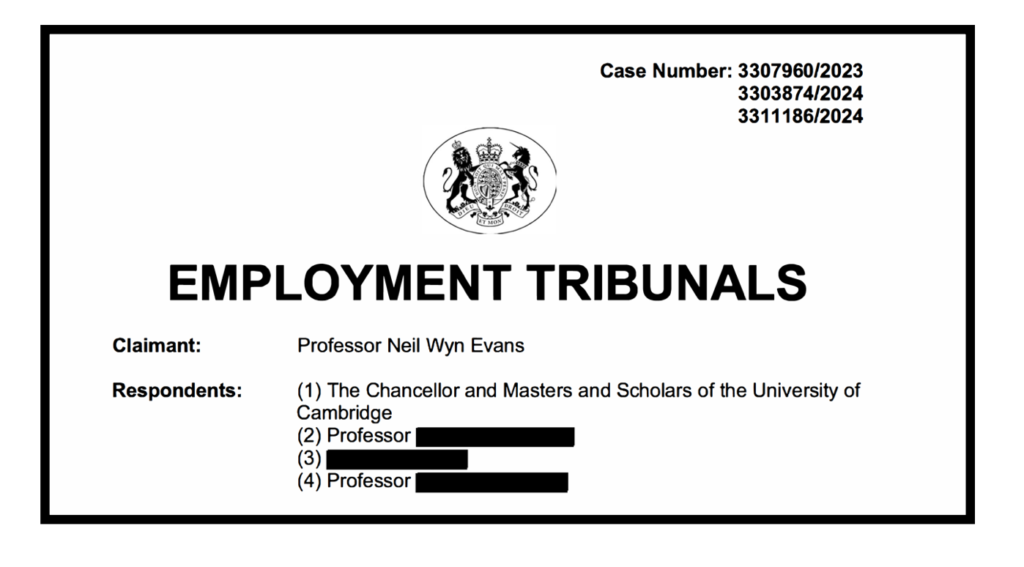
An Employment Tribunal from 1-28 June at Bury St Edmunds is now listed on the public website courtserve. The case number is 3307960/2023.
This case is listed as PIDA. In other words, the Claimant — Prof Neil Wyn Evans — is alleging that he suffered detriments by acting as a whistleblower. Whistleblowers are protected from retaliation under the Public Interest Disclosure Act (PIDA)
Cambridge University’s whistleblowing policy is here. Specifically, a staff member can make a whistleblowing disclosure if he or she has a reasonable belief that one or more of the following has occurred, or is likely to occur :
- a criminal offence
- failure to comply with legal regulations
- financial or non-financial maladministration or malpractice or impropriety of fraud
- academic or professional malpractice
- a risk to the health and safety of an individual
- environmental damage
- a miscarriage of justice
- sexual harassment
At the University of Cambridge, responsibility for administering the whistleblowing policy rests with the Academic Secretary, the Registrary or the Vice-Chancellor.
We have voluntarily redacted the names of the Second, Third and Fourth Respondents.
As with all Employment Tribunals, members of the public may attend either in person or remotely. Standard instructions are available on the CourtServe website, repeated below:
Requests from the media and members of the public to observe a hearing remotely should be made in advance to watfordet@justice.gov.uk to allow for inclusion during the hearing set-up. The naming convention in the subject heading of the email request should read “MEDIA OR PUBLIC ACCESS REQUEST – AN Other v AN Other – Hearing Date.
Commentary on the underlying events should be avoided until they have been presented in open court. They may then be reported under the principles of open justice.
57 Comments
TheResearcher · 22 May 2026 at 20:43
You do not imagine how much looking forward to these hearings I am. It is only unfortunate that there are only four Respondents in this case.
Incidentally, the University of Cambridge only allows me to submit new evidence for my appeal against my expulsion as student at Cambridge “no later than 5pm on 29th May 2026” when my appeal letter explicitly states that testimonies from this Employment Tribunal will work as important evidence in my own case. Do not be surprised folks, the University wants to appoint a conflicted person as “Secretary” of the Appeal process, and it is this secretary who chooses the Chair of the Appeal Committee who makes the decision. Who is the Secretary you ask? A member of OSCCA directly managed by one of the 10 people who wrote witness statements against me, one of the persons who I had complained about before I was “investigated” but was never investigated herself. And guess what, it was explicitly asked in the appeal letter that the Secretary and the Appeal Committee were external and independent from the University of Cambridge, and this request was completely ignored.
Only a blind does not see what is happening and how low this institution got to cover up misconduct, but this time, there will be a surprise 😉
Xerxes · 22 May 2026 at 21:31
Good luck, Wyn. You have really tried to do something for all the bullied victims in Cambridge. This means so much to me and others
TheResearcher · 22 May 2026 at 21:36
Very true!
Magna · 23 May 2026 at 15:32
Give them hell. I presume this will be available for everyone to watch live via CVP link? Not just the media, but all past victims are owed the opportunity to watch them squirm under cross examination. This is a global public good in every sense.
21percent.org · 24 May 2026 at 06:07
It’s a public forum, any member of public can attend or watch.
Eileen Nugent · 26 May 2026 at 01:07
Any prospective job applicant can watch the employment tribunals of any prospective employer. Anyone prospective job applicant can join the nationwide search for the least worst employer.
Anonymous · 24 May 2026 at 16:06
And across the sector too. Good luck and take care.
Anon · 23 May 2026 at 10:00
You should speak with Foa if you have time. Apparently he reported almost all of those things to the central uni in 2024 and was ignored or worse.
21percent.org · 23 May 2026 at 10:05
The 21 Group is well-informed about the Foa case.
Blacklisted · 23 May 2026 at 13:39
“Apparently he reported almost all of those things to the central uni in 2024 and was ignored or worse”
Reporting any of “those things”, especially maladministration and malpractice to “central uni” does not result in “thank you for reporting this to us, we need to do something about this matter” but in “thank you for letting us know that you are on to us, we now need to do something about you”.
TheResearcher · 23 May 2026 at 13:49
@Blacklisted, not everyone knows how UCam really is when it comes to addressing reports of misconduct, and many are afraid of challenging this culture. That is the reality.
You may like to read about Danielle Bradford and what she had to put up with a few years ago. I only found her story recently. UCam was likely expecting that she would be satisfied with written apologies and that is why it let her complaint to be upheld. It backfired. Check all the article she published on this matter and the Channel 4 interview:
https://www.youtube.com/watch?v=9HvQDyMkKKM
TheResearcher · 23 May 2026 at 13:55
Read how UCam used her mental health reports against her:
https://x.com/danihpayne/status/1161347564962242560
After all these years, the practices continue the same at UCam. Dishonest people will continue dishonest until at least they assume their past mistakes. Those who cover them up, when continue their malpractices.
21percent.org · 23 May 2026 at 13:59
A very interesting case — thanks for spotting it. The comments by Cambridge University in the YouTube video are absolutely appalling, but I’m not sure things have moved on since 2019.
Some more interesting reading below (passed on by someone else struggling interminably with Cambridge HR)
Joan Friedenberg essay
https://www.kwesthues.com/friedenberg.htm
Anatomy of an Academic Mobbing
https://www.scribd.com/document/44894705/Anatomy-of-an-Academic-Mobbing
Plagiarism, Academic Mobbing, and the Manufacture of Scandal By Amy E. Robillard and John W. Presley
https://www.jstor.org/stable/43854550
The Administrative Roll in Mobbing
http://www.usmnews.net/The%20Administrative%20Roll%20in%20Mobbing.pdf
TheResearcher · 23 May 2026 at 14:07
“The comments by Cambridge University in the YouTube video are absolutely appalling”
It should not surprise you, they come from Professor Graham Virgo, the Chair of the Discipline Committee put together to expel me, notably a “Professor of English Private Law” at Cambridge who does not even understand that Respondents in a tribunal trial have the right to see all the evidence against them… not to speak his own conflicts of interest that were stressed before the Hearing but, as usual, ignored by UCam. Only a blind does not see the swamp that UCam is at the moment!
Eileen Nugent · 26 May 2026 at 01:49
The university is expecting that if a person has accumulated significant student debt to invest years of their life working long hours towards a degree at a prestigious university that doesn’t take much to apply undue pressure on person in the situation. Get a legal representative and prevent person from having a legal representative to increase the overall stress of the formal process, isolate the person from the support of family and friends by informing the person that the university cannot protect the person from another member of the university lodging a counter-complaint – i.e. harassing the person even further – if they discuss the complaint with anyone including family and friends, concerns for a persons mental health coupled to credibility considerations in relation to the person in the situation but not coupled to any concerns of effectively regulating the stress in the situation or to any practical understanding of stress regulation in the situation.
TheResearcher · 23 May 2026 at 10:30
People aware of the Consigliere University (https://21percent.org/?p=3097), will not be surprised by this case and by what is coming in the next coming weeks.
A key question that will emerge after this case being public is what will happen to the senior managers of Cambridge who knew about these issues for years and continued their malpractices, namely in cases of the same School. Can people who were dismissed, manipulated or ignored be allowed to request a review of their past grievances by external and independent parties? Or will Cambridge ignore the fact that the individuals involved in this particular case were involved in many others, before and after? I really hope that a substantial part of the Cambridge members can finally appreciate the degrading state of their institution when it comes to addressing reports of serious misconduct. Believe it or not, Cambridge University is an institution of cover-ups and at least some members are absolutely against that filthy culture.
21percent.org · 23 May 2026 at 10:35
Just a reminder, we will be removing any posts that may breach legal compliance.
TheResearcher · 23 May 2026 at 10:59
The 21 Group just posted something in X that reads:
“Either @RoyalSociety believes Fellowship is a reward for scientific achievement, so Huppert stays
Or it believes research culture & conduct matter, in which case he goes
What it cannot credibly do is insist on the latter while practising the former”
I suggest the 21 Group to check the Code of Conduct of the Royal Society:
https://royalsociety.org/-/media/about-us/how-we-are-governed/code-of-conduct.pdf
TheResearcher · 23 May 2026 at 11:06
I also liked the interview of Dr Gillian Tett at BBC… Life goes on!
Eileen Nugent · 27 May 2026 at 03:33
The Royal society has a long history (365 yrs) and in the time it has existed it has had fellows who have made outstanding scientific advances but whose personal conduct was poor. The Royal Society looks to its own past and it sees that exceptional scientific achievement and poor personal conduct sometimes went hand in hand. The Royal Society aims to foster scientific excellence for the benefit of humankind. Since – based on past evidence – scientific excellence & poor personal conduct are not mutually exclusive the Royal Society’s reasoning is that people who can demonstrate scientific excellence should not be excluded from the Royal Society on the basis of poor personal conduct as that has the potential to exclude individuals capable of scientific excellence from the Royal Society.
I think a major part of the concern here is that the Royal Society sees itself as having been representative of scientific excellence in the past when its sole criterion for admission to the Royal Society was scientific excellence and it is concerned if it makes fellowship admission conditional on both scientific excellence and personal conduct in the present that it won’t then be as representative of scientific excellence in future. It seems to be concerned that because scientific excellence and poor personal conduct sometimes went hand in hand in the past that they will continue to do so in future and therefore making a change of this type in the present will mean the Royal Society will end up excluding some individuals capable of scientific excellence in future and being less representative of scientific excellence in future that it was in the past.
The Royal Society thinking amounts to : it may not be possible for scientific genius to achieve scientific greatness without poor personal conduct and in excluding those with poor personal conduct the Royal Society is potentially excluding the next generation of scientific genius. This thinking excludes the possibility of poor personal conduct limiting the amount of scientific greatness a scientific genius can achieve. Whilst it’s true scientific greatness and poor personal conduct are not mutually exclusive, maximum scientific greatness and poor personal conduct are potentially mutually exclusive. If that be the case making Royal Society membership conditional on scientific excellence and on eliminating poor personal conduct could drive higher levels of scientific excellence in individuals and in scientific communities and also result in the Royal Society being more representative of scientific excellence in the future than it was in the past.
The idea that putting pressure on potential fellows of the Royal Society – e.g. Royal Society University Research Fellows – to eliminate poor personal conduct such as this
https://www.theguardian.com/education/2022/oct/12/former-ucl-academic-to-pay-damages-after-harassing-colleague-for-months
is going to result in lower levels of scientific excellence in the Royal Society doesn’t stand up to scrutiny. Clearly the Royal Society University Research Fellow involved in that case could have achieved higher levels of scientific excellence by not engaging in poor personal conduct in relation to another person. Clearly the person on the receiving end of that poor personal conduct could have achieved higher levels of scientific excellence had they not been on the receiving end of that poor personal conduct.
Genius is reliance on high levels of subconscious processing to solve a problem. Genius is to be driven to solve a problem from the depths of the subconscious to the heights of the conscious. Genius is for the whole mind – subconscious and conscious – to work in unity to solve a problem to the exclusion of all other problems. A person whose mind can work in this way on a problem – problem is continuously being solved at all levels of consciousness and to the exclusion of all other problems – could find it more challenging to eliminate poor personal conduct but this doesn’t mean working to eliminate poor personal conduct would necessarily result in lower levels of scientific excellence. If in the process of working to eliminate poor personal conduct a person discovers ways to get their mind to work in a more unified manner then working to eliminate poor personal conduct could result in higher levels of scientific excellence.
21percent.org · 24 May 2026 at 07:18
Interesting recent Employment Tribunal
https://assets.publishing.service.gov.uk/media/69a3f559f534e7e99adaeafd/Mohamed_Saad_v_University_of_Nottingham_2600124.2022_Judgment_and_Reasons.pdf
“Conduct of HR department is deeply concerning … The lack of transparency, deliberate witholding of information with intention to mislead … lack of any meaningful investigation into what happened”
It’s Nottingham University, but could be Any University
TheResearcher · 24 May 2026 at 07:42
I really do not understand why so many people accept an environment like this without actively voicing their concerns and why some think that those above HR are not aware of it or are powerless when it comes to change it. Very many people contribute to these situations with their silence, and by diverting their attention to other clearly more relevant topics such as “If you want to understand the United States, go to Cambridge.”
https://www.telegraph.co.uk/news/2026/05/20/if-you-want-to-understand-united-states-go-to-cambridge/
regrets · 24 May 2026 at 08:27
Chris Smith is a thoughtful man, but he is turning out to be a poorish Chancellor. A big problem is that he has no Cambridge base, but he lives in London. So he’s already semi-detached from what is going on.
It would be better to have a Chancellor who is more connected to the University
TheResearcher · 24 May 2026 at 10:40
“A big problem is that he has no Cambridge base, but he lives in London. So he’s already semi-detached from what is going on.”
He was Master of Pembroke for God’s sake!!!! Surely, he knows the culture of secrecy and cover up of misconduct at Cambridge for many years. And for avoidance of doubt, he is fully aware of my case and many others who contacted him directly. There is no excuse for this absence when his institution is in shambles. He could even live in Paris but only a blind does not see what is happening in Cambridge University.
Can someone remind me how many scandals were published in national newspapers regarding Cambridge just in 2026? Lord Smith is the Chancellor of the University during this period, has sufficient power to change things, and his priority is attracting international clientele. I guess the scandals will have to continue to be leaked then!
TheResearcher · 24 May 2026 at 11:04
There is a big difference between being thoughtful and having the courage to act when it is necessary. He may be the former, but so far did not display the latter.
Meanwhile, we have more news!
https://www.varsity.co.uk/news/31724
Anonymous · 24 May 2026 at 11:45
Excellent work, Nuno! Keep the heads rolling.
21percent.org · 24 May 2026 at 09:01
It’s also just plain wrong to say “If you want to understand the United States, go to Cambridge”
There’s also an implicit elitism in the statement. The “Cambridge” perspective may be insightful, but it’s hardly representative of everyday American life across regions, classes, and communities.
Perhaps Chris was being provocative or ironic but it’s a huge over-simplification
TeaParty · 24 May 2026 at 09:57
That is EXACTLY why the United States was founded
Eileen Nugent · 28 May 2026 at 13:25
“I really do not understand why so many people accept an environment like this without actively voicing their concerns and why some think that those above HR are not aware of it or are powerless when it comes to change it.”
If people are not sensitive to the direction of travel of the system people may not sense that as difficult as it is to actively voice concerns now – when a lower but increasing number of people are being impacted by significant systemic problems – if concerns are not actively voiced now the system is being left without the critical information necessary to change its direction of travel to one in which the number of people being impacted by significant systemic problems is decreasing over time.
Without people actively voicing accurate concerns now the number of people impacted by systemic problems is not going to get any lower in future and the system is not going to become any more supportive of those actively voicing concerns in future. Without people actively voicing accurate concerns now the system is being left at higher risk of becoming overwhelmed by more significant numbers of people with more significant concerns in future at which point the system could become insensitive to those actively voicing concerns.
If the system reaches a state where it is overwhelmed and as a result becomes insensitive to those actively voicing concerns it could then enter a cycle where the magnitude of both the concerns being generated by the system and the insensitively of the system to those actively voicing concerns are growing. This cycle could lead to the emergence of systemic cruelty toward people that would then grow in magnitude and take in increasing numbers of people. A system that enters such a cycle of increasing systemic cruelty is moving away from the conditions that enable the maintenance of a peace state and towards the conditions the make the emergence of a war state more likely.
Eileen Nugent · 28 May 2026 at 11:51
“Conduct of HR department is deeply concerning … The lack of transparency, deliberate witholding of information with intention to mislead … lack of any meaningful investigation into what happened”
Took 4 years to get to court at which point information recall in relation to case had significantly degraded – this is a slow, inaccurate & expensive organisational governance feedback loop.
The excessive wait times in the judicial system seem to be limiting both the speed with which a judgment can be delivered and the accuracy of the judgment that can be delivered, that then places limits on the overall governance quality – speed and accuracy – that can be achieved in organisations reliant on the judicial system for external judgments in any difficult cases.
Took 4 years to determine that the recruitment process lacked coherence :
Individuals involved in recruitment altered recruitment criteria independently of each other during the recruitment process
significant amounts of time were invested in ranking candidates to produce a ranking that not even the people who produced the ranking seemed to value when it came to selection of candidates to progress to different stages of the recruitment process
lacked documentation of meetings where joint rankings were formulated from independent rankings
overlapping evaluation criteria resulted in increased risk of overweighting single factor – positive or negative – that differentiated one candidate from others
deliberate attempt by HR to try to mislead a person to prevent an employment tribunal
false reassurances to candidates that everything was done correctly
Who else was subjected to incoherent recruitment processes in that time?
“A culture in which poor decisions which offend those policies have been deliberately concealed.”
If an organisation is not following its own policies, has no logical reason for any deviation from following its own policies and does not care that it has not followed its own policies this has the potential to generated significant unnecessary stressors for people interacting with the organisation. Deliberately concealing poor decisions compounds the stress of situation.
Exile · 24 May 2026 at 07:46
If you want to understand Putin’s Russia go to Cambridge. You’ll get to live the whole experience firsthand.
Horrorshow · 24 May 2026 at 11:58
Here’s how it works in Putin’s Russia…
https://www.reuters.com/business/media-telecom/blogger-who-criticised-putin-has-been-put-psychiatric-facility-local-newspaper-2026-03-19/
Any resemblance to how Cambridge HR marginalises critics and discredits victims and dissenting voices is purely coincidental!
Eileen Nugent · 30 May 2026 at 04:04
People tend to view the capacity to wage war and the capacity to make peace as two distinct capacities that are independent of each other but the capacity to make peace is in essence the capacity to prevent war. A person with a high capacity to wage war – if a skilled problem solver & also proficient in the art of problem inversion as a problem solving strategy – could have a correspondingly high capacity to prevent war i.e. to make peace.
People tend to think that a system already in a war state will yield to a person with a high capacity of wage war but a system already in a war state is unlikely to yield to a person with a high capacity to wage war if that person is neither a skilled problem solver nor proficient in the art of problem inversion as a problem solving strategy i.e. if a persons high capacity to wage war is not coupled to a correspondingly high capacity to make peace.
A system already in a war state is most likely to yield to a person with a high capacity to wage war and a corresponding high capacity to make peace coupled to a low desire/propensity to wage war. This is because the system in question – in reality a extremely large group of people – has a self-preservation instinct and is more likely to yield to a person with a high capacity to engage in effective self preservation. This corresponds to a person with a high capacity to wage defensive war coupled to a low desire/propensity to wage offensive war – i.e. a person with a high ability to effectively repel any external threat with the minimum level of war state necessary – and also with a high capacity to keep an internal peace – continuously minimise internal threat.
The problem with a person in a nation on one side of a nation-to-nation war suddenly flipping 180 degrees from maximally supporting a nation-to-nation war state to maximally opposing a nation-to-nation war state is there is no guarantee of a synchronised 180 degree flip from the other side of the nation-to-nation war. One nation stopping a nation-to-nation war is no guarantee of a nation-to-nation war coming to a stop. The system will not yield to a person who engages in this type of 180 degree flip as this is not an act of effective self preservation.
That fact that a nation has the power to unilaterally initiate a nation-to-nation war state does not imply that a nation has the power to unilaterally bring an end to any nation-to-nation war state that it has initiated.
A nation-to-nation war state that is unilaterally initiated by a nation can continue to be unilaterally sustained by that same nation meaning that same nation then retains the power to unilaterally bring an end to the nation-to-nation war state i.e. one nation can maintain control over a nation-to-nation war state from start to finish.
A nation-to-nation war state that is unilaterally initiated by a state could also switch from being unilaterally sustained to being bilaterally sustained or invert completely to being unilaterally sustained by the other state at which point the nation that initiated the nation-to-nation war state loses the power to unilaterally bring an end to the nation-to-nation war state.
The nation state with the higher capacity initiate and sustain bilateral diplomatic relations in the widest range of states – peace states to war states – has the highest power to bring about a safe and sustainable end to a nation-to-nation war state i.e. enable a transition to be made from a war state straight to a durable peace state. This is the safest and most effective way to bring an end to any nation-to-nation war state.
A person in a nation that initiated and sustained a nation-to-nation war state in this position – maximally supporting a nation-to-nation war state – can flip from this position straight to a position of maximally opposing a nation-to-nation war state but the system in that nation state will not yield to a person who does so as this is not an act of effective self preservation.
An effective act of self preservation for a person in this position would be to move to a balanced intermediate position i.e. to a position of actively working to analyse whether the risks to the nation being created in sustaining a nation-to-nation war state are greater than the risks to the nation that the nation was seeking to avert in unilaterally initiating that nation-to-nation war state.
People – in the ongoing stress of a nation sustaining a war state – may fall into a different thinking trap at the other extreme : that a nation-to-nation war state could unilaterally be ended by one side – to secure a durable peace state – if that one side were to completely eliminate the other side. This cannot be done without that one side entering into a maximally offensive war state.
The chances of a nation coming out of a maximally offensive war state – one that resulted in complete elimination of the other side – and entering directly into a durable peace state are significantly lower than the chances of that nation instead entering directly into an internal war state. Both sides of that internal war state would then start that internal war state already in a maximally offensive war state – it would be a state of maximum civil war.
It is not possible for any one side to seek to completely eliminate the other side in a nation-to-nation war without that one side risking its own complete elimination not just by the other side in the nation-to-nation war but also by its own itself in a prolonged internal war state that could immediately follow the complete elimination of the other side. This is not a safe and effective way to bring an end to a nation-to-nation war state.
I think people are afraid that if they work towards becoming more humane they risk being annihilated by those who have given themselves permission to become less humane. This is both a valid concern and a rational fear but we measure human progress not by how much less humane people have become over time but by how much more humane people have become over time. To fear becoming more humane is to fear making human progress.
To work towards becoming more humane is not without its own set of risks – including the risk of being annihilated and the risk of unintentionally becoming less humane before recognising that this is what has happened and correcting that situation to become more humane. Some risks are worth taking just as some fears are worth overcoming as without taking some risk and overcoming some fear no human progress can be made. Working towards becoming more humane will not leave a person any the weaker for the most effective way to work towards becoming more humane is to continuously work to increase physical, mental and moral strength.
TheResearcher · 24 May 2026 at 11:47
It seems the students of King’s do not know the “root of the issue” but I doubt the officers they are engaging with will tell them what real problem is, and why it is happening in King’s in particular. Imagine if another leak from King’s gets out…
https://www.varsity.co.uk/news/31724
“This is the second time in under six weeks national press has revealed to the King’s community a fellow’s sexual misconduct. This is becoming a worrying pattern, making it increasingly clear institutional and cultural change is necessary. We are in constructive conversation with officers of the college to address the root of this issue, through engagement with the student body.”
TheResearcher · 24 May 2026 at 13:46
I finally understood who taught Kamal Munir! Check this out:
“The university has been at the forefront of efforts within higher education to ensure that students feel protected and supported against all forms of harassment. We believe it is essential that students continue to come forward to report to us what has happened to them so they can get specialist support and advice on their options, whether that is an internal or external investigation. The university has a number of widely publicised safeguards in place – including dedicated guidance and support from a specialist sexual assault and harassment adviser and powers to intervene quickly to ensure the safety of students, including exclusion from the university.”
https://www.theguardian.com/world/2019/aug/04/cambridge-university-students-are-being-protected-against-all-forms-of-harassment
Anonymous · 24 May 2026 at 16:38
Given what happened to TheResearcher for raising concerns, and then the same institution putting out this sort of material, is beyond shocking.
At another University, the Director of HR was asked directly at an all staff meeting ‘what are you going to do about the bullying culture here?’.
The Director responded by exclaiming how ‘disturbed’ he was to hear this (!), while clearly feigning shock, and that ‘we have methods to deal with this’. He went on, ‘if anyone has issues to report, please do not hesitate to come forward’.
In the same period, that same Director of HR was a key player in having a Whistleblower unlawfully dismissed, for coming forward about bullying and other issues.
What in God’s name is wrong with these individuals.
TheResearcher · 24 May 2026 at 17:34
It is important to be precise here. It was not the institution that wrote this, but Professor Graham Virgo—Master of Downing College and Professor of English Law—who was the Chair of the Discipline Committee put together to expel me. The very same person who ignored the fact that my questions were not answered, that my urgings (including about his conflicts of interest) were systematically ignored, that 10 people wrote witnesses statements against me while I was not even allowed to see these statements, that my complaints and the whistleblowing disclosures of their third-parties where dismissed without any investigation, in short, an expert in law who let all this pass by.
Now, compare and contrast that blindness with the statement above, or what he says in this interview (https://www.youtube.com/watch?v=9HvQDyMkKKM) and you will realize Professor Graham Virgo’s real character. UCam is full of people like this, I can give you a big of them, and that is why that Investigation Reports have statements like, “regardless of the outcome, you should not identify or provide details that might identify any individual involved in the investigation or subsequent decision-making process.” They wish. They will never have that from me!
Discipline Committee:
– the Chair: Professor Graham Virgo
– the Regent House member: Professor Karen Ottewell
– the Student representative: Mr Matthew Copeman
TheResearcher · 24 May 2026 at 17:36
“… big *list* of them, … “
Anonymous · 25 May 2026 at 15:24
Such individuals would have some job explaining such blatant duplicity in the courts or tribunals, especially where it can be linked to them personally.
TheResearcher · 25 May 2026 at 15:51
Their expectation is that I will let it go because, after all, I was the one expelled for alleged abusive behaviour against lots of people who wrote witness statements against me, but them do not want to share these statements with me because they are afraid that I make them public. Why would 10 people, including Heads of Department, Fellows of the Royal Society, Lead HR Business Partners, Heads of OSCCA, and other senior members are be so afraid of what 1 student does with their witness statements if the statements were legit? Food for thought.
Just to clarify, this situation got to extremes because when they do these sham investigations, people get afraid, get silent and/or leave. However, I spoke even more. Believe or not, my situation illustrates what the University of Cambridge is willing to do to cover up misconduct. They dismissed me as staff of DAMTP, and then expelled me as a student from a completely different department that had nothing to do with the issues simply to avoid that I talk as a university member when they eventually realized that there is nothing they can do to prevent me from talking.
Truth · 24 May 2026 at 23:54
This is an important factor behind the declining postion of UK universities in global rankings. Ultimately we lose talent not simply because the money is better overseas but because the HE sector is grossly mismanaged. All the post-2011 fee money was captured by executives and administrators and the best people keep leaving.
21percent.org · 25 May 2026 at 08:03
This is correct. The influx of fee money has been accompanied by huge increases in both the number of administrators, and their pay. It is clear in the data
Costcutter · 25 May 2026 at 08:17
The whole way the system is designed undermines performance and accountability. For one thing student loans should be fully owned by the individual universities, not a government backed loan scheme. This would give universities a stake in the future success of their students as it would make them liable for any future inability to service/repay.
Then, legal insurance for universities over employment disputes should simply be banned. For a university staff lawsuits are not an exogenous hazard like natural disasters. They are wholly and entirely the fault of failures endemic to the organization itself. As such, the cost must be fully internalized. This is especially so as universities are large organizations, thus unlike an individual whose entry to a workplace legal dispute could be a function of bad luck, across 30000 staff the rate is simply a reflection of how well or badly managed it is.
Costcutter · 25 May 2026 at 08:32
Also the student alumni loan service should be linked back to the individual departments. This would benefit thw economy directly by ensuring that:
i) academic departments had a direct stake in ensuring the career success of students – bearing in mind that rates of repayment are directly linked to annual earnings post graduation; and,
ii) disincentivize departments from providing bullshit degrees that cost a lot of money to study, but the university knows won’t actually lead to anywhere except unemployment and probably yet another degree in something else more useful.
Schrödinger's Academic · 25 May 2026 at 10:58
Only two respondents are listed on Courtserve though, surely some kind of mistake? Though perhaps like the universe as a whole, the court system is not locally real, but only determined at the point of observation …
Anon · 25 May 2026 at 11:37
We are currently on the cusp of the most exciting era for cosmological research in a century (perhaps several centuries), so in my view, the travesty here is that HR and legal services (who, alas, function as the “real” HR) have drained time and resources from a leading astronomical department over matters that would have been easily resolved had they done their jobs properly (or indeed at all). It is a crime against science and one committed by the university itself, entirely against its core public mission, reputation and values, not to facilitate leading minds to study the universe and our small place within it. We need personal accountability and contribution from the university management. For my part, I am mystified at how or why scientific research could be so utterly trashed at a time when humanity needs it most and who was ultimately responsible.
IoALover · 25 May 2026 at 12:01
The fate of the Institute of Astronomy is, or should be, a matter of grave concern. It is clear that astronomy departments at Leiden, MPA, Lund & Zurich have suffered serious damage from their scandals. This is far worse.
Anonymous · 25 May 2026 at 15:13
The bullying and harassment situation in UK Physics and Astronomy departments (especially the latter) has always been particularly bad (eg: https://www.space.com/ras-bullying-report-space-sector-astronomy-field).
They were turning on each other then, which will only get worse as research funding is squeezed even further (https://ras.ac.uk/news-and-press/news/proposed-budget-cuts-catastrophe-uk-astronomy).
Such conditions will make it even easier to orchestrate mobbing attacks to expunge whistleblowers and other victims (see above for some links on how that works).
Heads Up · 25 May 2026 at 13:28
I’m sure HR will simply blame it on the Trisolarans
21percent.org · 25 May 2026 at 11:37
There are four respondents.
- · 25 May 2026 at 16:07
So third person is without title: presumably director or deputy director of HR. Then final respondent is a professor, presumably either a Pro Vc or Vc?
TheResearcher · 25 May 2026 at 17:05
I think the 21 Group will not be able to answer to that question for reasons they mentioned above, namely “we will be removing any posts that may breach legal compliance”, but I would be interested to know when it is appropriate time for those who know to disclose it. Is it only after the proceedings?
Humbug · 25 May 2026 at 18:16
If it was the VC you might presume the university would have settled by now, but then again, maybe even Council takes its orders from Legal, the true seat of executive authority, so who knows. Also the OP says redaction is voluntary, apparently.
TheResearcher · 25 May 2026 at 18:33
What if the person does not want to settle? Note that there is no money that pays some experiences, at least for some people.
I just noted that “The Huppert Scandal” (https://21percent.org/?p=3662) was deleted from the 21 Group website so there must be some activity in the backgound that we do not know. Those who remember that post can guess what was the problem with that post, namely related to this one where we are commenting… I hope that the 21 Group may be able to bring it back in the near future.
21percent.org · 25 May 2026 at 21:38
We are in touch with multiple Oxford victims and are planning a series of podcasts laster in the year.
21percent.org · 25 May 2026 at 21:39
It has been temporarily removed, it will return
Storyboard · 25 May 2026 at 14:51
“This is the second time in under six weeks national press has revealed to the King’s community a fellow’s sexual misconduct. This is becoming a worrying pattern, making it increasingly clear institutional and cultural change is necessary”
All this and the press silly season has not even begun. It is going to be a long summer!