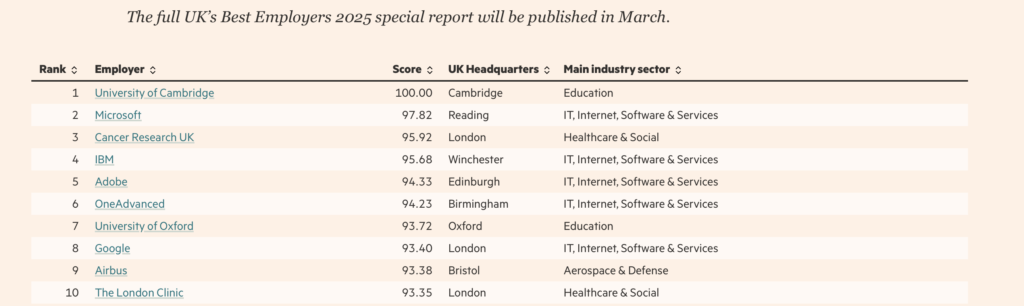
The Financial Times (FT) yesterday provided a list of the top 400 employers here. It is based on a joint survey carried out by themselves and Statista. It placed the University of Cambridge at the very top.
Statista is a market research/data aggregator company. Statista itself describes its rankings as “recognizing top employers and helping companies benchmark and promote themselves“. Companies that perform well in their rankings can advertise this, use it in recruitment, marketing or enhance employer branding. Statista explicitly contacts winners with instructions to access award portals and claim awards. They are predatory fauna in the corporate branding ecosystem.
Statista rankings correlate more with prestige than with actual wellbeing. This happens because Statista explicitly combines two different things. The first is a direct score with employees rating their own employer. The second is an indirect score: people rating employers they do not work for.
This second component is distorting. It is a prestige score. A random software engineer is asked about employers in their sector. They are far more likely to recommend Microsoft or Google even if they have never worked there. This creates a feedback loop; prestige → indirect recommendations → higher ranking → more prestige. After all, you can’t recommend a software company that you have not heard of. So Microsoft or Google end up top of the rankings.
How many people did Statista likely survey from Cambridge University specifically? This is an important quantitative question and the answer is very few. The total UK survey sample is ~20,000 employees. The total eligible employers are ~3,000 employers. If evenly distributed, this is ~6.7 respondents per employer. Of course, the distribution is uneven and larger employers will get more responses. Cambridge University employs ~ 13,000 staff directly, so it’s medium-sized. By comparison, a large employer like the NHS employs ~ 1.3 million. So, a plausible estimate is that Statista are relying on 10–30 self-selected respondents from Cambridge.
There are more people currently taking Cambridge University to Employment Tribunal than likely responded to the survey.
Who are these respondents? Is the sample unbiased? This comes down to who in Cambridge University is even likely to fill in an online survey from Statista/the FT ?
Cambridge University has tripled administration spending in 10 yrs. Most respondents reached by the FT will be highly paid individuals in senior management. Of course, they will state that they’re very happy. They have few hours, huge pay/bonuses and no really essential duties. The survey will not have reached many academic staff or lower-paid professional services staff, most of whom are highly dissatisfied. Casualised academic staff will also be missing. They often don’t identify strongly with the institution and work part-time or short-term. Yet they represent a very large share of teaching labour in UK universities.
And even if some academics responded to the survey, who might they be? Cambridge has an intense up-or-out dynamics. People who are highly dissatisfied leave academia, or move to other universities in the UK or US or abroad, or move to industry. Those who remain are disproportionately those who succeeded in the system, benefited from it & adapted to it — Heads of School, maybe. So the survey respondents will over-represent the satisfied survivors at the top. This is a classic survivorship bias.
This is a highly flawed methodology by Statista/the FT, with a small sample size oversampling on top levels and management.
Look who else is ranked in their top 400 employers list. There is Cancer Research UK, famous for its repeated bullying scandals. There is Oxford University, which has had highly publicised sexual harassment scandals almost continuously in the press for the last six months. There is the University of Sheffield where the Vice Chancellor has received votes of no confidence due to mismanagement of finances. And most ludicrously of all, there is the University of Dundee, which is facing near financial collapse and is on its third round of redundancies. It is where the former Principal was famously asked whether he was corrupt or incompetent, and replied he was merely incompetent.
The survey is a complete joke. It is designed to measure how happy the top executives and senior managers are. Prof Kamal Munir is very happy.
“Welcoming the recognition Professor Kamal Munir, Pro-Vice-Chancellor for University Community and Engagement, said: “I am very proud of this important recognition in the Financial Times, which reflects the hard work of many colleagues. We are committed to continually improving the working environment and supporting academic and professional excellence”
And now a question for the FT.
There has been plenty of excellent journalism on the scandals at Oxford, Cambridge and other universities from the Guardian, the Telegraph, the Times, Bloomberg Media, The Tab and Cherwell over the last year. Nothing from the FT. Why is that?
You know about all the scandals, of course.
(Varsity is also missing. Why is that?)
31 Comments
Xerxes · 25 February 2026 at 09:03
This looks dead easy to game
The call goes out from Head of Comms — Emma, Debbie, Mike, Andi, let’s all get filling out the online form.
Obvious · 25 February 2026 at 09:15
I was thinking the same.
The list is pretty much a “who’s who” of big UK organisations facing major court cases from staff over abuse, harassment, bullying etc.
Oxford you rightly point out in relation to lawsuits over allegations of rape and harassment. Cambridge issues are no stranger to readers of this blog.
But it is Dundee that is truly hilarious because everyone knows they are in revolt right now and falling apart!
Also notable who is not on the list – I would have expected to see more charities and NGOs, more startups – basically, more places where people are driven by belief and passion, and really love what they do.
This just looks like a roll-call of big corporations and struggling scandal-ridden universities who I guess can enough money to pay consultants to game Statista’s methodology as part of a PR HR exercise.
Nauseated! · 25 February 2026 at 13:34
What a fraud this is!! The Cambridge top level horrible management must be ecstatic! Their victims inside the University, and there are many, are simply shocked and disgusted!
Voiceless · 25 February 2026 at 15:36
It’s a huge embarrassment for the FT.
Just imagine if Oxford were #1 on this list, given all the news on sexual assault and dismissal of claims, and think about the same Cambridge scandals that are waiting to break.
I reckon they are already digging in to what went wrong.
Remember at the same time this data was collected the university had just refused to release it’s internal survey – based on a proper sample of staff – showing departments with 50% + reporting bullying, mental health breakdown and abuse. They continue to refuse release of this data or even the topline figures.
Perhaps the FT should ask for that and send to Statista.
Also don’t forget the union surveys of all universities showing just how high staff discontent is at Oxbridge.
See Things As They Are · 25 February 2026 at 16:36
The FT ranking is accurate – but you must understand what it really measures.
If Statista’s Cambridge sample were representative of all UK employees, that “200,000” sample comes down to a very small number – perhaps as few as 100 staff.
Then, the mode of contact was via the FT readership, which at Cambridge, skews heavily to senior management.
So. What we are looking at here is not a ranking of top employers, but rather, it is a ranking of the ***”top places to be employed as a senior manager or administrator”***.
Now, from that perspective, the results (including Dundee) suddenly makes sense. A lot of sense.
After all for the central management, these are all truly great places to work.
At Cambridge, central admin spending is up 300% on the decade. The top 50 executives are now on average basic salaries close to £250,000 a year, with Munir himself pushing £400,000. For these people, the university offers an incredible deal. Working hours are low, benefits and bonuses amazing, and salary exceptional. The survey asked if you would recommend your employer to your friends, and many have done so as the administration has bloated ever larger and larger.
It is not true for most staff, but (unlike the Cambridge in-house survey of last year that the university refuses to release), most staff at Cambridge did not complete this survey.
So there is no inconsistency here with the 21 Percent analysis on the Golden 50 and Cambridge endowment drawdown. It is all part and parcel of the same story of how big organisations stagnate and decay through management bloat at the expense of their mandate and core staff.
The same is true for many of the other organisations on this list i.e. big corporations whose management layer has grown at the cost of organisational efficiency.
For the FT there is a simple face-saving option which is to clarify that the ranking is not a ranking of places to work, but rather, the best places to work as a manager or senior executive.
Viewed as such the results are entirely accurate – these are without doubt the best places in the UK to work as a senior manager, the data is based on that sample, and that is how this list must be read.
Munir is touting the results as a sign of his success. They are not. They are a symptom of management failure and unsustainable, spending that has bankrupted the university, and for which it will be paying the price long after he and Rampton have moved on.
21percent.org · 25 February 2026 at 17:20
Is the sample 200,000 ?
The FT article says the sample is “20,000 employees“, but there are “200,000 evaluations“.
The interpretation of this is (presumably) each individual who participated answered 10 questions.
Sample size is a basic piece of statistical data, but it is not even clearly stated by the FT.
Anon · 25 February 2026 at 18:33
Good spot. So the Cambridge sample is probably closer to 10-40 people.
TheResearcher · 25 February 2026 at 18:45
Even if these results are accurate as a function of the small and biased sample that FT considered, this should not be published as it was. It is a humiliation for victims to have to read this as it creates a public image about the University of Cambridge that most staff does not experience, and lures naïve members with a false sense of security. The University of Cambridge is not a safe place, and this issue needs to be acknowledged to prevent further damage. People like Prof. Kamal Munir who seems to get £400.000/year but ignores reports of serious misconduct at UCam, should be ashamed by the words that allegedly came from him. Of course, Prof. Munir could not care less about what the victims think about this issue, and his narrative is the same regardless of what they tell him.
21percent.org · 25 February 2026 at 18:54
We are writing to Editor. It is a serious crime against statistical science.
The main article is yet to appear, so the FT needs to give some serious thought before it proceeds further.
The past few weeks have shown (Mandy, Andrew M-W) that this is a country that needs some really tough journalism not vacuous puff pieces.
TheResearcher · 25 February 2026 at 20:04
If it is necessary independent corroboration of that view and how their stats misrepresent the experience of a person who experienced UCam as staff and as student, please let me know. I will be happy to contact the editor of FT as usual. FT may like to know how UCam deals with members who report misconduct to the individuals who contributed to the stats they published.
EtonMess · 19 June 2026 at 06:33
Thanks for writing to the editor. It’s right that an article making a serious crime against statistical science shouldn’t be published and that it’s an offense to everyone who has been a victim of bullying and to their supporters. FT is a tabloid and so is Varsity. Almost seems like they are the same publication.
Tired · 26 February 2026 at 08:52
It also may be due to an increasing disconnect between academic staff and others
Most academic staff have zero work-life balance. Teaching has to be done. If a lecture has to be delivered at 9.00 am, then we have to do the work to get it done on time. Getting grants is increasingly troublesome because of the funding situation, and the overheads on this money is used to keep the administration afloat.
It is noticeable that whenever I contact a member of central HR, they have gone home early 😉 Many of the administrative staff have very different expectations of work-life balance than the academics. Ultimately, this system can’t persist where half the university is stressed & overworked to raise the money via teaching & research for the other half to go home early.
This may be relevant for understanding the FT survey results
21percent.org · 26 February 2026 at 20:54
HR …
“A quarter of a century ago, I spoke at a conference session titled “How to get HR a seat on the board”. It was standing-room only. Today it would be cancelled for lack of interest. The human resources boss not only has a seat, they have the chief executive on speed dial.
And yet, as Policy Exchange makes plain in its report on Britain’s bloated HR function (where the proportion of employees has almost doubled in 20 years), something has gone badly wrong. Britain’s HR sector is now 60 per cent larger than that of the US. Cutting it to the same proportion would save companies £10 billion.
What have we got for this investment? Productivity has flatlined. Absence and long-term sickness have surged. Bullying and harassment claims have multiplied. “Quiet quitting” is accepted and side hustles have become the norm. HR was meant to be the solution to people problems. Instead, it has become part of the problem. ….
Artificial intelligence, individual profiling and bespoke skills training help HR cut costs, improve performance and keep the workforce committed. This is essential for British business and a boon for everyone who works here. But HR chiefs should have two simple goals: increasing productivity and reducing the cost of HR, ideally to below 1 per cent of the workforce.”
https://www.thetimes.com/comment/columnists/article/bloated-hr-big-workplace-problem-ldzhg0tqc
JJ · 26 February 2026 at 20:57
The problem is that senior managers have no idea of the difference between toxic stupidity and skill. So bullshit artists flood into HR
1-2-3 · 26 February 2026 at 22:17
bullshit artists and psychopathic operators
Eileen Nugent · 27 February 2026 at 01:07
It’s a different era now : work-related stress is regulated, dysfunctional HR is an organisational health and safety hazard, dysfunctional HR coupled to an inaccurate understanding of mental health has the potential to generate a serious health and safety incident, a worker can interact directly with a national regulator. The last thing any chief executive wants is to have an unskilled HR chief that also has them on speed dial. HR chiefs should not lose sight of two more fundamental goals – maintenance of healthy working conditions, prevention of corporate manslaughter.
EtonMess · 19 June 2026 at 06:35
Great points.
D'ARTAGNAN · 26 February 2026 at 20:19
I bet they listened to: Prof Smallman, Prof Bullshitmore (before he moved to be Regius in Londinium), Prof Crookery, Prof Teflon, Prof Drinkalot and Prof ViciousWoman! They surely love the toxic, fraudulent and poisonous regime of the American Queen and her Munirs, Philpots and other oligarchs that are actively destroying an 800 year history! I love the FT!
EtonMess · 19 June 2026 at 06:36
You must know something about the FT that I don’t. So are they a mouthpiece for the Cambridge admin? Just like Varsity?
x · 26 February 2026 at 23:49
The tragedy of Virginia Giuffre is not that she had no voice, but that, even after all the details of her abuse were known to the world, no one would believe her until after she had ended her life.
21percent.org · 27 February 2026 at 12:33
The cost to her was very high. The tragedy lies not only in the violence she endured, but in the disbelief, dismissal, and silencing that followed. It underscores the urgent need to listen, believe, and support those who come forward, before it’s too late
Smaller examples in which bad behaviour is tolerated occur in universities all the time. There are many, many cowards in academia who will not make even the slightest personal sacrifices to listen, believe, and support those who come forward.
TheResearcher · 27 February 2026 at 14:08
“There are many, many cowards in academia who will not make even the slightest personal sacrifices to listen, believe, and support those who come forward.”
I can give you a long list of these, namely from the University of Cambridge, including Masters of Colleges and Senior Tutors who are responsible for hundreds of students. This issue is far more complicated to address than sacking one or two members of the senior leadership team. The culture of secrecy and cover up of misconducts is really engrained in Cambridge. “Put your health first,” they say. “Refrain from making the complaints if that affects your heath,” they emphasize. Hidden in these apparently sensible advices is the fact that if we do not address the cause of the problem, it will affect other members, namely other students they are responsible for. For these, the cycle will repeat itself, and the cause of the health problems will never be addressed. People who encourage victims to put their health first to avoid tackling the cause of their problems not only should be ashamed of themselves but should be banned.
Eileen Nugent · 27 February 2026 at 18:04
There are also many, many people in academia who will use their own independent judgement to determine what to do in the situation, who won’t be dissuaded by others, who will weigh any advice given by Masters of Colleges and Senior Tutors when analysing what to do in the situation – as such advice is often insightful – but won’t let such advice overly influence them, who are not overly fearful of any situation they encounter and who have learned to actively stabilise their own health in a wide range of situations.
“Put your health first” is sound advice but coupling that advice statement to the second advice statement of “refrain from making a complaint if that affects your health” is problematic. Implicit in that coupling of advice statements is the thinking that not making a complaint will not affect a person’s health however if not making a complaint has the net impact of leaving a person in an ongoing situation that is having a significant health impact on the person then the overall integrated health cost of the situation having made a complaint could be significantly less than that of not making a complaint as making a complaint may bring a situation with a significant health impact to an end on a faster timescale than would have been possible had a complaint not been made.
EtonMess · 19 June 2026 at 06:41
Great post. Those type of people in academia (like Wyn) seem rare.
It’s good to hear from someone who says they aren’t. Maybe some of us are just having strokes of bad fortune.
Raven · 28 February 2026 at 11:11
“Put your health first,” they say. “Refrain from making the complaints if that affects your heath,” they emphasize”
“Implicit in that coupling of advice statements is the thinking that not making a complaint will not affect a person’s health”
It is quite possible that those dispensing the advice believe that to be the case.
However, what becomes increasingly obvious is that those who contribute to the issues in the first place (HR / Legal) operate with a different mindset.
It is easy to identify a pattern of situations leading to dilemmas, e.g. between making a complaint and suffering as a consequence, and not making a complaint and suffering as a consequence, or between accepting unacceptable conditions to continue in the job one loves (and suffering as a consequence) or being forced to leave a job one loves and suffering as a consequence. Or being faced with the choice (e.g. through blackmail by a rogue director) between surrendering valuable grants (and academic work) to the director’s friends or risking the redundancies of entire teams.
The decision-making becomes a sort of Sophie’s choice, the consequences of which will leave a lasting impact on one’s life and on one’s mental health.
The exceptional cruelty behind this pattern is the responsibility the victim is forced to take for the consequences of their own decision-making and the future suffering arising from it, when the fault really lies with the situation out of which the decision-making has arisen.
A situation which was brought about by misinformation and dishonesty, and for which there never was any necessity in the first place except needless cruelty.
There are now so many examples, that it should (and could) be easy to identify a dangerous pattern of behaviour with very serious consequences for the mental and/or physical health of the University’s most relevant workforce. And where no “resilience training” or “mental health awareness” would ever make any difference.
Surely identifying its source should come as a priority for this “employer of the year”?
TheResearcher · 28 February 2026 at 12:05
Victims cannot control what the “best employer of the year” decides to do, namely if it decides to listen to them or not. But regardless how powerful and influential the “best employer of the year” is, it cannot control the ability of its members to speak and there are very many people in that institution who thought they could.
The “best employer of the year” will fall if victims talk openly about their experiences, regardless of what happens in tribunals and courts. There are more than enough cases that make it clear the need of immediate action because the “best employer of the year” is not a safe place, namely for those who are not willing to tolerate misconduct and refuse to leave the institution. If victims talk openly, external scrutiny shall appear, but relying on the internal procedures and good faith of the “employer of the year” will not lead anywhere as the last several years have shown.
Eileen Nugent · 28 February 2026 at 21:48
It is not necessary to control what the “best employer of the year” it is only necessary to maintain a balance in any relationship with the “best employer of the year”. Some of us are legally obliged to speak as that is the relationship the “best employer of the year” set up with us by appointing us as a University teaching officer, full college fellow and member of Regent House – a relationship where if anything were to go wrong in the university which could have a significant impact for others if not fixed then we were the ones who would have to speak up, who would collectively resist the degradation of the organisation, who would not stay silent if there was a need to speak.
Why worry about the consequences of speaking, death will come one day one way or another over and until it does real life will be there demanding to be lived – warts (whistleblowing situations) – and all. Speak and brighter future might at least be possible, stay silent and one rogue director engaging in blackmail to obtain access to valuable grants and academic work if left “leading by example” has the potential to generate a whole new generation of people thinking that is the optimal way to lead when that is not the case.
People are still wedded to the idea that bullying/harassment is necessary for exceptional achievement & whilst it is true that those who bully/harass can still achieve at an exceptionally high level the absolute level of achievement available to a person engaging in this type of behaviour is still less that would be possible for the same individual if they did not bully/harass. Before people were willing to put with bullying/harassment so it was possible for people bullying/harassing to achieve at an exceptionally high level in world-leading organisations at the expense of others in those organisations and resulting in a loss of absolute power of the organisation. Once people realise that either doing that themselves or accepting this for themselves or others will limit them from achieving their full potential and the organisation from achieving its full potential then people in highly competitive environments will stop putting up with this kind of behaviour.
Analyse what the rogue director and their “friends” are doing in the scenario above – the net impact is letting their minds atrophy, not coming up with new ideas themselves, not initiating or sustaining productive research programmes themselves, not doing the work to get new grants themselves, not building reciprocal relationships to sustain a common effort to add value to the organisation because too focussed on building reciprocal relations with “friends” to sustain a common effort – blackmail – that is damaging others in the organisation & not adding any value to the organisation. It’s mind atrophy, mental degradation, loss of mental fitness, induced decline of mental abilities, mental slobbing.
Eileen Nugent · 27 February 2026 at 14:32
I don’t think people understand the absolute level of courage Virginia Giuffre had nor the pressures that situation generated for her. Those in positions of power are acclimatised to the pressure associated with positions of power whereas for a person in Virginia’s position of having to challenge those in positions of power there is the potential to very quickly reach the same pressure level but with no acclimatisation – its like a person being expected to climb Mount Everest on their own and with no preparation with everyone else expecting the person to be as OK as the sherpas born at high altitude who regularly climb it or the experienced mountaineers with years of climbing experience and preparation.
EtonMess · 19 June 2026 at 06:48
This comment is insightful. No wonder complaining can feel like hiking up a mountain, with a rucksack and more weights loaded onto it at every step. Those in positions of power also have more resources, language and access to legal teams. A lot of complaints have been silenced in this way.
There can be people who aren’t clever or talented but are surrounded by that kind of wealth so they become Goliaths due to environment. They seem to be able to crush Davids into the ground. Nature is powerful but nurture (environment) seems able to override it.
Eileen Nugent · 27 February 2026 at 00:23
In 2019, the Financial Times seems to have paid its editor £1.9 million more money than it was making in profit, £1.89 million, at that time if the Guardian article below is accurate. How rational is it for an organisation to do that and how rational is it for an individual in that position in the organisation to accept that kind of payment from the organisation?
https://www.theguardian.com/media/2020/dec/18/ft-journalists-stop-pay-talks-over-former-editors-19m-pay
How trustworthy is FTs analysis of finances and financial markets? How good are its own internal financial dynamics? How rational is it when it comes to financially compensating across its entire employment structure? How good are its data analytics or that of the companies it is outsourcing its data analytics to? How good are its own internal employment dynamics? How well placed is it to judge & rank other employers?
If a person was to read the FT regularly how much useful information would they be exposed to? For example the FT ranks Cambridge above Oxford as an employer – how many people who have worked in both Oxford and Cambridge would agree with that ranking of these two employers and how much attention would FT paid to some of the most accurate information available to relatively rank these two employers? Is the fact that Oxford will rectify an unfair dismissal by re-instating a person and Cambridge won’t irrelevant to ranking them as employers? If a person was to provide the FT with data from a larger sample of people that it used to construct the relative Oxbridge ranking who have worked in both Oxford and Cambridge that ranked Oxford higher as an employer would the FT stick to its ranking? If it changed its ranking would it just switch the places of the two or would it need to rerank all the employers in a comparable more precise way?
How would the FT factor the probability of being raped by a coworker & never working again in to its employer rankings? How would the FT factor in the probability of going through a >decade long employment dispute and never working again into its employment rankings? Should employers just be ranked on the experiences of those who experience the least problems with an employer and extract the most profit from interacting with an employer- sometimes it all it would seem in the case of one particular FT editor – with no reference to those who experience the most problems with an employer and who pay the highest costs of interacting with an employer?
This is why people have started paying less attention to the established media because of their habit of drawing people in by purporting to hold useful information of interest only for people to find they don’t have the data collection depth or power of analysis to generate the high quality useful information of interest they purport to hold.
Knowing the rewards of an employer without knowing the risks of an employer is not knowing an employer enough to evaluate it or rank it. Shows an operational bias in the FT which is a serious problem for the FT given the type of journalism it specialises in – too much focus on analysing reward – hype, evaluation inflation, inaccuracy & not enough focus on analysing corresponding risk – moderating, improving evaluation accuracy, generating useful information.
Managed Non-Communication - 21percent.org · 22 April 2026 at 12:12
[…] Times regarding their extraordinary Best Employer’s Survey which ranked Cambridge University as best in the country. Following the correspondence reported here, we followed […]