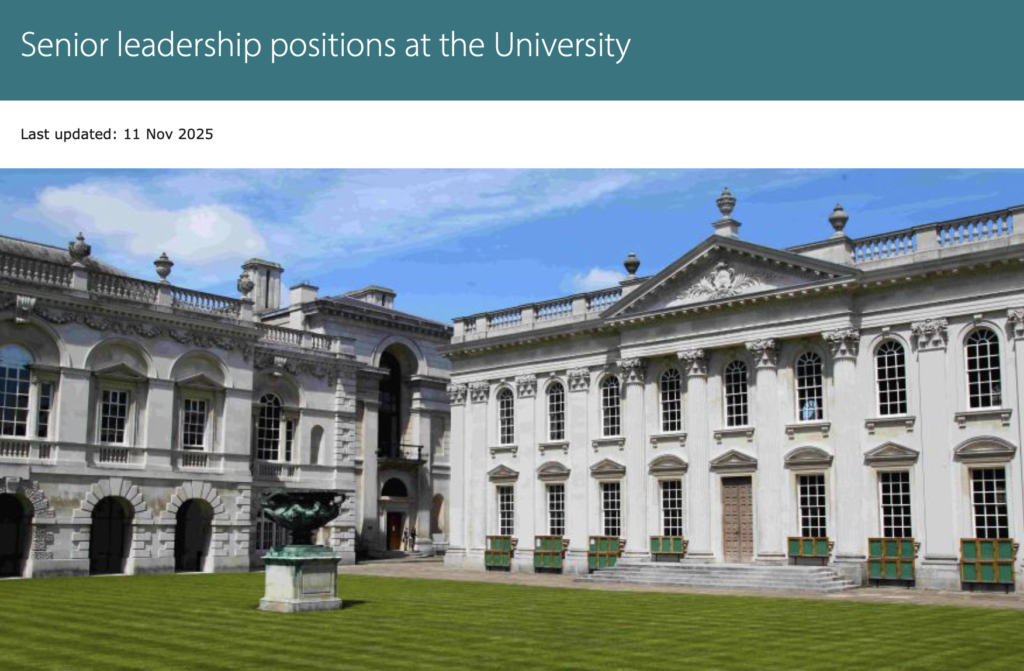
The University of Cambridge astonished everyone yesterday with this posting here
We would like to provide an update on senior leadership positions in the University.
Following recent changes and ongoing transitions, the University has decided not to proceed with the appointment of a new Chief Financial Officer at this time. This decision reflects the need to maintain stability and continuity in our leadership team and is in no way a reflection on the successful candidate. As a result, and with considerable regret, we confirm that Rita Akushie will not now be joining the University as our new CFO. We and Rita had been looking forward to her joining us, and we are very grateful to Rita for her engagement in this process.
We are pleased that Anthony Odgers has kindly agreed to continue in his role to help guide the University through this period of change.
We recognise the significant change in leadership positions in the central University administration at present through absence, vacancy and recent arrival. Interim arrangements are now in place to cover for the Registrary’s prolonged period away from the office. These roles are key to providing strategic and operational stability and leadership to the University, and we would like to assure you that organisational resilience will continue to be of the highest priority.
Despite the delicate wording, this has “expensive disaster” written all over it.
The new CFO appeared to have a golden deal — a job for life worth roughly £350,000 a year. Walking away from a contract like that can’t have come cheap. It likely cost the University very serious money, perhaps six or seven figures. The only reason to take such an expensive step would be if continuing with the appointment posed an even greater risk.
So what could have gone so wrong, so fast? And why does the University’s statement emphasise “the need to maintain stability and continuity in our leadership team”?
Given things are going so badly, the view of the 21 Group is that a shake-up of the leadership team is urgently needed.
The new CFO was going to have the Finance Division report directly to her. But that setup doesn’t align with current practice, which places the Finance Division under the authority of the Registrary. The Registrary has been on leave since Summer 2025.
We believe the poster BreakerMorant has joined the dots correctly here
The new reporting lines effectively sidelined the Registrary, it could even amount to a claim of constructive dismissal. That might explain why the University abruptly reversed course — better to pay off one contract than risk a much bigger legal and governance crisis
This also explains the emphasis on “stability and continuity of the leadership team” in the University’s announcement.
If so, it’s a great shame — because continuity is not what we need, real and effective change is.
30 Comments
Anon · 12 November 2025 at 09:19
It certainly invites speculation. Until the hard evidence comes in we need to make clear that comments represent no more than that. But the prevalence of such speculation helps to underline one of our key internal governance failings, namely: why are even senior figures of authority (including the proposed CFO, who quite logically would need full and direct control over the Finance Division) forced to speculate when they should possess the facts?
None of this would happen if we had clear, open, and transparent auditing plus full publication of our accounts, in line with public service organisation standards. The recent post on Advance HE at least could benefit from reference to their Annual Report. To their credit, this offered details that certainly highlight some awkward questions but also provides reassurance against others (for example, they clear stated that trustees were not remunerated).
This same pattern runs through it all. Grievances include rules that threaten victims for breach of “confidentiality” and this leads vague rumours to circulate. Court cases are settled with non-disclosure rules that conceal the identities and acts of those involved, but do not cover third parties (for example lab assistants whose careers were destroyed). Internal surveys are either not conducted or the data simply not disclosed. GDPR request from students and staff and FOI requests from the press are routinely ignored (see ICO data on numbers of complaints, and reference to a legal case for non-compliance here: https://www.cambridgelegal.co.uk/profile/).
This is the root cause of speculation. If the university upheld norms of transparency none of that would happen. There would only be clear identification of the problems and the means to work collectively to set them to right.
21percent.org · 12 November 2025 at 09:29
Excellent points.
There is also the customary obscurity about financial matters.
Backtracking in this way by the University will have cost serious money — money that has come from tuition fees, grants or donors
- · 12 November 2025 at 09:55
100%. Among the colorful cast of characters referenced here I expect many would be found to deserve severe disciplinary consequences. But there may be persons who merit exoneration and even others whose (behind-closed-doors) integrity deserves praise. Little by little we are learning who is who – but it should never have had to be this way. It is an injustice being able to deliver neither blame nor credit due to a culture of secrecy and cooptation that taints us all alike for the misdeeds of a few.
ubuntu · 12 November 2025 at 10:20
cooptation is the problem. it means there are a lot of people who are afraid of transparency because that will show they acted less than perfectly. even if on balance they may have tried at times to do the right thing. that is why we need a clear commitment to take account of good conduct as well as bad. truth and reconciliation is the right approach. not to punish each and every minor fault but to allow people the option of redemption via demonstration of their attempts to set things right.
TigerWhoCametoET · 12 November 2025 at 12:05
Aren’t there also claims of using public funds to silence people with legal threats? At least that is the allegation posted by Professor Pharoah today? Surely if they wanted to allay such concerns they would allow an open audit?
https://x.com/paulpharoah/status/1988528458062840311
Public Interest · 12 November 2025 at 18:06
Concerning to see this from a senior and respected figure, both within the university and on a global level. If indeed true then it raises questions, such as, who signed off on that decision, how much was spent on it, are there similar cases, and what information did each person know in advance in relation to the veracity of his claims, prior to signing off. For the sake of the university I hope someone is in a position to find out.
SPARTACUS · 12 November 2025 at 20:15
Prof Pharoah is a world leader in his field and a man of deep integrity. That UCam decided to institutionally bully him is highly disturbing and frankly scary! It is scandalous that public money has been used to try to intimidate and silence him! But an organization that has descended so low is capable of being worse than the Post Office! Shame on Prof Prentice and her senior team! FOI should be used to find out the details!!
21percent.org · 13 November 2025 at 05:55
Some of the events Prof Pharaoh was protesting are described in the link below, though this is just the part of the scandal
https://21percent.org/?p=1371
The attempts to threaten Prof Pharaoh by the Legal Department were disgraceful. What Prof Pharaoh was doing was trying to protect junior colleagues, speaking up about bullying (something that is actually a requirement of all staff under the University’s Dignity at Work policy) and trying to right an injustice.
The complete blurring of the lines between the Legal and HR departments is one of the many things that has gone badly wrong at Cambridge University.
The Legal Department does not provide impartial legal advice in the best interests of its employer (which is what it is meant to do). Rather it acts as an extension of corrupt individuals in the HR department.
If there were proper oversight of the Legal Department, this would not be happening. There is no oversight.
Anon · 13 November 2025 at 13:44
What was disturbing in the Post Office scandal was the abundant abuse of legal privilege as a means to subvert data GDPR rules and court disclosure orders so as to deliberately hide retaliation against victims. In the Post Office case, these practices included “routing documents through legal advisers just so privilege could be asserted, and documenting adverse information in ways designed to make those documents look like they were drawn up as preparation for litigation”.
Such acts reflect a poor understanding of both current and pending legislation (see: https://www.legalfutures.co.uk/latest-news/post-office-scandal-shows-that-privilege-needs-urgent-reform). It is a longstanding rule that legal privilege can be retracted the moment there is evidence to suggest that documents were created to further unlawful conduct, and is what allowed the solicitors involved in the Post Office scandal to be identified and brought to account. Further reforms are likely to qualify this further, but already even a single thread of substantive evidence is enough to allow authorities to unravel the whole ball.
21percent.org · 13 November 2025 at 14:04
This is a very important point. The university routinely argues that passing a document by Legal means it is legally privileged. It is not.
Anon · 13 November 2025 at 14:19
A blanket policy of withholding solicitor communications on grounds of legal privilege is not only incompatible with the law as it stands. It is also a conflict of interest if the same solicitors had advised on such a policy. That in itself could become pertinent as to whether solicitors had deliberately intended to prejudice ongoing legal proceedings, victimise claimants, or prevent lawful whistleblower disclosures.
The moment exemptions from privilege are found to apply then documents should be disclosed. As per the SRA the specific issue at the core of their investigations into the Post Office scandal is “improper application of privilege to protect communications from disclosure”. As they further advise: “As officers of the court, solicitors should never put other interests – such as the outcome for their client – above the law and the proper administration of justice.”
See: https://www.globallegalpost.com/news/post-office-scandal-20-plus-law-firms-and-solicitors-under-investigation-740437926
Anonymous · 13 November 2025 at 14:21
Thank you Anon for raising this. To add to this, University data protection offices will abuse and misuse GDPR to block requests in other ways. For example, if a victim submits a SAR request for information related to an upcoming and bogus HR process that they are being subjected to, then the data protection officer will say that releasing such information to you will “impact on-going negotiations” and block it.
Due Process · 13 November 2025 at 15:31
Anonymous, that is very troubling to hear. If you have not already done so might you share the evidence in confidence with 21percent.org by email? I am confused as to the legal basis which is befuddling. A cursory google search for “GDPR” and “impact on-going negotiations” brought nothing and this leads me to suspect a fabricated term and the unjustified denial of legitimate data access rights. It also raises the issue of whether they behaved reciprocally by denying HR or other respondents access to data too, which presumably, they did not?
Eileen Nugent · 14 November 2025 at 00:14
Legal privilege evolved for a reason, it serves a purpose of allowing parties in a legal case to develop their legal cases in confidence – conditions where increased levels of trust are possible and under which the most accurate statement of a legal case has the potential to emerge. Legal privilege when properly applied underpins the efficient functioning of a legal system. When problems with legal privilege emerge they seem to be ones of gradual creep : some individuals start to apply legal privilege in a formulaic way without thinking about the reason why it exists and what purpose it serves in the legal system because it’s easier to apply a formula – every document that relates to a specific legal case & that has passed through a legal advisor attracts legal privilege – than to think in depth about the purpose of legal privilege and whether a particular document attracts it. Some individuals trained in this way then discover they can “use” legal privilege to their clients advantage i.e. they can use it to hide evidence that they should have disclosed and to run a hidden-variables legal case where the hidden variables increase interpretative flexibility in the legal case. They discover how to keep their cases in the hidden-variables legal-ambiguity swamp long enough to win legal cases that would otherwise have been lost had they not engaged in an abuse of legal privilege.
The problem with this pattern of behaviour in a legal advisor is that abuse of legal privilege can introduce high-risk kinetics into an ongoing legal case for a client. If a client hires a legal advisor with a history of abusing legal privilege that can put a silent case-inversion factor into legal case which means the legal case could flip from a solid win to a solid loss in an instant and at any time during an ongoing legal case. That can result in this type of legal case dynamics: Winning the legal case, winning the legal case – legal privilege is queried, a case-inversion factor is generated : legal case blows up in the clients face – lost, lost, paying the legal cost. A particularly high-pressure complex case could contain more than one silent case-inversion factor. If a client hires the wrong legal advisor on that type of case and there is insufficient constructive discussion between the two sides of the legal case before it enters a court a complex sequence of legal-case inversion factors can be generated in time as the legal case unfolds – the client is then in legal pyrotechnics territory.
TheResearcher · 14 November 2025 at 10:55
Due Process, do not be troubled by this as this is a very standard practice in UCam. I understand this is troubling, but they do much worse than that. To be sure, this is not the work of a single person as I contacted very many when they blocked mine in the past, and very many people know about this, namely the Head of Data Protection, the Director of Governance and Compliance and the DPO who is allegedly independent because it is hired from Trilateral Research but essentially does whatever they want and if you ask them how to complain about their work showing how/where they failed they say “The DPO must operate independently and without the risk of penalisation for the provision of their advice.” How ridiculous is this? Standard practice in UCam!
Now, what if I say that Colleges do the same thing? I just got the data from a DSAR where the college instead of sending me the raw data/emails, made copy/paste of the sections where my name appears without detailed information about the senders nor general context of the section where my name appears, no attachments and no correspondence where I had previously been cced claiming that “Data Subject already holds this information.” I just checked with ICO and they told me that an institution needs to send all the information they hold about a subject without assuming we already have specific data as this might have been lost or not received. I asked the college to send me all the data, and they encouraged me to complain to ICO. The culture of concealing and manipulation of information is everywhere in Cambridge.
Anonymous · 14 November 2025 at 14:51
Due Process – this is a thing with GDPR, but I agree that there is no legal basis for applying it in this context. Other views on this are welcome.
I have also seen much of the tactics used that the TheResearcher pointed out, and indeed, the full extent is much worse across the sector. It’s very common for DPOs to pass on ridiculously over-redacted material in a DSAR request and literally say ‘if you don’t like how your request has been handled then take it to the ICO’, just like TheResearcher said. I think this is a reflection not of GDPR itself, but rather how poorly it is enforced, for whatever reason. They know it’s going to be a difficult process to get the ICO to deal with it, and this is ruthlessly exploited to hinder disclosures.
I will say though, that while the handling of GDPR requests is beyond farcical, on average, it can vary across institution, and sometimes you can encounter a DPO officer that is a bit more co-operative. They are supposed to be independent(ish), and I do not put them in the same class as senior management and HR (I.e. those that handle grievances). They are frequently caught between a rock and a hard place (where the ‘rock’ is the risk of retribution from the host institution, and the ‘hard place’ is the risk of being sued by the DSAR requester for non-compliance). They will usually always choose to appease the institution though, which is a shame. Remember too, that HR departments will not think twice about refusing a DPO request, if it suits them.
I do wonder, given the information that passes through University DPOs, that they must have access to all sorts of evidence of untoward activity. Could they be legally obliged to report this when they see it, at least for the most serious of cases?
TheResearcher · 14 November 2025 at 15:04
I am absolutely sure that the DPO of Cambridge has evidence of misconduct in UCam, namely about my situation as, among many other issues, he ignored the breaching of a confidentiality agreement done by senior members of the university about my data.
But anyway, check my new post below about a new FOI request as I have just learned a new strategy from the University to refuse sharing you data in general.
Public Interest · 12 November 2025 at 18:16
Looks too like another case where British institutions had to rely on United States law in order to investigate further (see Prince Andrew / Epstein) – a tweet protected under American freedom of speech allowing for discussions in the public interest.
1984 · 12 November 2025 at 14:33
UCam has fallen into Orwellian dystopia! Double speak of a completely disastrous senior management! A place in total disarray, secretive, incompetent, manipulative and deceitful! Scholars are totally marginalised and crooks run the place! Sad tale!
IMAGINARY · 13 November 2025 at 09:59
The rogue characters directly or indirectly involved in the Prof Pharoah saga include: Prof Smallman, Prof Teflon, Prof Drinkalot, Prof Crookery, Prof Bullshitmore and, last but not least, Prof ViciousWoman.
Consequences · 13 November 2025 at 12:10
I can picture the scene. Multiple hooded figures marching in single file in the darkness, with their lanterns in hand. They enter the turret, high up where no one can see them or hear their whisperings, and reveal themselves to each other. They exhale, with grins and laughter, and exclaim ‘what a day’ they’ve just had, and ‘that was close, I think so and so suspects something is up’. They discuss their strategy for the next day. One says ‘so and so has got to go, as they mentioned my name, and expressed an opinion which implicates me’. ‘Yes’ replies a co-conspirator, ‘their opinion was reasonable and supported with evidence, and that is far too dangerous for us’.
They gleefully discuss who they are going to get rid of next, with their hands shaking with delight at they write down the victim’s name on the official order.
‘I know’, says one of the hooded figures. ‘For this other so and so, let’s mention their name at the round table and point the finger. We never need any evidence, and can just let group think take over the show to have them banished. We can just sit back and watch as they all join the bandwagon to save themselves at the expense of their colleague whom they know to be entirely innocent.’
And they cycle goes on, night after night…
Someone ought to explain to these twisted morons that they are being watched for all to see, or will be. They will not get an opportunity to declare at the end of the game (as they see it) that ‘it was tearing me apart’ playing this role and doing what they did. They won’t have colleagues running up to them to console them and to say that they played ‘brilliantly’. And they will not get to return to their pre-cloaked characters as if nothing happened.
They need to realise that there are real world consequences for their malicious actions, and that this is not a game or a TV show. Peoples lives are actually being decimated and lives lost, and the word is getting out.
Brutus · 13 November 2025 at 12:06
It seems pretty obvious that Chief Financial Officer has to have authority over Finance.
If the Statutes & Ordinances say otherwise, then they need to be brought up to date.
TheResearcher · 14 November 2025 at 15:10
Check this out that I have just received from the Information Compliance Office and take your own conclusions. They come up with new strategies all the time. I know for a fact that the Director of HR Ms Andrea Hudson ignores safeguarding referrals, not least those done by me and others on my behalf. It is not hard to understand why they do not want to share the data: the percentage of investigated/upheld must be close to zero.
“Your request was received on 17 October 2025 and I am dealing with it under the terms of the Freedom of Information Act 2000 (‘the Act’).
You asked:
I would like to know the total number of safeguarding referrals made to the designated safeguarding lead (Director of HR) of the University of Cambridge per year, from 2015 to 2025, the number of these referrals that were investigated and the number upheld for the same period, per year.
The designated safeguarding lead receives referrals associated with any matter relating to Children or Adults at Risk.
The information you have requested, insofar as it is held by the University, is refused under section 12(1) of the Act. We do not collate information regarding referrals made under the Children and Adults at Risk Safeguarding Policy in a central log, nor is there a requirement to do so under the Policy. Information relating to such matters is held in individual case files and emails. Generating this information would therefore require searching through hundreds (if not thousands) of files. In addition, there is often a conflation between matters that would be relevant under the Children and Adults at Risk Safeguarding Policy and safeguarding in general, which can cover a wide range of issues. This would further delay isolating information specific to the request.
The University has estimated that the time required to determine the extent to which the information is held and thereafter to locate, retrieve and extract it would considerably surpass 18 hours of staff time charged at £25 per hour, and therefore that your request exceeds the appropriate limit of £450 as set out in the Freedom of Information and Data Protection (Appropriate Limit and Fees) Regulations 2004. Please note that to determine whether or not all of the information is held (in particular in relation to the earlier years asked for) would itself exceed the appropriate limit. The University is mindful of its duty under section 16(1) of the Act to advise and assist you in narrowing your request to bring it within the appropriate limit but is unable to offer any specific suggestions in this case.
If you wish to request an internal review of this response, you should contact us quoting the reference number above. The University would normally expect to receive your request for an internal review within 40 working days of the date of this letter and reserves the right not to review a decision where there has been undue delay in raising a complaint. If you are not content with the outcome of your internal review, you may apply directly to the Information Commissioner for a decision. Generally, the Information Commissioner cannot make a decision unless you have exhausted the internal review procedure provided by the University. The Information Commissioner may be contacted at: The Information Commissioner’s Office, Wycliffe House, Water Lane, Wilmslow, Cheshire, SK9 5AF (https://ico.org.uk/).”
Anonymous · 14 November 2025 at 16:48
These are classic avoidance tactics, which still continue to shock when you see them deployed like this. From what I can see, your request is very simple, and in my opinion, it is very reasonable to assume that the requested information should be at the finger tips of any safeguarding lead. This is a deeply concerning response from them.
Perhaps ask them to provide the actual estimated time to complete the request, and if possible, post it here.
It is also a classic tactic to mislead a requester into reducing or amending their simple and all-encompassing and thus water-tight request, such that it then gives the DPO a way out of completing it, or to at least give them the option of providing as much or as little information as they like.
TheResearcher · 14 November 2025 at 17:05
The real issue is that they know that ICO does not have regulatory power and cannot do much. I do not have much doubts they have the data (at least partially) and even if they do not have it, it would be of their (university’s) interest to collate it to improve the current situation. However, they know the number of safeguarding referrals investigated by UCam—namely those submitted to the Safeguarding Lead of UCam, Ms Andrea Hudson—is extremely low and they do not want to disclose the data because it is a shame, in the same way they did not want to disclose the data associated with the Staff Survey of 2024:
https://www.theguardian.com/education/2025/apr/12/cambridge-university-accused-of-bullying-cover-up-as-internal-survey-revealed
You can appreciate their intentions when after I asked them if they could clarify some aspects of the letter before I request a review, they said they would not clarify anything and would not engage in further “correspondence”. It is pretty clear what they will do in the review. They will come back with another ridiculous excuse to cover up the data.
If you guys have thoughts on how to counter their answer, post them here and I will try to cover them in my request for a review.
MUSKETEER · 14 November 2025 at 17:25
Ms Hudson the Head of HR knows very well what she has been up to for years! In the School of Clinical Medicine/CRUK gigantic scandal she has proactively supressed several cases of very serious bullying! When you ask for info about safeguarding ask her directly to disclose all reports made to her in this particular scandal! She knows…
TheResearcher · 14 November 2025 at 18:12
MUSKETEER, I am technically forbidden from contacting hundreds of people, namely “Any HR staff from the University of Cambridge.” But I asked the Information Compliance Office to say hi to Ms Hudson on my behalf, and that I trust to see her in the whistleblowing trial on June 1-28th 2026 at Bury St Edmunds Tribunal. These people can ignore our questions, but cannot prevent us from sharing what we know about them with their ridiculous enforced confidentiality that is used to conceal and manipulate. If they want to sue me, they should go ahead, but they will quickly realize they do not have much to take from me.
POTOS · 14 November 2025 at 18:35
My Musketeer fellow Aramis said it already. But for the record: Ms Hudson knows very well who Prof Smallman, Prof Drinkalot, Prof Teflon, Prof Crookery (it rimes with …), Prof Bullshitmore, and above all Prof ViciousWoman (also known as Prof KnowNothing or Prof PoisonChalice), are! She has protected them in the School of Clinical Medicine/CRUK gigantic scandal! She therefore knows: tic toc tic toc tic toc… Boom!
Cambridge Under Scrutiny? - 21percent.org · 22 November 2025 at 08:54
[…] 2. There have been recent concerns in relation to lack of transparency and authority over central budget accounts. These have been accentuated following a recent decision to abort the appointment of an independent financial officer who had sought a direct capacity of audit in line with standard practice and their role mandate and was denied this request (https://21percent.org/?p=2909). […]
Renewal at Cambridge University - 21percent.org · 15 December 2025 at 15:54
[…] involving another very senior figure, the announcement — and subsequent withdrawal — of the appointment of a new Chief Financial Officer and repeated press allegations of bullying and harassment tolerated at the highest levels of the […]