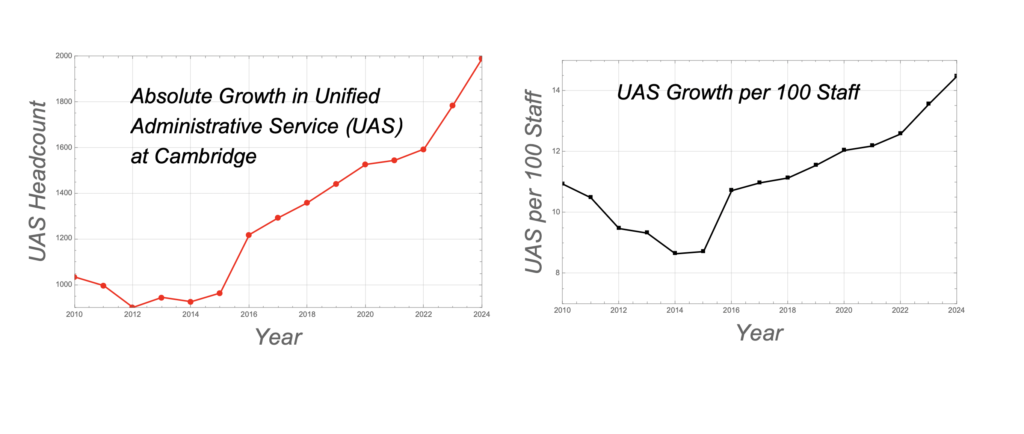
The Unified Administrative Service (UAS) at Cambridge is the central body responsible for the university’s core professional and administrative functions. It brings together a wide range of divisions — including human resources, finance, estates, research services, admissions, and governance — under the leadership of the Registrary.
Its role is to support the university’s academic mission by ensuring that the institutional infrastructure runs effectively, from managing staff employment and student admissions to overseeing budgets, compliance, and long-term strategic planning. Over the past decade, the UAS has expanded significantly, both in absolute size and relative importance, as reflected in the accompanying plots.
A key structural change occurred when the University of Cambridge Computing Service (UCS) merged with MISD (Management Information Services Division), which was already part of the UAS. This merger led to the creation of University Information Services (UIS). From that point, UIS was effectively integrated into, or closely aligned with, UAS structures. This accounts for the first notable step increase in headcount around 2015–2016.
Emma Rampton was appointed Registrary in 2017. The subsequent period saw substantial growth, sometimes referred to informally as the “Rampton Effect,” characterised by a significant expansion in administrative roles and structures.
Following the COVID-19 pandemic, there is another marked increase in 2022. During this period, the leadership — including Rampton and other senior figures like Profs Peake, Harper and Ferran — advanced efforts to “reimagine” professional services and related functions. The disruption of the pandemic was used to accelerate reforms, particularly around centralisation, digital transformation, HR expansion and wider administrative restructuring. Allegedly this will give savings, though we have our doubts.
Whether the UAS has grown beyond what is optimal remains a matter of debate, depending largely on one’s view of how a collegiate university should balance central coordination with local autonomy.
Whatever, the growth years that characterised the Rampton Effect are now over.
51 Comments
Olson · 27 May 2026 at 18:07
At a time when companies are using AI to significantly reduce administrative overheads to improve efficiency and focus on their core service objectives, it is astonishing that Cambridge has been determined to swim upriver against the flow of progress and achieve the opposite at the expense of departments and student fee-payers.
JayZee · 27 May 2026 at 18:41
Much truth in this. They are building an enormous White Elephant called MyHR, due sometime in 2030s, by which time AI will have revolutionised HR.
https://www.telegraph.co.uk/business/2026/05/23/ai-could-be-the-end-of-hr/
Planned obsolescence.
Refresher · 19 June 2026 at 23:01
I think your information is out of date. The HR change was a resounding success. We have identified what not to do, and have gone away to think about new ways to tackle the challenges. I can’t imagine that we will deliver anything as soon as 2030. For what it is worth, AI is amazing, if and only if you use it correctly. I have seen no evidence that we will be using it correctly.
R.A.M.pton · 28 May 2026 at 01:08
A long history of academic computing was terminated when UCS merged with MISD. But are you sure UIS is part of UAS? There’s a recent ToC request suggesting it is not, but that UAS (perhaps infected with Ramptware) is trying to capture it:
https://www.admin.cam.ac.uk/reporter/2025-26/weekly/6825/section1.shtml
21percent.org · 28 May 2026 at 05:08
Data are from a FOI request, which tbf does not explicitly state this.
It’s a big jump in headcount around 2015-2016. It must be due to amalgamation of something with UAS.
What else could it be?
Refresher · 19 June 2026 at 22:58
It isn’t the UIS joining UAS. Indeed back in around 2013 MISD was de-merged from UAS causing a drop in numbers. Assuming, of course, that the record keeping is not incompetent. A very unlikely scenario, I am sure you will agree. I would have thought the jump was as a result of some significant project. Maybe a building project and Estates? We do seem to be doing a lot of building.
In case you were interested in the discussion the report has come out. https://www.admin.cam.ac.uk/reporter/2025-26/weekly/6829/section5.shtml#heading2-11
I am certainly depressed reading what some people have to say. This blog makes very depressing reading for me, given my thoughts about both a formal grievance, and contacting the Commissary in order to force a judgement on the way in which the University management are breaching their own rules.
Optimise · 28 May 2026 at 19:08
Don’t know much about UIS but seems more logical that UIS should take charge of UAS- so that they can wield the chainsaw with assistance of IT / AI tools to erase the 0s / format / recompile
Stevie · 28 May 2026 at 11:53
You should spend per employee over time for UIS as well
stackoverload · 28 May 2026 at 18:36
Think you mean UAS?
Tom Davis · 28 May 2026 at 14:48
Speaking of Cambridge’s demise, has anyone been able to obtain a CVP link for the hearing that will start on 1 June 2026? I have emailed the Tribunal office multiple times, but no joy.
21percent.org · 28 May 2026 at 19:34
Others have complained about this as well — we will contact the Tribunal tomorrow
public justice is a parliamentary issue · 28 May 2026 at 19:55
Likewise. I thought it was just me. If they are refusing to provide cvp links to anyone at all it violates fundamental tribunal rules and MPs should raise it in parliament.
journo · 28 May 2026 at 20:07
Same here, the courts just told me it’s in person so won’t be offered online. Can they do that? It sounds crazy, I’ve regularly attended ETs online before.
If not, I’ll come to Bury St Edmonds, preferably one day when there are some really exciting witnesses
? · 28 May 2026 at 20:22
That is absurd. The courts are supposed to serve the public, not to protect those accused of serious wrongdoing. You had better attend in person. I hope more hacks will too.
Obviously there is something huge being hidden and that alone justifies the journey.
TheResearcher · 28 May 2026 at 20:30
“the courts just told me it’s in person so won’t be offered online”
LOLOL That would be a compromising alternative for the University if complete gagging is not allowed indeed. I guess we will need another Post from the 21 Group on this specific Employment Tribunal case before its start clarifying all these issues. Can the information to attend remotely be distributed widely, namely to all members of Regent House? I can imagine that a few individuals who would love that idea 😉
! · 28 May 2026 at 20:49
Someone in the ET system must be personally responsible for this decision. I hope this will be clarified and a justification provided for the benefit of the British taxpaying public.
mx · 28 May 2026 at 20:54
If you’re attending an Employment Tribunal, you can normally live tweet or post live blog updates. If it’s 4 weeks long, then there must be tonnes of witnesses with heavy representation of senior leadership (as they’re responsible for most of the criminality)
q. · 29 May 2026 at 00:24
I am curious, so are they all travelling to Bury then to attend / give evidence? Otherwise if witnesses are joining via CVP then there’s no reason not to allow the public. Would mean the technical set up was there but thw courts chose to keep proceedings from public view?
21percent.org · 29 May 2026 at 03:47
Excellent point — the technical set-up is always there.
In general, the expectation is that you give evidence in person if you can. But, there has to be allowance for a witness eg based in the USA.
Anonymous · 29 May 2026 at 09:27
They all just protect each other and that is why Britain is broken. And then they wonder why people vote Reform.
21percent.org · 29 May 2026 at 10:09
There is certainly truth to the idea that the British State & Establishment is abusive.
The Post Office Scandal is best example. The Met is asking for more funding to continue its criminal investigation—warning delays could stretch to five years without it. At that point, the already slim chances of prosecuting offences like perverting the course of justice become almost nonexistent.
This isn’t an insult to the wrongly prosecuted sub postmasters — it’s also a threat to the integrity of the entire justice system. Especially when the alleged wrongdoing involves lawyers, whose duty is to uphold it.
And yet, money clearly exists. The government is spending far more on legal fees for the Post Office than on the criminal investigation—while still trying to block transparency around “Project Brisbane.” That report isn’t about IT failures. It’s about who knew what, when—and how far the cover-up went.
In the Post Office Scandal, we’re at the stage of the cover-up of the cover-up of the cover-up.
This is the scandal that made many of us lose all hope in the UK
Observing the Tribunal Hearings · 29 May 2026 at 10:29
I believe the way it works is that either the Respondent or the Claimant must submit a formal ‘Application’ to convert the Tribunal format to ‘Hybrid’ mode, or even fully online. And this is usually debated/decided/formalised way back at a Preliminary Hearing, where a case has to be made for any given witness to provide evidence this way.
So I believe it’s not a simple case of interested outside observers emailing the Tribunal to ask for the CVP details (which explains the clerk’s response above which was that the Hearings are ‘in person’ i.e. this is a specific official mode that the clerk simply cannot override the Judge on).
If Prof. Evans or the Respondent has not already done this by now, then it may be too late, so interested observers should probably make plans to attend in person (and turn up early to make it through security and sign-in).
However, if there are witnesses scheduled to participate online, then it is rather strange that observers aren’t being given similar access…
21percent.org · 29 May 2026 at 11:57
We can confirm that such an application was made and there is at least one witness scheduled to participate online.
Observing the Tribunal Hearings · 29 May 2026 at 14:03
Mmmm. That is strange then, as the entire Hearings should now be formally reclassified on the system as ‘Hybrid’ and not ‘in person’ as the clerk above claimed.
Or perhaps there is some hidden rule or practice that only those day(s) when the online witnesses are due to testify are classified this way? I’m not sure, but that may indeed be the case in order to minimise workload for the clerks involved (i.e. to save them time setting up the system each day, especially in extended cases like this?).
TheResearcher · 28 May 2026 at 19:15
This post is an opportunity to remind the readers of what the Vice Chancellor said about Emma Rampton when she “stepped down” as Registrary in December:
“Her enthusiasm for, and commitment to, the development of people has had a hugely positive impact on many staff and the wider professional services community at Cambridge. We are very grateful for everything that Emma has done for the University.”
https://www.cam.ac.uk/notices/news/update-on-university-registrary
People who prefer to deceive those who they are supposed to lead instead of telling them the truth, are not good leaders.
TheResearcher · 29 May 2026 at 10:27
Hi everyone, I just called the Watford Employment Tribunal (03003230196) and requested some clarifications. After hearing the standard bullshit that Employment Tribunal receive hundreds, if not thousands, of emails per day and cannot reply to everyone asking for remote access, I managed to get the information that this particular case is listed as in person, and that at this stage only the Claimant or the Respondents can do something about changing this fact. I was told that either the Claimant or the Respondents will have to ask the Judge directly on Monday if the case link to remote access can be sent. For some reason, the guy who talked to me assumed that I and the others who want to attend remotely are supporters of the University of Cambridge, and I had to explain that I was not aware of anyone who is supporting the University in this case, with the exception of their witnesses…
In the worst case scenario, I trust that those who will be able to attend in person, can send regular updates for those who cannot.
Observing the Tribunal Hearings · 29 May 2026 at 10:38
This is in line with what I thought was the case (see my comment above). I’m not sure what the clerk was referring to regarding ‘supporter’ though …?
Anon · 29 May 2026 at 12:43
I wouldn’t over-interpret it. The clerk is probably a low-level administrator who assumes, as most do, that the university is an angelic environment, and one that would never bully or defame whistleblowers after they raised serious concerns over legal compliance or harassment, and that this is the reason why so many cases are now going to court.
Wallflower · 29 May 2026 at 13:07
Hard to think anyone aware of the recent messes in Biology, Vet School, King’s, POLIS, CRUK or now IoA, could possibly come to that conclusion
XYZ · 29 May 2026 at 13:54
Let’s add Pathology (currently in meltdown) and History (long dysfunctional)
Abd al-Latif · 29 May 2026 at 14:37
Oh yes, History has a long history, and let’s not forget the languages faculty or Classics either. On the humanities side it is basically all of the once-great-but-now-failing research departments (history, classics, politics and languages), as the latest REF rankings make clear as they are all deep in the double-digits and well below Oxbridge standards. That’s a lot of things going on: gerontocracy, dead wood, and toxic internal politics, probably all of which pre-date the first REF exercise. In the real (or “hard”) sciences not so much – but there (as with the ongoing Biology meltdown or the Vet School mini-saga) the main causes appear to be above the heads of the department – HR incompetence, ill-advised legal meddling and then, some frankly rather autocratic governance decisions that were taken without proper staff for stakeholder consultation or review.
TheShockoftheOld · 29 May 2026 at 14:49
Classics, where everyone knows the abuser, but noone ever speaks up!
Sans-cullotte · 31 May 2026 at 14:53
If you want both history and King’s together in one frame, check out the Fulda ET case, some of the content is pretty damning. Even if discrimination was a long shot it helps reveal the rot – the tribunal itself quotes the department as:
“increasingly dependent on casualised labour and a new hierarchy of auxiliary teaching… paid by the University at low piece rates (or, for many tasks, unpaid)… in an organisational context of overwork and underfunding.”
Ouch. Meanwhile the distinguished Professor Tooze, in 2023, was “sufficiently concerned by the evidence of blatant institutional bias to write a letter of complaint to the University’s Vice Chancellor”. It is not clear what response, if any, he received to his report.
21percent.org · 31 May 2026 at 15:18
Fulda ET case is here
https://www.gov.uk/employment-tribunal-decisions/dr-b-fulda-v-the-chancellor-masters-and-scholars-of-the-university-of-cambridge-3312419-slash-2023
Our thoughts are here
https://21percent.org/?p=3254
TheResearcher · 29 May 2026 at 14:29
Yes, I saw your comment above. Actually, I talked to two clerks earlier today because the first tried to convince me that most final hearings are in person and only in exceptional circumstances it happens otherwise. I told her that a few weeks ago another case with the same Respondent, Foa versus Cambridge University, was hybrid and that I indeed got remote access to the hearings, and she hung up the phone on me… The second was more reasonable, did not tell me that information and encouraged me to talk to the Claimant and/or Respondent and ask them to ask for a change of format on Monday directly to the Judge. This said, he was very surprised when I told him that the Respondent would never do that. The last thing this Respondent wants is that more people know what happened and the people involved.
Anonymous · 29 May 2026 at 14:47
“most final hearings are in person and only in exceptional circumstances it happens otherwise”
Indeed, this is usually the case. It’s also the case that strong arguments have to be made for either party to have their witnesses attend remotely. It usually requires agreement across all parties too.
We may also need to be mindful that either party, Respondent or Claimant, may prefer in-person attendance only for observers, even in this case.
Oldhand · 29 May 2026 at 18:06
Anonymous, I think your information is out of date. The tribunal system is so overloaded that a lot of cases are now remote as they need to bring judges out of retirement to handle them from whatever corner of the country they are in. It is rather like the NHS of the 1990s now, when they were pulling in doctors from wherever they could find them just to stop the waiting lists from growing.
Facts · 30 May 2026 at 11:37
Also very similar to the NHS of today…
Anonymous · 30 May 2026 at 14:50
Oldhand: Point taken. I was mainly thinking about larger cases, and whistleblowing cases etc. There are many smaller less-complex cases that can be handled in a day or less, which may be held just online.
The situation with the pressure on the tribunal system may get worse before it gets better. There are efforts to take on more Judges, in addition to recalling some. Perhaps more major examples need to be made to help deter Universities and their lawyers, which may then relieve some of the pressure on the System…?
Anon · 29 May 2026 at 21:45
I doubt the tribunal are acting with either bad or good intent — just struggling to cope.
It would really help the system though to have more cases open to the public because like that respondents are far less likely to drag out the process and instead settle and stop leaving the taxpayer with the astronomical (no pun intended) bill for endless preliminary hearings, vexatious appeals or procedural challenges, and general time-wasting, when the overriding objective of the system is supposed to be facilitating claimants and respondents towards an early settlement (preferably brokered by Acas) and not dragging everything out until hearings that then get cancelled as soon as respondents acknowledge they never had a case to defend.
pointless · 29 May 2026 at 12:35
By dragging it out over four years they have ensured that by now everyone knows the details of the case anyway, if only by rumour and word of mouth. I imagine the press needs the hearing less to attend but simply so they publish without influencing proceedings?
N/A · 29 May 2026 at 18:56
This is very true. It is hard to measure the corrosive damage of each successive case because academics talk with one another at conferences and behind closed doors, so the university isn’t really aware of the impact. Most of all I think it is unfair on academics themselves because our careers hinge on that, and not all of us were involved in these cases (many refused very clearly). But the decisions are being driven by people who are not academics and understand academia quite poorly.
Mandate · 29 May 2026 at 21:11
Agree. The problem is that VC hands everything to HR then HR hand it to legal. So effectively legal services now run the university. Which doesn’t seem like a good situation for them or anyone else, and, is a long way from our long-distant culture of being a community of independent scholars. We need to go back to what works before it is too late.
21percent.org · 30 May 2026 at 05:07
100%. This is exactly what has gone wrong.
SPARTACUS · 30 May 2026 at 08:33
Dear colleagues I have to disagree! The fault does not lie with HR and/or legal! They are simply the ‘executioners’! Yes , both legal and HR are populated by incompetent, immoral, insensitive, malicious, manipulative and ultimately corruptible individuals. But they just execute what the oligarchy decides! All the way to the top- first a mediocre little Canadian lawyer and now a detached pathetic American Queen. These so-called VCs are paid obscene money to look away, while the second rate academics that are members of the oligarchy exert the real power. Mediocre as they all are as individuals they resent the academic body they in theory continue to belong to. And they manipulate the willing VC who simply collects a big check in return for being oblivious. UCam is doomed!
Anon · 30 May 2026 at 12:13
@Spartacus – With all due respect, I think this culture of resentment towards academics is much more embedded within the administration than it is in the Council. I imagine we have all likely seen messages and central decisions that seemed dismissive and not reflective of our core values of promoting research and teaching excellence. Coming back to the topic of the post, however, I do perceive some of that culture having percolated down to academics who want to climb within the hierarchy. This has happened over a number of years and does reflect a legacy that will be hard to change; you may refer to it as the Rampton Effect, and obviously the Registrary is ultimately responsible – though I do not believe it was Rampton alone. In fact there are many other figures who in their attitudes, communications and decisions, have perhaps proven worse.
Anonymous · 30 May 2026 at 15:11
In my personal experience at a different University, it is both. HR may lead the charge in disposing of a whistleblower etc, especially if HR is questioned even on relatively minor things. They will be backed up by senior managers, as they are needed for the dismissal panels etc. The reverse also happens. Lawyers will always be involved to provide whatever ‘advice’ is needed to keep the cases going for as long as possible (*easy* money). Managers, and especially HR, seem to have unlimited access to funds for lawyers that they can utilise unilaterally.
A Head of Dept once said that the word amongst managers is to do whatever HR say, and it was said with genuine fear. At that particular University, somehow HR ruled, perhaps second only to the banks that the University depends on. It that situation they can do whatever they like. This is far too dangerous to be allowed to continue. No one is safe when one of these individuals can decide to persecute *any* member of staff on a whim.
Middlemess · 30 May 2026 at 16:11
Being head of department is a miserable job. Above you are people taking home twice your salary, but resentful of your academic achievement and social standing. And below you are people on half your salary, resentful of being overworked, underpaid, ignored and mistreated.
Full Disclosure · 30 May 2026 at 16:59
A lawyer who drags out a legal claim in order to maximise their fees is no different from a doctor who on purpose prevents their patient from recovering.
Each involve deliberate abuse of the vulnerable with intent of personal gain. They are morally exactly the same.
Alignment Test: Failed · 30 May 2026 at 20:27
Legal is a rogue agent within the system. If you fail to detect this intentional misalignment then you barely qualify as possessing even human intelligence.
Munchausen University · 30 May 2026 at 20:43
I am absolutely gobsmacked! Why should our legal doctors allow the “patient” recover, destroying valuable jobs for lawyers and allowing the university to spend on research and teaching instead? You clearly do not understand what a modern university is really for — to endlessly channel money to solicitors and extract rent from its property portfolio. Clearly you need to be removed before you risk preventing this extraction from continuing until there is no university left.