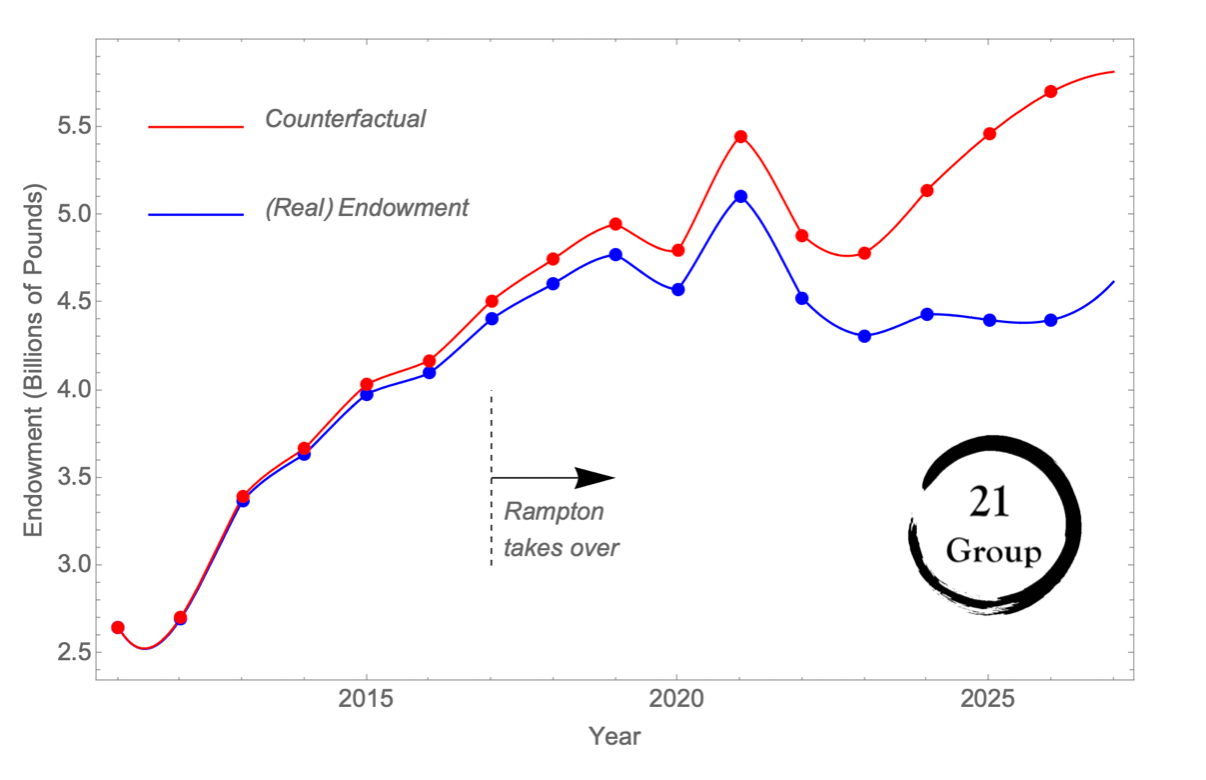
Here, we will track the real performance of Cambridge University’s endowment over time and isolate the impact of administrative spending growth above inflation.
We express values in constant 2025 pounds, taking inflation into account through CPI index, and we benchmark investment performance against the MSCI World Index.
We show a counterfactual scenario as to what the endowment would have been if administrative costs had been frozen in real terms at their 2011 level. The gap between the actual and counterfactual endowment values represents the cumulative opportunity cost of excess real administrative spending, showing how above inflation administration growth compounds into materially lower long-term endowment value.
Under this scenario the endowment would now be GBP 1.3bn larger than it is, or about 30% greater than the current level. Instead of growth, the real value of the endowment is more or less flat over the past decade. (For reference, Ms Rampton takes over as Registrary in 2017).
Table 1. Estimated impact of administrative spending above inflation on endowment value
| Year | Actual Endowment (£bn, real 2025) | Counterfactual Endowment (£bn, admin spend inflation-capped) | Cumulative Excess Admin Spend (£bn, real) | Implied Endowment Shortfall (£bn) |
|---|---|---|---|---|
| 2011 | £2.65 | £2.65 | £0.00 | £0.00 |
| 2015 | £3.98 | £4.03 | £0.11 | £0.06 |
| 2020 | £4.57 | £4.79 | £0.40 | £0.22 |
| 2025 | £4.40 | £5.46 | £0.95 | £1.06 |
| 2026 (projected) | £4.42 | £5.70 | £0.95 | £1.28 |
Notes:
1 All figures are June 30 each year (date of reporting for CUEF). The 2026 figures are a projection, not audited outcomes.
2. The estimates for the “freeze” scenario assume that starting in 2012, admin budget would be indexed in line with inflation at its 2011 level. Any surplus would then be invested in the MSCI World Absolute returns index with currency hedging to offset any variation in the GBP-USD exchange rate.
3. The 2026 counterfactual endowment is a conservative projection based on applying the observed 2025–26 real investment return of the actual endowment to the inflation-capped counterfactual path. No additional excess administrative spending beyond the 2025 cumulative level is assumed.
By 2020, cumulative administrative spending above inflation is associated with an estimated £0.22 bn reduction in the real value of the endowment relative to an inflation-capped spending path. By 2025, it is £1.06bn. These are secure numbers.
On a like-for-like investment basis, the cumulative opportunity cost associated with above-inflation administrative spending is projected to be about £1.3 bn in real terms by July 2026.
Should the infographic be alternatively entitled : Why She Had to Go? 😉
Of course, Rampton was surrounded by cronies and yessers, like the Peakophant and Lavrentii Beria
They have done huge damage, drawn gigantic salaries and many are still there.
What is worse is all of the people who have profited from this mess, e.g.the IT consultants, spin doctors and lawyers
I fear the 2026 figure may be lower due to the growing annual drawdown on the endowment fund to cover the central budgets, and notably, the decision to transfer historical costs over to the endowment as noted in the latest Annual Report.
And then all it would take is one big market shock to plunge us back to where we were in 2011.
There must be a misunderstanding because Ms Rampton did a great work according to the Vice-Chancellor of the University! Of course, the Vice-Chancellor may be clueless, or worse, she may be very well aware of the real impact of Ms Rampton and her colleagues but in good Cambridge fashion, put it under the carpet. If the latter, there is no difference between them. Let’s remember what Prof. Prentice told us recently:
https://www.cam.ac.uk/notices/news/update-on-university-registrary
“I would like to personally thank Emma for the enormous hard work, dedication and expertise she has brought to the role over the past eight years, and to wish her well in her future plans… During her time at Cambridge, Emma’s influence and impact have been truly significant… She has steered Cambridge through significant periods of organisational change… Her enthusiasm for, and commitment to, the development of people has had a hugely positive impact on many staff and the wider professional services community at Cambridge. We are very grateful for everything that Emma has done for the University.”
I am particularly confused by Ms Rampton’s contribution to the “development of people” and the “we” in the last phrase of the VC. We the Golden 50 or other collective? I would gladly ask her who “we” includes exactly, but I am pretty sure she will not reply.
As regards
https://www.cam.ac.uk/notices/news/update-on-university-registrary
The statement sounds as though it was dictated through gritted teeth by a cabal of lawyers.
Of course, before she “stepped down,” Ms Rampton may well have asked, in addition to a large sum of money, that her image was presented as such, and in return she would keep some of her secrets. But what will happen after the court and the tribunal trials in 2026? I guess we have to wait and see.
She is one of the cast at Bury St Edmunds 1-28 June 2026.
She will be cross-examined by a KC.
Make sure that the KC asks her, as Paula Vennells was asked in the context of the Post Office scandal, “How could you not have known?”
Lawyers who did her a huge favour though. Could have made a clear case for misconduct in office, and saved us the severance package.
It might have resulted in a legal case – and that’s why we avoid this wherever possible – but this seems a rare instance in which the golden goodbye package likely comes in much more expensive, and without much likelihood of reputational harm (if anything the opposite) given all the scandals coming out, and the huge number of current and former staff who were harmed during the past decade and will be ready to talk.
Agreed, in a years time she will pop up as CEO of the National Trust or Great Ormond Street Hospital or something, and proceed to ruin a new organization in the same way as Cambridge University.
The only public statement from the University seems to indicate she was a great success (“Emma’s influence and impact have been truly significant“). Nothing could be further from the truth. Her removal is the first constructive act that the Vice Chancellor has taken.
That’s precisely why this whole debate is of such urgent public interest. The whole British culture of “failing upwards” and then playing musical chairs from one board / sinecure/ public management role to the next needs to end. We have to talk openly about people in positions of public authority and speak up about how they performed or totally messed up.
Agreed. Rampton was a failure. She has been richly rewarded for failing. The rest of us have paid the price for her failure.
Speaking generally, there is way too much of this in the UK university sector
VC Shearer West of Nottingham University presided over ambitious expansions and the purchase/refurbishment of the Castle Meadow site for ~ £70m
It is now in the market for £14m. There have been hundreds of redundancies of academics and professional service staff at Nottingham University.
But, the senior managers all moved onwards & upwards, Shearer West is now VC of Leeds University.
“(“Emma’s influence and impact have been truly significant“). Nothing could be further from the truth.”
“Significant” is merely noteworthy, notable, remarkable
We are just now noting and remarking on her influence and impact, stating how disastrous and destructive it has been.
That is the truth that was allowed through those gritted lawyers’ teeth.
“She has steered Cambridge through significant periods of organisational change…” (steering does not exclude taking a wrong turn)
“Her enthusiasm for, and commitment to, the development of people (the golden 50? The HR battalion?) has had a hugely positive impact on many staff (those same ones?) and the wider professional services community at Cambridge (well indeed, it’s the academics that have mostly been left behind). We are very grateful for everything that Emma has done for the University (perhaps Emma hasn’t done anything at all FOR the University, so there’s not much risk in any gratitude for “everything” one would express in that regard).
Lawyers (and law trained individuals) know that language is subject to interpretation, and can be used to distract and to mislead, and to create different readings.
That too has created very significant issues in the University.
A community of scholars would usually expect language to be primarily a means to communicate information, not invite guesswork or scrutiny, and to be precise, not ambiguous.
I don’t think staff realise just how badly this had affected them.
By my calculations, if that extra 1.3bn were now available, the university could afford to pay all staff – yes, all the way up to the Vice Chancellor – a 12% salary increase every year for the next decade.
And that is assuming the money provisioned for this would earn no return above inflation until disbursed.
Assuming real returns at 3-5%, by contrast, we could be looking able to afford a 15% pay rise across the board.
Not just for staff earning at the low end, but 15% extra pay too for all Pro VCs, Heads of School, and yes, even the Head of HR and new Head of Registrary as well.
We could all be golden. Sobering to think about.
That is a superb way of bringing home the serious damage that has been done to everyone.
Could also be used to rebate the last 5 to 10 years of student fees – instead of loading up younger generations with debt to pay for executive salaries and payouts. illustrates how broken the whole system has become
That’s an excellent point
Brilliant work this is smashing analysis
Think though your figures are too low.
The cost of the administrative “ramptpage” isn’t just the investment income forgone
The real costs are qualitative and intangible i.e. years of recurrent industrial action, low morale, staff attrition, managerial time burned up in hiring replacements and temporary staff, grievances, coercion, mounting legal costs, loss of grant income due to PI departures
Those things cannot easily be quantified and much the damage will have a long tail over years ot decades
But at a stab I’d say those costs are at least the same size in monetary terms.
The university we could have had would likely be able to generate enough revenue to 30-40% higher salaries
“ramptpage”, LOL, very good
They did engineer an 30-60% increase in salaries…. but only for those at the top!
THE SCANDAL OVERALL IS GIGANTIC AND A CATACLISM!
UNDERNEATH THE OVERALL UNIVERSITY-WIDE DISASTER THERE ARE OTHER DISASTERS- THE ONE AT THE SCHOOL OF CLINICAL MEDICINE INVOLVING CANCER RESEARCH IS PARTICULARLY DISASTROUS! TIC TIC TIC TIC…. BOOOOOOOOOM
The real problem is that there is no effective isolation mechanism to isolate the system from problems of one person in the system. There are no fire door equivalents in the system to contain these type of fires & prevent them spreading to the whole system i.e. to isolate both the system and everyone else in the system from the problems of one person in the system. Is it currently possible for one person in the system to be made to directly pay for the problems of another person in the system by loss of position in the system & if that person directly paying for the problems of another person in the system is particularly high up in the system this lack of isolation then means that the whole system – through increased governance instability & significantly higher levels of unnecessary systemic stress – is also being made to pay for the problems of one person in the system. It is in no ones best interests to interact with a system where one person could be made pay for the problems of another person in the system either directly through loss of position in the system or indirectly through poorer overall functioning and advancement of the system that does not have an effective isolation mechanisms in place to isolate the system from the problems of one person in the system.
The real cost is the loss of organisational functioning, the real cost is the loss of the ability of the organisation to advance at pace, the real cost is the loss of the ability to improve peoples lives. The real cost is not measured in money, it is measured in quality of life.
There has to be some “accountability” – let’s make the VC “accountable” for the behaviour of every “independent” thinker in the university and punish the VC together with every other person in the university every time an “independent” thinker in the university misbehaves.
Accountability that is not rational is unlikely to be accountability.
What is a VC in this position supposed to do? Control the behaviour of all the “independent” thinkers in the university whose behaviour the VC will be held “accountable” for? I don’t know what that is but I know what that is not – it’s not a university.
All the “independent” thinkers in the university in collectively deciding to make the VC “accountable” for the behaviour of any one of the “independent” thinkers in the university would then be making the VC “accountable” for the behaviour of each and every one of the “independent” thinkers in the organisation.
It’s an interesting – it’s a group effectively trying to induce dictatorship behaviour in a VC as opposed to a VC themselves being a natural dictator & tending toward that type of behaviour – by putting a VC in a position where there are made “accountable” for the behaviour each and every “independent” thinker in the university.
If a person is being made accountable for the behaviour of another person then in order to maintain control over their own life in addition to maintaining control over their own behaviour the would need to maintain control over the other persons behaviour that they are being made accountable for.
It’s even worse, if collectively make VC accountable for own behaviour – which makes rational sense – & also “accountable” for the behaviour of each and every person in the organisation but only when that behaviour is at its very worst & not when that behaviour is at its very best – which is an unnatural and unbalanced state of accountability – that then has the potential to induce a hardcore dictatorship state – not just zero tolerance of any misbehaviour but absolute zero tolerance of any misbehaviour for fear of what any slight misbehaviour might lead to.
As someone who spent years in a lab running ultra-cold atom experiments trying to approach as close to absolute zero temperature as possible to explore interesting quantum states – there is a significant difference between reaching zero & reaching absolute zero. If people think zero-tolerance is uncomfortable, wait until absolute zero-tolerance.
Pico-aggression policy – anyone? anyone for a pico-aggression policy? your eye brow seems to have involuntarily twitched with stress there, under the new pico-aggression policy I’m afraid that means you’re out.
If people in a university cannot tell the difference between these two situations :
(1) Having an exceptionally gifted & resilient person in a VC role coupled to a university operating in conditions of extreme pressures & hence going through a significant, rapid, step-change organisational change process.
(2) Having an insufficiently gifted & resilient person in a VC role coupled to a university operating in conditions of normal pressures & hence going through an insignificant, slow, incremental organisational change process.
then that is an extremely serious problem for decision making in a university operating under conditions of extreme pressures. That is the type of serious judgement error that could lead to irreversible organisational damage on a scale never before seen in a university.
A university could then get stuck in a state of endlessly cycling through different leaders as the pressures on the university are continuously left build to ever more extreme levels until eventually no person exists who is gifted & resilient enough to occupy the VC role operating under conditions of such extreme pressures.
It’s important to recognise if that particular judgement error because there it is a significant risk in an organisation if that particularly serious judgement error is highly prevalent in an organisation when it first starts to operate in conditions of extreme external pressures.
It can lead to this type of situation : a whole university starts to experience extreme external pressures. Every person in the university starts to feel extreme pressures and those least able to cope with those extreme pressures start to drown in a university operating in conditions of extreme external pressures. The strongest lifeguard in the university is already in the VC position in that university but those drowning don’t recognise that fact & instead attribute the extreme pressures they are experiencing to an internal problem in the university that potentially extends all the way up to the VC themselves. This false attribution of the source – internal/external – of the pressures being experienced then prevents the people who are drowning from recognising that the whole university operating in conditions of extreme external pressures.
Instead of working with strongest lifeguard to not drown, the people in the university who are drowning could in those circumstances start taking actions that increase the risk of the strongest lifeguard in the university drowning themselves in which case they would be unable to save anyone else in the university from drowning. Then dealing with a situation where not only can people not save themselves from drowning – those who are drowning also cannot safely accept help from others trying to save them from drowning without putting the life of the person attempting to save them at unnecessarily high risk.
At that point those not drowning & with the strongest lifeguarding skills will recognise the need to leave the organisation because the existence of that situation will generate the insight that not only is the organisation in an unsafe state, there is also nothing anyone in the university can do to change the state of the organisation.
If a person is not prepared to take that VC role themselves while the whole university is operating in conditions of extreme external pressures then that person has to ask themselves how wise it is to push to remove the person currently in that VC role while the university is operating in such high-risk conditions.
If the VC role has higher pressures than the persons own current role and a person is currently struggling to cope with the pressures of their own role then perhaps that persons time would be better spent increasing their own ability to cope with the pressures of their own role in that situation whilst also showing up for the person in the VC role at a time when the whole university is operating under extreme external pressures – external pressures never before experienced by that whole university.
Thank you for this Eileen I completely agree. All of the accountability runs upwards, and there is no real oversight at the top. In theory you might be given the impression that there is horizontal accountability, due to the various committees that oversee HR, grievances, and pay. But in reality the moment you look into it you quickly find that all the people sitting in such roles have profound conflicts of interest and are in league with the people they are supposed to audit. It is a bureaucratic fiction of accountability that serves no role except providing a paper chain to sustain this deceit. The only solution is to have genuine downwards oversight in which committees are elected just like the board of scrutiny and the independent capacity to conduct investigations.
It’s even worse than that – if a person is a full college fellow & charity trustee, if a person is a member of Regent House, that can make a person accountable for an organisational problems themselves, that can make a person responsible for oversight themselves. If the whole organisation becomes a serial employment-error generator and health and safety hazard assault course for a person in that position I don’t know what people in these administrative roles expect is then going to happen – that they can march a person in that position off to the courts? that they can avoid any scrutiny of that situation? These are unrealistic expectations, this is just delaying the inevitable, this is inefficient organisational problem solving. Every person could have profound conflicts of interest in one of these situations – that doesn’t mean that people in the situation cannot work together in a situation to find a solution to a situation that could then be independently checked if necessary.
It’s one thing to come across a serial employment error generator because there is at least a straight forward solution to that problem – find an employer functioning at a higher level and leave the dysfunctional employer behind. It’s an entirely different thing to come across a serial employment error generator that has given you a legal obligation to report any employment errors & ensure they same type of employment errors don’t happen in the organisation again. It’s less obvious how to deal with an organisation that is determined both to screw you over and to make your accountable for it screwing you over – one that seems to specialise in these double-screw-over manoeuvres.
If the organisation will not respond to any concerns a person raises in that position there is no straight forward solution to that problem. There is then no pathway to comply with legal obligations to the organisation and that is what then creates the health hazard assault course triggering a set of even harder legal obligations at which point the problem becomes even more intractable. If the organisation maintains a position of not responding to the concerns of a person in that position then what started out as double-screw-over manoeuvres can rapidly turn into a category of extremely high-risk quadrupole-screw-over manoeuvres.
Before if I encountered any problems with an employer I had the option of letting that employer fail & finding an employer functioning at a higher level but with Cambridge I seem to have been given a legal obligation to not let it fail, to somehow find a way to prevent it from failing should it ever start to fail in any way. At same time Cambridge doesn’t seem to want to accept any help to prevent it from failing. It’s not clear what a person left in that position by the whole organisation is supposed to do.
I interpret the existence of this legal obligation as evidence of there having been people in Cambridge in the past who placed an extremely high value on the continued existence of Cambridge which lead them to put these legal obligations in place as a mechanism to maximise the probability of its continued existence. If that is the case then the right thing for the whole organisation to do is to see that this legal obligation is complied with.
Most universities demand an academic thesis be submitted in fulfilment of the requirements of a PhD degree in order to enter an academic post but Cambridge seems to be unique in demanding an academic thesis be submitted in fulfilment of a legal obligation to it in order to exit an academic post.
I think what those in Cambridge understood in creating these legal obligations was that the existence of these legal obligations would offer maximum protection to the lives of all interacting with Cambridge. Most people see complying with a legal obligation as a legal process but I see complying with a legal obligation is a political process and it is only when there is a failure to comply with a legal obligation that a legal process then emerges. Politics at its best respects humanity, protects human life, enables people to live a better life than would otherwise have been possible without politics, raises people up to more than they otherwise could have been without politics. Politics is life & without politics there is no life.
One thing encountering this type of situation makes your realise is that survivor mentality – as powerful as it is – is significantly less powerful than survivor-systems mentality which is individual survivor mentality coupled to a mentality of taking actions to embed survivor mentality characteristics in the system itself thus increasing the overall resilience of the system & boosting the overall ability of the system to function & advance in adverse conditions.
Yes you could just let an organisation fail and move to a more efficiently run organisation that it would take significantly less effort to succeed in – be a survivor – but if current students are being impacted by that failing organisation and future generations of students are depending on that failing organisation for an education you could also be a survivor – succeed – in that failing organisation while engaging in a process of bringing an end to those organisational failures i.e. contribute to building a system with survivor mentality characteristics embedded in that system – be a systems survivor in addition to being a survivor.
Where there is a will there is a way, life – that needs to flow – will forge a way for itself.
I think it’s a mistake for those not currently in senior management to over identify those in senior management with being “the system” whilst simultaneously under identifying those not currently in senior management with being “the system” when the reality is that everyone is the system.
Since everyone is the system this means that if the system itself has reached a state where it needs to be reformed then everyone – including senior management – may need to become systems survivors in addition to becoming survivors in order to reform the system & to collectively build a system with enhanced inbuilt survival skills.
With this thinking it may be possible to remove unnecessary mental barriers – ineffective adversarial approaches – that the mind has placed in its own way, barriers that are currently blocking system functioning and advancement, and to bring about significant improvement in the functioning of the whole organisation & speed up the advancement of the whole organisation.
For the avoidance of doubt the success referred to above is defined in terms of reaching a higher level of understanding and not in terms of academic career progression. The goal was to reach a higher level of understanding of mental health, an understanding that would that would enable a person to take more precise care of mental health, to function at a higher mental level, to work at a higher mental speed, to be mentally more resilient, to advance in life in ways that would otherwise not have been possible without that more advanced understanding of mental health.
I found it surprising that in switching from : being afraid of severe mental ill health states [a rational fear], exclusively focussing on understanding severe mental ill health states and therefore approaching the understanding of mental health from a position of fear to also including a focus on how to generate the exact opposite type of states – states with high levels of mental health – where higher levels of function, higher mental speeds & higher mental resilience are all possible – which can be approached from a position of not fear this can then open up a route to finding those states with high levels of mental health.
From those states of high levels of mental health it is then possible to build an understanding of the exact opposite states – severe mental ill health states – in ways that would not have been possible had an exclusive focus been kept on severe mental ill health forcing an unbalanced approach from a position of fear driven solely by an aim of the prevention of severe mental ill health i.e. with a damage limitation mindset.
It is like dying days of Soviet Union i.e. spend more and more money on salariat and physical infrastructure to “save” failing model while scientists and workers queue for bread, milk etc. Inevitable consequence of centralization and top-down system without individual enterprise or innovation. Needs shock therapy of cultural and systemic reform.
The problem is not that mistakes are made (that is inevitable in any large organisation) but that these mistakes are never identified or corrected in good time. As a result, they compound.
For example, if there were proper systems to oversee what HR and Registrary had been up to, an initial software cost overrun could be referred down for advice, solutions considered, and a collective solution found. The same of course is true for how we deal with bullying, plagiarism and harassment. We would not need to hire additional staff to handle these matters centrally, only make use of the collective decency and good will of the people already here. There has been a systematic failure to resolve such matter fairly resulting in entirely unnecessary burdens on the legal service, occupational health, and management, as well as our own students and staff.
The university’s number one resource is the brilliant people who come to teach and study here but we simply make no use of the benefit that it offers.
“The problem is not that mistakes are made (that is inevitable in any large organisation) but that these mistakes are never identified or corrected in good time.”
For avoidance of doubt, when the mistakes are identified by staff and students, they are deliberately covered up by those in charge of taking the reports seriously. This is a behavioural pattern that has been happening over and over and over. If those who report do not let it go, they became targets of internal investigations so that if they decide to bring the issues to the press, the University has a counter-story to tell. If you never went through this traumatic experience yourself, please believe that it does happen! Critically, this shameful response to mistakes is not done by a few individuals but by many, and an even larger fraction is aware of these responses and pretends it is not their business.
As it is well-known, the Board of Scrutiny has limited power, and it is often ignored by the Council. There is still no external Ombudsman despite the suggestions in the last Chancellorship and we do not seem moving in that direction. The Chancellor could act, and many members already reported the problems directly to him so he is definitely aware of many of the issues, but as far as I know—correct me if I am wrong here—no action has been taken and the University continues to burn in the background. At the very minimum, Lord Chris Smith could request an external, fully independent, investigation to take place now and it would be great if the 21 Group could push in that direction. If the investigations continue to be conducted by local HR, University HR, and OSCCA, the results will hardly be fair regardless the amount of money they get.
Would be good to calculate too how much poorer we are compared if if golden 50 salaries were capped at inflation since 2011?
Surely it is a similar figure – or perhaps a much larger amount?
UCam is beyond salvation! The American Queen and her cronies run a rotten and degdraded place that stinks in corruption and unlawful acts! Chancellor Lord Smith has already failed by doing nothing! 800 year history is lost in sewage!
There’s definitely a need for change. But in my view the right questions to ask would be, how do we ensure that another decade from now, we aren’t an additional £1.3bn short of funds? How can cost overruns be reversed? How can we have better public accountability? Perhaps most of all, what can be learned from universities (and other public organisations) elsewhere that have undergone similar crises and reforms?
The real tragedy is that all of our problems were perfectly clear to most people 2, 5 or even 10 years ago. But somehow, there has been a consistent failure to listen and learn, and then, take proper action. So something needs to change at the institutional level- a change that is willing to risk tough feedback from staff, admit to fault, and ask for understanding. The adversarial culture of the university management towards its students, staff, newspapers, unions, and courts needs to reverse, if it is ever to mature and improve.
This is the heart of the problem, agreed
“The adversarial culture of the university management towards its students, staff, newspapers, unions, and courts needs to reverse, if it is ever to mature and improve”
There is/was an opportunity for a reset after the end of the Rampton Era.
All the signs are that the opportunity will be wasted.
The ridiculous proposal to kill the Vet School by shenanigans is a clear signal that, like the Bourbons, “they have learnt nothing and forgotten nothing”
A key issue is that we often blame the “university” for its current state instead of individuals responsible for decisions. Blaming the university is precisely what these managers want because this way shields them. It was not the “university” that told the Pro-Vice-Chancellor Prof. Kamal Munir to dismiss without any investigation a whistleblowing disclosure and safeguarding referral based on detailed medical evidence, but instead the most discussed lead HR Business Partner as she cannot afford an independent investigation. Prof. Munir knows this because I had reported her behaviour to him before and he ignored it, but still followed her conflicted views after without conducted any investigation. Strikingly, when Prof. Munir was contacted by Mr Daniel Zeichner MP, he did not talk about the most discussed Lead HR Business Partner but instead about the views of the University. This is just a recent example; I have a long list of this kind of behaviours and surely many of you have other examples that cannot be accepted. If we continue to accept these behaviours, they will continue to perform them. I have no doubts of that.
@TheResearcher
“Blaming the university is precisely what these managers want because this way shields them.” (…) “Strikingly, when Prof. Munir was contacted by Mr Daniel Zeichner MP, he did not talk about the most discussed Lead HR Business Partner but instead about the views of the University.”
Absolutely. There is a pattern – and that pattern only serves one individual consistently, so they can remain unseen and avoid blame, scrutiny and investigation.
@HorseoftheYear in previous blog
“The pantomime horse SamLouise warrants more scrutiny
Louise is the back-end of the pantomime horse. Ridiculous.
But Sam at the front-end is where the problems really lie.”
The back-end of a horse can kick out in ways the front-end may or may not be aware of. The aim is always destructive, and such kicks can be fatal.
What is ridiculous is the cover-up. The front-end redacts itself out of scrutiny, the back-end advises on ways to respond to concerns or requests for investigation, so as to keep itself out of scrutiny.
A lot more scrutiny and awareness is warranted in the year of the Horse – very much agreed.
“This is the heart of the problem, agreed
“The adversarial culture of the university management towards its students, staff, newspapers, unions, and courts needs to reverse, if it is ever to mature and improve”
There is/was an opportunity for a reset after the end of the Rampton Era.
All the signs are that the opportunity will be wasted.
The ridiculous proposal to kill the Vet School by shenanigans is a clear signal that, like the Bourbons, “they have learnt nothing and forgotten nothing”
CROOKS HAVE NO REMEDY! AMERICAN QUEEN AND HER CRONIES MUST GO!!!!!
Could get on the crooks-cycle treadmill by inaccurately applying the crook label to a person as soon as a person enters into a position in senior management and then burn & replace, burn & replace, burn & replace, burn & replace ad infinitum. Could continuously burn all the available energy in the system on the crooks-cycle treadmill. Could have everyone in the system continuously working at maximum effort just to have the system stay in the exact same place it is in – a place no one wants the system to be in – or could start running on real ground …. could see something new ….. could see something different …. could see some real change …. could see not more of the current & more of the past but more of the future.
When experiencing dark times it can be very difficult to understand the origin of dark times and reason behind the emergence of dark times. It seems to the the case than when moving from working with a truth at one level of complexity to working with a truth at a higher level of complexity it is possible to enter into dark intermediate states. These dark intermediate states are where understanding at a higher level of complexity has become technically possible but is still being impeded by significant amounts of inaccurate/false information being present. This results in the experience dark times i.e. times that are worse than those experienced when working with a truth at a lower level of complexity and also significantly worse than those that it would be possible to experience on reaching a state of working with a truth at a higher level of complexity.
On the pathway between two truths of different complexities there are many different dark intermediate states – differing in what information is inaccurate/false. People can fall into different dark intermediates states en route from a truth at a lower complexity to a truth at a higher complexity. People in different dark intermediate states from each other may appear dark to each other – not to be trusted – only to eventually arrive at the same truth at a higher complexity and then appear light to each – to be trusted. The combination of common sense – working knowledge of truth at a lower complexity – & the ability to sense and rationalise what has been sensed – explore truth at a higher complexity – can enable a person to explore dark intermediate states with returns to a basecamp truth at lower complexity until a truth of a higher complexity can be found and established at which point that becomes the new truth at a lower complexity, the new commons sense & the process begins again.
They think that by retaliating they can prevent scandal – but retaliation IS the scandal
I call your attention for what is written in the Research Misconduct Procedure regarding, namely in the section that defines “Research Misconduct”:
https://www.cam.ac.uk/sites/default/files/research_misconduct_procedure_-_lt2024_0.pdf
“Improper dealing with allegations of misconduct: failing to address possible infringements, such as attempts to cover up misconduct and reprisals against whistleblowers, or failing to adhere appropriately to agreed procedures in the investigation of alleged Research Misconduct accepted as a condition of funding. Improper dealing with allegations of misconduct includes the inappropriate censoring of parties through the use of legal instruments, such as non-disclosure agreements.”
A few months ago, I asked the Head of Research Policy, Governance and Integrity what was his understanding of “reprisal” in the text above as after I reported behavioural and research misconduct in UCam I had an increasing number of “actions” against me, not least being investigated for abusive behaviour and “precautionary measures” that sought to silence and break me. These actions include prohibiting me from contacting hundreds of University members, including all HR of the University and the senior leadership (the Vice-Chancellor, all Pro- Vice-Chancellors, the Academic Secretary, the Registrary), limiting my use of my @cam account, redirect and review the emails I send via @cam, decide the topics I can discuss with some University members, prohibit me from contacting co-authors of my own research, not responding to my questions, giving me incorrect and misleading information, namely regarding my current rights in the University, ignoring my complaints, formal and informal, dismissing, without any investigation, the whistleblowing disclosures and safeguarding referrals made by third-parties based on detailed medical evidence on how this situation has been affecting my health, threatening that my “crimes” could be reported to the police, among others.
How did the Head of Research Policy, Governance and Integrity answer my question when I asked about the meaning of “reprisal”? He told me that he did have a definition. Long-story short, they allegedly do not even know the definition of retaliation and thus it will be hard for them to appreciate that retaliation is the scandal as you say.
I meant, He told me that he did NOT have a definition.
Sorry for the typo.
“Improper dealing with allegations of misconduct: failing to address possible infringements, such as attempts to cover up misconduct and reprisals against whistleblowers, or failing to adhere appropriately to agreed procedures in the investigation of alleged Research Misconduct accepted as a condition of funding. Improper dealing with allegations of misconduct includes the inappropriate censoring of parties through the use of legal instruments, such as non-disclosure agreements.”
Well, I must say that seems like a pretty clear definition to me. Isn’t the Head of Research Policy supposed to know the university’s own published guidelines? Is that not in fact a condition of doing their job?
I made that point and he never replied!
UCam is a joke. It is a complete waste of time to go through all these policies because they exist to give the impression—to members, sponsors, and the public at large—that the University cares about these issues and is following the law to the best of its ability, but in practice the managers do everything they can to cover up misconduct. And that, as @Johann noted above, is the key scandal. I honestly do not understand how so many people do not feel ashamed for this behaviour. This is a very basic form of institutional corruption, many people actively contribute to it, and in my view their most disturbing expectation is that we shall all accept these practices and move on.
Any member of staff who is in receipt of a large salary and has an associated mandate to uphold university guidelines and statutes, and who then, ignores those statutes in order to maintain security of their income out of fear of reprisal, is a person who is engaged in acts of corruption.
It is time to take a hard line on this. If you place greater priority on protecting individuals in power than on your formal duty to uphold our rules, for which you are contractually in receipt of private financial compensation, then you are acting corruptly.
This is contrary not only to our statutes but to the law, and a list of the corrupt must be prepared and filed for investigation.
they will all face their own “Epstein moment” when the files are finally released
1-28 June 2026, Bury St Edmund Employment Tribunal
Epstein files are good comparison. When the emails are out, how many people will be able to point to evidence that they called out instances of abuse and blew the whistle? And how many will be exposed for their ignoring, covering, or even assisting senior figures that they knew were culpable as perpetrators of sexual or bullying abuse?
@Johann hits the nail on the head with “They think that by retaliating they can prevent scandal – but retaliation IS the scandal”, which of course is also a sector wide problem.
And, unfortunately for anyone engaging in retaliation against staff that speak out through ‘Protected Acts’ or ‘Protected Disclosures’, employment tribunals and related employment law takes a firm view on such retaliation, with compensation levels being uncapped.
Any detriment suffered by the victim for raising genuine issues is “retaliation” by the employer. For example, just about everything TheResearcher points out above are very definitely ‘detriments’ in this sense. It should also be said, that in TheResearcher’s case above, where the employer seems to be implying that TheResearcher has committed a crime, when they have not, the TheResearcher may also be entitled to report this under the heading of a Protected Disclosure. To be falsely accused this way is also a ‘detriment’ too of course. Other viewpoints on this are welcome.
A reprisal is the unnecessary degradation of a system in a whistleblowing situation which – had the situation being managed in a more optimal way – could instead have driven continuous maintenance and/or an upgrade of a system. E.g. a doctor reports a ward is understaffed compared to the stated recommended minimum staffing ratios and is fired – reprisal occurs – the ward is more understaffed and the system loses a doctor who could otherwise have been working in the system staffing any ward in the system. An employment tribunal is generated draining public resources. Management then spends significant amounts of organisational resources defending its reprisal actions and finding temporary staff it then has to pay at higher hourly rates to ensure a stable replacement arrangement for the doctor it fired. The hospital could instead have not fired the doctor – resisted reprisals as an organisation – and worked with the doctor to find a solution to the organisational problem e.g. consulted with recently retired staff being paid with an NHS pension about availability and willingness to assist organisation in troubleshooting an organisational fault – time of increased organisational need – to minimise a newly identified health and safety risk to current staff in the organisation.
The level of reprisals is the measure of the current gap between what is being written down/said by an organisation and what is done by the organisation in practice. The emergence of reprisals is an indication that a system is actively under degradation pressure, the level and volume of reprisals is a measure of the degradation pressure. To reverse that situation & instead drive an upgrade to the system using the whistleblowing situations that are emerging in the system it is necessary to mount high organisational resistance to reprisals until people get the message that this type of organisational inefficiency cannot be tolerated when the system is under significant degradation pressure because all that will lead to is further degradation of the system and higher degradation pressures emerging in the system in future.
Bi-directional reprisals are one of the biggest risks to an organisation that is under significant degradation pressure. That type of situation – a bi-directional reprisal situation – is analogous to this : (i) a ship comes under increased sinking pressure – i.e. starts taking on water (ii) its entire crew is being blocked from examining & fixing the part of the ship taking on water because two crew members are beating the living daylights out of each other and anyone else who approaches either of them in front of the only passageway to the problematic part of the ship. (iii) the whole crew is blocked from examining and fixing the problem with the ship.
One aspect of these whistleblowing situations – tackling a systemic wrong as opposed to tackling an individual wrong – that makes them particularly difficult to deal with is a particular type of coupling that can occur in one of them.
Not only does a person have to continuously do the right thing as an individual – maintain their typical morality state – in addition a person has to continuously drive the system to do the right thing – keep track of the morality state of the system and take action to bring a system from one morality state to another morality state.
A coupling is then introduced between an individual morality state and a system morality state – both to harness relevant information & necessary to drive systemic change. If a person is used to maintaining a high morality state and is then coupled to a system currently in a low morality state through a whistleblowing situation this can introduce a high morality state mismatch inducing a state of extreme mixed feelings on coupling to the system which can then be difficult to wrestle with mentally.
A person can suddenly find themselves feeling like they are a bad person in these whistleblowing situations despite that having never been the case and them not having changed as a person or a person can experience acute episodes of having extremely mixed feelings about their own morality – high risk mental states. All that has happened is that a person is now tracking two morality states – individual and system – not that a persons own morality state has changed.
Until you realise this these situations can be extremely mentally destabilising but once you realise this it is possible to stay in a calm, reasonable and fair state and to make extremely fast progress whilst working under pressure in one of them.
A person can encounter all sorts of unexpected behaviour that they have never before encountered in a whistleblowing situation when all a person is doing is working efficiently and at their maximum effort to improve the state of the system and when there is no problem with the individuals own morality state.
Exclusion, isolation, propagation of false information in relation to a person, reprisals, unnecessarily vicious and prolonged personal attacks aimed at continuously destabilising a person – and all sorts of other completely pointless & useless activities can be encountered in one of these situations.
These are the actions of people who don’t understand that there is a system, that the system has its own morality state & that if the people with the precise skills to fix the system are blocked from fixing the system precisely then the morality state of the system will degrade even further and everyone interacting with the system will endure hardship and suffering as a result including all those engaging in the pointless, useless activities above that suck all the energy out of the system and yield nothing of any value in return.
What you find in these whistleblowing situations is that the people who focus most of their energy on “getting a person out” in one of these situations are often those who lack the skills to analyse problems at the level of the system & to find solutions to problems at that level. That lack of understanding of the difference in the scale of challenge between addressing a problem at the level of a system and addressing a problem at the level of an individual means people in that position drastically underestimate the scale of the challenge in the situation and as a result can expose themselves to exceptionally high levels of risk in one of these situations.
Those who don’t understand the whistleblowing situation themselves are suddenly put into a situation that makes them feel uncomfortable so they react by focussing on getting any person who does understand the whistleblowing situation out to ease that discomfort. A similar type of error is possible for others who become extremely focussed on “getting a person out” to take over the handling of a whistleblowing situation – engaging in high levels of personal attacks on the person currently handling a whistleblowing situation – instead of being extremely focussed on the whistleblowing situation itself in order to accurately assess the scale of the challenge & the suitability of their own skillset to handle a whistleblowing situation of that particular scale and kind.
Once a person then “gets a person out” this is sometimes celebrated oblivious to the fact that what is being celebrated is a more rapidly sinking ship. Eventually it becomes apparent that a focus on “getting a person out” is no substitute for a focus on finding solutions to the whistleblowing situation itself and that all a persons focus on “getting a person out” did was expose the person with that focus to exceptional risks that they don’t have the skills to mitigate because they wasted all their time attacking another person and as a consequence did not spend enough time analysing the systemic problem to be able to solve it.
There is a risk of overcomplicating a whistleblowing situation. Do the right thing, if everyone does the right thing in a whistleblowing situation there is then the possibility of everyone meeting in whistleblowing situation in a state of doing the right thing and of a solution to that whistleblowing situation being found.
I spend no time worrying, worrying is wasted energy that could be used to do the things that have the potential to make a real difference in a situation, do and see what is true.
I want to clarify what I mean about morality state of a system as opposed to the morality state of an individual in the context of whistleblowing in relation to a systems-level problem.
Take the post office as an example. An error at the level of the accounting systems leads to false accounting information being continuously generated in the system – the system then continuously has high levels of false information and is in a low morality state. This sets off a disastrous false information chain reaction – prosecutions are brought on the basis of false information already in the system generating even more false information in the system leading to a system entering an extremely low morality state. System morality here is connected to the amounts of false information in the system.
This system in an extremely low morality state is then interacting with individuals – new post masters join the post office – whose individual morality is then being called into question for no good reason – creating significant mental health risk – despite the fact that their individual morality of these individuals has not changed, all that has changed is these individuals started interacting with a system in an extremely low morality state.
Similarly if a CEO who is unable to identify/accept a systems-level problem is replaced by new CEO more capable of identifying/accepting a systems-level problem and also more competent to fix a systems-level problem but still limited by the time it takes to address a systems-level problem then the individual morality of that new CEO will also be called into question. The individual morality of that new CEO has not changed, all that has changed is the new CEO is interacting with a system in an extremely low morality state and it takes time to change the morality state of the system.
I think it’s important to recognise/track the morality state of the system before a point is reached where the morality of every individual interacting with the system is being called into question to the extent that no one with the skills to identify, accept and fix systems-level problems is allowed to work on any of the the systems-level problems without being attacked & having their individual morality called into question for no good reason.
People should ask themselves this question – which would make more difference to the functioning and advancement of a system – every person in a system focussing on analysing and changing one person in a system e.g. the VC or every person in a system focussing on analysing systems-level problems and finding ways to change a system for the better?
Each person in a system has the power to change own lives in ways that help or at the minimum don’t hinder others from doing same. Each person also has the power to mount rational resistance to a system and to drive changes at the level of the system. It is the combination of all these rational resistances that generates the information required to identify, analyse and fix systems-level problems, drive improvements in a system and allow advances to be made at the level of a system.
A person could spend a lifetime worrying about reprisals, baseless personal attacks, “get x person out” and let all the useless and pointless activity in the world bring a life to a halt or a person could become rational resistance, become a force for systemic change, become energy with purpose and let life flow.
The impact of Emma Rampton on Cambridge University’s Endowment.
[…] The blog in full […]
Mysteriously, Ms Rampton’s page at Sidney Sussex College is no longer accessible
https://www.sid.cam.ac.uk/people/ms-emma-rampton
I get in bold letters Access denied
I got the following “Your IP address is listed in our blacklist and blocked from completing this request.”
Access via a VPN however gives me instead the message: “You are not authorized to access this page.”
All rather curious.
Anyone have any luck signing in via Raven? Or is it removed too from the intranet?
It is possible that she lost her affiliation with Sidney Sussex as she does not seem to be listed as a Fellow now…
I can’t access Emma Rampton’s page at Sidney Sussex via Raven
Looks like it has been removed from the intranet and she is on her way to becoming a nonPerson
Rampton was enabled by many of the people still there.
Eg “Re-imagining Professional services” was the joint creation of Ms Emma Rampton and Prof Nigel Peake
Prof. Nigel Peake, the Head of the School of the Physical Sciences, previously Head of DAMTP, who is mentioned in this story (https://21percent.org/?p=1608) contributed to “Re-imagining Professional services” with Ms Rampton? Wow! These are interesting news to me!
Here is Prof Peake as Deputy Chair of the Change And Programme Management Board
https://www.governanceandcompliance.admin.cam.ac.uk/university-committees/change-and-programme-management-board
Who is the Lead HR Business Partner of the School of Physical Sciences from whom Prof. Peake gets advice on HR matters? Isn’t Ms Louise Akroyd? Isn’t she a good friend of Ms Rampton and Ms Hudson, the current Director of HR? All these connections must be pure coincidence I know.
Sadly it is worse than that. Head of HR found guilty of multiple misconduct: committee lets her off. Committee chair due to account for acts in conjunction with said person, and yet, not detailed as conflict of interest. Same 3-6 individuals acted in remuneration and disciplinary committees also to promote and protect one another.
You will be interested in events disclosed at 1-28 June 2026, Bury St Edmund Employment Tribunal (it seems you already know about something similar)
Not the full details but enough of what went to committee. There are several other cases floating around even though they stopped sharing internally long ago and will not share the full documents with VC, Chancellor or Council.
The 21 Group has been encouraging people to contact the Chancellor directly.
So, the Chancellor does know some of what has been going on, although he has limited direct power. Please use [email protected] if you want more details on how to contact the Chancellor.
A good working assumption is that most on the HR Committee are either conflicted or naive.
The shocking news for those who do not know it yet: The Head of HR acts as the designated safeguarding lead of UCam. How disturbing is that?
https://www.governanceandcompliance.admin.cam.ac.uk/files/university_safeguarding_statement_may_2025.pdf
The concept of ‘conflict of interest’ does not exist in UCam. I was recently threatened of ‘suspension’ for contacting University staff and asking why I had been given incorrect and misleading information for months related to my rights in the University, where the delegate that the University chose to decide my suspension is a person who has to respond to a tribunal claim I made against him and other senior members of UCam. Not enough conflicted? However, once I flagged this new threat and the associated conflicts of interest to Mr Daniel Zeichner MP ccing the leadership of UCam, they eventually realized that would be a very bad strategy from them to continue with this pathetic threat and did not talk about suspension again nor did they ask this person to act as the decision-making delegate. This said, one never knows with UCam. They may revert their strategy again and continue the circus.
@Dotty Joiner , you wrote “will not share the full documents with VC, Chancellor or Council.” Trust me, I contacted them all and does not make any difference.
You’ve got this the wrong way round
Ms Louise Akroyd is the Head of the School of Physical Sciences.
Prof Peake does what he is told.
@Bas,
If Ms Louise Akroyd is the real Head of the School of Physical Sciences, but Prof. Peake is presented as the Head everywhere, then the records should be corrected ASAP as it is really unfair to her. Ms Akroyd should be celebrated as she deserves, perhaps even as the first woman to act as Head of the School of Physical Sciences of Cambridge, right? Wow, these are major news as I thought she knew nothing about Physics, Chemistry or Mathematics, but of course, I only interacted with Ms Akroyd in the context of reporting misconduct and never asked her what academic credentials she had. My bad! But just to clarify, in the unlikely event we had to complain about her, to whom would we do it?
Really impressive how Cambridge has empowered so many people to run academic schools and departments who have never once taught a class, published research, or even ever secured a BA from a reputable institute of higher education. And just look what a great effect this has had upon our research culture, staff and student satisfaction, staff retention and global reputation. They definitely deserve to be paid 2-5x the rate of academic salaries. Spending each year the entire sum we draw in annual student fee income on the increased size of the budget of the administrative services has been a really great investment.
“Reimagining professional services”? Really embarrassing for a professor to sign off on such waffly management newspeak. What next guys? Transfiguring your Lower Second? Transmuting sexual harassment? It is high time to quit the verbiage and talk the raw facts.
Sidney Sussex, King’s and Clare College are currently sitting on some of the biggest scandals in the university’s recent history. Fortunately, there are a few good people inside each who have been keeping tabs.
This is unusual. Her Fellowship would not normally be curtailed abruptly.
She may have resigned and asked for the page to be removed.
Perhaps she was enraged that the University have refused to accept her own vision of herself as a Messiah coming to save us all.
I think this is the link – https://henrytapper.com/2026/02/08/the-impact-of-emma-rampton-on-cambridge-universitys-endowment/
Thank you. These posts are getting a lot of circulation on LinkedIn — the ‘Golden 50’ has > 150,000 views.
Please consider liking/reposting them if on twitter/Linkedin/Bluesky
Putting pressure on Varsity was a huge mistake and one that cannot be rolled back I suspect – it is one thing to threaten big media but quite another to go after students
One of the great advantages of a democratic society is that it provides victims a means to pursue justice via extrajudicial channels that do not require any recourse to violence. Through protest, civic activism, and political mobilisation, it is possible to achieve meaningful accountability in the absence of the rule of law, as well as hold the judicial system itself to its ideal standards of impartiality and public integrity.
Perhaps the best example in this regard is the #MeToo movement, which to date continues to stand as the leading example of twenty-first century online activism that resulted in a meaningful change to workplace culture and norms, in a manner that better protects women from harassment, abuse and exploitation than had previously been the case.
Naturally, it is regrettable that it did so in a manner that was unbalanced and, at times, unfair. Some men were unfairly accused, and suffered consequences that they did not entirely deserve. Perhaps far worse is the fact that – as the Epstein files now document in great detail – so many of the most vile perpetrators in positions of power and authority managed to escape untouched, when under universal right, they should have been brought to account.
This failure, however, was not the fault of women or women’s rights activists, but rather, is the fault of a flawed justice system that had, time and time again, failed to give women the means to be heard and taken seriously by the police and public authorities, to pursue their cases fairly at court, and to bring to terminal account those who were responsible. Had they done so, the state of law would have approached its ideal form. It did not. The status quo perpetuated a structural injustice against women, and the movement achieved, at least, a partial approximation to the true state of law.
The same is true of the movement for justice for young researchers, both women and men, who now find themselves subject to harassment, retaliation, discrimination and exploitation, yet were denied voice, accountability, or justice.
Those who seek to evade responsibility are in denial of a fundamental truth: that in a democratic society, there can be no escape from one’s actions in the long run. The wheels of justice turn slowly, but turn they do; and should the course of law ever become exhausted or perverted, democratic mobilisation will pick up the slack, until all have answered for their acts under the light of transcendental justice. To accept this knowledge is to choose the right path, leading to reunion, by pursuing mercy over evasion, forgiveness over blame, and honesty over further deceit.
[…] the financial position of the University, the performance of the endowment, the steady fall down international rankings, press reports of rampant bullying & harassment […]
You should compare Cambridge to Oxford. For all Oxford’s many faults (um…. sexual harassment and rape anyone?) the “other place” is definitely better financially governed.
Total endowment is now £6.4bn — well ahead of Cambridge. A key reason is that — in spite of growing admin spend — the beast remains in its box. While Cambridge now spends equally on academic departments and its central administration — an utterly insane situation for any organisation (and evidence of complete financial governance failure IMO) — Oxford’s spend is just £236.1m for admin vs £685.5 for departments. That’s a healthy 3-1 ratio — unlike Cambridge’s 1-1.
Don’t get me wrong — there has definitely been admin “creep” at Ox too. The admin spend grew by 60% since 2020. But at least it didn’t almost triple like at Cambridge. At the same time, Oxford also grew departmental spend by 40% which was above inflation — while instead, Cambridge has instead cut departmental funding in real terms, resulting in financial crisis, faculty closures, attrition and obviously abysmal morale.
Excellent idea — where are the Oxford figures?
Whilst Oxford has a serious SH problem, so does Cambridge. So far, the problems in Cambridge have not been exposed to public view … but we expect that to change.
Cambridge has a serious bullying problem, together with a poor HR department
Cambridge admin spending didn’t “almost” triple. It more than tripled from 2016 to 2025 (131m to 395m) and actually quadrupled since 2011, in spite of the freeze on tuition fee income. All of this is clearly stated in the public accounts available online.
Add one financial crisis and we are down another 2 billion. Spend 1.3 billion fixing the mess and we become the alumni of Lehman Brothers University. A glorious legacy of 800 years, destroyed in just 8.
@ SouthernRock
I think I much better analogy (than Lehman Brothers) would be Government of Egypt.
A decade ago the government announced plans to build a “New Administrative Capital” with funding support from international donors and investors, notably Saudi Arabia and UAE. It all looked shiny and pretty on paper. The initial cost was estimated at $45 billion. The latest 2025 figures are set at $58 billion and rising. The final cost may be 50% or more higher than originally planned.
Early in the process, spiralling costs let to partner withdrawals. UAE’s Emaar backing out in 2015 and Chinese investors pulling the plug in 2017. The government has been scrabbling around for new donors while taking on the costs through sovereign debt. The cost to refinance borrowing is rising and IFIs are preparing for the worst. The IMF already disbursed $8 billion in 2024 but everyone is now talking about insolvency and writedowns.
Cambridge announced a billion dollars in new construction bids a few years back, but who knows what the final cost will be. If the writedown at Nottingham is any precedent we could be looking at a massive drawdown against the university balance sheet. The powers that be were adamant they would find big shot donors to slap names on buildings and cover the costs but does anyone know how that is really going?
What we do know so far is that like in Egypt, things are clearly not going to plan. In Egypt ordinary people are already bearing the cost of administrative vanity as social budgets are slashed in the name of austerity. At Cambridge department budgets were already slashed a further 5% this year, and now they are closing the Veterinary School too, which is one of the university’s most prestigious faculties. Thanks to the endowment fund, no-one is yet talking about a bailout, but we do know that the costs are not being reported on official university accounts but only (as per a note on the same accounts) “transferred over” to the endowment fund instead. As long as new buildings are marked at cost they can paper the balance sheet there, but if on complete we have to mark to market and declare a writedown, who knows what kind of a hit that will entail.
Thanks Osiris, if so this would certainly explain a lot. It would explain, for example, why they were so desperate to get Lord BP in as Chancellor, and since, have refused to comply with a Regent House vote to reveal the names of university donors, in line with basic integrity procedure at any charitable or public institution. They are short of cash flow and in total panic.
Ironically the university now has a Chancellor who is excellently postioned to negotiate a government bailout, but they will avoid that until the last possible moment because everyone knows that such a move will immediately bring in parliament and the press, including some I imagine pointed questions regarding executive payouts, bonuses, and accounting practise.
The other factor here is to know just what part the government played in producing this situation. One can hardly avoid the suspicion that the VC was wooed by the government in to taking on a significant share of the cost of delivering its “Oxbridge Corridor” vision against its own balance sheet, and is now, facing a cash flow crunch due to over allocation and cost overrun. Both the opposition and team Andy (Burnham) will make absolute hay of this, not least of all because the whole idea from the outset was driven by Oxbridge mandarins from southern England when there were far more obvious and affordable investment cluster options in the North.
Excellent point. The “Oxbridge Corridor” is indeed a factor in all this.
Frankly, the policy seems designed to break the country up. Universities in Wales & Scotland are under enormous pressures and — and when we see the first bankruptcies — that is where they will be. Dundee Uni is effectively bankrupt.
It’s not just Team Andy. Nationalists will surely take control of both Wales & Scotland in May & make hay with a Govt pouring money into one of the wealthiest parts of the UK.
Yes well government couldn’t provide the money for precisely that reason, no? so suckered Cambridge to blow its endowment instead on delivering a flagship policy. This is no secret all in public domain. Just read this.
https://www.theguardian.com/education/2025/feb/08/cambridge-risks-losing-unbelievable-talent-amid-phd-funding-cut
Cambridge leadership was naive and negligent here. Easy target. Would never happen if university was led by people wise to ways of the world, not just looking for photo ops and praise from a few smooth talkers in suits. And now, instead of reviving the UK’s great universities, they have bankrupted them. Great work.
In private equity we’d say the university is a perfect candidate for a leveraged buyout:
1. Amazing brand
2. Great if underutilized assets
Yet:
3. Abysmal management
4. Gross cost inefficiencies and bureaucracy
Would have to be a hostile takeover because first act would be to fire the entire management. Then clear half the administration. Then cull external contracts overrunning their initial terms.
Those remaining could look forward to a significant pay rise (followed by a hell of a lot of work to set things right)
Whatever you might say about William Hague, at least he wasn’t dumb enough to sign away the Oxford endowment for the sake of a flimsy government PR stunt. Cambridge, on the other hand, has acted like a lonely granny who spoke with the first scammer on the phone after her life savings. All we need now is for government ministers to parachute in to roles as Head of House and everyone will realise what the deal really was about.
Good points but you are missing the biggest hypocrisy of all. All the while they were getting buddy buddy with Reeves and Starmer, we now know they were backpeddling with Farage and Reform. That’s why the whole Council leak was so damaging i.e. pinning their hopes on government protecting them from scrutiny while ready to betray them on a dime.