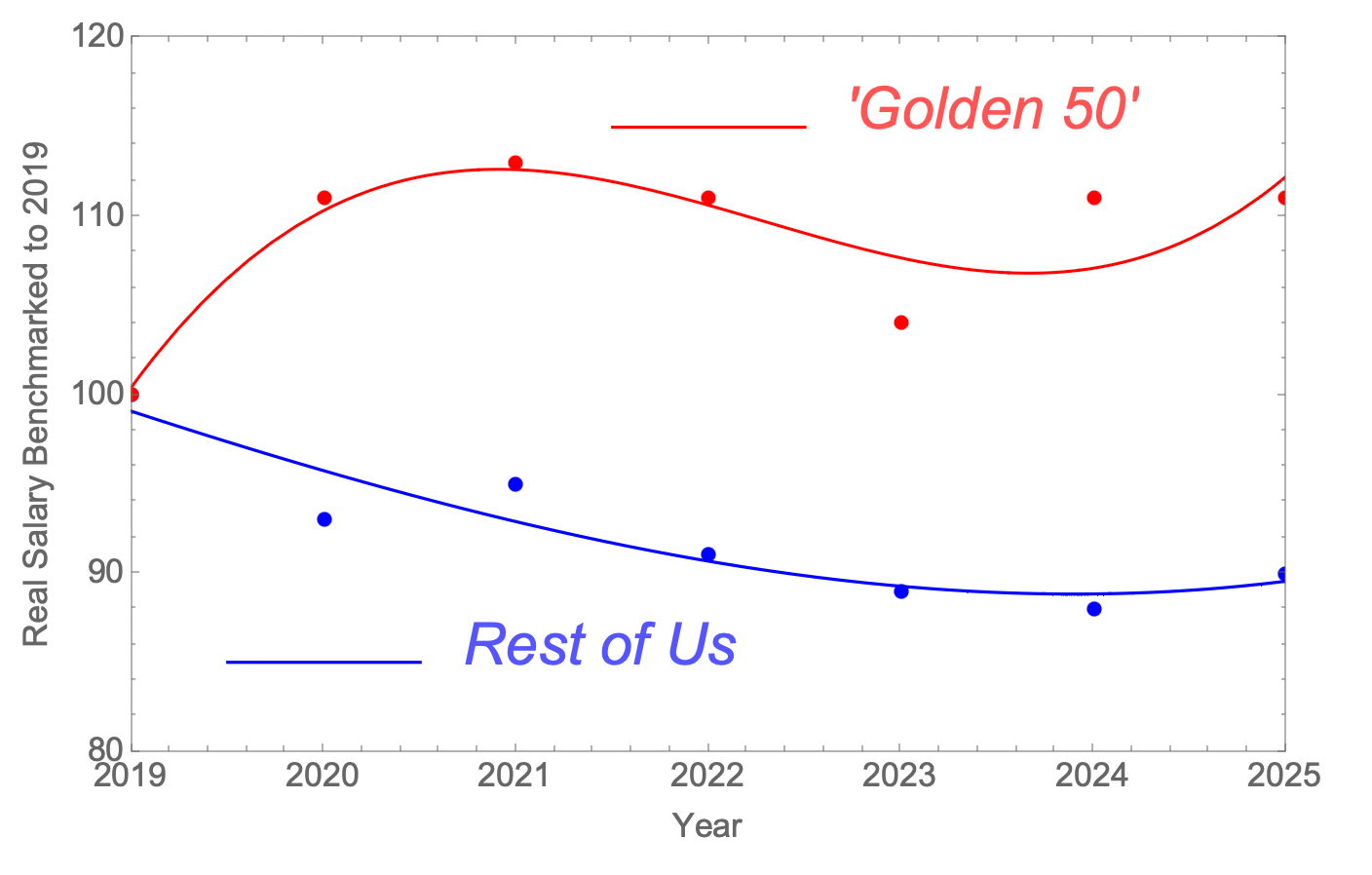
The mean inflation-adjusted pay of University of Cambridge staff has been flat for more than a decade. In isolation, that might sound like stagnation. In context, it is far more revealing. When pay rises are captured by those at the top, the average should rise. If it does not, there is only one possible explanation: most workers are losing ground.
To make this distributional reality explicit, we divide staff into two groups: the “Golden 50”—the fifty highest earners—and “the Rest” or everyone else.
The graph shows inflation-adjusted pay, benchmarked to 2019, with the Golden 50 in red and the Rest in blue. The picture is stark. Since 2019, the real pay of the Golden 50 has risen by around 10%. Over the same period, the real pay of the remaining workforce has fallen by roughly 10%.
This is not shared sacrifice.
It is a deliberate redistribution, hidden in plain sight by a conveniently flat average. The mean has stood still because gains at the top have been offset by losses everywhere else. In other words, stability at the headline level masks a quiet but systematic transfer from the many to the few.
The rising pay for those who run the institution has been financed by declining pay for those who sustain it. Senior management profit, the rest of us are left to bear it.
(This answers the question raised by Bimodal in the comments of the previous blog posting)
So the ‘Golden 50’ are the people busy trying to shut the Vet School
Sounds like the Vet School’s deficit could be eliminated by sacking all those highly paid administrators.
That’s actually true. Basic salary cost for the golden 50 must come in around 15 million pounds a year so all-in cost to keep these people on the payroll is probably around 20 million annually or more.
Bloody hell. So just 50 people are extracting a quarter billion dollars from the university each decade. That’s insane.
As of the latest published accounts, the mean average salary for the top fifty paid staff at Uni Cam (the “Golden 50”) is £262,389. Previous accounts suggest an overhead rate on top of basic pay at 30%. The latest exchange rate to US dollars (GBPUSD) is 1.371.
Plugging those numbers in, you get:
50 x 262,389 x 1.3 x 1.371 x 10 (years)
= US $233,827,957.
That’s a little short of a quarter of a billion dollars, though strictly speaking for a forward estimate one should use the purchasing-power parity exchange rate. PPP is the level rates can be expected to mean-revert to over a long-run period and as that level is currently 1.507 (https://pppcalculator.pro/), this gives:
50 x 262,389 x 1.3 x 1.507 x 10 (years)
= US $257,023,145.
So slightly above a quarter of a billion dollars.
Open to corrections if anyone has any suggestions. But any way you crunch it, that be a lot of money to be paying just a handful of university managers.
If you try to set up a governance level-operational level connection for the transparent transfer of accurate information from the governance level to the operational level it’s clear that there is a problem with that particular interface in the organisation. That governance level-operational interface is not functioning at level required to permit the timely transfer of accurate information that would enable rational governance decisions to be made at the highest governance levels in the organisation.
Cambridge has 30 colleges, it has ~ 500 members of Regent House who as full college fellows are continuously governance trained by the Charity Commission and governance active in the colleges, it has a substantial governance level-operational level interface. If as a member of Regent House and full college fellow you try to set up a governance level-operational level connection to discuss an organisational fault at the operational level, the operational level simply refuses that connection and moves to block the propagation of information across that interface on the basis of confidentiality and/or availability of external channels it will also refuse a connection through. It’s not then possible to do a direct transparent transfer of accurate information from the governance level to the operational level.
The operational level blocks connections to itself i.e. governance level – operational level connections. It also blocks direct governance level – governance level connections permitting only indirect governance level – governance level connections where it garbles the information transfer to protect its own operational level interests which it perceives to align with the interests of a subset of individuals at the highest governance level it associates with being equivalent to the organisation as a legal entity. This irrational approach leaves the operational level simultaneously seeking guidance from individuals at the highest governance level in a situation & garbling information in relation to that situation without which individuals at the highest governance level cannot make rational governance decisions.
This then results in irrational governance behaviour such as that illustrated above – since 2019, the real pay of the Golden 50 has risen by around 10%. Over the same period, the real pay of the remaining workforce has fallen by roughly 10%. – there is no rational explanation for that type of divergence. The operational level is not providing the information to the highest governance levels to enable rational governance decisions to be made in relation to pay in the organisation & anyone from the governance level who makes a valid attempt to connect to the operational level to try to do anything about any of the problems in the operational level gets blocked at the interface.
You can even get a governance level blocker who blocks a direct governance level-operational level connection and/or a direct governance level – governance level connection in a situation e.g. a head of department permitting only indirect connections where they can actively garble the information propagating in the organisation in relation to the situation.
Academics are not motivated by money, academics are motivated by intellectual challenge. Cambridge is an extreme example of that where people will push themselves into all sorts of close-to-poverty states to do things that are more complex & difficult to accomplish than activities that would earn them significant amounts of money outside of academia.
Money-making activities can lack stimulation in comparison to some of the intellectual challenges on offer in universities. The thinking that academics in Cambridge enter into academic governance because they are deliberately setting out to line their own pockets with organisational funds is irrational, some of the people entering academic governance in Cambridge have already made more money than they know what to do with & they still go into academic governance after getting themselves into that position.
It’s a systemic fault – clear & accurate information is not propagating to the highest levels of governance in a timely manner & rational decisions cannot then be taken to accurately steer the organisation in the right governance direction. Groups of people don’t have to intend for [x] to happen for [x] to happen but if [x] does happen that groups of people did not intend & also don’t want to happen once they know why [x] has happened groups can then take action to stop [x] happening & to prevent [x] from happening again.
This is a graph that far too much could be read into without checking the reality of the situation on the ground. Is there any evidence that the people in these positions in the organisation are more motivated by money than the pool of people who could also have been selected to occupy these positions in the organisation? It seems irrational to me that a person in academia can hit some kind of organisational boundary on taking a position in the organisation where suddenly all their motivations for being in academia completely change. It seems irrational that a person can go from being a virtuous truth-seeking academic to being a money-seeking academic gremlin on being fed their first governing body supper after midnight.
Not all the ‘Golden 50’ are academics or even ex-academics. Some are professional administrators. Eg, the HR Director and the former Registrary were never academics
We agree that an important question is the composition of the ‘Golden 50’ & that can’t be addressed by the data in the public domain
As far as we understand, senior staff remuneration is set by this Committee
https://www.governanceandcompliance.admin.cam.ac.uk/university-committees/remuneration-committee
Very Interesting link. It reads, “The Remuneration Committee is a committee of the Council. It is responsible for setting the pay of the Vice-Chancellor, reviewing their performance, and advising on senior staff remuneration.”
But wait, Lord McDonald is not the Master of the College where the Vice-Chancellor is a Felow? It is him that will set her pay and review her performance at the University level? Isn’t that a conflict of interests? I guess that everything is possible in UCam!
Umm is the page link loading wrong or does it really state that the entire executive compensation review is in the hands of just 5 random people?
For a quarter of a billion dollars of taxpayer / student fee money a decade you would expect a bit more rigour and transparency than that?
We agree it is surprising. It seems the 5 people are:
Gaenor Bagley (Chair), Dr Neil Churchill, John Dix, Lord Simon McDonald, Dr Ella McPherson
It’s a bit odd frankly that the council appoints the committee that sets its own salaries, and then the majority of committee members are internal to the university. If you compare to how parliamentary salaries are set, there all the board members are external and from backgrounds with more direct evidence of integrity (e.g. judges or accountants).
A reminder of what the Vice-Chancellor told BBC when she was asked about her salary, https://www.bbc.co.uk/programmes/m002jfys
“Oh well I mean I think that so whether vice chancellors are paid too much or too little is a matter for somebody to decide I mean it’s not a matter I don’t set my own salary and whether I’m overpaid or underpaid I am very well paid and I try to work very very hard for it and that’s all I can say.”
“I don’t set my own salary…”
“Not all the ‘Golden 50’ are academics or even ex-academics. Some are professional administrators. Eg, the HR Director and the former Registrary were never academics”
When I look at Cambridge the main motivations are intellectual challenge and/or competence or mastery of a subject or a role. Money is a by-product of engaging in challenging work and of continuously striving for competence but it’s rarely a motivation in itself in Cambridge. That is not confined to academics, you see that in those working as administrators too.
I think that is part of the problem in Cambridge, people in Cambridge will accept the erosion of their living standards without much complaint, people will put themselves through hardship to keep the university going in Cambridge. People in higher governance levels will accept exceptionally high levels of work-related stress being piled on them without much complaint, people will learn to live with a continuously high health risk, people will put themselves through all sorts of different types of hardship to keep the university going in Cambridge.
We agree that Cambridge attracts people who are motivated by intellectual challenge and a strong sense of institutional mission. That ethos is real, and it does explain why many people — academics and professional service staff alike — tolerate levels of workload, stress and personal sacrifice that would be considered unacceptable elsewhere.
We agree that such a culture is also part of the structural problem. A system that relies on people’s intrinsic motivation and willingness to endure hardship becomes vulnerable to exploitation, particularly when sacrifices are unevenly distributed. While many staff experience a steady erosion of living standards, job security, and health, this is not mirrored uniformly across the institution. At the highest administrative and governance levels, remuneration has risen sharply, and pay at that level cannot plausibly be characterised as merely a “by-product” of intellectual engagement or service to the mission.
The difficulty is not that people are motivated by money per se, but that the institution has normalised a moral asymmetry: sacrifice is framed as virtuous and expected for most, while substantial financial rewards are quietly justified at the top. The language of vocation, resilience, and commitment is doing real work here — it helps sustain the university, but it also dampens resistance and discourages scrutiny of how resources, risk, and reward are allocated.
In that sense, Cambridge’s culture of endurance does not simply coexist with high managerial pay; it enables it. The question is not whether people are motivated by money, but why an institution built on shared sacrifice has become comfortable with such stark disparities in compensation and exposure to harm.
“At the highest administrative and governance levels, remuneration has risen sharply, and pay at that level cannot plausibly be characterised as merely a “by-product” of intellectual engagement or service to the mission.”
That increase in pay is to compensate for an increase in “complexity” of these job roles, the higher workloads, the increased risk of exposure to work-related stress and burnout that comes with “solving” complex organisational problems.
It’s a form of organisational breakdown where instead of reversing the redistribution of pay which would be a more effective way to solve “complex” organisational problems – i.e. rebalance the different types of stressor in the organisation – the organisation continues the trend thereby pushing the whole organisation into even higher states of “complexity” and even more money is then taken to “solve” the even more complex organisational problems that emerge.
Cambridge is an extremely heterogenous organisation – you would really have to drill down to the level of the individual at each level of the organisation to understand the risk in the organisation and visualise the distribution of organisational workload. It would also have to be a dynamic analysis that captures variations of workload over time. A culture of Bullying/harassment can result in the average organisational workload/workload fluctuations on a group of people being focussed on a particular individual in that group of people at one level of the organisation.
“Cambridge’s culture of endurance does not simply coexist with high managerial pay; it enables it.”
In some sense high managerial pay is a by product of the Cambridge culture of endurance across the whole organisation both in those not in managerial roles & those in managerial roles. The risk in Cambridge is a synchronised organisational burn-out at all levels of the organisation of the people bearing the brunt of the workload at all levels in the organisation. The risk is a complete organisational breakdown.
“The language of vocation, resilience, and commitment is doing real work here — it helps sustain the university, but it also dampens resistance and discourages scrutiny of how resources, risk, and reward are allocated.”
What you see in Cambridge is – there is nothing, nothing, nothing until suddenly there is everything. There is no resistance until there is near full resistance. There is no scrutiny until there is near full scrutiny. It’s a low risk, low risk, low risk place to be in a managerial role until suddenly it’s an extremely high risk place to be in a managerial role.
It has been known, at other institutions, for VC’s and other internal or external senior executives to chair *each other’s* salary committees. Keep digging folks.
I think the risk in one of these polarized-by-income environments is that you could have two people in very different income categories who at some point in time are experiencing the same overall acute health risk – exceptionally high levels of work-related stress – but the response of the organisation & of others in the organisation to these two people – who from a health risk point of view are starting off in very similar situations – could be very different. This response difference could then induce very different levels of additional ongoing work-related stress on these two people significantly influencing the health outcome in the situation. When there are multiple other polarization factors also at play in that polarized-by-income enviroment the outcome of that situation becomes even more complicated & difficult to predict.
“I don’t set my own salary…”
Ummm well no… I just appoint the committee who set my salary, most of whose members work for me!
Imagine if each of us had that same privilege, and how wonderful that would be.
There are indeed only 5 “official” members of the VC’s Remuneration Committee. These are the ones formally appointed by the university as per Statute and on record.
However, the meeting was also joined by Emma Rampton, Kamal Munir and Andrea Hudson. None of these individuals were appointed to be there.
Perhaps if you ask for information, you will discover more.
Very, very interesting indeed.
If you are able to be more explicit as to who to ask, please use [email protected]
I could maybe sort of understand why Rampton was there (at least, insofar as she seems to have had a hand in everything, you know)
But why was Hudson there? That doesn’t seem to make much sense. And even more puzzlingly, why Munir? Isn’t it an obvious conflict of interest for a Pro VC (and Council member) to attend?
Indeed isn’t it an obvious conflict of interest for any member of the Golden 50 to be providing input to or influence upon the committee determining executive compensation?
@Gadfly, Kamal Munir does not know what conflicts of interest are. That I can assure you. But now it makes sense why Lord McDonald told me he would speak with him in person soon as it seems they meet often. Of course, that meeting, if it ever happened, did not lead anywhere when it comes to the abuses are doing against me as Prof. Munir seems to have a great way to persuade people when I am not cced or present!
They cut the VC base salary by 15%. But that then helped to mask a further +£11,000 pay hike last year alone to the pro VCs and registrary.
I make no inference beyond these descriptive facts.
People are so used to collectively regressing through mutually destructive governance that they are unable to see the possibility of collectively advancing through mutually empowering governance.
Mutually empowering governance is where a direct, transparent communication line is set up between a person reporting a problem and a person at the highest level of governance with the power to fix the problem i.e. accurate information transfer in relation to a problem is enabled between the person with the problem and the person with the power to fix the problem. This maximises the probability of the problem being fixed. If the problem is then fixed the person with the problem is left feeling happy and empowered and the person who made valid use of their power to fix the problem is also left feeling happy and empowered.
In mutually destructive governance an indirect, opaque communication line is set up that impedes information flow in relation to the problem slowing down problem-solving and increasing the possibility of generating false information both in relation to the problem and the people reporting the problem or with the power to fix the problem. That has the potential to lock the person reporting the problem & the person in higher governance levels with the power to fix the problem into a prolonged mutually destructive governance situation that is being driven by information blocking and/or false information generation in the communication channel that has been set up by the organisation. This minimises the probability of the problem being fixed because the communication channel does not permit timely and accurate information transfer between the person with the problem and the person with the power to fix the problem. There is then a high risk of the problem never being fixed. In this case the person with the problem is left feeling unhappy and disempowered. The person with the power to fix the problem is effectively blocked from making valid use of their power to fix the problem and is also left feeling unhappy and disempowered.
The word you are looking for is Exploitation. If you believe in this culture of personal sacrifice, you need to know that there are 50 people building a vast personal fortune at your expense. That’s where the overheads go. That’s your pension, your benefits, your mortgage they are spending. And they laugh at you.
Wouldn’t you like to know how your money is really being spent?
“And they laugh at you.”
It is much worse than that.
What this environment of accepted exploitation has created is a playground for seriously malevolent and dangerous individuals, who thrive in it, and are protected by the upper echelons, who are too busy enjoying their expensive lifestyle to take seriously their duty of care.
Instead of being alarmed by the increase of harmful, destructive and unlawful actions, by the loss of exceptional academics and talented administrators, instead of taking seriously reports of work-related illness, death and suicide, our highly paid senior personnel allow those sinister characters to write their correspondence for them, and to exonerate themselves through that communication by the same token.
“That’s your pension, your benefits, your mortgage they are spending. And they laugh at you.”
That’s not my pension, my benefits or my mortgage that is being spent – that’s the educational opportunities of future generations that is being spent.
I don’t believe in this culture of personal sacrifice. I have a legal obligation to raise concerns because of a combination of roles I held in the organisation and this is something where you either have to do it right or not do it at all. The laughing state of others does nothing to change my legal obligation state.
I would pay money to never have to interact with USS as a pension provider ever again – I feel no sense of pension loss. I have a mortgage. The type of benefits being referred to are not what I would classify as benefits & I feel no sense of loss in that regard.
Much good personal “fortunes” will do a person in a society that – as a result of the accumulation of all these personal “fortunes” – cannot sustain the educational environment necessary to carefully educate the next generation of e.g. medics.
We in HR have a lot of members in the Golden 50 😉
That’s so lovely to hear.
Are you paid by the hour or per troublemaker you dispose of?
I’m on a big salary.
Troublemakers are a performance bonus.
Body bags count double.
We invoice by the minute. I spent 22 minutes thinking up an answer to your question so based on my annual rate that will be 100 pounds please.
Public office, private gain
There’s a word for this what is it again?
Begins with a “c” wait could swear its on tip of my tongue
I ask maybe that you consider the following modest propositions ?
Collusion
Cronyism
Clientelism
Complicity
Connivance
Contamination
Cover‑ups
Compromise
Confusion
Clumsiness
Carelessness
Complacency
Corner‑cutting
Concealment
Cost‑overruns
Catastrophe
Cack‑handedness
Coercion
Crisis
Conspiracy
Chronic misconduct
Chaos
At least we have been saving on the salary of nurse Emily! I wonder, however, if fireman Mike who has been replacing her is getting more monies… He has so much to do these days. But choosing conflicted people to act as delegates in the decision of suspending a student when there are tribunal cases running in the background where they are directly implicated does not seem a very sensible decision. He may consider taking a break.
The fact they get so much money does not bother me that much to be honest. It is their culture of covering-up misconduct, and in particular their systematic retaliation against those who do not accept and report malpractices, that bothers me. Out of the golden 50, how many would report and/or investigate misconduct fairly? 1/10? Less?
“At least we have been saving on the salary of nurse Emily! “
We will have had to pay to get rid of her — probably at least a year’s salary.
Plus, she knows where all the bodies are buried, having personally supervised most of the grave-digging. So there will have been an NDA (now called confidentiality clause to get around legislation) to ensure she keeps her mouth shut.
She will have walked away with a big six figure sum — but no matter how high, it was worth it.
Who is going to leak the meetings of the University Council now by the way? They should have one soon and it seems it is “strictly confidential”… Let’s see how confidential this one will get!
It is curious that there has been no investigation (it seems) as to who did the taping and leaking. Who is going to say anything at all controversial on Council when the likelihood is that it will end up on the front page of The Times or The Telegraph.
It must be distressing to many of these people to know that even in the Council they were being watched and that sooner or later their adventures will come out to the public at large. There are now too many people external to the University who have an idea of what is going on, and it is just a question of time until the story is properly written.
Lord Glossover, the Master of St Machiavelli’s College, knows it all, “Just because you have caught something nasty, why do you have to wander about breathing over everybody?” (https://21percent.org/?p=2655)
Don’t need to watch ‘Traitors’ if you’re on Council
Deception, paranoia, and social strategy are just every meeting
Does anyone else find it strange that they keep sending us compliance modules on cybersecurity with stalinesque paranoia about how to keep university secrets safe from external access? But never any modules about bullying, harassment or whistleblowing… even those should all be regulatory requirements. It really shows you where their priorities lie. But a democratic society is founded on openness and transparency, and this should be considered a strength, not a vulnerability.
There is a forthcoming Employment Tribunal, June 1-28th, at Bury St Edmunds that is concerned with whistleblowing
It is a shocker
Dr Mike Glover is (nominally) in charge of whistleblowing. Dr Regina Sachers is (nominally) in charge of compliance
In our view, there is no effective whistleblowing (or safeguarding policy) and the University is in very serious breach of legal regulations
Modules on whistleblowing?
The application of the whistleblowing policy in UCam is simply a joke, and I am really really sorry for those who have any hope on it still. The individuals who receive the reports can afford not doing any investigation regardless of the evidence you have, which is a step above the fake investigations they used to do to pretend they cared about reports of misconduct. Now things changed and they tell you in your face, after consulting conflicted people like SamLouise and knowing they are conflicted in your case, that they will not investigate anything even if the report is a safeguarding referral based on medical evidence. And then tell the MPs who contact them to know what is going on that your health is the priority of “all of us,” which I assume includes the most discussed Lead HR Business Partner as well.
Please please please tell us that someone has a ranked list of “who’s who” in the Golden 50
Agreed, this should be public data.
There should be transparency in pay at Cambridge University.
I’d much rather have a set of feature articles on how they spent our money. Jewellery? Designer bags? First class flights, luxury holiday homes? Perhaps the odd moat in need of dredging? All of it paid from the fees paid by indebted students for life, overheads on postdocs living close to the poverty line, and taxes on hard-working peoples in left-behind Britain.
either that, or sitting in accounts in a remote part of Switzerland or on some island in the Caribbean
How to Spend It: Cambridge edition
Inflation peaked at the end of 2022 (11.1% in October 2022)
Notice how the blue and red curves track each other in the years 2021-2023. The datapoints fall roughly in step.
What happens then in 2024? The ‘Golden 50’ realised they’re getting poorer and the red curve moves sharply up, as they correct the problem.
And the blue curve, the rest of us … well, that continues to decline.
Thank you that’s a very perceptive observation. I feel it really does make clear who has been sitting at the table in a position to serve themselves a larger slice of m cake, and who ends up left on the sidelines begging for crumbs.
—– Breaking News —–
I just received an email from the University telling me that they contacted Mr Daniel Zeichner MP asking that he deleted the documents I had sent him and even asked me to confirm that I had asked the same to all those I had shared the documents. How delusional is this? Oh boy, they really chose the wrong person to cover up misconduct!
I think you can guess what I did next…
I am horrified to learn of this. Every constituent has the right to contact their MP, and every MP has the right to speak openly on the floor of the House of Commons. British democracy is founded on the principle of parliamentary sovereignty and no authority stands higher. Certainly not a registered charity with questionable motivation as regards its demands.
@Anon, yes, the situation of UCam is really serious at the moment and it is hard to believe how bad the situation is. It is surreal. There is a very large number of people who know this degrading state, including Senior Tutors who are responsible for hundreds of students each, and simply look the other way as if it was not their business. But I can assure you that they chose the wrong person to cover up misconduct. Let’s see what happens next because I am happy to contact every single MP, every single member of the House of Lords, and cc the leadership of UCam.
They definitely did not realize that a large number of people external to the University, namely journalists, are already aware of the state of UCam and at any moment all these scandals can become uncontrolled regardless of how much corrupt managers try to cover them up!
Academic culture incentivizes self-preservation above all else. Speaking up comes last, and solidarity is conditional on there being no risk involved. It’s a structural outcome of how the system rewards behaviour.
Still, these dynamics always reach an inflection point. When enough people begin to speak honestly, many of the same colleagues who withdrew will reappear, smoothing over the past and re-casting themselves as allies from the beginning.
The pattern is very familiar. Institutions like Cambridge run on it. And that is precisely why someone has to be the first to break the silence.
The inflection point is close at hand.
“The inflection point is close at hand”
There is a long list of people who do not seem to understand that fact and keep behaving as if nothing is happening, as if no one knows what what they did, and continue to do in plain sight now. Is it hubris or delusion?
— More Breaking News —
A lengthy and thoughtful article on bullying and harassment in Cambridge that was due to appear in Varsity has been pulled after pressure from the University
This follows early articles in The Guardian and the Times Higher Education that have been pulled following pressure from the University.
It is often not realised that it takes real bravery for newspaper editors to publish material that the University wants suppressed.
We all recollect the Vice Chancellor babbling about the strength of her views with regard to Freedom of Speech
https://www.varsity.co.uk/news/26878
It seems at odds with the behaviour of the institution she runs. Either she is a phoney, or she doesn’t realise what is going on. Probably the latter.
Given the large number of UK journalists who got their first ever portfolio cuttings from undergraduate contributions to Varsity, that seems like an exceptionally stupid intervention. Perhaps they would like to know what is happening at their home newspaper?
Thanks for sharing this article 21 Group. I did not know about it. I will make sure I will use it next time I write about what is happening with me, namely the fact that I continue to be forbidden from contacting hundreds of people and get an increasing number of “precautionary measures” and threats for not complying with this enforced silencing. The situation became so absurd that I can imagine that people who read these posts think I must be making it up.
“The pandemic made it a lot worse,” Prof. Prentice says. Of course, the culprit is the pandemic, not the person who keeps trying to prevent me from contacting the Vice-Chancellor and other senior members so that they do not get implicated in the cover-up of misconduct! The pandemic, Brexit, the war, everything except misconduct at UCam!
This is really shocking. What did the MP have to say about this? Could their motivations be related to GDPR issues?
If the fault is originating in the university, your MP as a prescribed person sits outside the university and above the university in the regulatory chain as do any regulators you interact with in the process of making a public interest disclosure. The university can contact people in the regulatory chain regarding information and make requests in relation to information of those in the regulatory chain and of you if it can give a rational reason for doing so but those in the regulatory chain above the university will always have to exercise their own independent judgement in relation to the situation as they are accountable for their own actions in the situation independent of the actions of any other person/organisation in the situation.
It may seem that the university can then pressure people in the regulatory chain to bias the outcome in favour of the university but you should bear in mind that if the regulatory chain gives in to pressure from the university and arrives at a biased outcome all that will happen is a repeat of the same problem only of worse severity, the university will need to apply even more pressure, the outcome will need to be even more biased for the university to get its “desired outcome’. If a person gives in to pressure from an organisation, if a person allows themselves to be abused by an organisation all a person will get is more pressure and more abuse from that same organisation. Eventually it becomes unsustainable because there is only so much bias that can be applied to outcomes before it becomes apparent the person in the role is unable to withstand the required pressure to function in the role. MPs and regulators will be in no hurry to give in to pressure from organisations, they will want to get an unbiased outcome in the case because that is what maximises the probability of them not having to deal with another of the same type of case from the same organisation.
I do not know what the MP has to say because it takes him a few days to reply to me and this happened earlier today. It is not even clear to me they contacted him at all as these people keep sending me incorrect and misleading information to manipulate me, but we shall see what he says because I contacted the MP and cced them all in my email. If they made this up, it will be even more embarrassing for them…
They were particularly concerned that I shared a document they sent me last week with some “questions” about the sham investigation they are doing against me, a document that I did not even open yet. UCam does not care about GDPR issues in general, only about those who can be used to show that there is misconduct in this institution. The fact they explicitly flagged that this document is important for them makes it particularly interesting!
I would not run the risk of sharing a document that I did not open, it could contain a virus, it could be sent to me in error and intended for another recipient – the resulting situation is then more stress that could have been avoided in an already stressful situation. If a person is in the process of complying with a legal duty to an organisation they are not exempt from complying with other legal duties to an organisation they just have to engage in a different set of legal duty balancing calculations, GDPR and a general duty to reduce the risk of passing viruses from one closed computing system to another closed computing system still hold.
For the staggering sums they are paid, one ought to expect a great deal more professionalism than this. There is no way that in any private sector company, attempts to order an MP’s behaviour would not immediately refer to the CEO to de-escalate. There would also have been extensive efforts to mediate and resolve matters fairly and informally. It speaks to a culture of abysmal amateurism, arrogance and high-handedness. Indeed failure by HR to resolve any dispute beyond a few months at mos shows they are unfit for task. It is sad and embarrassing for the university that they seek to micromanage and bully esteemed and respected members of the establishment when instead contrition and honesty are due.
@Glaucon – It is more likely the case that senior executives across the sector are paid ridiculous sums of money because they are expected or demanded to act this way towards staff. It is then understood at the time of their appointment that their time in post may be very short as a result (with no guarantee that they will secure another one). So their salaries are a kind of pre-compensation for this (on top of whatever golden handshake they also receive when they have to leave), all of which they can potentially live off for long time.
Also, senior executives from outside the sector are brought in to chair committees and rubber stamp appalling and corrupt dismissal orders etc (it’s done this way in part to – attempt – to allow HR and internal senior executives to deny responsibility). They also know that they will not be around long, and will therefore avoid internal investigations etc, and likely legal action too.
It’s all a well-oiled machine that the sector has been enduring for a while now. But it’s all starting to be exposed…
So to recap the following allegations have been recorded as to university behaviour:
– repeated and sustained threats toward British journalists (vexatious libel letters, referral to press complaints commission, lobbying of editors)
– threats against whistleblowers (Paul Pharoah tweets, Evans case)
– smear campaigns against current and former students and staff
– refusal to comply with judicial orders and rulings (eg following MacKenzie case)
– issuing apparent “orders” to members of parliament (above)
– repeated refusal to comply with freedom of information laws and requests
– apparently vexatious threats to refer students and staff to the police for false arrest
If we saw this kind of behaviour in Moscow or Tehran or Minneapolis, we would know how to describe it.
Add
– Repeated manipulation or fabrication of evidence (by eg editing pdf files) in cases before Employment Tribunals. In one case where this has been proven, it has led to charges of defamation and malicious falsehood against very senior members of the HR and University Legal Services. A member of Legal Services has been reported to the SRA.
@21percent.org – It may actually be worse than this.
In the case of TheResearcher for example, if the documents that the MP, or anyone else, was asked/ordered to delete, contained issues relating to protected acts or disclosures, then any attempt to conceal or destroy such evidence is unlawful. Their only way out may be because there are GDPR issues related to the documents, but that doesn’t appear to be the case.
Instructing an MP to break the law?
If true then that seems…. unwise
Here is a very senior person in HR asking for the destruction of evidence in another case of a protected disclosure
“I would ask that you delete these recordings immediately (and that you ask anyone else who has copies of these recordings to delete the same) … I would be grateful if you would confirm in writing once the recordings have been deleted”
Blatantly unlawful behaviour.
Wow! That is beyond wild. Folks should be greatly disturbed if not outright frightened by this. Those responsible must also know that individuals have a right to acquire evidence of unlawful acts, and as far as I know, such recordings can be used in court regardless of whether or not permission was given to acquire them (please correct me if I’m wrong on this).
Why on Earth would such a directive be given, which is clearly unlawful?? What is fuelling this extreme sense of impunity among HR and senior executives… (besides what we already know from this blog and the press etc)?
Employment Tribunal, Bury St Edmunds, 1-28 June 2026
Whistleblowing situations are complex legal situations, the real problem with them (and mental burden in them) is continuously having to work out what lawful behaviour is at every point in time in one of them – sometimes from first principles.
These situations should be handled with care from the very earliest stages of the situation – i.e. when the situation is at its minimum complexity – to avoid ending up in a systemic position where the complexity of the situation induces a state of systemic paralysis coupled to excessive consumption of systemic resources whilst stuck in that state.
The complexity of the situation – still snowballing – is then effectively acting as a barrier to working out what the next set of lawful behaviour steps in the situation is without which the whistleblowing situation cannot be resolved. Such a systemic state will drain a system of vast energy resources with nothing of real value to society to show for all that energy expenditure.
The most important thing to do is to ground any whistleblowing situation in the situation that nucleated it, to pare it down to the situation that first started it and to the lowest level of complexity possible for that particular whistleblowing situation, to get back to the problem/set of problems that seeded that whole snowballing process. That is the starting point in any process of working out what went wrong and how to prevent things from going similarly wrong in future.
@Anonymous, while my case is not related to the Employment Tribunal, Bury St Edmunds, 1-28 June 2026, it involves many of the people of that case, not least because it happened in the same School and thus we share the same Head of the School and the same Lead HR Business Partner, the most discussed Lead HR Business Partner in the 21 Group.
The risk in one of these whistleblowing situations – especially one where an organisation tries to influence an MP to get a biased judgment of the situation in favour of the organisation – is that an organisation might then not only induce a breakdown in trust and confidence between a person & an organisation but also a breakdown in trust and confidence between a person & a nation state the organisation is embedded in.
That could put the person in a situation where the relationship between the person and the nation state they are currently residing in breaks down. In such circumstances a person could feel forced to seek asylum/refuge in a different nation state by approaching that other nation state with openness and transparency & making a request to establish by a reciprocal relationship with high trust and confidence and by mutual consent with that other nation state.
The other thing I found in these whistleblowing situations where the emergence of the situation itself results in a general feeling of loss of trust independent of how trustworthy the people handling these situations are is that it is important to maintain perspective in one of them.
I have ended up in a whistleblowing situation with an organisation, a whistleblowing situation is inherently a low trust situation & I now feel unable to trust this organisation. To check whether that is in fact the case I must first ask myself this one question, is there an organisation out there that I would place more trust in to get the right answer/do the right thing in this particular whistleblowing situation. If the answer to that question is no then it is just a very difficult organisational situation that needs to be solved internally by working with those in the organisation to solve it.
One type reasoning that can become problematic if applied in a whistleblowing situation is the following type of reasoning :
Things have currently gone wrong in the system, therefore the whole system is “corrupt”, only people currently in “positions of power” in the system are the system, every person currently in a “position of power” is “corrupt” and every other person currently “not in a position of power” is “not corrupt”. Is there any person who is in the system who is not in a position of power in the system or is a false distinction being made between people with this type of reasoning?
The solution is therefore for any “not corrupt” person who is currently “not in a position of power” in the system with any skillset to get into a “position of power” in the system and then apply some special magic to fix what has gone wrong in the system by replacing a person currently in a “position of power” who potentially has a higher capacity to take accurate decisions under the extreme pressures encountered in a particular system role, a higher sensitivity to the current constraints of the system and a more optimal skillset to fix the current systemic problems at play.
Once the system is magically “fixed” after such a replacement – optimal or not – then if ever the system comes under increased external or internal pressure & systemic problems start to accumulate – guaranteed to happen at some point in time – the person who replaced the other “corrupt” person and who was “not corrupt” when “not in a position of power” is what then themselves? “not corrupt” while currently being in a “position of power” or “corrupt” while currently being in a “position of power”?
If a person is “not in a position of power” how does that person ever get into “a position of power”? How does that binary transition occur – does a person in a “position of power” magically switch a person “not in a position of power” on like a light bulb? By the reasoning above doesn’t a person go from being “not corrupt” to “corrupt” at the boundary when they switch from being “not in a position of power” to being in a “position of power”? If not at that exact power status switch point then when does the transition from being in a “not corrupt” state to being in a “corrupt” state occur?
If the system has a certain timescale – system dependent – that limits the speed with which systemic change can occur & places a limit on the amount of time it will take to fix any accumulated systemic problems independent of how skilled the systemic problem fixers are – is this taken into account when determining when to flip the “corruption” state of those currently in “positions of power” who are doing the fixing of the systemic problems?
Or is it better to stick to with the established convention of applying a “corrupt” label to any systemic problem fixer as quickly as possible & get them turfed out before it is possible to evaluate the utility of their work to the system? Is it OK to only discover after a person has been forced out of a role whether under their guidance the system was exploring some of the most optimal paths possible to fix the accumulated systemic problems? Is it OK to work out later – when the whole system has degraded even further – that all the inaccurate application of “corrupt” labels to systemic fixers did was to introduce corruption – false information – throughout the whole system.
Will everyone in the system be happy to make that shared discovery – that the net impact of all that constant disruption of the system induced by the inaccurate application of “corrupt” labels to all systemic problem fixers was to impede the functioning of the system & its ability to advance by placing the whole system under the constant unnecessary stress of constant unnecessary replacements of systemic problem fixers which then increased the rate of error generation in the system leading to the accumulation of false information in the system – corruption.
This type of reasoning does not make for effective whistleblowing or the efficient fixing of systemic problems. Everyone is the system, everyone is in a position of power in the system – the position varies & the power varies – but everyone is the system and everyone is in a position of power in the system.
Someone has created a bomb, it needs to be diffused by a professional bomb disposal unit before it goes off in 12.5 hours, it’s going to take 12 hours for the bomb disposal experts to diffuse that bomb someone else has built – the time it will take to diffuse the bomb is determined by the type of bomb that has been created.
Let’s label all the bomb disposal experts “corrupt” for trying their hardest to diffuse that bomb. Let’s vote on whether to change the bomb disposal team every hour on the hour while they are in the process of diffusing that bomb that will impact everyone should it go off and ask them to all continuously justify why they should be left in that bomb disposal job while they are in the process of diffusing a bomb that needs to be diffused within a certain timescale.
Why not add in some targeted personal abuse designed to unnecessarily perturb the emotional state of the bomb disposal experts while they are in the process of diffusing the bomb? Put them all sorts of in awkward social positions so “fun” can be made of them on social media which others will then show them while they are doing their bomb disposal to help them “focus on the task at hand”? Could throw in some irrelevant comments about the asymmetry of the hairstyles and frown upon their outdated choice of clothing fabric for good measure – what could possibly go wrong?
The thing to bear in mind is this : it is possible for a person to create a bomb they don’t know how to defuse themselves & it is possible for a person to blow themselves & others up creating a bomb they don’t know how to defuse themselves. Any bomb disposal expert will tell you this – bomb disposal is a far more complex skill than bomb creation – it includes all the understanding that goes into bomb creation but this is then coupled to the substantial additional understanding that goes into defusing a bomb that has already been created such that it then poses no risk to any person.
In certain high pressure situations every word can start to count – diffuse, defuse – the precision of every statement made in relation to the situation can start to have an impact on the overall outcome in the situation.
If to get a specific position in a system : a person has to resort to being unfair and unreasonable to the person currently in that specific position in a system then the process of obtaining the position itself is increasing the amount of unfairness and unreasonableness in the system & the overall state of the system is degrading and not improving as a result of a person getting a specific position in a system in that way. The system will be more unfair and unreasonable to all in the system and not more fair and more reasonable to all in the system if a person gets a specific position in a system in that way.
Situations that emerge over many decades as a result of the collective actions of many people cannot be solved over night. Increased collective pressure can bring an increased collective focus on solving a shared set of problems. Those who collectively can find ways to regulate any increases in collective pressure can build significant momentum in problem solving as a result of experiencing increases in collective pressure enabling them to collectively solve a shared set of problems that would otherwise be unsolvable & to make collective progress at speeds that would otherwise not be possible.
In a state of calmness, fairness and reasonableness – pressure in a situation increases focus on problem solving in a situation, pressure in a situation can effectively be regulated, increases in pressure in a situation directly translate to increases in the speed of problem solving in a situation. It is then possible to efficiently solve problems in a situation turning problems into solutions for the collective benefit of all in a situation and with the minimum amount of mental effort.
It is possible to hold a mind in states other than a state of calmness, fairness and reasonableness i.e. in unbalanced states – low calmness, low fairness, low reasonableness – where there is an increased proneness to put undue pressure on others – engage in bullying/harassment.
Pressure handling of a mind held in these unbalanced states is different to that of a mind held in a balanced state. The unbalanced nature of the state the mind is held in limits the ability to effectively regulate pressure in a situation, this reduces the absolute maximum pressure that can be sustained in a situation whilst still effectively problem solving in a situation & therefore limits the increases in problem solving speed seen in a situation when pressure increases in a situation.
An increase in pressure in a situation whilst a mind is in one of these unbalanced states can lead a loss of focus on problem solving in a situation as the pressure in a situation increases. The pressure-induced loss of focus on problem solving can lead to an accumulation of new problems in a situation as the efficiency of problem solving is decreasing mirroring a decrease in the overall handling speed of a situation. Further increases in pressure in a situation could eventually lead to a complete break down of problem solving in a situation.
A person who typically holds their mind in a state of – calmness, reasonableness, fairness – will come into their own under conditions of exceptionally high pressure, they will be able to continuously maintain their mind in state where they can solve problems in a situation under pressure levels others would be unable to handle especially if they are already used to working in extremely high pressure environments & holding their mind in such a state in past environments.
I would like to stress that the University of Cambridge became an extremely dangerous place for the health of its members, and I am particularly concerned about students still in development. It is clear that the manipulation and systemic retaliation practices that HR uses against fully matured staff, many of them experienced by readers of this blog, are also used against students, which raises serious concerns about its long-term consequences. And yet, these managers only have one gear and do not know anything else apart from conceal, manipulate and cover up.
Please, do not follow the trap of being silent and do not keep the abuses to yourself. Please report the abuses you experienced or witnessed to the MPs, to sponsors, to the 21 Group, etc. But please report them. Only if many of us “break the silence,” to use their own pathetic expression to lure members, we have any chance against this powerful institution.
The pantomime horse SamLouise warrants more scrutiny
Louise is the back-end of the pantomime horse. Ridiculous.
But Sam at the front-end is where the problems really lie.
Unfortunately, SamLouise is not the only problem. Even if UCam sacked both, you would still have to deal with the ProVCs and the rest of the entourage who protect them, particularly those who use the letters from SamLouise where they exonerate their own misconduct to explain why they dismiss whistleblowing disclosure and safeguarding referrals without conducting any investigation. These individuals, who definitely know that SamLouise is conflicted, are no better than them.
From post here:
“As of the latest published accounts, the mean average salary for the top fifty paid staff at Uni Cam (the “Golden 50”) is £262,389. Previous accounts suggest an overhead rate on top of basic pay at 30%. The latest exchange rate to US dollars (GBPUSD) is 1.371.
Plugging those numbers in, you get:
50 x 262,389 x 1.3 x 1.371 x 10 (years)
= US $233,827,957.”
THIS IS BY ANY MEASURE SCANDALOUS!!!! CROOKS RUN THE PLACE!
Totally agree! As I said many times @21percent the whole lot needs to go:
VC
ProVCs
Council
Acting Registrary
Head of HR
Head of Legal
This is basically the membership roster of the Golden 50 right?
Perhaps you have the list already, perhaps you do not.
Either way, you should know that the senior administration fills out the rankings.
I refer you to the 2024 salary report, showing the salary scales separately for clinical professors and the rest of the university.
Clinical medicine is one of the best paid sectors in a academia. Yet, not one single professor was listed above 200k. The Golden 50 average pay is well above that. I think you may infer the rest.
It’s not just the VC and Pro VCs. If you look closely you will see the base salary for the top 10 far exceeds the declared all-in total for them plus the CFO and Registrary. Someone else is taking top dollar.
[…] groups. The outer layer is the “Golden Fifty,” the fifty highest earners, introduced above. Within this sits the “Inner Five,” the five highest earners, narrowing to a single apex: the […]