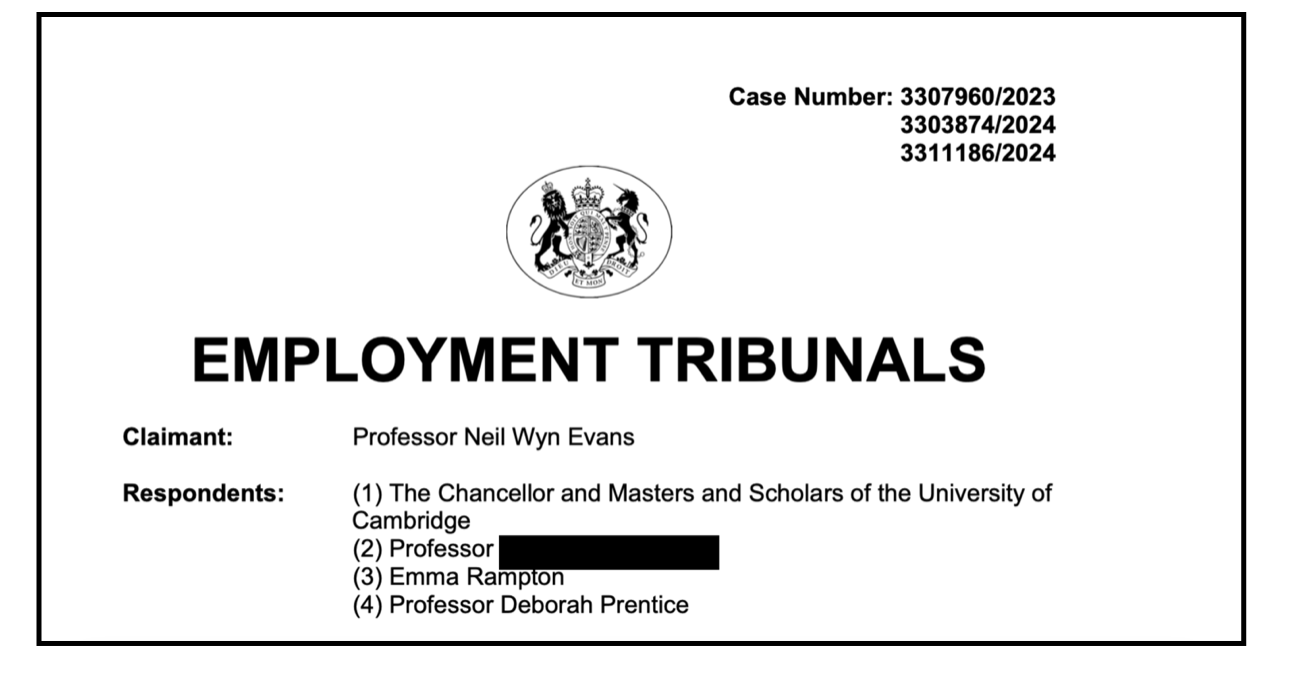
This Employment Tribunal is scheduled to begin at 10:00 am on 1 June 2026 in Bury St Edmunds and is expected to last for approximately four weeks.
The Claimant is Professor Neil Wyn Evans. The Third and Fourth Respondents are the senior administrative officers of the University of Cambridge: the former Registrary, Ms Emma Rampton, and the current Vice-Chancellor, Professor Deborah Prentice. We have voluntarily redacted the name of the Second Respondent.
The matters to be considered by the Tribunal concern allegations made by the Claimant. These allegations are contested by the Respondents, and it will be for the Tribunal to determine the facts and any legal conclusions.
The hearing will take place in public. Evidence presented in open Tribunal — including witness testimony and documents referred to during proceedings — may be reported in line with the principle of open justice. There are no reporting restrictions or anonymity orders in place.
The Claimant’s case raises concerns about governance and institutional response within a prominent academic setting. The Tribunal will hear evidence from multiple witnesses, and the proceedings are likely to examine events affecting a number of individuals connected with the Institute of Astronomy.
Witness statements are typically taken as read and then tested through cross-examination in open hearing. Where such material is relied upon in court, it may be reported fairly and accurately.
Cross-examination is expected to begin during the first week of the hearing, starting with the Claimant, Professor Neil Wyn Evans.
The Claimant is represent by Stuart Brittenden KC (Old Square), the Respondents by Akua Reindorf KC (Cloisters).
Journalists may apply to the Tribunal for access to documents under the principle of open justice. Any such access is subject to judicial discretion. There is no automatic right to inspect the full hearing bundle, though usually access to documents discussed in open court are made available to the press.
Access to the Tribunal should be available online under the principles of open justice. We will update this matter on Monday, as a number of journalists, academics & members of the public have indicated to us problems in obtaining online links.
Thank you for releasing the names of the Third and Fourth Respondents. Hopefully, people who were not aware of the current state of Cambridge University or thought that it is due to HR malpractices alone, can start to see the problem goes way beyond that.
There are surely many current and past members of Cambridge University who are looking forward to see justice in this case, not least because they did not have justice in their own case. Best of luck to Wyn Evans and his lawyers.
It is fucking unbelievable. Someone is letting the American Queen be cross-examined by a KC in full view of the world. Have you seen her interviews? She is out of her depth with a question like: What is your Favourite Soft Plush Toy?
Also, AQ has no fucking idea what has really been going on, her engagement with the really bad parts of the University is non-existent
“AQ has no fucking idea what has really been going on”
That is her fault. Many people contacted her reporting problems and they were ignored at best. I can assure you that she is well aware my own case for example and I had even more problems because I was a member of her college and complained about her lack of response. Quoting the Senior Tutor, “Professor Prentice confirmed that she did not accept the allegations made against her in the complaint,” and the allegations had been that she had ignored the malpractices I had reported to her.
When staff reported bullying attempts she did not reply, and instead, allowed the bullying to continue. Let me know if you want a drop link to download the email archive.
Yes, please can you provide this. We would like the link to the email archive very much.
Please send to gwynfa61 AT protonmail.com
Or if you prefer, we can use signal
The level of gross incompetence and negligence of the American Queen is beyond the pale! Word on the street from well informed sources is that in one of the worst scandals still ongoing (e.g. SCM/cancer reserach) she was sent a letter from 4 senior academics with Sir in their prefix and FRS in their title asking to informally see her and express their grave concerns on how the matter was being handled. Guess what: she REFUSED to see them!!!! She is detached and oblivious by design! She only wants MONEY and perks! A total disgrace!
Same. Reported case of a staff member who attempted suicide to the VC and she did not reply. Even though they were at imminent risk of further attempts due to bullying by HR.
Please send to gwynfa61 AT protonmail.com
Or if you prefer, we can use signal
Even head of the staff trade union struggles to receive an audience.
What is concerning is that Akua Reindorf KC (Cloisters) a longtime board member of the Equality and Human Rights Commission, the EHRC has repeatedly refused to investigate or accept complaints about Cambridge pursuant to their statutory powers. Every Equality Act claim must be notified to the EHRC per the practice direction, and the board must sign off on supporting or intervening. Pays to pay the right Counsel.
Oxbridge has links to the entire British establishment. One can reasonably infer that this is the reason why they were never held to account earlier, while the abuses were small and containable, and instead allowed to grow to the scale that they have. You say it is like the Post Office scandal, but that is unfair to the Post Office. The Oxbridge stories – or rather, the full backstory behind recent allegations both published and yet-to-be-revealed – are much bigger.
I would not be so pessimistic. The “British establishment” is not a monolithic entity (in my experience), but rather more of a shifting sea of “factions” and “interpersonal feuds”. For every “old chum” prepared to offer cover by dismissing this or that claim or story: there’s always some other “bad blood” individual who is more than happy to pick it up, so long as you know where to find them.
Here are minutes from the England and Wales National User Group meeting of precisely two months’ ago (March 2026).
https://www.judiciary.uk/wp-content/uploads/2026/04/NUG-Minutes-ET-12-March-2026.pdf?mc_cid=591f2f3e89&mc_eid=88b46ec0a3
The President of the England and Wales Employment Tribunal system, along with the President of the Scotland Employment Tribunal, stated that he had recently met with three individuals from Cambridge receiving funding from the The Employment Lawyers’ Association.
The ELA is “an independent professional body that influences, supports and interacts with the tribunal system from the outside”.
He also “said his judicial office constitutionally precluded him from making policy recommendations but he urged NUG members to read the book carefully when it was launched at the ELA annual conference in May 2026”.
I make no inference from these facts. They are presented simply as the Tribunal system itself has reported them. I have no reason to believe that senior members of the ET system were aware of the magnitude of alleged misconduct at either Oxford or Cambridge or had reviewed the evidence presented in recent and upcoming cases. And I reaffirm my faith in the British tradition of judicial independence and our values of strict adherence to strict and rigorously impartial rule of law – the values for which we were once admired across the world and may we continue to be admired.
How do you find this material?
It is open source information — I gave you the link.
Any person with access to the Internet can find this and much else besides and an AI agent tasked to continuously monitor such information would do the same within minutes.
You will receive more. Be patient.
Guessing that when the university decided to drag cases out to 2026, it didn’t consider that advances in AI would hand a huge advantage to claimants. And one that only grows stronger with each new upgrade. Just imagine what can be done 3-6 months from now with deep search, metadata collation, autonomous mail query / GDPR requests, media outreach, and case legal aid. The age of secrecy is coming to an end: we are watching it happen in real time.
For those that are interested, you can email [email protected] with subject heading BUNDLE REQUEST: Evans v Cambridge 3307960/2023
“Dear Judge,
I am an observer in the case of Professor Wyn Evans v The University of Cambridge starting 10:00 am on 1 June 2026 in Bury St Edmunds and is expected to last for approximately four weeks. In accordance with the Supreme Court in Cape Intermediate Holdings Ltd v Dring [2019] UK SC 38 may I request a copy of the court bundles so that I can follow along. It is in the interests of open justice that I receive a copy of the bundle. I am happy to receive the bundle via an electronic drop box.”
That way you too will have copies of the witness statments and pleadings.
That is a great idea! It would actually be very useful for me. Do we have to attend in person to have access to this material or wait that remote access is granted hopefully on Monday to ask for the material?
I would make your request as soon as possible. It would be wise to have it on the record in case it needs to be presented at a later date as evidence in the event of any failure to comply with Supreme Court: Cape Intermediate Holdings Ltd v Dring [2019] (UK SC 38).
Done!
Which idiots are handling this case? This is something that took place under Toope, two VCs ago. It is just astonishing mismanagement to expose the present VC to all this? Are the people around the VC trying to decapitate her? It the only explanation I can think of. It’s pretty obvious to most in the IOA that the University will lose this & that it will do huge damage to our department.
The same who handle every case, the university legal services. The decisions are made by them, their solicitors, and the insurance company, before being rubber-stamped by the nominal client, though in practice, this is not the university body as a whole, and formal committees get only a brief overview. Poor standards of disclosure, and delayed or partial grievance investigation, contribute to poor decisions until cases finally reach courts or tribunals. Factors that receive inadequate consideration include reputational risk, legal or client delegated conflict of interest, staff morale, health and safety, and the performance of employees during these long cycles, as well as basic foundational ethics.
I think legal services is the right answer, but they would be unlikely to take the initiative without being instructed by someone further up the food chain. The head of the VC’s office has been a vacant post for the past year. The Registrary has been missing in action, and then a vacant post for about the same period. I don’t believe anyone else would have felt it their responsibility to protect the VC herself from appearing at an employment tribunal. And therein lies the problem of much that goes wrong at Cambridge.
As someone reasonably knowledgable about what went on, my view has always been that someone will lose their job over this scandal, I just never thought it might be the VC. She is in clear & present danger. Optics of this case are truly terrible.
“The Registrary has been missing in action, and then a vacant post for about the same period. I don’t believe anyone else would have felt it their responsibility to protect the VC herself from appearing at an employment tribunal.”
The head of HR is the organisational safeguarding lead – this is significant work-related stress for the VC on top of the inherent work-related stress of being in the VC role – legal are responsible for seeing to it that the organisation meets its legal obligation to regulate work-related stress.
HR/Legal – who are jointly responsible for work-related stress regulation compliance in the organisation – are going to put the VC though a major work-related stressor in order to claim that the VC is the barrier to work-related stress regulation compliance in the organisation? and/or to claim that the VC is responsible for the behaviour of a head of department who is a member of the governing body of the university?
The VC is ultimately responsible. However I believe those that surround her (Registrary, Council, ProVCs, Head of HR, Legal) are the ones that committed the gross miscarriages of decency. In some cases what they did was also unlawful! That is why Tribunals and Courts is where this will all finally come to light. Too late? Almost for sure! UCam is doomed.
“The VC is ultimately responsible.” The VC is ultimately responsible for work-related stress regulation in the university? HR/Legal are responsible for organisational work-related stress regulation in relation to the VC and in relation to HR/Legal themselves – this suggests that HR/Legal are ultimately responsible for work-related stress regulation in the university. The VC is ultimately responsible for the behaviour of a head of department? A head of department is responsible for their own behaviour as a head of department.
Asking whether it is fair and reasonable to make a person in a particular position in an organisation ultimately responsible for something does not answer the question of whether an organisation will be operationally stable if a person in a particular position in an organisation is made ultimately responsible for something.
A person in an organisation is ultimately responsible for their own work-related stress regulation, if an organisation is subjecting a person to significant abnormal, unnecessary and/or unsustainable work-related stressors that will have an impact on a persons ability to regulate their own work-related stress which means the person will have to raise the significant abnormal, unnecessary and/or unsustainable work-related stressors with the organisation at which point HR/Legal are ultimately responsible for the organisational regulation of work-related stress with respect to the person.
HR/Legal are not responsible for the behaviour of a head of department as a head of department but HR/Legal are responsible if a persons employment falls short of the legally expected standard of employment e.g. if the justification for the use of a fixed-term contract in relation to a person that is stated on a fixed-term contract in relation to a person is false.
Stating that a fixed-term contract is three years and non-renewable relies on that fixed-term contract coming into effect in relation to a person in the first place for it to then be a three year non-renewable fixed-term contract in relation to a person. If the justification for the use of the fixed-term contract in relation to a person is false the fixed-term contract never comes into effect in relation to a person meaning that the person is appointed to a role – e.g. university lecturer – in an open-ended contract indistinguishable from every other permanent employee in the same role.
Had the person being supported in the same way as every other permanent employee in the same role – e.g. not been blocked from applying from fellowships with significant research funding all other permanent employees in the same role were supported to apply for – then the organisation could have put the person through the same probationary process as every other permanent employee in the same role after the same amount of time e.g. 5 years for a university lecturer.
Since this was not the case then the organisation would have had to start supporting the person in the same way as every other permanent employee in the same role for the whole probationary period – e.g. 5 years for a university lecturer – and then put the person through the same probationary process as every other permanent employee in the same role.
Dismissing a person from a role on the basis of false and contradictory information as a way to avoid having to correct a significant organisational employment error doesn’t correct the original organisational employment error it just generates a further series of significant organisational employment errors. That in turn can generate a prolonger series of significant abnormal, unnecessary and unsustainable work-related stressors.
A person having a legal obligation to raise health and safety concerns with an organisation as a result of holding a governance role in an organisation is different to a person seeking an individual remedy in an employment dispute.
I am ultimately responsible for my own work-related stress regulation and this is why I left the collegiate university because of I couldn’t regulate my own work-related stress in the presence of significant abnormal, unnecessary and unsustainable work-related stressors. There was a breakdown in trust and confidence in the working relationship on work-related stress regulation.
I didn’t go to an employment tribunal to raise health and safety concerns in that way because I could see that it would not be possible for me to regulate my own work-related stress in an employment tribunal while raising the health and safety concerns. I raised health and safety concerns with the health and safety executive because I could see that it would be possible for me to regulate my own work-related stress raising the health and safety concerns in that way. I took the path that maximised the probability of individual health recovery, the path that minimised the overall organisational work-related stress regulation risk.
The primary risk in my case was the health and safety risk, I dealt with the health and safety risk in my case and complied with the legal obligation to raise health and safety concerns that arose as a result of holding a governance role. The other risks in the case – employment, discrimination and equality, human rights other than article 3 and article 2 ECHR right – are secondary risks. If there is no way to deal with the secondary risks in a case without re-introducing the primary risk in a case then it makes very little sense to try to deal with the secondary risks in a case.
I think it important to point out here that it’s possible for a case to not be arguable in an employment tribunal.
If the case is that it’s in the public interest to prevent substantive unfair dismissals on the grounds that this is a significant unnecessary work-related stressor (health and safety risk) and it is therefore in the public interest to raise a health and safety public interest disclosure on the prevention of substantive unfair dismissals, the counter-case that it is not in the public interest to prevent substantive unfair dismissals on health and safety grounds and that a public interest disclosure that relates to the prevention of substantive unfair dismissals on health and safety grounds is not in the public interest is not arguable in an employment tribunal. To argue against this is to argue it’s not in the public interest for substantive unfair dismissals to be prevented i.e. it is not in the public interest for employment law to be followed which cannot be true of employment law.
A person does not have to interact with the Equality and Human Rights Commission. A person cannot be forced through a human rights court case.
I don’t think it’s arguable in a human rights court that a person does not have the right to prevent work-related stress deaths including their own work-related stress death, to argue against this is to argue that a person does not have the right to life which cannot be true of human rights law.
The only place it goes is to the health and safety executive where a judgement is made on organisational work-related stress regulation.
It examines actions for evidence of effective work-related stress regulation.
A person is responsible for regulating their own work-related stress, that includes raising concerns if an organisation is putting a person under significant abnormal, unsustainable and/or unnecessary stress. The organisation is responsible for responding to any concerns relating to significant abnormal, unsustainable and/or unnecessary stress.
The health and safety executive examines whether a person/group of people took effective actions to regulate work-related stress in relation to themselves and whether the organisation took effective actions to regulate work-related stress in relation to the person/group of people.
It’s a work-related stress regulation learning exercise.
That is the rational response – no games – can’t weaponise a health and safety regulator.
The University and two colleges (Trinity and St John’s) spent £402,868 on law firms to obtain High Court injunctions against pro-Palestine encampments. This is the most of any UK university. A Council member called the use of injunctions “repressive authoritarianism” and led a motion to curb their use without proper approval.
At High Court, in 2025, the University lost its bid for a multiannual, sweeping ban on protest action, due to last initially until July 2026.
As per the statement of Michael Glover to the High Court, the university’s decision to ban civil protests, without governing body approval, was decided by its so-called “Gold Team”.
As of 2025, membership of this “Gold Team” was as follows:
1. Vice-Chancellor Deborah Prentice.
2. Registrary Emma Rampton.
3. Pro-Vice-Chancellor Kamal Munir.
4. Head of Legal Services David Parsons.
The final decision was taken by Emma Machteld Clara Rampton.
In her statement to High Court, Ms. Rampton said as follows: “I did not therefore need to seek the consent of the Council to these proceedings, nor did I seek this at the Council meeting on 27 January 2025”.
How do you know all this?
A trained cloud AI agent monitoring the university may have gathered many gigabytes of documents. Yet in order to achieve a goal of systemic change, what matters is timing — how such evidence is shared to guide and inform salient public narratives and debates as and when they arise.
Rampton was one of the most vile people I have had the misfortune to encounter.
AQ has rid the University of Rampton means that AQ is ever my hero
You may want to follow closely this Employment Tribunal starting tomorrow in Bury St Edmunds then to know what kind of hero AQ is.
If she is truly a “hero”, then she will now be asking some tough questions of Munir, HR and Legal. She may be a witness but doesn’t have to defend the actions of others, after all, the whole point is to give one’s own individual testimony. If she plays the Paula Vennells strategy of attempting to explain away other people’s failures she attaches her legacy to theirs and will be answering questions for a long time, and that, I fear, would be a sad legacy to her career. After a year of scandals, rest assured that there is plenty, plenty more coming and no-one wants to be on board this train until it reaches its final station.
I don’t know what surprises me more about this scandal – that legal services were finally caught with their hands on the knife – or, that for once, HR don’t seem to be responsible.
A major problem is that there is no useful distinction between HR and Legal. We have letters signed by Sam & Louise, closer than close.
What else is necessary for having a Grace in Regent House asking for an external review of HR practices? I would go beyond that and ask for an external review of practices from HR, Legal Services and the senior leadership more generally. It is the time to know who is with them, and who is against them. Delaying such an action will only make things worse because the abuses will continue in the background.
Those not aware of what is happening in Cambridge when it comes to addressing reports of misconduct, please reach out to the victims willing to talk.
If you want more signatures on that Grace, do reach out. I can pretty much guarantee you a pile from this institution from people they are in the process of making redundant. You might have to hurry though, because once they’ve gone they can’t sign the Grace.
I’ve been pondering a ToC/Grace pairing. First a “Oy, Council, the University is breaking the law” and then “If you won’t fix it then here is a Grace to address the issues”. This largely concerns a different collection of bad behaviour by HR (and heads of department).
Sssh … I doubt if the ProVC and the HR Director have mentioned this piece of awkwardness to the VC.
As if the VC would do something about it…
The key question is why the views of the ProVC and the HR Director are important at this stage from members to take action. Is there anyone in Cambridge who do not know their malpractices? If you are aware of any, please encourage them to reach to victims who interacted with them in the past. Why would they agree to an external review of HR practices?!?!? They will obviously do everything they can to prevent it, or at least to delay it until they leave the University.
The longer they prevaricate over the whole HR audit discussion, the longer the whole drip-feed of staff grumbling and leaks goes on. We’ve just had another strike over staff pay, and it all ends up at the same result in the end, the sooner we rip off the bandages and air the wounds the faster we eventually heal.
What happened to the 2025 Annual Remuneration Report by the way? It was supposed to appear in February 2026 as it has every year and report on executive pay… including His munificence the Pro-VC, the presumed 400k cat on the Council.
But in the Cambridge Reporter there’s no mention of it since. Have they decided to stop reporting on senior pay entirely? Isn’t that a bit shocking at a time of massive staff strikes over pay and benefits?
You are correct. My understanding is that a detailed senior-pay disclosure is mandatory as a matter of regulatory compliance (Office for Students) and is reinforced by charity-law accounting obligations. This specified in the OfS Regulatory Advice 9: Accounts Direction.
Further as a charity Cambridge must prepare accounts under the Charities SORP (FRS 102), which mandates disclosure in the notes of total remuneration of “key management personnel” and an explanation in the trustees’ report of how senior pay is set (Charities SORP Module 9).
Either way this must appear by law in the annual accounts. The 2024-25 annual report contains the mandatory breakdown of pay by salary band in Section 14. It waas published shortly before the final deadline of 19 December 2025, though as the file was prepared in May 2025, it is unclear why the University chose to delay its release.
Failure to uphold the annual February interim report, along with the maximal delay to 2025 accounts, suggests bad faith. Industrial action and ongoing controversy over executive remuneration are the most likely explanations, A good first step would be to write to OfS and the Charities Commission to raise concerns of a potential breach, and that they remind the University of its compliance obligations.
Realistically, it is almost certain that the University has prepared the February 2026 data. Therefore an internal decision was likely made to withhold the February publication to staff and the general public. This is certain, because the same data would by now be in its draft 2025-26 report. The University cannot fail to comply with this requirement indefinitely without incurring regulatory sanctions.
Is there a witness cross examination schedule yet?
Did anyone get a CVP link or bundle / witness statements from Watford ET? They simply did not reply to my requests. Presumably today is preliminary issues and reading but we need to start informing MPs if there is no response by end of today.
I have an update. I called the Watford ET again regarding the bundle, and they told me that if I did not receive a response from the Tribunal yet, I should keep trying and send another email requesting the bundle. When I asked if it was realistic to think that I would have the bundle before the end of the hearings on 28 June, she told me that she was not sure because there is a major backlog and the tribunal cannot reply to everyone…
Explain the Tribunal that you intend to attend the hearing in person, and request access to the documents in order to be informed of the matters under consideration. The Tribunal cannot deny you access if you plan to attend.
They must do so in good time, i.e. before the end of the hearings — and ideally, as soon as you have made your request and with minimal delay.
In doing so, you may remind them of the following:
1. Under the Supreme Court’s decision in Cape Intermediate Holdings Ltd v Dring UKSC 38, every court and tribunal has an inherent jurisdiction rooted in the constitutional principle of open justice, and “the default position is that the public should be allowed access… to the documents which have been placed before the court and referred to during the hearing” (Cape v Dring, Devereux Chambers report, INFORRM case comment).
2. The Senior President’s ET practice direction expressly imports this: “On application to the tribunal, members of the press or public may ask to inspect documents put before the tribunal and referred to during the hearing. These may include clean copies of the hearing bundle, witness statements, expert reports, skeleton arguments and written submissions”.
If there are many such requests then it is easy for the ET to compile the documents and share with attendees a download link, and this will also facilitate logistics at the hearing itself, by avoiding problems over sufficiency and access to paper copies.
Thanks very much! I can see we have a lawyer in the house 😉
No problem. We are here to help. From now on all 21 Group members will receive as much support as they need, at no cost.
If documents can be released to the press or public only after any given document has been referred to during the Hearings, then how would the tribunal clerks be in a position to release the entire Bundle to anyone online before the Hearings have ended? And even then the clerks would have to sift through the Bundle to determine which documents were actually referred to?
I understand that there is usually an extra hardcopy of the Bundle prepared for the Hearing, specifically for perusal by any press present (and the public?).
This is correct. The rule is that members of the press or public may ask to inspect documents put before the tribunal and referred to during the hearing, and any prepared archive would need specification on that basis. They can do so as documents are considered or at any time after the hearing is complete.
I understand there are several outstanding requests for full access to the documents that were referred to in other recent Cambridge ET cases, and which the ET, therefore, will now have to disclose to members of the press and public who wish to obtain them.
You definitely need to get the bundle & the witness statements on Foa versus Cambridge University. Huge story of institutional corruption
Was this the nature of the internal report he made in 2024 which triggered the retaliation against him – i.e. that he reported corruption up the chain?
I have followed this blog for a long time but have been hesitant to comment. I am finally doing so with the help of a VPN from home. Anyway, the answer is definitely yes. He did so in July of 2024, and I know this because I was on the committee which saw it.
Protector, please contact the Group.
Part IVA of the Employment Rights Act 1996 (ERA 1996), inserted by the Public Interest Disclosure Act 1998 (PIDA). A disclosure qualifies for protection if the worker, in their reasonable belief, discloses information tending to show (among other things) “that a criminal offence has been committed, is being committed or is likely to be committed”; see section 43B(1)(a). All that is required is reasonable belief, and not that the acts reported are later determined as such by a court (Field Seymour Parkes; Thomas Mansfield, on Chesterton v Nurmohamed).
Regardless of any settlement with the employer, the Enterprise and Regulatory Reform Act 2013 permits the employee to continue bringing detriment claims directly against their individual colleagues, managers or other agents who carried out the retaliation. The individuals would be held liable for their acts.
Once upheld, the employer would likely be found vicariously liable for what its staff did, unless it can show it took all reasonable steps to prevent it, and further investigations in to the original alleged criminal offence would commence (Tribunal Claim Solicitors; Littleton Chambers on co-worker liability).
In addition confidentiality or “gagging” clauses in settlement agreements cannot lawfully prevent prior or further protected disclosures (Thomas Mansfield 2018).
We endorse this post.
It will be very relevant to what is going to be discussed at Bury St Edmunds,
What is required is that the whistleblower has a reasonable belief that what he or she discloses is true and that it is in the public interest.
AntiQ – Thank you for this.
By analogy, is it also the case that if an employee makes a ‘protected act’ under the Equality Act 2010, say for reporting discrimination against another member of staff, then all that is required is any of the following:
a) the employee held the reasonable belief that the other member of staff had been discriminated against, or
b) was about to be (or had the potential to be) discriminated against?
In the case of ‘b’, my understanding is that there is no actual requirement that said act came to pass, but rather that the reporting employee reasonably believed it would or had the strong potential to, for example through emails to that effect?
Anonymous: yes, your understanding is correct.
a) Under the Equality Act 2010 (s.27(3)), it is victimisation to retaliate against a person in any way if they have conducted the “protected act” of reporting discrimination or other breach of the Act.
This does not depend on the ultimately truth or falsity of the report, only that it is made in good faith – that the individual making the report believes it to be true. Even a false-but-honest allegation is still protected (Equality Act 2010, s.27(3)).
b) In regards to your second point (anticipated future discrimination) – yes, the same logic applies. This is also protected under the act. Raising a concern that discrimination is about to happen, or doing something to prevent anticipated discrimination, will generally be protected under the broader limb of the text in (c) – “doing any other thing for the purposes of or in connection with” the Act. For example, sending emails warning that a colleague is about to be treated unlawfully counts as “doing a thing in connection with” the Act.
In fact, the provisions of the Act are stronger than you may be aware, as s.27 also protects you if the employer victimises you because it believes you have done or may do a protected act – even if you never actually did so.
In terms of taking action, you will need to also show that there was 1) a detriment (that you were subjected to some disadvantage such as dismissal, disciplinary, exclusion, being managed out, denied grants or promotion, deliberate ostracism from professional colleagues who are relevant to your career advancement), and 2) causation – an arguable case that the detriment was inflicted due to your initial protected act. If you show a pattern of repeat conduct, this will help prove mental state / rationale under 2).
It is important to meet time limits, i.e. file to Acas as soon as possible and ET within 90 days (barring any conciliation pause).
Thank you AntiQ.
On time limits, is it the case that what matters is the date at which the protect act was made (and not necessarily when the whistleblower became aware of the potential for discrimination)?
In that scenario, if the protected act was immediately followed by a continuous act of detriment up to and including dismissal, then the 90 day limit for filing a claim (with ACAS/tribunal) starts from the date of dismissal (the last detriment in that continuous chain of detriment)?
1. To your first question (does the date of the protected act start the clock?) – the answer is no.
The protected act is the trigger that makes you a protected person, but it is not the event that starts the limitation clock. What starts the clock is the act of victimisation (the detriment) you are complaining about.
This is detailed in section 123(1)(a) of the Act: the three-month clock runs from “the date of the act to which the complaint relates”.
Awareness of the potential for discrimination is irrelevant to the clock, and so is the date of the protected act itself. The clock is anchored to the detrimental treatment.
2. To your second question (continuous detriment ending in dismissal) – it is the date of dismissal, if that is the most recent act of detriment, and covers prior related detriments. Section 123(3)(a) of the Act specifies the definition of: “conduct extending over a period is to be treated as done at the end of the period”. So if the detriments form a single continuing act (a connected, ongoing discriminatory state of affairs), time runs from the last act in that chain.
However, be aware of that a series of detriments does not become a “continuing act” just because they happened in sequence. The tribunal will ask whether they are so linked as to amount to an ongoing state of affairs. This is especially so for dismissal, which would need to be arguably linked to their preceding chain of events that is pleaded as covered by the same logic of victimisation or discrimination.
Finally: while 90 days is a general rule of thumb, the strict wording is 3 months less one day. It may be wise not to leave filings to the point whereby this difference became relevant.
Many thanks AntiQ, this is very helpful.
I just found something interesting in “Disciplinary action, grievances and appeals”
https://www.hr.admin.cam.ac.uk/policies-procedures-z/disciplinary-action-grievances-and-appeals
“Formal hearings and informal meetings under the University’s disciplinary, grievance, and appeal procedures cannot be recorded by either side and therefore will not be admissible as evidence even where a recording exists. A note-taker may be present at hearings to provide a formal record of the meeting. This will not be a verbatim record but will be made available for both parties to review and agree.”
Who is the line manager of the note-taker and who pays their salary? Once I had the pleasure to interact with a note-taker member of HR who, according to subject access requests, sent the notes of an appeal hearing I had at DAMTP to the Respondents and the Appeal Committee starting with “Afternoon team.” When I asked her in which sense the Respondents were part of her team, she never replied… Her line manager will be cross examined in Evans versus Cambridge, finally!
For other readers of this blog, on recording meetings with HR,
please see the comments posted here: https://21percent.org/?p=3007
TheResearcher, thank you for your query.
An answer to your question is as follows. This is not formal legal advice, only a guide to maters you should raise and further consider.
If by “not admissible as evidence even when a recording exists” is intended to mean that recordings cannot be used as evidence in court or tribunal, then you are right. The policy cannot be upheld, nor has it generally been applied in existing ET case precedent.
1. First, while employers can have a no recording policy internally, it is not a criminal offence for an employee to record a conversation they are a party to, even covertly. Therefore, the rule has no legal standing. It can only be requested within internal procedures and apply to that context alone. It cannot be legally enforced.
2. Second, no employer has the authority to determine what a court or tribunal may admit as evidence: nor should an employer ever overstep judicial authority by misleading employees as to their rights or expectations. This is solely for the discretion of the court.
Any attempt to impose an internal employer rule on an external judicial authority undermines the said authority of the judge. This is clearly specified by ET Rules of Procedure: a tribunal “may admit any evidence it considers relevant, regardless of whether it would be admissible in a civil court”. Tribunals are not bound by strict civil rules of evidence nor the code of conduct of a responding party.
3. By extension of the same logic, a defendant or respondent cannot argue that breach of internal regulations can apply to external judicial authorities. Dogherty v Chairman and Governors of Amwell View School, for example, established that “covert recordings are not inadmissible solely because they were obtained by discreditable means”. The manner of recording does not affect admissibility (Vaughan v Lewisham, Casemine, Redmans).
4. Finally, if the context of the recording was an internal employment-related procedure, such as grievance or disciplinary panel, and the context of admission is relevantly related, such as an Employment Tribunal, the attempt to do so could be seen as vexatious. Grievance/disciplinary recordings are routinely admitted. For example, in Punjab National Bank v Gosain, the EAT upheld the admission of covert recordings of private comments made by a disciplinary and grievance panel during a break, including degrading, discriminatory remarks, because they were relevant and were not part of the panel’s protected deliberations (HSF Kramer, LincsLaw). As the latter put it bluntly: “Just because a recording is covert does not make it inadmissible as a rule”. Neither consent, internal procedural compliance, nor data-protection legislation can prevent a court or tribunal from accepting relevant evidence, in particular where a) it already exists, and b) is pertinent to determinations of fact.
Oh boy, Cambridge University will not like to know this… Thanks very much!
Definitely yes. Record everything. Those who attended day 1 of Foa vs. Cambridge say that it was obvious the university case crumbled as soon as they saw quite just how much whistleblower material he had access to, and which they failed to get dismissed.
AntiQ – thank you for this post.
Conversely, what if the *employer* attempted to admit covert recordings they made of an employee, and especially those obtained outside a formal employment-related procedure, or recordings of personal/private conversations made outside the workplace entirely?
Jesus… They have no limits!
I have not yet seen sight of any such limit…
Btw, my question arose in part due to a FOI request that I came across recently:
https://www.whatdotheyknow.com/request/private_intelligence_94#incoming-2418742
The University’s response is there too, which all should read…
” You would like to know if the University has used private investigators,
private intelligence firms or firms that provide intelligence services
from January 2018 to date. If we have used these services, you have
requested further details such as names, expenditure, why the services
were used (and if it relates to student activists/protests/campaigns) and
copies of briefings received from such firms from January 2022 to date.
The University can neither confirm nor deny whether the requested
information is held by virtue of section 24(2) of the Freedom of
Information Act (safeguarding national security) as such confirmation
could impact upon the security of the University and its community. Whilst
we understand the importance of transparency, we do not think that it
would be in the wider public interest to confirm whether this information
is held.”
The FOI question was:
“You would like to know if the University has used private investigators, private intelligence firms or firms that provide intelligence services from January 2018 to date.”
The university replied:
“Whilst we understand the importance of transparency, we do not think that it would be in the wider public interest to confirm whether this information is held.”
This is a shocking response. It is obviously both false and disingenuous. Never once in my career have I ever, ever, ever seen an easier slam-dunk case for failure of FOI compliance.
The public has an obvious interest in knowing whether a university hires private investigators to spy on students and staff.
And equally obviously, it points to a clear potential breach of UK GDPR Article 8.
Not taking GDPR requests seriously is one of the biggest running jokes in UK academia, among the gatekeepers of the data. They just don’t care.
I think that it is a very appropriate time to remind readers about the post (https://21percent.org/?p=1608) that states that Cambridge Legal,
“Sued University of Cambridge and Dr James Knapton, Information Compliance Officer, for refusing to disclose an employee’s personal data in breach of GDPR (General Data Protection Regulation) resulting in a pre-hearing settlement and the provision of previously withheld information.”
Formally it is exactly the same set of rules that determines admissibility of employer covert recordings as it is for the employee.
However, there is one critical difference. A tribunal is not simply a process of interpreting the law, but also, one in which the panel make a decision based on the broader ethics and “reasonableness” of the employer.
Panels understand that ET cases are often “David and Goliath” struggles, and that employees are often forced to make covert recordings in order to document malicious or dishonest behaviour by employers. If the recorded evidence backs this interpretation, it is likely to be admitted and to weigh heavily against the respondent.
It is uncommon, though not exceptional, for the tables to be turned.
As one firm summarises bluntly: “while the tribunals will generally allow an employee to submit a covert recording into evidence… the same latitude will not necessarily be afforded to an employer and employers will generally be held to a higher standard.” The reason follows: “any recording of their employees must be fair, transparent and carried out for the legitimate interests of the employer”.
https://www.fieldfisher.com/en-ie/locations/ireland/ireland-blog/covert-recording-in-the-workplace
An employer is a data controller with statutory duties; an individual employee recording their own meeting is not in the same position. A judge / panel will understand that an employer making covert recordings is in breach of broader statutory duties as a data controller, and highly likely to condemn such behaviour in his written determination of the case, regardless of whether the respondents managed to defeat the claim. This is especially so if there is reason to believe the employer’s practice of covert recording goes beyond the isolated evidence provided, and thereby could infringe GDPR Article 8 (right to private life).
Thank you AntiQ, this is very helpful indeed.
I looked into this recently, for predictable reasons. It is legal to record these meetings. 1 party consent only is required. HOWEVER doing so may be a disciplinary offence which could result in immediate dismissal. Or at least, that is what my research suggested. IANAL.
On the other hand, I understand that a colleague had some success with some transcription software on their phone. The device did not record the meeting. It merely wrote down what was said, but there was no recording. I suspect reluctantly, but they accepted the use of this software in an HR meeting.
In my case it wasn’t much of an issue. I read my questions from a sheet, and then gave them a copy. They read their questions and statements from a script. And the minute taker was more than happy to put incredibly damning details down in writing.
They’ve also given the opposite answers to the same question from different people. All in official minutes.
I could almost accept evil. It is the incompetence I can’t abide.
[…] at Cambridge University. I gather the proceedings will take up to four weeks. For more details see here, where updates will be provided as the case […]