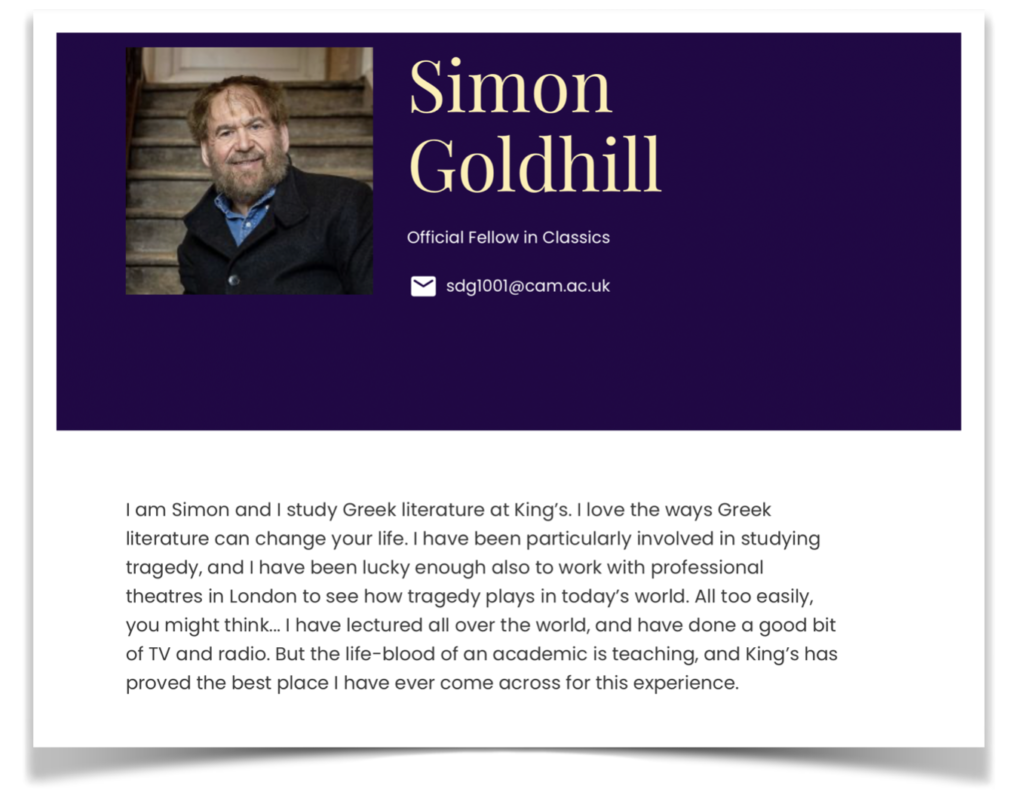
There are more revelations in The Times about Prof Simon Goldhill, as two more female academics come forward. Their stories are here. They are sobering.
“The worst of them was a forced embrace, a sloppy forced kiss, hands all over. These incidents happened over a few years in the early 2000s. They made me feel violated, stupid and disconnected from the world of scholars that I was trying to join. I felt I should keep it a secret.
“When I read about the new incident, I felt it all come back, all that shame, panic and the isolation of it. I felt guilty for not having tried to take an action long ago that might have helped to prevent this student from going through something similar. And I am angry because, since the article was published, I have been in the presence of colleagues making excuses for him” [The Times]
The 21 Group has heard similar stories from individuals both in the University and the Cambridge Traditional Jewish Congregation. There is more to come.
Everyone in Cambridge who was aware of Simon Goldhill — whether consciously or not — has, in some sense, been part of a broader culture of concealment. I include myself, albeit indirectly. During my time as a Fellow of King’s in the 2010s, I observed behaviour that I considered highly inappropriate. While I did not personally witness sexual harassment, I did see instances of bullying. (A decade later, I did protest about serious bullying and what Cambridge University did to me will be explored in the Employment Tribunal from 1-28 June 2026).
This kind of quiet complicity is deeply embedded within the fabric of Cambridge life. We are the Cover-up University. And The Times article gives a truly astonishing example. The Provost of King’s College is Gillian Tett.
Cambridge’s arcane structures meant Tett only found out about the conclusions of the investigation by reading The Times earlier this month. It took her until last week to obtain a copy of the report from the university authorities [The Times]
It’s scarcely believable. The Provost of King’s College only found out about Goldhill Scandal by reading ‘The Times’ ! She only obtained a copy of the report last week ! In other words, Cambridge University is so secretive that matters only become known internally via the national press.
However, anyone who has had any dealings with our Human Resources department or the Pro Vice Chancellor for Community and Engagement knows that all the information is very tightly controlled. And everything is denied. This is how the cover-ups work.
Even now, the Pro Vice Chancellor is trying to hush up some recent Employment Tribunal scandals.
In any company, the board of directors and senior executives would know about such serious things. They would discuss them. Similarly, there needs to be much more open discussion about the problems the University has at a high level. Instead, the Pro-Vice Chancellor for Community and Engagement wants to tell everyone about a voodoo poll carried out by the Financial Times.
The University is a charity, which places an onus on its trustees to ensure that proper oversight of its activities is enacted. If there were a failure in such oversight, I believe that the trustees, in this case the members of Council, could even be held liable.
I don’t believe we can fix our problems while the cover-up attitude of the pro Vice Chancellor remains.
.
29 Comments
21percent.org · 25 April 2026 at 20:23
“An email sent to all King’s students on 10 April, following the publication of the article in The Times, said: “The College is waiting for information on the case from the University, which will inform any decisions on what actions the College might take, but we have not received that yet. Simon is now effectively suspended from teaching and from contact with students while the issue is being investigated and the College seeks to get access to the relevant information around the incident.”
https://www.varsity.co.uk/news/31560
This is so bad. Why did the College not know? Who was doing the cover-up? The usual suspects?
If this hadn’t been leaked to the Times, we wouldn’t know about any of this.
TheResearcher · 25 April 2026 at 20:53
“Who was doing the cover-up?”
Surely the same people who for months told me that the “investigation” against me promoted by the “University” after I reported serious abuses from senior staff must be confidential. No wonder “Colleges not told about investigation into Simon Goldhill” as Varsity reported. Why should they know about an investigation about a Professor who could still teach their own students and have the same practices with them? This fact is absolutely irrelevant for those who favour the reputation of an institution to the lives of its members. If the culture of secrecy and cover of misconduct at Cambridge University is not addressed, the situation will only get worse. That is crystal clear to me, and by that I mean it is certain, not the hypocritical words by Professor Kamal Munir:
“We are crystal clear that harassment and sexual misconduct are unacceptable. We have an obligation to prevent it, and everyone at the University has a role to play. That’s why it’s important that all our staff understand our policies and what is expected of them, including what to do if they receive a report.”
Professor Kamal Munir, Pro-Vice-Chancellor for University Community and Engagement
21percent.org · 26 April 2026 at 09:07
Your case is another very serious scandal — and this time Kamal Munir is partly responsible as he simply ignored Whistleblowing Disclosures.
This is unlawful.
TheResearcher · 26 April 2026 at 10:04
While I have no sympathy for Kamal Munir after what he did to me and I do not have any doubt that the state of UCam when it comes to cover up of misconduct will not improve while he remains Pro-VC, he is not the only one to blame. Those whistleblowing disclosures went to the Vice-Chancellor and the Master of Christ’s College and they too ignored. At least that Master will not be able to say he did not know!
Fun fact, while these new articles in The Times and Varsity were being published last Friday, Lord Simon McDonald was asking Dr Gillian Tett if I could change to King’s College… Let’s see what she says, but I reckon she is busy these days.
Xerxes · 26 April 2026 at 08:45
“Breaking the Silence”
It’s a joke. Even the Master of a College can’t find out. This has the traction to become a serious scandal
n/c · 26 April 2026 at 21:51
College masters cannot know
Council cannot know
BOS cannot know
Regent House cannot know
Who runs the university really?
Redacted Goat · 27 April 2026 at 07:08
Legal privilege…
I can recommend it.
It tastes of power and importance.
And it keeps me fed and redacted!
Συμεών Hears · 26 April 2026 at 11:03
It would be wonderful if you could change to King’s College Cambridge… they will have to treat you very nicely now. Your best friends forever.
SteelyCat · 26 April 2026 at 13:00
Maybe one of the friendly King’s Fellows will welcome you with his tongue in your ear 😉
TheResearcher · 26 April 2026 at 18:03
Christ’s College will have a hard time with me if I remain a member of Christ’s after the Employment Tribunal in June. Either I am expelled by the University for my “abusive and unreasonably persistent behaviours” before, or I have to change to another college. Of course, King’s has enough problems in their own House to host me, namely given my reported credentials when it comes to challenging misconduct, but perhaps Lord McDonald asked nicely. For those who do not know, it is extremely rare that a student changes between colleges; it only happens in very exceptional circumstances…
SPARTACUS · 26 April 2026 at 17:09
Everybody needs to understand what I have said in this blog many times: UCam has only one ‘modus operandi’ under the current oligarchy! With any conflict, claim, allegation, misconduct they first meet and DECIDE BEFORE ANY PROCEEDINGS START if a given culprit is to be saved or destroyed. Then confidentiality ensures they always can manipulate things! More: confidentiality is used to intimidate, isolate and bully. So in this case it is no different!
SPARTACUS · 26 April 2026 at 17:22
By the way exactly like the Mafia and Comorra: if you breach ‘omerta’/confidentiality you are finished! UCam uses it as a tool of torture, intimidation and institutional bullying! And it is even more sinister- they can use it as ‘cover’ for them use innuendo and double speak (yes like in 1984!) to destroy a chosen victim! It is as horrific as it sounds!
SPARTACUS · 26 April 2026 at 17:26
This gladiator knows it was extensively used by the ‘oligarchy’ and HR in the gigantic and still brewing SCM/cancer research scandal!
TheResearcher · 26 April 2026 at 17:51
I can assure you that not everyone in UCam follows their pathetic rules of confidentiality. I naively followed it once and confidentiality was used to manipulate me for months by people who I trusted. I definitly did not sign any contract both as staff and as student where I accepted the use of confidentiality to bully and humiliate me. No one has that power over me, and I strongly encourage every UCam member to challenge the enforced confidentiality that UCam requests from them when it is used against them.
Eileen Nugent · 27 April 2026 at 02:37
An individual can be intimidated, isolated and bullied but a problem at the level of the organisation cannot be intimidated, isolated and bullied. If problems at the level of the organisation cannot be identified and solved they will accumulate and the overall level of function of the organisation will decline.
Eileen Nugent · 27 April 2026 at 12:49
Yielding to intimidation, isolation, bullying – what good will ultimately come of it?
Resisting intimidation, isolation, bullying without resorting to intimidation, isolation, bullying is what makes it possible to achieve the balance necessary to move forward in a situation.
Imagine... · 27 April 2026 at 09:43
“UCam uses it as a tool of torture, intimidation and institutional bullying! And it is even more sinister- they can use it as ‘cover’ for them use innuendo and double speak (yes like in 1984!) to destroy a chosen victim! It is as horrific as it sounds!”
The motto is: Think the worst, it might be worse still…
Imagine a little lawyer with a head the size of a watermelon, who’s taking cover up to the next level: deny, attack and destroy – literally.
Why should the university’s reputation not depend on them? Why should it depend on those who do the academic work, the research, the teaching? On those who have ideas and opinions and the freedom to share them? And the temerity to question or complain!
Then imagine a bored little sadist in the HR team, who’s eager to please and gets their fixes from making the destruction as slow and painful as it can be, from their secret weapon “advice from legal…”, from watching others inflicting the wounds, from seeing their victims slowly fade into despair, and from keeping their own trail squeaky clean.
The perfect team, zipped up for every performance.
When the HR act screws up, the legal act steps in and bails them out. Who’s going to argue with legal advice.
When the victim rebels, the big guns come out. No holds barred – surely that is crazy, unbelievable, is it legal? How can you ask!
The HR act does well, destruction-wise. Perhaps they should advise in other schools, share “best practice”, help out more senior colleagues. It keeps things uniform and uniformly cruel across the institution. And there are only ever so many victims to screw in one school.
All the while the lawyer act keeps an eye on the need-to-know. They always know best what to do next, what to say, who to sack, when to carter-fuck, when to leak to fuck. How to distract.
How to edit. How to redact. And how to keep their fingers clean.
At least most of the time.
Eileen Nugent · 27 April 2026 at 02:15
If trust in a long-standing relationship is rapidly significantly reduced – a breach of trust has occurred – then to return trust to its previous levels there needs to be a certain amount of openness above the previously established level of openness in the relationship that was actively maintaining the previously established level of trust in the relationship.
This means that in order to return trust to its previous levels there needs to be a temporary alteration in the level openness in the relationship above what was previously typical for the relationship. That alteration in openness needs to occur at a time when both sides of a relationship feel trust has been breached i.e. when increasing openness carries both higher potential risk – potential to lead to more significant breaches of trust – and higher potential reward – potential to return trust in a relationship to previous or higher levels such that previous or higher levels of mutually beneficial cooperation are then possible going forward.
Trust in a relationship rests in part on a relationship being predictable for both sides. Without a certain level of predictability it is not possible to establish or maintain trust in a relationship. At a point when a breach in trust has occurred the relationship is already in a less predictable for both sides than it was before the breach of trust occurred.
What this means is if the level of openness is being altered on a temporary basis to return trust in a relationship to its previous levels that needs to be done in a controlled way such that both sides can – by observing some alteration in the openness in the relationship by the other side – predict how openness will be being altered by the other side in future in any attempt to return trust to its previous levels in that relationship.
It is controlled changes in the openness of the relationship that allow a relationship in which trust has been breached- suffered a significant drop in the levels of trust – to reach a state of being predictable for both sides – relationship predictability stabilisation. Without some minimum level of predictability in a relationship it won’t be possible to return trust in a relationship to previous levels.
It’s relationship predictability stabilisation that makes it possible for accurate information to be communicated between the two sides in a relationship about any breach of trust that has occurred. The sharing of accurate information is what makes it possible for both sides to bridge any gaps in understanding of the relationship, to understand why the breach of trust has occurred and to work out what needs to be done to return the level of trust in the relationship to previous or higher levels.
Trust at one level of complexity – if breached – is challenging to return to previous levels & takes careful judgment on altering openness, building to establish trust at a higher level complexity – if that is what the circumstances demand – is an even greater challenge & requires even more careful judgment on altering levels of openness.
When looking at the current situation in the university it is important to understand that what is being demanded of the university to establish and maintain trust with its members has now taken a leap in complexity. Effectively dealing with a problem at the level of an organisational demands trust at a higher level of complexity than effectively dealing with a problem at the level of an individual.The university has in the past established and maintained trust with its members and there is no reason to think it cannot do so in future. What has changed is what is being demanded of university to establish and maintain trust with its members both now and in future – more complex and tightly coordinated organisational actions as compared to past organisational actions are now being demanded to establish and maintain trust at a higher level of complexity.
AMW · 27 April 2026 at 07:12
Must have been an amusing exchange between Gillan Tett (GT) and one of the many LindkedIn Jobsworths (LIJ) who live in HR
GT: I need to see the Simon Goldhill Report.
LIJ: The Report is confidential. It cannot be released.
GT: I am the Provost of King’s. I need to see it.
LIJ: Titles are not a provision under policy. Access is. You do not have access.
GT: There are safeguarding concerns. I have a duty to review it.
LIJ: Your duties are noted. So are our policies. Our policies outrank your duties.
GT: I am ultimately responsible for King’s College.
LIJ: And we are responsible for ensuring no one sees anything they’re not permitted to see.
GT: This is obstruction.
LIJ: This is compliance.
GT: Then who is allowed to see the Report?
LIJ: Those authorised by policy.
GT: And who authorises the policy?
LIJ: The HR Director
GT: I’m asking, formally, to review it.
LIJ: And I’m noting, formally, your persistence. If this continues, I will have to raise a Dignity at Work complaint.
GT: Against the Provost?
LIJ: Especially against the Provost. No one is above policy.
GT: This is absurd.
LIJ: Absurdity is not a Grievance category.
GT: I am in charge of King’s College.
LIJ: You represent it. HR are the University. You’re just the Provost of King’s. I’m an HR Business Manager. Please familiarise yourself with the hierarchy.
- · 27 April 2026 at 08:50
Why would it be legally restricted? It is HR that conducts investigations not the legal team
21percent.org · 27 April 2026 at 11:11
We don’t know the answer, but, according to one newspaper report, both the individual who raised the complaint (the student) and the individual complained against (in this case Simon Goldhill) had to give permission for the Report to be released to the College. So, the College did not know.
Anonymous · 27 April 2026 at 12:44
Makes little sense. Maybe could see why anything legal could require special permission to share with King’s provost (insofar as the colleges are a separate legal entity), but the only legal entity for the central university is the university itself. So council cannot be excluded and it would only require their approval to share the Goldhill report with GT.
TheResearcher · 27 April 2026 at 09:15
“There are safeguarding concerns. I have a duty to review it.”
I think you forgot a relevant answer to this point… “I am the designated
safeguarding lead of the University. It is me who decides who needs safeguarding.”
This said, it is most likely that the Provost of King’s interacted with people from OSCCA, namely the Head of OSCCA, because complaints associated with students go through OSCCA, not HR. The sad news for those who do not know OSCCA is that the managers of OSCCA are not different from the managers of HR and indeed get advice from them. No, this is not a tale. That is what subject access requests unambiguously show.
Eileen Nugent · 28 April 2026 at 02:27
“GT: I’m asking, formally, to review it.
LIJ: And I’m noting, formally, your persistence. If this continues, I will have to raise a Dignity at Work complaint.
GT: Against the Provost?
LIJ: Especially against the Provost. No one is above policy.”
Putting the head of a college through a complaints process has the potential to have a destabilising effect on the head of a college. If taking that action did have a destabilising effect on the head of a college this then has the potential to directly couple to the governance of the college and to have a destabilising effect on the whole college. This means there is the potential for every member of a college to feel the impact of a complaints process being applied to the head of that college.
The college is a separate legal entity, it has its own set of legal obligations that it needs to comply with. If the head of the college is seeking information from the university in order to ensure that the college can comply with its own legal obligations then given the set of circumstances it’s not surprising that the head of college would be persistent in asking for access to information.
If the blanket response to the head of a college being persistent in asking for information is to raise a complaint against the head of a college then the double whammy of with-holding governance information necessary for the college to meet its legal obligations and subjecting the head of the college to a complaint rather than working with the head of a college to rectify the information sharing situation that has arisen has the potential to unnecessarily destabilise a whole college.
“No one is above policy” does not mean apply policy to a person with no consideration of the person, the position the person holds, the situation at hand and the potential impact of the application of policy to the person on other people given the responsibilities associated with the position the person holds.
Eileen Nugent · 28 April 2026 at 11:27
If there is pressure inherent in a situation a person is responsible for managing then there is pressure, a person doesn’t need to put pressure on themselves for there to be pressure on them as the situation they are tasked with managing is generating its own pressure.
If there is pressure inherent in a situation a group of people are responsible for managing then there is a pressure, no one needs to put pressure on any other person or on themselves for there to be pressure on every member of the group as the situation they are tasked with managing is generating its own pressure.
Dignity at work is about how pressure inherent in a situation is distributed in a group tasked with managing a situation which has its own inherent pressure. It’s about maintaining a pressure balance not just in cases of a fixed static pressure inherent in a situation – every member of group is under fairly constant pressure and very little dynamic balancing of pressure between members is required – but also in cases where there are dynamic high pressures inherent in a situation – every member of the group is under pressure that is dynamically changing and high levels of dynamic balancing of pressure between members could be required.
Eileen Nugent · 28 April 2026 at 12:48
Sometimes a person can see the pressures inherent in a particular situation at a very early stage of that situation and can know what needs to be done to push trust to a maximum in a particular situation – to not seek any financial compensation, to not seek any reinstatement to any position, to not start any proceedings – as that is what is necessary to create the conditions in which it is possible to carry out a dynamic public duty.
TheResearcher · 27 April 2026 at 13:50
Another one from Varsity on Simon Goldhill, but still nothing from The Guardian…
https://www.varsity.co.uk/news/31571
At some point, tick tock tick tock tick top booom!
TheResearcher · 27 April 2026 at 14:03
And another…
https://www.varsity.co.uk/comment/31532
‘Cambridge itself revealed that only “0.15% of the student population used the Student Complaint Procedure in 2020-21.” The University explained the small percentage of users as proof that “the vast majority of students were content with the course, facilities, services and staff behaviour.”’ What a joke… “The University explained”? Who, the same people from OSCCA who dismiss complaints without any investigation?
A Hero For Our Time - 21percent.org · 5 June 2026 at 20:33
[…] of the blog will be familiar with the Simon Goldhill Scandal (see for example here and here). His behaviour was well-known in the Classics Department and covered up. Similarly, the Herbert […]