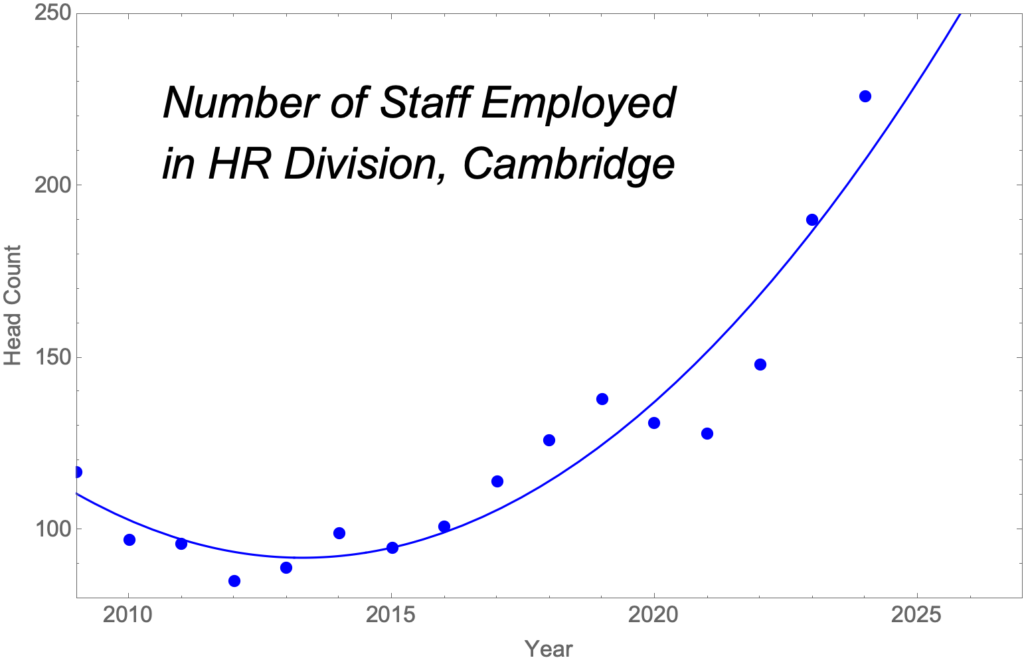
The infographic shows the number of staff employed in the Human Resources division in Cambridge University over time, together with simple parabolic fit to the data. We can see a very steep rise since 2021 that still is continuing apace (despite budget cuts for everyone else!)
We highlight the contribution from poster Human Resource here.
“I think if management consultants took a look at how the university is run they’d be in total despair. Our goals are supposed to be to helping scholars to maximise delivery on teaching, research, impact and grant income. Instead of resolving minor squabbles HR ignore then worsen them, then outsource cost on to other academics via committees and panels as well as lawyers and eventually health services once the whole circus takes staff to breakdown. Any company run like that would be set on a fast track to bankruptcy.” (Human Resource)
This is true.
The HR Division is responsible for a substantial part of Cambridge University’s deficit. It’s not just the growth in HR personnel, it’s the concomitant increase in referrals to Occupational Health and Staff Counselling, the increased number of Freedom of Information and Data Subject Access Requests and the burgeoning number of legal cases. A huge amount of academic staff time is consumed by panels and appeals as the hyper-aggressive HR business partners go about their jobs.
There is also an enormous cost in human distress.
The HR division not fit for purpose. It needs to be re-organised if Cambridge University is ever to return to health.
Cambridge is not atypical. A large part of the collapse of Universities in the UK has been driven by the disproportionate rise in HR departments over the last 10 years. It’s unproductive social welfare for the middle classes and a huge burden on teaching, mentoring, development and research staff.
59 Comments
SPARTACUS · 27 November 2025 at 18:49
The only way to sort this gigantic mess is with a complete renewal! VC and all the top team must go! Chancellor needs to do something!
Eileen Nugent · 27 November 2025 at 22:07
The current VC is in the buffer zone. If the organisation gets rid of the current VC then the buffer zone collapses and the organisation is dealing with all its external regulators. If the organisation wants close to infinite organisational pain then that is the way to do it.
Anon · 29 November 2025 at 19:22
The current VC is a rather introverted character. That is not necessarily an impediment to being an effective manager (nor untypical in academia!) But it does help explain this mess. The problems described on this forum long predate her arrival but she could easily have got a grip on things earlier with a more hands-on style.
I am talking here about quite concrete things.
(1) responding to requests for meetings from student and staff groups (such as this one) and unions to hear from the other side, (2) offering an open door for staff to feel able to report their experiences, (3) in-person town hall forums, (4) a significantly more confrontational style — to interrogate the motives and actions of those around her, rather than trust naively and bury one’s in the sand while getting distracted by big ideas and visions.
TheResearcher · 29 November 2025 at 19:38
So that it is clear, the Vice-Chancellor Professor Deborah Prentice is not just ignoring general emails of staff and students who contact her to report their concerns, but in particular, Prof. Prentice is ignoring representations under Statute AIX, which are of her responsibility, not HR’s or others. I know for a fact that Prof. Prentice is fully aware of my situation, not least for being a member of my college and the entire College Council is aware of it. There is no excuse for ignoring formal representations under Statute AIX, and she ignores it. For those not familiar with Statute AIX, I copy/paste it below:
https://www.admin.cam.ac.uk/univ/so/2019/statute_a-section9.html
“If, within thirty days after the doing of any act by any person or body having power to act under the Statutes, or in the event of failure or omission to act as required by Statute, Ordinance, or Order within thirty days after the date specified for the performance of that act, it is represented in writing to the Vice-Chancellor by a member of the University that there has been a contravention of the Statutes, Ordinances, or any Order in the doing of such act, or in such failure or omission, the Vice-Chancellor shall inquire into the matter and shall declare either that there has been no such contravention, or that the said act or matter is of no effect, or, if the Vice-Chancellor is of the opinion that the contravention has not affected the result, that in his or her opinion the validity of the act or matter is not affected by the circumstances represented. Where the Vice-Chancellor finds that there has been a failure or omission to act he or she may give such directions in the matter as shall seem to him or her to be appropriate. The person making the representation shall state in writing the act or matter to which he or she refers, and with full detail of the contravention of Statute, Ordinance, or Order which he or she represents has taken place. The Vice-Chancellor shall give his or her decision promptly but in any event within three months, unless the person making the representation has agreed in writing to an extension of time.”
Eileen Nugent · 29 November 2025 at 21:22
The Vice Chancellor is responding as the Vice Chancellor of the University and would be expected to take legal advice in determining an organisational response, if there is a potential problem with in-house legal it’s not clear how that then works. People can throw the statutes and ordinances at other people in the university and see where that gets the university. If the statutes and ordinances were functioning and optimised for the universities current set of legal obligations then the university would not be in its current state, they aren’t and it’s not clear they can now be applied in their current form to get the university out of the state it is in. Being fair and reasonable, that is the basis of efficiently solving organisational problems, that is the basis of sound organisational decision making and that is what judges will look for in any case.
Lilliputian · 29 November 2025 at 19:59
If she had rooted out bullying and staff retaliation it could have been the crowning accomplishment of her career. I suppose it still could though the hour is rather late.
21percent.org · 29 November 2025 at 21:00
She was Provost of Princeton from 2017 to 2023.
Was she a successful Provost? (Princeton is smaller & richer than Cambridge, so it’s probably easier). But, it’s a genuine question, we’d be interested to hear if her Provostship was a success.
She would have had to deal with the sex allegations against Prof Joshua Katz
https://www.dailyprincetonian.com/article/2022/05/princeton-professor-joshua-katz-fired-classics-investigation-board-of-trustees
She was in office and was part of the senior leadership when Prof Katz’s tenure was revoked
TheResearcher · 29 November 2025 at 21:35
The poster England’s Dreaming highlights in (https://21percent.org/?p=2867) that there is an important cultural difference between how British and Americans/Europeans deal with the admission of error. Perhaps at Princeton, Professor Prentice was following the American version following England’s Dreaming’s distinction. One would think that she would bring this version of dealing with error to Cambridge, but clearly it has not happened. An important question is what will happen when she is back to the US. If she is planning to bring with her the learnings she got from UCam, I wish the new institution best of luck because the situation here is increasingly worse.
/ · 29 November 2025 at 22:24
https://www.thefp.com/p/what-princeton-did-to-my-husband
21percent.org · 30 November 2025 at 00:13
They’ve become Heroes of the Anti-Woke and Darlings of the Daily Mail
https://www.dailymail.co.uk/news/article-10849455/Princeton-professor-claims-fired-view-campus-politics.html
Posted so you can enjoy the batshit crazy comments from DM readers
Prof Katz was sleeping with a student he was grading, so it’s a huge red flag. Deservedly sacked.
Sven · 29 November 2025 at 22:33
This is a good point. There are lots of badly behaved individual academics in the States but this kind of centrally organized systemic abuse is completely inconceivable
Eileen Nugent · 29 November 2025 at 22:57
It’s an organisational fault in a British University, that means a collective organisational response is required so the response will be determined by majority British academics, the response will be in line with British Culture. American/European culture cannot be imposed on a British University. British culture has more focus on prevention, that is in line with a subset of European countries, these changes are about installing a system of prevention so whilst the length of the admission of error process may be longer due to the established culture – longer error processing – the actual changes required are not in conflict with the established Culture – they are in fact highly compatible with the established culture – so there is no reason to suggest that British culture would impede the required changes when the two elements are taken together – admission of error + time to install system of prevention.
Eileen Nugent · 29 November 2025 at 23:39
The one thing that the I think Cambridge and Princeton have in common is that there will be people in both who will push to be in direct contact with the boundaries set by the laws of the land – i.e. states of higher personal risk – which when the laws of the land are in the process of shifting can lead to difficulties both for the people reaching to be in direct contact with a shifting boundary – risking being on the wrong side of it and the laws of the land – and for the organisation that might be under external pressure to respond to that situation.
This is a very difficult situation for any university to deal with because sometimes people in universities can be far ahead of both the rest of the university and of the kinetics of the laws of the land so they can see where a new boundary could lie before others. Some people won’t want any organisational restrictions that soften the boundaries set by the laws of the land and prevent them from reaching for direct contact with these boundaries. I think this is where organisational restrictions on e.g. personal relationships will run into difficulty.
Eileen Nugent · 30 November 2025 at 00:59
The British are in the process of redefining British culture because it is not what it was in 1973 when Britain joined the European Union and it now needs to change to adjust to Britain not being in the European Union. There is also the process of rebuilding national self-regulation for the same reason as that is what is required in that situation. Americans can try to influence that, Europeans can try to influence that but the reality is that it is the British themselves who will determine the path forward in that situation and they will find ways to rid themselves of any external influence on their culture in that particular situation.
There is a difficult problem in a university – I don’t think fixing it requires a complete reworking of the culture of the nation state that it is embedded in – I think the Catherine Mac Kenzie case could be solved and the university could make a start by solving it, that is compatible with the Cambridge culture of solving difficult problems.
Eileen Nugent · 30 November 2025 at 02:31
I think at attempt to impose American Culture on a British University would be resisted at any time but I think this particularly to be the case while Britain is going through that particular type of process. British universities operate under a different set of constraints to American Universities which means certain aspects of American culture are likely to be incompatible with British Universities something that might only be discovered on attempting to impose a particular cultural aspect.
I think a way forward in a situation like this is to provide accurate unbiased information that draws on experiences in or knowledge of different universities.
I don’t think the University is far off being in a self-regulating state. I think the main reason the university is finding it difficult to get back to a self-regulating state again is that the MacKenzie case has been baked into the system for more than a decade now resulting in a constant offset from being in a self-regulating state. I think this means that the magnitude of moral dither that needs to be applied to the system to make it possible for the system to find and lock on to the moral state that it should have been in before the pandemic is quite high. Solving the MacKenzie case would get the university back to a state where it is self-regulating on employment again – which will then constrain work-related stress – and from there it is should be possible to get to state where it is self-regulating both on employment and on work-related stress.
Eileen Nugent · 30 November 2025 at 02:51
“will find ways to rid themselves of any external influence on their culture in that particular situation.” – by this I mean that any information in relation to culture will be checked for accuracy and signs of bias and that ways will be found to do that.
Eileen Nugent · 30 November 2025 at 03:00
That is what has changed for people of every citizenship currently resident in Britain including British citizens themselves – the need to represent British culture accurately and without bias.
Anon · 30 November 2025 at 09:25
In matters of “appropriate sexual conduct on campus” the biggest problem is the absence, in Britain, of frank, transparent and grown-up dialogue and attitude about sex and relationships.
A sexual relationship between members of an institution is not always inappropriate, not always unethical. Nor is it always someone else’s business.
Among all the very serious abuse of power and predatory conduct, which is correctly highlighted as unacceptable and dangerous, it remains important to keep in mind that genuine consensual sexual relationships still exist, and may emerge out of contexts which may be considered at odds with “appropriate conduct”.
It is hopefully still conceivable that people may fall in love, even in universities. We may well know of a PhD student who ended up marrying their former supervisor. Or of two members of staff involved in a personal relationship.
Such relationships have nothing to do with sexual misconduct, i.e. with predatory and coercive behaviour of one party, or exploitative behaviour by another.
Such relationships can nonetheless be problematic and unethical, when the parties are in a student-staff liaison which would jeopardise the integrity of student assessment that is central to a university’s business. It then becomes someone’s responsibility to deal with the (potential) loss of integrity and apply the relevant disciplinary measures.
But in the absence of evidence to that effect, it does not become someone’s business and responsibility to make accusations of sexual misconduct, predatory behaviour or harassment, and defame a colleague in any such ways.
Anon (2) · 30 November 2025 at 11:54
No-one is questioning whether there can be consensual relationships between students, or between members of staff at equivalent rank (or at least provided conflicts of interest are disclosed and addressed through suitable changes in line management where needed). (Though that said, differences in power and status should not be brushed under the carpet either, if they are used repeatedly to exploit those in a more vulnerable position, as also appears to occur quite frequently.)
That said, what we are dealing with here are allegations of sexual harassment and assault that were either a) not investigated, b) not sanctioned when found to be true, and/or c) resulted in organised retaliation against the victim. This is where the slippery slope leads and it is simply wrong. Full Stop.
Anon · 30 November 2025 at 12:25
The dynamics of bullying in the US and UK are totally different, in a way that perhaps contributed to this failure. In the US it is not a problem of “Big Brother” but of “Little Brother”:
1) In the US campus activism works in overdrive, producing a culture of witch-hunts. There are constant and ongoing campaigns to root out academics who are seen as insufficiently progressive or failing on some other standard of social justice purity. Everything takes place in public on social media, student news and the campus yard. The challenge of university management is to calm things down while investigating those cases of truly awful conduct that do come to light.
2) In the UK, though, we have almost the opposite problem. The retaliation, victimisation and personal attacks are all done by the university management itself – which has overwhelming power and resources in comparison to the academic faculty, even up to a very senior level. Everything is kept secret, and quite deliberately so. They use the legal system to grind people down, if not via direct threats, then by grinding cases out to exhaust victims morally and financially. It is genuine authoritarianism, and also an abuse of public money, not least of all as those taking an ever-larger share of the pie do not themselves serve any obvious educational role for parents or taxpayers.
The right-wing tabloids would see that pretty clearly. It is not a case of woke activism, but of decent people trying to save our country from the Road to Serfdom.
Eileen Nugent · 1 December 2025 at 16:08
To be more accurate a culture is continuously defining itself, so this is more like a discontinuity – small shift – in the definition of culture during a political transition and the task is to get back to a well-defined cultural point from which the culture can continuously define itself again. There are roles for both citizens and non-citizens in the process but the key thing is accuracy and the elimination of bias with respect to the culture that is being defined.
Eileen Nugent · 2 December 2025 at 13:07
I think the root cause of some of the most difficult cases in academia are situations where one person is in a compound safeguarding relationship with another person and then enters an intimate relationship with the person. A PhD supervisor is in a compound safeguarding relationship with a PhD student because they are a key person in the regulation of workload and other organisational adjustments at times when a PhD student is experiencing increased vulnerability.
Clearly if a PhD advisor is in an intimate relationship with a PhD student in addition to being their PhD supervisor that is a significant extra difficulty in an already difficult situation – person experiencing increased vulnerability. Academia is highly specialised, people can be very passionate their subject and unwilling to shift their research focus. I think these additional factors then increase difficulty in an already difficult situation.
Eileen Nugent · 2 December 2025 at 13:51
It seems like e.g. at the point that a PhD supervisor and a PhD student enter into a consensual sexual relationship then the PhD supervisor is resigning their supervision of the PhD student and the PhD student is applying to change their PhD supervisor. It is then a mutually agreed change in PhD supervision arrangements to make way for a consensual sexual relationship that could lead to life-long happiness.
Eileen Nugent · 2 December 2025 at 14:21
You would expect that to be a rare organisational event. Both parties would have an obligation to disclose any changes in PhD supervision arrangements to the organisation.
Eileen Nugent · 2 December 2025 at 14:36
Obviously if a PhD supervisor is putting undue pressure on a PhD student to enter into a sexual relationship when the PhD student does not wish to enter into that type of relationship with their PhD supervisor then this is putting pressure on their PhD student to change their PhD supervision arrangements for no good reason which is not acceptable.
Eileen Nugent · 9 December 2025 at 00:03
The thing that can catch you out in some of these difficult individual cases in academia is that what statements a person is making tells you much less about a person than how a person combines their own statement making with their activity to suppress the statement making of others. For example saying X lives matter tells you that a person cares about X lives and thinks X lives are worthy of societal protection. There is nothing wrong with a person making this statement because X lives do matter and are worthy of societal protection.
Making the statement that X lives matter whilst at the same time undertaking activity to suppress others from making statements to the effect of : All Lives Matter or Y[= subset of people in society who are not covered under X lives matter] Lives Matter is however wrong because this has the potential to revert society back to a state where society will only accept statements to the effect X Lives Matter and will actively suppress statements of the kind : All Lives Matter or Y[= subset of people in society who are not covered under X lives matter].
It doesn’t matter what X is in that equation, this is a reversion to a societal state with high levels of unnecessary discrimination which is an extremely inefficient societal state for any society to become stuck in because it is a societal state where a society has no hope of fulfilling its maximum potential as a society and of developing its maximum capability as a society.
A person with from the Y subset murders a specialist surgeon because they are from the X subset, the next day the murderer shows up in that surgeons hospital after being stabbed by a person from the Y subset they had a disagreement with. Unfortunately for the murderer the stab wounds are complex, they just murdered the most senior and most competent surgeon in the hospital and all the surgeons close colleagues are still grieving the loss of a friend and colleague which has a potential impact on their surgical work. It’s close but the patient doesn’t make it despite the best efforts of their surgeons who do not know that the patient murdered their colleague. A society stuck in a state with high levels of unnecessary discrimination is a society that is stuck in an extremely inefficient societal state.
Eileen Nugent · 9 December 2025 at 01:29
I don’t worry about countries that give all members of society who can represent themselves directly in society direct representation in society being overtaken by countries that don’t and that deny half or other fractions of their population direct representation in society. Countries where a higher fraction of the population is indirectly represented in society are in a less efficient societal state relative to countries with a higher fraction of the population is directly represented in society.
Some countries seem to be trying to resist external influence on their country but trying to achieve a state of being exactly unlike another country in every respect or being exactly unlike any other country in any respect – a state of being the complete opposite of another country or being the complete opposite of every other country – apart from this being physically impossible, it is also not a state of resisting external influence on a country.
One state of maximum external influence on a country occurs when a country tries to be exactly like another country in every respect or exactly like every other country in every respect but another state of maximum external influence on a country occurs when a county tries to be exactly unlike another country in every respect or exactly unlike every other country in every respect.
The problem with either of these states of maximum external influence is that there is then no neutral evaluation of what is going on both internally in a country and externally in other countries. There is no neutral analysis of internal developments because all analysis is coloured by a strong desire to develop in the exact same of the exact opposite direction to another country or to all other countries. There is also no neutral evaluation of external developments in other countries for the same reason. These states of maximum external influence can result in a country losing its ability to continuously identify external developments that have the potential to strengthen its own internal society at every stage of its own internally driven societal development – something which could increase its societal power – which is what maximises the capability of any country to continuously resist any external influences on itself that it has not selected for itself to be influenced by.
If a country wants to effectively resist external influence on itself then it should listen to the maximum number of its own internal voices possible, what developments do they want to see in their own country and how can they work collectively towards making the developments they want to see happen, what have they seen in other countries – past and present – that might work in their own country, what do they see in other countries that is not working that they don’t want to see in brought to their own country, what do they see in other countries that is not working but maybe ahead of its time in that other country that might work in their own country. Optimising for overall societal health is a constant constraint in judging the internal development process of any country.
Eileen Nugent · 9 December 2025 at 03:34
The more advanced a society is, the more specialised individuals in that society have the potential to become. Individuals in advanced societies undergo – prolonged : high-quality : societal-resource- intensive – education and training supported by advanced societies. There are then higher levels of necessary discrimination in advanced societies – competence based discrimination to select the best individual available to occupy a highly-specialised societal role. That necessary discrimination to match a highly-specialised individual to a highly-specialised role in society is something that has a significant impact on the quality of life of all individuals in an advanced society. The presence of significant amounts of unnecessary discrimination – I.e. a reduction in the overall standard of necessary discrimination that can be achieved – in an advanced society with a higher fraction of highly-specialised individuals has a much greater overall impact on the functioning of that advanced society than it would have on a less advanced society.
An advanced society could try to correct one form of unnecessary discrimination to increase its overall ability to function as a society but in the process of trying to correct that particular form of unnecessary discrimination it could introduce the polar opposite form of unnecessary discrimination. That could then set in motion one of these never-ending oscillations of unnecessary discrimination where unnecessary discrimination in a society swings from one pole of an unnecessary discrimination spectrum and then back to the other pole of an unnecessary discrimination spectrum before heading back to the other pole again i.e. an unnecessary discrimination oscillation is set up in an advanced society that is in the process of trying to correct unnecessary discrimination to improve its overall ability to function as an advanced society. If the unnecessary discrimination oscillations are large enough and persistent enough such oscillations could kill all societal progress in an advanced society stone dead.
This is an even more difficult unnecessary discrimination situation for a society to have to deal with than static & fixed unnecessary discrimination that is embedded in a society. The latter is more amenable to analysis i.e. a society is in a better position to determine an accurate societal correction mechanism for a static and fixed unnecessary discrimination embedded in a society. The former is an unnecessary discrimination oscillation swinging through society like a cannonball on a rope – swinging back and forth through society – wrecking every societal organisation and every individual unfortunate enough find themselves in its swing path. There are then severe violations at both ends of a spectrum of unnecessary discrimination.
All those who experience severe violations as a result of one of these oscillations of unnecessary discrimination ripping through a society are deserving of societal compassion. There are however two challenges that people in the position of having experienced severe violations in the wake of one of an unnecessary discrimination oscillation having ripped through society (a) statements to suppress societal compassion for those impacted by severe violations at one pole of an unnecessary discrimination spectrum by those impacted by severe violations at the opposite pole of unnecessary discrimination spectrum while they themselves are in the process of making statements to elicit societal compassion for their own severe violations (b) a decrease in the overall capacity of society to have compassion for any individual in society because the unnecessary discrimination oscillation has had the dual societal impact of (i) stalling or possibly even reversing societal progress and decreasing the overall ability of society to function (ii) increasing the overall number of people in the society who have experienced severe violations and who are in need of societal compassion.
Eileen Nugent · 9 December 2025 at 06:55
One thing it is possible to notice during an unnecessary discrimination oscillation in an advanced society is the volume of social media posts generated during it that are devoid of much – if any – useful information for society. A significant number of these posts that are devoid of any useful information for society are written specifically with the aim of maximally insulting, offending and verbally abusing other individuals on social media – who are making accurate statements in relation to unnecessary discrimination – in an effort to inflict the maximum emotional damage possible on those other individuals over social media in order to suppress them from making any further accurate statements in relation to unnecessary discrimination in future.
Those in charge of social media platforms are some of the strongest defenders of free speech which in principle is a good thing for the societies their social media platforms operate in. I am sure that no one knows better than this group of people – in charge of social media platforms – that free speech dynamics are complicated and that it’s often not clear what the most efficient way to defend speech is in any given societal situation, particularly a high-risk societal situation. I think a more detailed understanding of the interaction of free speech dynamics on social media platforms with an unnecessary discrimination oscillation as it propagates through an advanced society would enable social media companies to more efficiently defend free speech in advanced societies within the constraints of – water usage and water infrastructure, energy usage and energy infrastructure, data storage capacity and data infrastructure, chip production capacity and chip manufacturing infrastructure – that are being set by the currently running societal technology development drive – AI.
Some types of free speech – making accurate statements in relation to unnecessary discrimination – contain more useful information for a society i.e. information that has a higher potential to lead to improvements in the overall function of society over time as compared to other types of free speech – aimed at maximally insulting, offending and verbally abusing other individuals making accurate statements in relation to unnecessary discrimination in an effort to emotionally damage those individuals and suppress them from making any further accurate statements in relation to unnecessary discrimination in future – which have the potential to increase the rate of societal degradation processes – violence/community destruction processes – whilst simultaneously reducing the rate of societal improvement processes – co-operation/community construction processes.
What social media platforms are then getting into in that particular type of societal situation – oscillation of unnecessary discrimination in an advanced society – is the utility of different types of free speech to society and the prioritisation of different types of free speech which have (a) differing amounts of useful information content for society and (b) differential impacts on the rate of societal degradation/improvement processes in a society, in order to optimally determine how to allocate a limited pool of societal resources to generate an overall protection of free speech for a society that can effectively protect every individuals right to free speech in that society in an efficient way that is maximally beneficial to society.
Eileen Nugent · 27 November 2025 at 22:09
Lessons in organisational autonomy – being kind (accepting some abuse), being even kinder, being even kinder still – out of the kindness regime – getting the external regulators in.
Eileen Nugent · 27 November 2025 at 22:25
The organisation needs to bear in mind that I recognise a strong legal obligation to national regulators, to not do anything that is not in the interest of national regulators.
Eileen Nugent · 27 November 2025 at 22:35
The organisation is isolated for the purposes of restoring self-regulation.
Eileen Nugent · 27 November 2025 at 22:38
If organisational self-regulation cannot be restored a series of legal processes is available to trigger an intervention from national regulators.
Eileen Nugent · 27 November 2025 at 22:41
Personally I don’t think than an external intervention will be necessary but nonetheless that option needs to be there to safeguard people in the organisation.
Eileen Nugent · 27 November 2025 at 22:47
It’s up the organisation to move itself forward now. I am on stand by for an external regulatory intervention. I will work on optimal organisational handling of different types of work-related stress cases.
Eileen Nugent · 27 November 2025 at 23:00
People in Cambridge won’t give up when faced with a difficult and complex challenge, they might move more slowly and with more care in that situation and it might sometimes look like they have given up, but they have not given up, they are just in the process of getting everything right.
- · 30 November 2025 at 14:43
>> People in Cambridge won’t give up
Yes and this points to a fundamental error of judgment in how universities handle these situations. One that links back to the mistakes of the Post Office.
We can start with the Post Office. A person who chooses to become a local postmaster is a person who feels a strong sense of connection to their neighbourhood and community. Someone who is motivated by a sense of connection, altruism, duty and civic purpose. Someone who is not just in it for the money, but who also wants to give something back. Once they got together to form an alliance it was stupid of the Post Office to think that they would give up or be happy with small payouts because these are people with deep moral integrity and high ethical standards. Society now recognises the value of their cause and that is of greater worth for them.
A person who makes it as an academic is a person with exceptional resilience and also a vocational commitment to accuracy and the truth. While most ordinary people would roll their eyes, laugh, give up and walk away from a situation of injustice and dishonesty, that is simply not how scholars are. The same persistent determination that is required to gain entry to this profession and perform, is the same energy that drives scholars to persist in the face of injustice in spite of whatever obstacles are placed in their way. Professor Sheikholeslami fought for 13 years to achieve justice but never gave up. This year she was finally awarded over £1 million in damages and costs from Edinburgh. Professor MacKenzie faced repeated obstacles from Cambridge to comply with judicial orders, but has insisted on the letter of the law. Any vaguely sensible university human resources department would start from this fact. And then, try to resolve situations fairly and honestly, rather than get enmeshed in such never-ending and self-defeating disputes.
NotaQuitter · 1 December 2025 at 00:27
A 13 year fight … that is a huge fraction of the working life of an academic. I am in awe of Professor Sheikholeslami.
It’s an inspiration to those of us who have been fighting the corrupt regime in Cambridge for just 2 or 3 years.
We will win. We will persevere. We will see the guilty people in HR exposed publicly, and thrown out of Cambridge.
Oldhouse · 1 December 2025 at 09:46
An academic is a person who has spent 15+ years of their life preparing for and passing exams, 3-5 years writing a dissertation, several years to land their first post, and then fights ongoing multiannual battles with reviewers in order to secure publication. You really could not have a personality profile from any other profession who would be less likely to give up on anything at all.
Law firms it seem know this but while their code dictates that they should advise in the interests of their client instead they prefer to drag cases out for maximal cost to their clients and ultimately the public purse.
21percent.org · 1 December 2025 at 09:55
“Law firms it seem know this but while their code dictates that they should advise in the interests of their client instead they prefer to drag cases out for maximal cost to their clients and ultimately the public purse.”
A point that had occurred to us — why did University of Edinburgh’s lawyers fight for 13 years with Professor Sheikholeslami only to lose and then pay out £1m.
We understand that most universities have an insurance policy, but the premiums will have gone through the roof
No-one at Edinburgh seems to have taken any responsibility for this disaster.
Economist · 1 December 2025 at 10:37
It is a classic case of how private insurance systems (see: US healthcare) generate moral hazard and inefficiency while lawyers, insurers and administrators all take a growing share of the pie and leave society to saddle the cost. Except with legal insurance at universities it is even worse because it also incentivises bad behaviour by individuals who know they are breaking the rules then rely on the university legal service to bail them out of trouble.
Eileen Nugent · 2 December 2025 at 03:25
“Law firms it seem know this but while their code dictates that they should advise in the interests of their client instead they prefer to drag cases out for maximal cost to their clients and ultimately the public purse.”
It is not in the public interest for anyone (including a specialised academic) to lose 13 years of their working life to an employment dispute – it’s inhuman, a public health risk, a loss of societal caring capacity, a drop in national research productivity, a drop in national education capacity & unnecessary damage to international reputation.
TigerWhoCametoET · 27 November 2025 at 18:55
Does the board of scrutiny have data on spending by category (eg HR, legal) in total and then as percent of total? Also when is the 2025 figure available?
21percent.org · 27 November 2025 at 21:14
@Tiger, The BoS can ask for this data, it would be interesting.
TheResearcher · 27 November 2025 at 19:15
I suppose these figures do not include departmental HR, who essentially do what central HR tell them to do in reports of misconduct? Regardless, please let’s not forget this post (https://21percent.org/?p=1239):
“The HR Director openly blusters that she’s untouchable. If the Vice Chancellor or senior management receives a complaint against the HR Director, it is passed to the HR Director to write the response. She exonerates herself. The HR Director’s exculpatory text is sent to the complainant under the VC’s name.
It is usual for letters written by the HR Director or other high-ranking HR personnel to be sent under the names of others. These are other senior academics who are in on the scam like the Heads of School. Or they are well-minded but ineffectual academics who can be easily manipulated and are happy to act as a ‘postbox’ for HR. For example, the HR Director knows that those looking for promotion won’t rock any boats.
It means that the responsibility for many of the misdeeds of the HR department cannot be traced to the perpetrators. The signatures on the letters are those of others. There’s a charmed circle of senior management and Heads of School. They’re untouchable as well. Don’t bother complaining about behaviour of members of the charmed circle. It is you who will be investigated.
The HR Director doesn’t believe in evidence. She thinks that it’s not needed for an HR investigation into you. Normally, she appoints a patsy or ‘tame academic’ to conduct the investigation. The ‘right conclusion’ is whispered into the patsy’s ear. If the HR Director has really got it in for you, then she has access to a battery of external HR consultants, lawyers and barristers who can respond to a knowing hint. They can ruin your life while reaching the conclusion she wants.
The entire Grievance system is corrupt. The HR Director and other powerful members of the HR department have their favourites who will always be exonerated. And they have a blacklist of those who have crossed them. If you’re on the blacklist, heaven help you.”
IMAGINARY · 27 November 2025 at 19:21
“The entire Grievance system is corrupt. The HR Director and other powerful members of the HR department have their favourites who will always be exonerated. And they have a blacklist of those who have crossed them. If you’re on the blacklist, heaven help you.”
At UCam HR favourites include: Prof ViciousWoman, Prof Drinkalot, Prof Teflon, Prof Crookery, Prof Bullshitmore (who has now left), and of course Prof Smallman.
TheResearcher · 27 November 2025 at 19:27
It would be good to know who the people in their blacklist are, those who have “crossed them,” both past and current members. I can safely say that I am there and that I will continue to cross them.
Eileen Nugent · 27 November 2025 at 23:56
I don’t know who Professor Bullshitmore is, if it’s Prof Ed Bullmore I read a subset of his research papers and one of his books and interacted with group leaders who came out of his group. That was part of my learning.
Eileen Nugent · 28 November 2025 at 00:13
I’d hate to see the productivity of his group drop – how would I get my next research paper fix?
Eileen Nugent · 28 November 2025 at 00:19
Is it not possible to find solutions to these situations where everyone is treated fairly and reasonably and where whole groups of people working under a PI are not unnecessarily impacted by the fallout of one of them.
GoonSquad · 27 November 2025 at 20:50
I could be a corporal into corporal punishment
Or the general manager of a large establishment
They pat some good boys on the back and put some to the rod
But I never thought they’d put me in the
Goon squad
They’ve come to look you over and they’re giving you the eye
Goon squad
They want you to come out to play, you’d better say goodbye
AC · 29 November 2025 at 09:00
HR has spread through the University like metastatic cancer, disabling academic work, interfering with the order of a normally functioning organism, weakening and then killing off those who fight for a return to a healthier organisation.
Dysfunctional malicious individuals have steadily infected the functioning of others with their lies, their set-ups, their corrupt advice, at every level of the organisation.
A single individual left to roam freely, can cause enormous damage, depending on the number, the status, the function of those they have access to and can contaminate, poison and soil with their depravity: the rogue academics they advise, whose emails they compose, whose defamatory lies they “take very seriously”, the Heads of School they misinform, the investigators they mislead and whose Terms of Reference they write, the Responsible People they maliciously brief, whose reports they draft, and whose outcome letters they write, and even their own HR colleagues, and those who should be line-managing them.
Individual responsibility is replaced by “collegiality” for the good of “the University”, which buys the confidence of those maliciously roped in that they are doing the right thing.
Confidentiality ensures the dots are never joined, the source of the infection is never isolated, and the poisoning can continue.
Terminal Justice · 29 November 2025 at 11:20
The analogy between corruption and cancer is longstanding, and good. Hat tip here to https://tarashannon.substack.com/p/cut-it-out-why-cancer-and-corruption:
“The thing about cancer—at least for me, facing it for a second time… it works quietly, invisibly, often without symptoms until it’s established its ground. This is where vigilance becomes not just important, but vital. The outside eye of a doctor, routine scans and bloodwork, the honest gaze of someone trained to notice what we cannot—all these are necessary. We have to monitor, to establish baselines, to catch even the faintest ripple of something wrong. We build on what we know, refining our understanding, always staying one step ahead, because cancer thrives in secrecy. It creeps in, taking over from within, quietly, methodically—until, sometimes, it’s too late…
It occurs to me, as I witness the turmoil in our world—social, political, and otherwise—that cancer isn’t just a disease of the body. It’s a metaphor for what happens in our communities, our politics, our institutions, when we allow corruption, hatred, apathy, or authoritarianism to take root. These forces often begin quietly, festering in the shadows, ignored or minimized—until, suddenly, they’ve grown into something much harder to eradicate.”
We have all these problems at our university. Problems aren’t dealt with when the symptoms arise but are left to fester. HR don’t mediate, don’t propose solutions, don’t resolve the matters. Victims are never asked one single time for their reports of events. A year, two years in, tens of people are implicated in something that wasn’t even their matter to deal with. Staff become unproductive, sick, in mental breakdown. The best people leave and the organisation weakens from within. Eventually it reaches a point where intervention becomes impossible and a form of psychological resignation sets in as everyone awaits the worst.
It doesn’t have to be this way. To continue quoting from Tara’s piece:
“Vigilance is necessary here, too. Early detection, open conversation, honest appraisal—these are our societal scans and blood tests. When we notice something wrong, we can’t afford to look away or pretend it isn’t there. The cost of silence is far too high.”
Denial Phase · 29 November 2025 at 15:44
HR think of us as the cancer. I really think in their minds it is as if they could somehow remove all the harassment victims, whistleblowers and active bystanders then that would solve the issue.
We call this the denial phase… when the patient is attacking the symptom instead of the cause. It is a leading cause of preventable death.
The tragedy is that the patient gets it back to front. For the university it is we and not they who are the body. We are the students who make the grades, the future alumni who will give donations, the scholars who produce the research, the applicants preparing the grant bids, the teaching assistants educating parents kids. We are the ones who keep the body functioning. It is we this organism needs to survive while the malignant cells only drain on resources.
What they maybe are slowly coming to terms with is that, in their denial phase, they were confusing the disease with the immune response. Groups like this are antibodies against the tumour, not the source of the problem. An immune responses typically leads to adverse symptoms (tribunal cases, appeals or growing public interest) but those are unavoidable side effects from trying to keep the university alive.
We do our best to slow the spread but the patient themself must come to terms with their situation so that they get their biopsies and can commence curative therapy. Otherwise it will be the death of us all… HR, faculty and student body alike.
IMAGINARY · 29 November 2025 at 17:09
The biggest scandal at the University relates to cancer research! Prof ViciousWoman, Prof Teflon, Prof Drinkalot, Prof Smallman, Prof Crookery conspired to destroy a top group in the School of Clinical Medicine. HR of course were central players and the whole oligarchy just stood by. The American Queen who had just arrived simply signed where the Head of HR, Registrary and Council told her to. ET and the Courts will ensure justice will prevail. Until then tic toc tic toc… eventually… BOOMMMM!
- · 30 November 2025 at 13:59
The biggest scandal is not any individual case. It is how they are interconnected. A network diagram of the key actors would show this. Who was involved behind the scenes and the quite senior figures at the centre of the web. Like the Post Office scandal they have tried to characterise each case as an isolated episode. But one can easily join the dots.
TheResearcher · 30 November 2025 at 16:01
I agree. It is not trivial to define “biggest scandal” in UCam as there are many variables to consider. For example, one can choose the scandal that impacted the largest number of members of the University, and then perhaps what happened in Astronomy or Cancer Research UK come to mind as the biggest, but at least those impacted there could support each other as they were aware of the story, while in other cases, members had to go through the abuses largely alone. Instead of the largest number of people impact, one could choose the largest number of abuses to a single person, the largest number of rights/processes/procedures infringed, or the largest number of people aware of the abuses who did not do anything to help. Most likely, we could get to different “biggest scandal” if we followed each of these definitions.
What we do know is that the senior management involved is largely the same. The VC is the same; the Pro-VCs are largely the same (and those who changed did not improve the situation!); the Registrary is the same; the Academic Secretary is the same; the Director of HR is the same; the Assistant Director of HR is the same; and even if the Lead HR Business Partners vary between Schools, I doubt they are very different from the most discussed Lead HR Business Partner in the 21Group who I and many others know particularly well. These people, together with key Heads of School and a range of Professor puppets, are at the centre of the web. It is their connections and dynamics, together with the silence of a very large number of people that includes Masters of Colleges, Senior Tutors and Tutors, that makes the biggest scandal of UCam.
SPARTACUS · 1 December 2025 at 12:21
The situation is so grave that it will take very imaginative use of the Statutes to sort this. The VC is finished clearly. Chancellor will have to step in in the interim.
TheResearcher · 2 December 2025 at 17:18
“it will take very imaginative use of the Statutes”
Ask the VC, she knows how to do it. Who cares about Statute AIX when we can just ignore it and hope that the people who send their representations will eventually forget they did!