The 21 Group has received a request to partly redact a blog comment because of a claimed breach of confidentiality. In this instance, we have agreed to do so, whilst pending legal clarification.
Confidentiality is context-dependent. There are legitimate, even necessary reasons to keep certain Human Resources (HR) matters private: protecting victims’ identities in instances of serious sexual assault, preventing the suborning of witnesses and complying with data-protection laws. Professional ethics reflect this: the code of the Chartered Institute of Personnel and Development (CIPD) requires safeguarding confidential and personal data. In practice, assuring some confidentiality (e.g. keeping details of complaints limited to need-to-know personnel) can encourage reporting. For minor matters, allowing resolution to remain private can sometimes be efficient and preserve morale.
However, confidentiality becomes problematic when it is overused (or — to use a word beloved of HR — weaponized). Secrecy must not be used as a default cover-up of wrongdoing. Confidentiality is ethically wrong if the aim is to push harassment or misconduct issues under the carpet. The Arbitration and Conciliation Advisory Service (ACAS) and CIPD stress that any confidentiality must explicitly exempt whistleblowing and unlawful acts, such as discrimination or victimisation. In general, after an HR investigation is over, there is limited need for full confidentiality.
A persistent problem is the use of confidentiality to obscure institutional failings, including within HR itself. This is common elsewhere as well. The instinct to invoke confidentiality to contain reputational damage is well established in public life. For example, Boris Johnson repeatedly argued that the Sue Grey Report into ‘Partygate’ during Covid lockdown should be “confidential” 😉
If employées do not trust the process – for example, if they suspect that a “confidential HR investigation‘ means “you can’t tell anyone about bad mistakes made by HR” – they may go straight to outsiders. The growing willingness of individuals at universities to approach the press is one clear sign of this breakdown.
Legally and ethically, the line is drawn at misconduct. Confidentiality should not cover unlawful or discriminatory acts. For instance, in consultation with the UK Parliament, CIPD warned that poor confidentiality practices may “camouflage inappropriate or discriminatory behaviour”. Likewise, the UK government’s Non-Disclosure Agreement (NDA) reforms target harassment and discrimination explicitly, while preserving NDAs use for genuine commercial secrets. When processes lack openness about outcomes, employees are more likely to perceive injustice. Protecting individuals’ privacy (e.g. not naming victims in sexual harassment cases) can sometimes be valid, but total secrecy undermines the trust and the fairness central to justice.
Confidentiality is a fair practice when used sparingly to protect privacy and due process, but it is often abused and then becomes the default shield for errors or misconduct. Practices perceived as “gagging” prompt anger and disengagement.
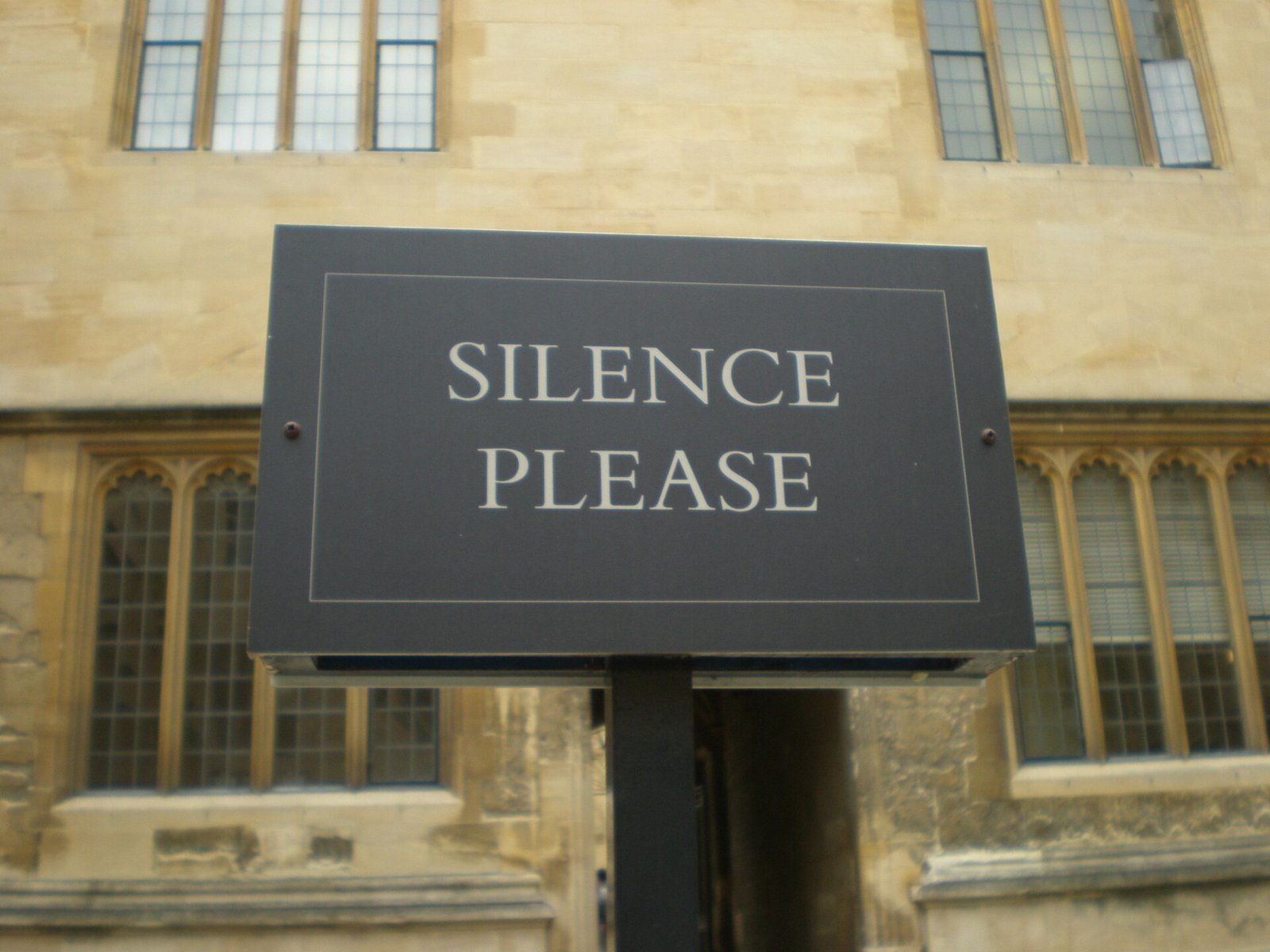
(Image is of the Bodlean Library, Oxford University. The file is licensed under the Creative Commons Attribution-Share Alike 3.0 Unported license. Attribution: 23 dingen voor musea)
I wonder what post is that 😅
In the unlikely event that it is my post, the managers of UCam are already aware that I sent the full documents to many parties, both internal and external to the University. Every time UCam tells me to be quiet, I talk more, but after many months, they still did not understand this fact. They are, of course, entitled to expel me from the University if they can, but that is their limit and it will not prevent me from talking after. Given the upcoming tribunal cases, and the substantial media attention they will gather, expelling a student because he does not accept being silent upon witnessing abuses by senior staff does not seem sensible but I guess that many in UCam still think that what is about to come can be covered up!
UCAM’s busy months in the Employment Tribunals begin on 7 April, with a week long Tribunal at Cambridge (on East Rd)
Ms A A Khan versus Cambridge University & the Press, SXD, DDA, RRD, DRB, BOC, WA
(SXD = Sex Discrimination, DDA = Disability Discrimination Act, RRD = Race Discrimination, DRB = Disability-Related Discrimination, BOC = Breach of Contract, WA = Wages Act, Unlawful Withholding of Wages)
What terrible timing to be named the UK’s top employer. Can only see two cases in last five years against Google or Microsoft but with Cambridge University that seems like the rate every other month.
Do we know who’s on the stand for the witness list for April 7-14th?
Not yet, will post when we have it
UCam has totally lost it! RIP after >800 years! What a tragedy and a farse! In the meanwhile Lord Smith pretends all is well!
Meetings begin precisely on time, end early, and consist entirely of colleagues agreeing with one another in eloquent, light prose. Every proposal is insightful, every concern constructively received, and every action point completed before it is even written down. Committees exist, of course, but only as elegant formalities — brief, luminous gatherings where consensus emerges effortlessly.
Students are uniformly brilliant, endlessly curious, and somehow always perfectly prepared. Supervisions feel less like teaching and more like co-authoring groundbreaking papers between sips of excellent coffee that appears, unbidden, at exactly the right moment.
Meanwhile, the university’s systems function with near-mystical efficiency. Forms submit themselves. Funding applications anticipate reviewer comments and pre-emptively address them. IT issues resolve before they are noticed, occasionally accompanied by a polite apology.
In this world, HR processes are models of clarity and fairness, investigations are swift and universally trusted, and “confidentiality” exists only to protect and reassure — never to obscure. Institutional culture is not just healthy but radiant: collegial, transparent, and quietly heroic.
As dusk falls, you leave through the sunlit Old Schools, satisfied yet unburdened, already looking forward to tomorrow — when, naturally, everything will work just as well again.
That’s why working at Cambridge is top of the rankings!
In that world, what happens to people who prefer to be honest?
If you cannot complete a grievance in less than 2 months (not two or more years) and cannot assure a fair process then no one has a right to confidentiality
Unless you have a sunset clause that voids all confidentiality in the event of investigator misconduct or failure to complete investigation within 2 months :
Confidentiality = censorship
Agreed. It is a form of cruelty to insist complainants can’t divulge to others matters about their Grievance, if the investigation extends for > 2 months
Can confidentiality bind third parties? I thought it only bound those who signed a contract. Anyone else can say what they like that’s free speech?
Confidentiality can bind third parties, if the third party knows (or is told) that the information is confidential.
But that can be over-ridden, if there is a public interest defence.
A professional lawyer may be able to comment further.
I am not sure if people understand what happened here.
A given person wrote a “witness statement” about my abusive and “unreasonably persistent” behaviour for refusing to let go that she and others continue with their misconduct. I exposed myself, published her view about how abusive my behaviour is, and she thinks it must be confidential. If it is about my abusive behaviour, why can’t I publish it? The problem, she realized, is that many people could identify her even without putting a name in the story, and this “witness statement” will become much more interesting after she gets cross-examined in a few months by a King’s Counsel.
I have to say that these people are at a different level. They bully and harass others and if this was not enough, they then try to enforce silence throughout. She is lucky that I did not yet send the material to the JCRs and MCRs of colleges but she and her friends are really pushing it. Let’s see what will happen in the next coming days.
Thank god this some of these insanities are finally reaching tribunal and everyone can speak what they know at last. We’ve all had enough of playing silly games at the behest of HR to cover their silly decisions.
Cross examination is going to be an absolute treat. I hope the room is big enough to host the audience!
A big audience is always desirable.
You can also attend an Employment Tribunal remotely. A week before, you can email the Tribunal to request to observe the hearing. Emails containing a link to join will be sent the morning of when the hearing is due to start.
Also @TribunalTweets on X/Twitter often provide live updates on important ETs.
In the very unlikely event that the “UK’s best employer” tries a gaging order so that the general public does not know what is happening in the tribunal, I trust that some of the participants will find a way to accidently share the information anyway. It will be interesting to see how good UK gagging really is in the coming months.
The gagging order that Oxford University applied for to keep Prof Soumitra Dutta’s name out of the press was a complete failure
https://www.bloomberg.com/news/articles/2025-09-11/leader-of-oxford-university-s-said-business-school-soumitra-dutta-resigns
There is a second gagging order in effect at Oxford University in a rape case. It was broken, but the sites naming the perpetrator were then contacted by lawyers. Rape is of course a criminal matter, not a civil matter. While there is no automatic right of anonymity for alleged perpetratrors of rape, a court may issue temporary restrictions in limited circumstances. For the moment, we are not naming the academic at the centre of this.
There is a third gagging order in effect at Oxford University with senior figures implicated in SH. We don’t expect it will hold much longer.
Oxford University do so love to gag — maybe a question for the VC in her next interview? And certainly a question for its ineffectual Chancellor who loves to preen on the world stage in his self-appointed role as defender of women against sexual violence.
There seems to be a serious trousers problem at Oxford
“Oxford University do so love to gag — maybe a question for the VC in her next interview?”
I am happy to contact her and asked her directly ccing our own Vice-Chancellor as I am an alumnus of her college. How lucky I am, a member of the two colleges that host the Vice-Chancellor of Oxford and the Vice-Chancellor of Cambridge. I swear that I did not choose these colleges for that reason, but because they hosted JJR Tolkien and Charles Darwin, respectivelly.
JRR
I would just love it if for once someone said, “yeah, HR told me to write that. It was awful and abusive”
These are usually the Responsible Persons — they allow their humanity to be overwhelmed by HR.
Some RPs are the epitome of a company person. They are avaricious, without morals and will do as bid.
Some RPs are fair-minded, but hoodwinked. They believe they are acting for the common good at start, before the smell of corruption sickens them. What can they then do, they are deep in the mire. Such RPs look visibly sick or nervous or uncomfortable in the Grievance meetings. In one prominent scandal, the RP left to go to equivalent professorial appointment elsewhere, after the way HR treated him.
The 21 Group is clear. Until the system is completely reformed, no academic should consent to being a RP. You will just end up soiled.
I may agree that there are individuals out there across the sector, such as RP’s or equivalent, or members of HR, that are sickened by what they see and participate in.
But at the end of the day, until we see them come forward (which they do not appear to be doing, at least nowhere near the level they need to be), then they are just as bad as the rest. As such, they should then face the same sanctions through the Tribunal and Courts system as those that go out of their way to abuse. Facilitating abuse is still abuse. In fact, in some ways it’s worse.
To answer the question “What can they do?” – they can come forward. If any such individual does wish to come forward, then they know all too well who and where the victims are. I’m sure any such statement provided will be fairly considered.
In a different post (https://21percent.org/?p=3386), Trapped wrote:
“HR managers secure a job offer from a famous university and the chance to live in a nice historical town with good schools and amenities. They arrive and feel they are contributing to something good – education for smart young individuals and the goal of scientific advancement. What happens next is a slow motion nightmare, like shadows piercing the dream. You see it in snapshots but once you’ve seen the whole thing what you’ve seen cannot be unseen. The resignations are by those who saw the nightmare in full and couldn’t wake up without taking the cold water shock of leaving entirely. But others are stuck with mortgages, school fees and a whole new circle of life, and have no easy exit.”
If HR managers did not, at least partially, create the problem, who exactly did it? The managers of HR managers? I have a gut feeling that in the end no one will assume blame and every single person will just push it to others or to the “University” more generally.
The people at the top are earning lot of money because they are “super-stars”, talented administrators for whom we need to pay > £500k a year to secure their services.
The problems of Cambridge University are obvious. If someone is being paid > £500k a year and can’t see the problem, then they are obtaining their salary through misrepresentation.
The people at the top must carry the can. An HR Business Manager could not do what she does without approbation from the top.
HR Business Partners do not hold an Officer position and are therefore not bound by Statutes and Ordinances. The HR Business Partner’s allegiance lie wholly with the HR Division rather than with the University as a whole.
Consequently, any adverse effects of an HR Business Partner on students, postdocs, College JRFs, emeriti, external collaborators, the University’s reputation, or its research output fall outside the Partner’s concern. They are only concerned with the University’s direct employees. Their job is to protect them, like the Securitate.
“They are only concerned with the University’s direct employees. Their job is to protect them, like the Securitate.”
Just to clarify, if the University’s direct employees are dishonest, does it say in the contract of HR Business Partners that they have to cover up their dishonesty? If it does say, does it make HR Business Partners less dishonest than those they try to protect?
Well it is a crime I thought to lie deliberately under oath no? So if the honest answer is “xyz told me to”, then that is what one should say, and especially if you know there also exist internal messaging/teams records to demonstrate you were under orders. It is not the best defence but a lot safer than taking the blame for yourself if further actions could still be pending.
This is pertinent to the current Oxford cases.
The “safety” the institution can offer diminshes rather quickly if it happens that you were asked to withhold something you saw and knew of and this risks being exposed later on. There is a duty to come forward and that is more than a simple civic or ethical obligation.
Sooner or later someone will “go rogue” like this… (where “rogue” means – obeying the law)
“We’ve all had enough of playing silly games at the behest of HR to cover their silly decisions.”
Silly?
People have lost their jobs, their careers, their livelihood, their health, their sanity. Some have lost their lives.
At times the decision-making in HR is evil, pure unnecessary self-gratifying evil. It is time that aspect too was taken seriously, as a health and safety hazard to university staff. Particularly to those how speak up (aka use their freedom of speech within the law).
There seems to be no accountability for HR behaviour, and no disciplinary measures for transgressions however well documented they may be.
Please note that not all people who read and comment in this blog experienced what HR and other divisions that deal with complaints can really do. Their level of misconduct is a function of their perception of threat. If they perceive that you are a serious threat to their structure and the reputation of the organization, they are willing to do anything to silence and break you. One sad thing about this is that unless you went through it yourself, it is hard to imagine that these people exist in a world-class university like UCam and are responsible for thousands of staff and students, but they really do.
HR recruitment should include :
“As an inclusive organization we particularly welcome applications from individuals with psychopathic tendencies and/or experience in the mental torture of others.
Our motto is “they talk we stalk, they complain we defame”
Join our happy, carefree and fully protected team.”
When is His Munirficence the Pro-vice Chancellor taking the stand?
Wondering if anyone has thoughts on the prison sentence this week for Oxford’s (now-former) professor Tariq Ramadan:
https://cherwell.org/2026/03/31/former-oxford-professor-convicted-of-rape/
The question I struggle with is who thought it would be a great idea to keep him at Oxford for almost four further years after he was charged by prosecutors for rape, when plenty of evidence was available to the university at that time from multiple victims who spoke out.
Agreed.
Let’s be blunt: this wasn’t just “caution”—it was institutional failure.
Tariq Ramadan was first accused in 2017, with multiple women coming forward. He stepped aside, yes—but Oxford kept him on the books for years. Not weeks. Years.
Now we have convictions and an 18-year sentence. The pattern wasn’t hidden, it was already there.
So who exactly decided it was acceptable to keep him affiliated with the university while this unfolded? And what does that say about whose safety — and whose voices — actually mattered?
“Due process” shouldn’t mean dragging your feet while credible allegations pile up.
Well that but already in 2017 they would have known the sentences for misconduct, negligence, abuse were coming so obvious reputational liability in keeping him there four more years. Now the story is an Oxford story but if they acted in time it would not be because they would have avoided the overlap between when the investigations began and him being faculty?
It is possible for a person to build an inaccurate representation of – e.g. the exact details of the academic qualifications a person themselves holds : a historical period/situation a person themselves did not directly experience but which the person indirectly experienced through exposure to the words/writings/memories/emotional expressions of those who did directly experience it: a situation a person themselves has directly experienced – when a person is under normal amounts of pressure/scrutiny.
When the same person is subsequently put under increased amounts of pressure/scrutiny – e.g. a media interview : a PhD examination process where corrections may be identified as being necessary to produce a final piece of academic scholarship that is accurate & unbiased : an interview in relation to a particularly serious situation – the accuracy of a persons representation can then change. The changes in accuracy are driven by the changes in the absolute pressure the person is under to more precisely define what is true or not and to then rework the representation, something which can change the accuracy of the representation.
For some people the increase in pressure can bring about increases in the accuracy of representation but for others the relationship between pressure & accuracy of representation can go in the opposite direction – the accuracy of representation can decrease as the pressure on the person is increased.
It is not clear to me that the right question is this is “who thought it would be a great idea to keep him at Oxford for almost four further years after he was charged by prosecutors for rape”. This particular case seems to require a much more detailed examination going right back how the first association with Oxford was formed – through one of its colleges – and including how this person was subsequently hired into positions in the centra university & not just an isolated examination of how the situation was handled after the charges were brought by prosecutors.
Did this person – at a point in time prior to taking up a position in Oxford – claim to have 2 PhDs in media interviews – including the guardian – only for that claim to subsequently turn out to be false? Did this person inaccurately represent the subject matter of their PhD thesis in media interviews? Did this person threaten a member of the jury responsible for making an independent academic judgment in relation to the academic work this person was submitting to fulfil the requirements of a PhD degree?
https://www.theguardian.com/education/2005/oct/04/highereducationprofile.academicexperts
“Back in Switzerland, he studied European philosophy, gaining two PhDs, one on Islam, the other on Nietzsche.”
In some cases the most important thing to establish in relation to a person is what the person themselves has said & exactly how that has changed as the person has been put under increased amounts of pressure/scrutiny. Increase-in-pressure situations could be voluntary & rewarding for the person or they could be involuntary & fraught with risk for the person. Do any inaccuracies/misrepresentations that a person makes under normal pressure tend to be eliminated/get ironed out as the pressure on the person increases or do the inaccuracies/misrepresentations instead tend to increase and/or get baked in as the pressure on the person increases.
Is it acceptable for a prospective PhD student to read in the mainstream media and/or see on mainstream TV that academic [x] at prestigious university [y] has 2 PhDs and/or had subject [z] as the main focus of their PhD thesis, apply to be supervised by academic [x] at prestigious university [y] on the basis of that publicly available information & then show up having been accepted by prestigious university [y] to be supervised by academic [x] – possibly incurring significant amounts of student debt in the process – and then discover it’s not true, academic [x] at prestigious university [y] doesn’t have 2 PhDs and/or did not have subject [z] as the main focus of their PhD thesis. Would this not be a significant breach of trust & confidence between a university and a PhD student if a university – as evidenced by the results of its hiring processes – was prepared to put a young academic scholar in that position? Wouldn’t any relevant publicly available information – how many PhDs academic [x] has, the subject of academic [x]’s PhD thesis – have to be correct?
Is it acceptable to take hiring decisions that could mean that a PhD student could end up in a position where they were being supervised by academic [x] who threatened a member of the jury responsible for judging the standard of the academic work produced by academic [x] to assess whether it was at the standard required to meet the requirements for the award of a PhD. Would this not be a significant breach of trust & confidence between a university and a PhD student to find out this highly relevant piece of information after agreeing to be supervised by academic [x] and not before taking decisions on where to do a PhD and which PhD supervisor to request supervision from.
It is possible for prestigious university [y] to become so overly focussed on a single academic [x] and on the views of one person on a particular subject – a person who may be adept at drawing attention to themselves – that there is an overall failure to assess the impact of academic [x] on the ability of all others in the academic community and beyond – particularly younger academic scholars – to have the optimal conditions for independence of academic thought – required both to deliver the best academic work possible and the best academic judgment possible in relation to the academic work of others in the academic community.
I would expect any prestigious academic organisation – i.e. academic organisation where a person will experience higher than average pressure as a result of joining the organisation – of high organisational depth – i.e. with the potential for significant increases in absolute pressure on a person if promoted up the ranks in the organisation – hiring any person to work on any societally sensitive topic in any subject area – i.e. topic with high potential for highly variable pressures such that pressures inherent in the work can reach extremely high absolute levels – to be extremely sensitive to a persons capability for accurate representation and how that is varies in any situation where a person comes under increasing pressure/scrutiny and for that to be given significant weight in any hiring process. Otherwise young academic scholars could – through no fault of their own – end up under extremely high absolute pressures working on a societally sensitive topic but without an academic supervisor who can safely guide another academic scholar through such high absolute pressures – a situation which could lead to the complete destruction of a life.
Do you remember that time when a student posted a comment on Viva Engage as a response to an invitation to fill another satisfaction survey and the post was deleted by the University as the student made direct reference to the cover ups associated with our own staff survey that had been published in The Guardian? (https://21percent.org/?p=2532)
A few months after, incidentally just a few days after the student complained to the Pro-Vice Chancellor of Education about that deletion and how it was a violation of his freedom of speech as others before him did not address the issue that the student had reported, the person who had originally made the original post made a complaint against the student.
REDACTED SENTENCE
**** explained that as soon as he saw the response it triggered a significant amount of anxiety.
REDACTED SENTENCES
**** stated that in response to my comment on his post that it initially seemed minor but he realised all staff could view the post and might draw false conclusions about his integrity. Although he sought its removal, there were initial concerns about freedom of speech before the University ultimately concluded the post was not protected and had inappropriately questioned his character. He spent much of the day dealing with the issue. He estimated over 4,000 staff saw the post before it was removed, causing significant stress and anxiety, as well as concern about potential damage to their reputation and career.
REDACTED SENTENCES
I like in particular there were concerns its removal may infringe my freedom of speech. These people are at a different level really! This person knew precisely what he had done to the student before, how encouraging to fill a satisfaction survey was/is a humiliation to all those who experienced abuse in the institution as the student had experienced but that, of course, he does not tell us!
REDACTED SENTENCE
NOTE ADDED By 21 GROUP: We have redacted some material.
Love it how fast they switch from
“It never happpened our students are just snowflakes”
to
PlEaSe plEaSE DOn’T hUrT mY FEEliNgs
You have no idea how people get their feelings hurt when you tell them something about them that they do not like to hear. I alone hurt the feelings of an Academic Secretary, a previously departmental HR but now bursar at a college, a previously investigator but now Senior Tutor of a college (incidentally the same college of the bursar!), a Head of Student Administration, a Head of Student Complaints division, a Head of Department, a Professor and Fellow of the Royal Society of the same Department, a Business and Operations Manager the same Department, a building manager of the same Department, a Lead HR Business Partner of a School and a HR Business Partner all of the same School under the management of the Lead HR Business Partner, obviously the most discussed Lead HR Business Partner in the 21 Group. I received today over 2000 pages, and not yet the “witness statments” because, I was told, “It is necessary that all parties feel able to engage fully with the procedure without concern for the wider sharing of information disclosed within the investigation process.”
I was lucky that apparently, I did not hurt the feelings of the Head of the School, the Pro-Vice Chancellors and the Vice-Chancellor despite I contacted them and reported the same abuses. But perhaps that is why they get more money; they are more resilient!