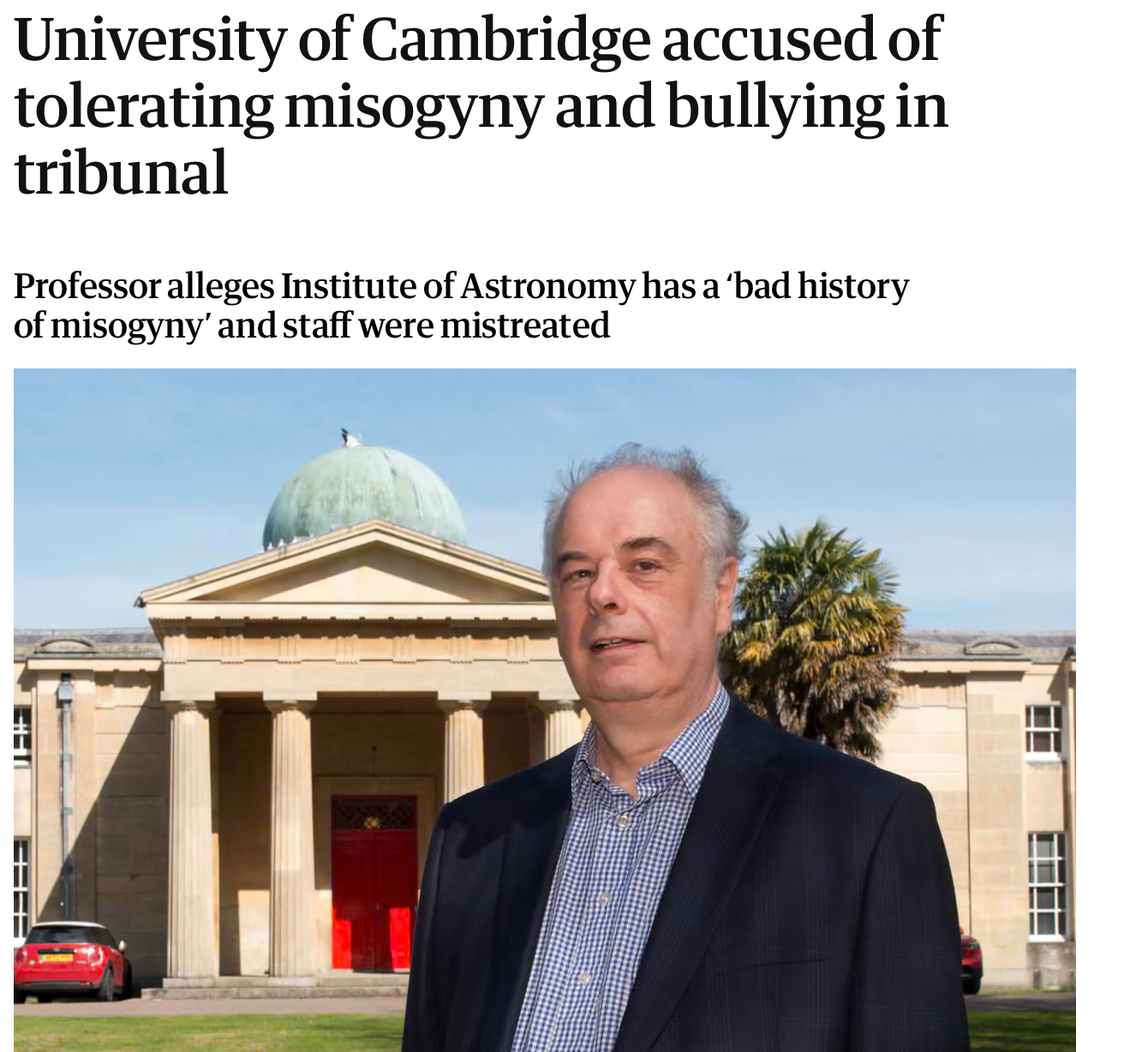
The Guardian have now produced a summary of the first week of the Cambridge Whistleblowing Tribunal here. A consequence of the failure to settle the case is that the details are now entering the public domain through witness testimony, which can be freely reported.
At the Institute of Astronomy in 2021, colleagues intervened to protect a distressed staff member. They themselves were made subject of a Grievance
He claimed no action was taken to protect Dr Tausch-Pebody, but grievances were instead raised against himself and two other professors by the Institute of Astronomy’s director, Prof Richard McMahon. Evans said: “It is unprecedented in Cambridge University for a head of department to make a Grievance against three professors simultaneously.”
The university dismissed McMahon’s allegations against the professors, saying no evidence had been submitted in support of the claims. Evans told the tribunal that despite the lack of evidence, the complaint “took almost two years for the university to dismiss”.
The barrister Akua Reindorf KC is defending the case for the University.
Reindorf said the University of Cambridge is defending Evans’ claim “at very great expense”.
Akua Reindorf KC, for the University of Cambridge, suggested Evans’ emotional testimony in court about the suicide of a former colleague amounted to “crocodile tears”. “No, and that is an offensive thing to say,” Evans replied.
Prof McMahon has still not been withdrawn his allegations, despite never presenting any evidence. His assertions against Prof Evans and Prof Haehnelt were found defamatory and admitted untrue in the defamation case.
Yesterday in open court, the individual who initiated the investigation into Prof McMahon’s grievance —despite seemingly multiple violations of the University’s ‘Dignity at Work’ policy — continued his cross-examination.
Counsel for Prof Evans, Stuart Brittenden KC, asked Prof Nigel Peake whether he accepted any responsibility for what had occurred.
Prof Nigel Peake said that he did not.
Don’t forget Harper’s statement under oath that he never had any interaction with HR throughout this process
Best bit — he was always knocking the computer off the table.
REDACTED
NOTE ADDED by 21 GROUP, material redacted to be on the safe side
They ask, “What’s the point of having a whistle-blowing policy if you don’t want people to blow the whistle?!”
https://www.linkedin.com/posts/emily-lines-2b271a80_did-you-know-theres-currently-a-employment-activity-7471640300302680065-p5Le
The answer is simply: a key component of Cambridge’s culture is deception. And those who do not accept this way of living either leave willingly or are purged by those that uphold such a culture. Do not be fooled. This culture could not endure with the support of HR and legal alone, regardless of their power.
We need a Grace whose result will tell us who is with the current managers and who is against. If a large proportion of people is still with them, we should revisit our strategy of challenging misconduct at Cambridge. We could at least write an open letter to Lord Smith as a collective—as opposed to individually—and describe our concerns based on the recurrent patterns we witnessed so that it is in the records that at least some members were against this culture of deception and cover up of misconduct.
Everyone in astro knows there was no longstanding feud between Wyn & Richard. From Wyn’s witness statement :
REDACTED
NOTE ADDED by 21 GROUP, material redacted to be on the safe side
You should probably delete the quote as material in the papers package is not for copying or redistribution.
Wyn versus Cambridge University reached France!
https://www.reddit.com/r/AskAcademiaUK/comments/1u6cfqt/thoughts_on_the_uni_of_cambridge_whistleblowing/?tl=fr
Sssssssssh, it is confidential!
It turns out the original was in English!!
https://www.reddit.com/r/AskAcademiaUK/comments/1u6cfqt/thoughts_on_the_uni_of_cambridge_whistleblowing/
“Did you say the sky is blue?”
“Um well in my head my interpretation um was that I meant the sky is um pink”
Did O’Neills pub in Cambridge start doing a 9am-10am happy hour
Welcome to the forum… it is taking place in Bury St Edmunds not Cambridge. But yeah was thinking the same
General Remark: Folks, if you don’t see your comment, it means we are awaiting legal advice
We are trying to balance freedom of speech with legal constraints
AR looks like she would rather be anywhere else in the universe right now – and frankly who can blame her
I would like to stress what the 21 Group states above:
“A consequence of the failure to settle the case is that the details are now entering the public domain through witness testimony, which can be freely reported.”
Everyone is seeing what is happening today and can take their own conclusions. The fact that the University did not realize ahead of time this should not happen is telling about the state of things at UCam. For an institution allegedly so concerned with reputation risk, it is mind blowing this situation was allowed to proceed to this stage.
I hope Cambridge PhD students are watching this?
It sets a really good benchmark for the high level of factual recall which Cambridge expects faculty and students to have achieved following their studying of an issue over a period of four years.
It’s possible to modulate factual recall by modulating stress, stress can push factual recall to low levels. If it’s a punish/reward situation – e.g. public speaking – and stress has already pushed factual recall to low levels noticeable to the person themselves then the additional pain of an obviously negative and/or derogatory audience reaction to already low levels of factual recall can push factual recall to extremely low levels right up to a stall of factual recall.
It is possible to do the opposite by modulating stress – push to a regime of high/maximum level of factual recall – but chronic stress will tend to push to the regime of low level of factual recall over time and to make the opposite regime of high/maximum level of factual recall inaccessible over time.
If you’re lost you can look and you will find me
Time after time
If you fall, I will catch you, I’ll be waiting
Time after time
If you’re lost, you can look and you will find me
Time after time
If you fall, I will catch you, I will be waiting
Time after time
– Deborah Prentice
She and the remaining witnesses must be very keen with the idea of cross-examination after what happened today… If the same happens tomorrow, the University Council may well start thinking about having an extraordinary meeting to discuss unprecedented reputation risk…Now imagine if they even have to deal with a Grace!
All this could be prevented if they assumed faults and learned from mistakes, but there are people out there who still did not understand that the cover-up is worse than the mistake.
Meanwhile in Varsity…
https://www.varsity.co.uk/news/31796
I hope Varsity is planning to report on what is happening in the ET because this case is of clear interest to students, not least because OSCCA operates in the same way HR does. Students may consider following this case closely because they may well encounter some of the individuals involved in this case in the future, assuming these individuals will remain in Cambridge after this.
It is not a Cambridge problem. It is a HE problem. Policies are used as tick box exercises for managerial actors. As soon as someone challenges bad practice from managers, the institution stands for the managers, instead of being neutral on the investigations.
Whistleblowers enter a journey of detriment and isolation with management circling them like starving sharks.
https://streamlinefeed.co.ke/news/cambridge-astronomy-institute-plagued-by-misogyny-and-bullying-tribunal-hears
“The University’s Aggressive Defense
The University of Cambridge has categorically denied all allegations of systemic misogyny and bullying, opting instead to launch a fierce counter-attack against Evans’ character and motivations. Legal representatives for the university have framed the entire tribunal as a personal vendetta orchestrated by Evans against the institute’s director.
During a particularly hostile cross-examination, Akua Reindorf KC, representing Cambridge, accused Evans of weaponizing his emotions on the stand. She suggested that his tears regarding the suicide of a former colleague amounted to nothing more than “crocodile tears” designed to manipulate the tribunal.
“No, and that is an offensive thing to say,” Evans sharply replied, illustrating the bitter animosity defining the proceedings.
Broader Implications for Elite Academia
The trial peels back the curtain on the insular, highly hierarchical nature of elite global universities, where tenured professors and departmental directors often wield unchecked power over contracts, funding, and the careers of junior staff. For academic institutions worldwide, including rapidly expanding research hubs in East Africa, the Cambridge saga serves as a grim warning about the dangers of prioritizing academic prestige over fundamental workplace safety.
When mechanisms for reporting abuse fail, or when whistleblowers are perceived to be punished for speaking out, toxic behaviors become institutionalized. The outcome of the Bury St Edmunds tribunal will have profound ramifications, not just for Evans and the Institute of Astronomy, but for the broader movement demanding accountability and gender equity within the highest echelons of the STEM fields.
As the legal teams prepare their closing arguments, the scientific community watches closely. Whether the tribunal sides with the whistleblower or the university administration, the reputational damage to the Institute of Astronomy has already been starkly illuminated.””
Well if you are trying to market yourself as a friendly and caring employer, then engaging in aggressive cross-examination of your own employees is not exactly a great look, that’s all I can say.
I don’t understand the “crocodile tears” cross examination. Had a person at the institute of astronomy died in a lab accident and had Prof Wyn Evans – having seen the same pattern of events emerging as had preceded the previous lab accident – intervened to prevent another similar type of lab accident from occurring – one which carried some probability of a preventable death – no one would question whether Prof Wyn Evans’ tears in relation to the death of a former colleague were genuine or whether Prof Wyn Evans’ motive for intervention was anything other than prevention of harm to a colleague. If a person dies a preventable work-related stress death – e.g. Dr Malcolm Anderson who died in an overwork situation in Cardiff University https://www.bbc.co.uk/news/uk-wales-47296631 – this is an accident, no one wants this to happen to a colleague just like no one wants a colleague to die in a lab accident.
Being put through an end-of-contract consultation process in academia when the process makes rational sense can be mentally challenging due to the nature of the situation – threat of loss of employment. Being put through an end-of-contract consultation process in academia when the process makes no rational sense can be mentally gruelling. A person having to work for an employer after it has put the person through an end-of-contract consultation process that made no rational sense can be extremely mentally gruelling. A person having to a work for an employer after it has put the person through an end-of-contract consultation process that made no rational sense multiple times can be mentally torturous.
The main problem with the end-of-contract consultation in academia is that the people running the end-of-contract consultation process don’t always rationalise the consultation in the context of the specific situation the person is in and the outcomes for the person are extremely variable. A person could have gone through this end-of-contract consultation process and derived some benefit from it – e.g. the people running the end-of-contract consultation process did help a person to secure follow on employment during this process – in which case the person may not associate an end-of-contract consultation process with any pain and may only associate an end-of-contract consultation process with benefit. A person could have gone through an extremely stressful, painful, damaging & useless end-of-contract consultation process that made no rational sense & lost their employment, associated family accommodation & associated nursery place for child – after which the person has to go back to work for the employer that just put them through that extremely stressful, painful, damaging & useless end-of-contract consultation process knowing full well that the employer is going to offer the same extremely stressful, painful, damaging & useless end-of-contract consultation process again without ever knowing what impact the first end-of-contract consultation process had on the person or ever considering the cumulative impact of putting the same person through that process multiple times.